In 1983, University of California, Berkeley historian Robert L. Middlekauff earned the Pulitzer Prize finalist distinction for "The Glorious Cause: The American Revolution, 1763-1789." He offers an erudite yet accessible introduction to the social, political and cultural values that shaped the Revolutionary era in the book, which was the first published volume in Oxford University Press's acclaimed History of the United States series. (The series currently is edited by Stanford historian David Kennedy, a past chair of the Pulitzer Prize Board who received the 2000 History Prize for its ninth volume.)
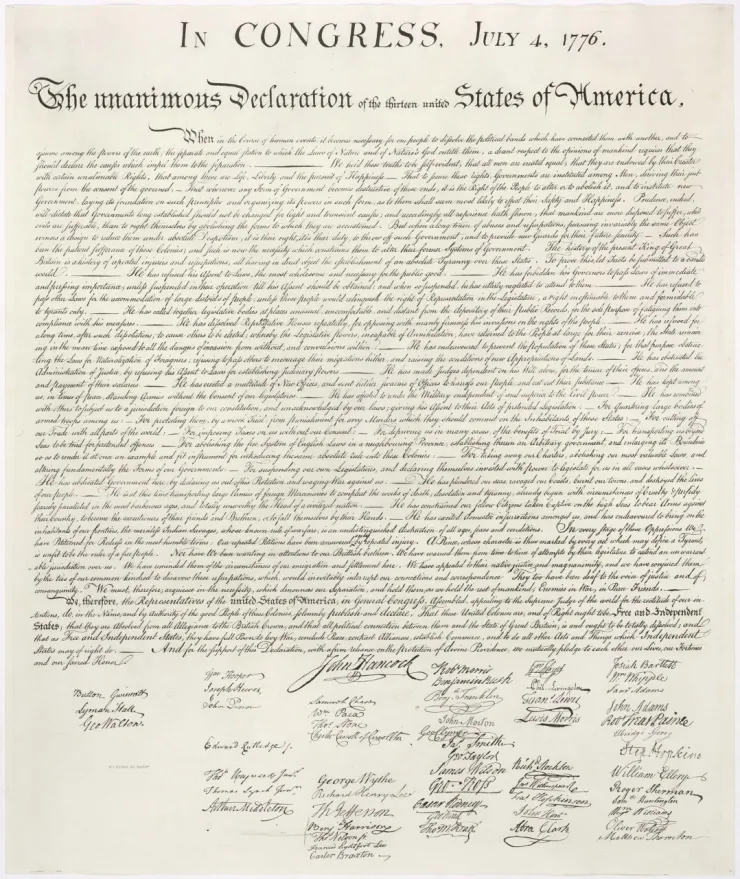
As the United States celebrates Independence Day, we are proud to present Middlekauff's account of the drafting and signing of the Declaration of Independence. The Pulitzer Prize Office would like to thank former Oxford University Press President Niko Pfund and his permissions team for generously furnishing this excerpt.
"Independence"
By Robert L. Middlekauff
By the first months of 1776, the group in Congress which was disposed to seek foreign aid was adding to its numbers. These radicals—their radicalism consisted of their belief in American independence rather than reconciliation—agreed upon a schedule of actions which they believed gave promise of a successful war for independence. The two Adamses, the Lees, and their followers thought that the formation of new state governments was the crucial first step. Although they had no clear idea about the shape of these governments, these men saw in their creation a means of tying the American people to independence. Once the colonies had given themselves new governments the next steps should be, as John Adams proposed to Patrick Henry, "for all the colonies to confederate and define the limits of the continental Constitution; then to declare the colonies a sovereign state, or a number of confederated sovereign states; and last of all, to form treaties with foreign powers." Adams was to write to Henry on June 3, when it was fairly clear that all these measures would soon follow, that perhaps, their order was not very important.
In February the radicals had considered the sequence of action as critical to their plans. And their plans, though centering on the measures Adams disclosed to Henry, included a variety of moves which only solid governments could take. A memorandum drafted by John Adams listed them: an alliance should be made with France and Spain; ambassadors should be sent to both countries; coins and currencies were to be regulated; armed forces were to be raised and maintained in Canada and New York; the production of hemp, duck, saltpeter, and gunpowder was to be encouraged; taxes were to be levied; treaties with France, Spain, Holland, and Denmark were to be concluded; British ships were to be declared fair game for American privateers; independence was to be declared as was war on Britain. There were other items on the radicals’ agenda, but their overriding concern remained a declaration of independence.
The radicals faced determined, though shrinking, opposition in Congress after "Common Sense" signaled that the drift of public opinion was away from reconciliation. Just how the radicals should deal with such men remained a perplexing question. These moderates were no less patriotic than the radicals; nor were they any less concerned to protect American liberties which—they agreed—had been savagely trampled on in the previous year. Still they preferred to see America free within the empire rather than outside it. Several in fact seemed to doubt that the colonies could gain sufficient strength to survive as free states without the protection of the mother country.
Congress appointed five moderates—James Wilson, Robert Alexander of Maryland, James Duane of New York, William Hooper of North Carolina, and John Dickinson—to a committee commissioned to provide an answer to the king’s charge that the colonies intended to separate themselves from Britain. The radicals probably agreed to this composition in order to force the moderates to make their position clear on independence. Wilson wrote the committee report, a much maligned statement then and since, which said that the colonists wished to remain British subjects but were determined to continue as free men. This by now time-worn formula would no longer serve, and when the committee reported, on February 13, the radicals succeeded in tabling it. The tabling of Wilson’s statement does not seem to have aroused much opposition among the moderates, who were losing hope as news of British hostility continued to come in. Fresh evidence of the king’s anger shook them, and then they learned that foreign mercenaries were on the way.
Meanwhile, as the winter began to give way to spring, the radicals speeded up the pace of their action in Congress. In late March, Congress authorized "the inhabitants of these colonies. . . to fit out armed vessels to cruise on the enemies of these United Colonies." John Adams, who earlier had lamented that the colonies were fighting only half a war, told Horatio Gates that the colonies were now engaged at least in "three Quarters of a war." And early in April, after months of tortured discussion, Congress agreed to open colonial trade to all the world but Britain.
The Congress acted in part because the country seemed at last to have decided that there was nothing left to do but move toward independence. The colonial legislatures and their stand-ins, the provincial congresses, soon caught the popular mood and began removing restraints on their congressional delegations. On March 21, South Carolina gave its delegates permission to join with others in Congress to do what was necessary for the defense of America, oblique phrasing which everyone understood to mean that South Carolina was prepared to declare independence. Shortly after, Georgia’s delegation received murkier instructions, which in effect also freed them to vote for independence. On April 12, North Carolina’s Provincial Congress gave its delegates authority to "concur with the delegates of the other colonies in declaring independency, and forming foreign alliances. . . ." Rhode Island was more forthright than any colony and in the first week of May declared its own independence. It also gave its delegates in Congress a rather loose charge to combine with others in attempts to annoy the common enemy.
All of these actions were uncoordinated and all stopped short of proposing that Congress pull America together. As in Congress, there was in provincial legislatures agreement that the colonies must be tied together in a league of free states before they declared themselves free of Britain. And, as in Congress, many within the states believed that a French alliance would be necessary if America was to win its war for liberty. Even Patrick Henry, always an eager advocate of the American cause, feared a declaration that preceded an American confederation.
By May 15 in Virginia, others, even "old man moderation," as Edmund Pendleton was called (behind his back), had shaken off these concerns. On that day resolutions composed by Pendleton instructed Virginia’s delegation to propose that Congress declare the colonies "free and independent states" and that they agree "to whatever measures" Congress thought necessary "for forming foreign alliances and a confederation of the colonies, at such time, and in the manner, as to them shall seem best: Provided that the power of forming government for, and all the regulations of internal concerns of each colony, be left to the respective colonial legislatures." These resolutions reached the Virginia delegation some days later and were read in Congress on May 27.
It was a Congress now dominated by radicals strengthened by further evidence of British hostility. Rumors and reports had arrived from Europe of an English government determined to crush opposition in America by force. There seemed no other way to explain the news that the king’s ministers were busy adding German mercenaries to an army bound for America. If the ministry had no intention of reconciliation by negotiation, delegates asked, how could America negotiate?
With hope of reconciliation virtually dead, the problem of how to proceed remained. The long-debated first step had been taken on May 10, five days before Virginia acted, when Congress recommended to the colonies that they adopt governments "sufficient to the exigencies of their affairs," governments, it explained, which "best conduce to the happiness and safety of their constituents in particular, and America in general." This resolution incited no opposition, but three days later John Adams proposed a preamble to it which did. The preamble approved on May 15, argued that
Whereas his Britannic Majesty, in conjunction with the lords and commons of Great Britain, has, by a late act of Parliament, excluded the inhabitants of these United Colonies from the protection of his crown; And whereas, no answer, whatever to the humble petitions of the colonies for redress of grievances and reconciliation with Great Britain, has been or is likely to be given; but, the whole force of that kingdom, aided by foreign mercenaries, is to be exerted for the destruction of the good people of these colonies; And whereas, it appears absolutely irreconcilable to reason and good Conscience, for the people of these colonies now to take the oaths and affirmations necessary for the support of any government under the crown of Great Britain. . . . it is [therefore] necessary that the exercise of every kind of authority under the said crown should be totally suppressed, and all the powers of government exerted under the authority of the people of the colonies, for the preservation of internal peace, virtue, and good order, as well as for the defence of their lives, liberties, and properties, against the hostile invasions and cruel depredations of their enemies. . . .
The preamble seemed to discard all pretensions to a step-by-step approach to independence, and it was at odds with the body of the resolution itself which proposed important but limited action. In contrast the preamble, as the moderates protested, almost declared the colonies independent, most clearly in the remarkable sentence requiring the suppression of all governments deriving their authority from the Crown, these governments to be replaced by new ones exerting power under the authority of the people. The moderates’ assessment surely captured the mood of their radical colleagues, a mood now extending throughout the colonies.
The radicals, however, distrusted the evidence of their political senses, failed at this time to understand how much power had swung to them. For a few weeks they hesitated and then on June 7, Richard Henry Lee offered the motion "That these United Colonies are, and of right ought to be, free and independent States, that they are absolved from all allegiance to the British Crown, and that all political connection between them and the State of Great Britain is, and ought to be, totally dissolved." The next day, Friday, and on June 10, Monday, Lee’s resolution was debated by Congress. The alignments were familiar and so were the debates. Both sides spoke intelligently, though it is likely that each erred in its estimate of popular attitudes. Both agreed that the middle colonies, especially Pennsylvania and Maryland, were "not yet ripe for bidding adieu to British connection but that they were fast ripening. . . ." The moderates attributed the unripeness of the middle colonies to the people and advised Congress to delay "until the voice of the people drove us into it, for they are our power." The radicals found the people ready—"they are in favour of the measure, tho’ the instructions given by some of their representatives are not." The people indeed only "wait for us to lead the way." There was another reason for delay according to the moderates: an alliance with foreign powers might be concluded on better terms after a favorable military campaign which they trusted the summer to bring. Back came the radical response: a declaration of independence was more likely to produce a helpful alliance.
Congress listened to these exchanges and decided to postpone a final decision on Lee’s motion until the first of July. While waiting, it appointed a committee to prepare a declaration of independence for possible use. This committee, John Adams, Franklin, Roger Sherman, Robert R. Livingston, and Thomas Jefferson, with Jefferson composing most of the document, finished its work on June 28.
Jefferson was thirty-three years old in 1776. He was born in Shadwell, Goochland (which became Albemarle County the year after his birth), the son of Peter Jefferson and Jane Randolph. Peter Jefferson had brought his young wife up the Rivanna River, a tributary to the James, only a short time before the birth of his son. He was an ambitious man, and before his death, fourteen years after the birth of his son, he had established himself as a leader in western Virginia. Though his wife brought him no property, his marriage surely helped his rise. The Randolphs were a great family, and an alliance with them set a man off from ordinary planters.
Peter Jefferson wanted his son educated and sent him to a nearby parson for instruction in Latin and Greek. Thomas Jefferson’s love of the classics was born in these years. He continued his studies at William and Mary College between 1760 and 1762 and then prepared for the bar with George Wythe, a distinguished attorney in Williamsburg and a fine classicist himself. Jefferson may have met Wythe through William Small, a professor of natural philosophy at the college. Small saw something in Jefferson and made him his friend as well as his student. Jefferson could not have found better instructors and friends in Williamsburg. Both Small and Wythe were lively cultivated men; both set standards for the young Jefferson and, though he needed no encouragement to study, these mentors undoubtedly led him to make demands upon himself.
Jefferson was a serious student but not entirely a solemn young man. Wythe put him to reading "Coke Upon Littleton," the first of four parts of Edward Coke’s "Institutes of the Lawes of England." Jefferson soon read all four parts but not without an occasional protest. To his friend John Page he confessed "I do wish the Devil had old Cooke [Coke], for I am sure I never was so tired of an old dull scoundrel in my life." He was nineteen when he wrote these words. He tired of Coke and yearned for the society of his friends—"Remember me affectionately," he told Page, "to all the young ladies of my acquaintance." A young Virginia gentleman commonly enjoyed a wide acquaintance, and Jefferson’s list was long. It included one Alice Corbin from whom he planned "to win a pair of garters." His letters at this time reveal an attractive young man full of enthusiasm for his "Belinda," as he called Rebecca Burwell, and full too of his dreams of dances and young women, and of uncertainty about his future.
Whatever Jefferson dreamed, he must have believed that his future rested in the practice of law and the raising of tobacco. He began to do both with more than the usual responsibilities of a young man. His father had died when Jefferson was fourteen, and when he reached twenty-one he assumed the responsibility of looking after his mother and his younger sister Elizabeth. He was equal to the task. He managed the family’s property carefully, and he began raising tobacco about the time he was admitted to the bar. The financial accounts he kept in these early years of manhood reveal a meticulous man much given to recording every detail of his expenditures. If, when traveling on legal business, he had his clothes washed and paid a shilling to the washerwoman, that fact made its way into his records. If he had his horse shod, that too was recorded.
Jefferson apparently impressed his neighbors in more important ways, and in 1769 they elected him to the House of Burgesses from Albemarle County. Three years later on January 1, 1772, he married Martha Wayles Skelton, a young widow. Although Jefferson wrote little about his wife and seems not to have spoken much about her even to his friends, the marriage was one of great love on both sides.
Up to the outbreak of war in 1775, Jefferson’s life resembled that of many Virginia planters. Still, in 1776, thirty-three years of age, he was an extraordinary man. His difference did not simply lie in the range of his interests and his already formidable learning. To be sure, he seems to have been interested in everything around him and in almost everything that could be learned from books. He had studied architecture, music, classical literature, politics, law, history, and science. But what really set him apart from others was not his learning, or his interests, it was the quality of his mind. He was not a systematic thinker or a theoretician. Nor was he really interested in the formal problems of philosophy—he despised Plato. But if he had little taste for abstractions, his thought was often speculative. He asked probing questions about everything that he studied, and he sought empirical answers. He had more than a lawyer’s desire for evidence; he had the bent and the appetite of a scientist. But more than most men of his time, surely more than most men of any time, he had imagination. The Revolution quickened it and almost immediately drew from him a vision of the opportunities that lay before free men in America.
By June 28 all the colonies except New York had authorized their delegates to approve independence. Pennsylvania had been especially reluctant, but popular groups there, armed by the Adams preamble of May 15, met in mobs and conventions and sent the sluggish assembly into oblivion. Thus when debate resumed in Congress on July 1, there was a large majority for independence. The vote that day found Pennsylvania’s delegation joining South Carolina’s in opposition, however; and Delaware’s only two members present divided. New York’s delegates explained that they favored independence but could not vote for it because they were bound by old instructions. The next day, July 2, with a third member on hand from Delaware, its delegation joined the majority, as did South Carolina’s and Pennsylvania’s. Only New York remained uncommitted to independence until the approval of its convention was laid before Congress on July 15. Before that day, on July 4, the Declaration of Independence was approved after Congress made several revisions.
Congress had made the loudest noise about independence in July 1776, but before it gave voice to its desires some ninety declarations of independence were issued in one form or another from outside Philadelphia between April and July. Nine states acted, several through instructions to delegates; Rhode Island, always different, passed a legislative act; others chose preambles to their constitutions. At least eight counties sent instructions to their provincial conventions or legislatures. Three grand juries drafted presentments for independence. A half dozen or more semi-private or private groups—New York mechanics, for example, and militia battalions in Pennsylvania—declared themselves for independence. More than fifty towns wrote declarations.
The declarations all reveal a mastery of the history of the conflict with Britain, several in great detail. Not all are written in the plain style favored by ordinary people in the eighteenth century; some indeed are rather gaudy in their phrasing, piling clause upon clause of denunciation of King and Parliament. Thus the grand jury of the Cheraws District, South Carolina: when the "protection [of King and Parliament] was wantonly withdrawn, and every mark of cruelty and oppression substituted; when tyranny, violence, and injustice, took the place of equity, mildness, and affection; and bloodshed, murder, robbery, conflagration, and the most deadly persecution, stamped the malignity of her intentions; self-preservation, and a regard to our own welfare and security, became a consideration both important and necessary." Whatever the phrasing, all of the declarations seem certain of their conclusions. Most prominent in all the conclusions is the confidence expressed in what they are doing in separating themselves from Britain. The Cheraws District grand jury said of the "separation" that it "now proves its own utility, as the only lasting means of future happiness and safety." By early 1776, this conclusion seemed obvious to many Americans, and not just to those in towns, cities, and hamlets, but also to those in the Continental Army and in the militia all over America.
From "The Glorious Cause: The American Revolution, 1763-1789" by Middlekauff (2005) pp.767-786. Copyright © 1982, 2005 by Oxford University Press, Inc. Visit Oxford University Press at http://global.oup.com/.