Following Monday's announcement of the 104th Pulitzer Prizes in the midst of the COVID-19 pandemic, individual winners and their friends expressed joy, wonder, vulnerability and hope. Read a selection of those stories and social media posts below.
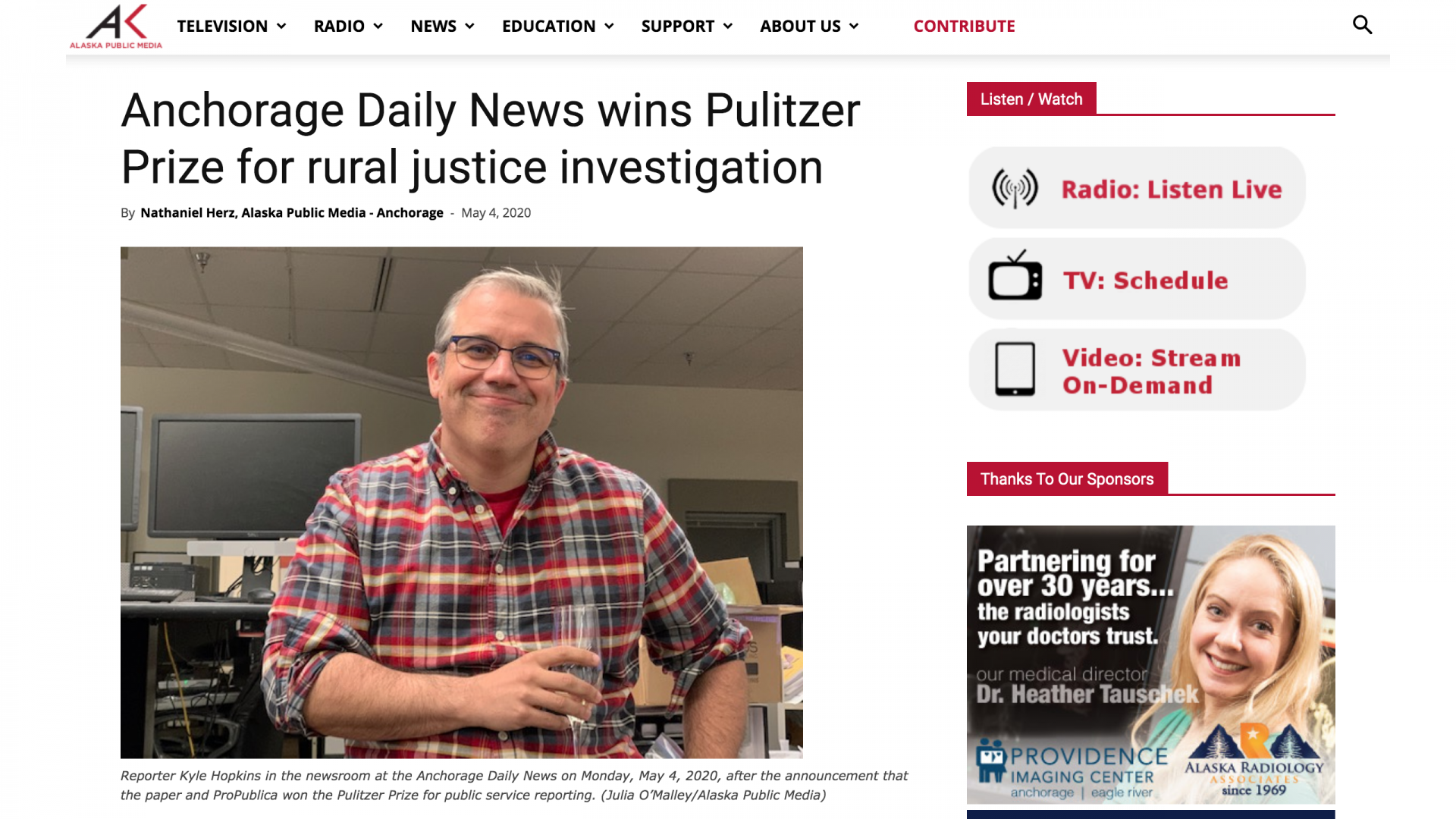
Alaska Public Media covered the Anchorage Daily News' Public Service Prize for "Lawless," an investigation produced in collaboration with ProPublica which revealed that "a third of Alaska’s villages had no police protection [and] took authorities to task for decades of neglect," embodied by the hiring of convicted criminals as police officers in 14 villages. Their work elicited a wave of attention from lawmakers and law enforcement officials (including Senator Lisa Murkowski and Attorney General William Barr) amid "an influx of money and legislative changes." Remarkably, all three of the newspaper's Pulitzers have been in the Public Service category, envisaged as the most prestigious award in American journalism, under different owners.In an interview with Nathaniel Herz, Special Projects Editor Kyle Hopkins, who oversaw the investigation, said: "We felt like these first stories [...] were meant to [...] say, 'Look, things are different in Alaska, there's an inequity here which is baked in and has been going on for generations."
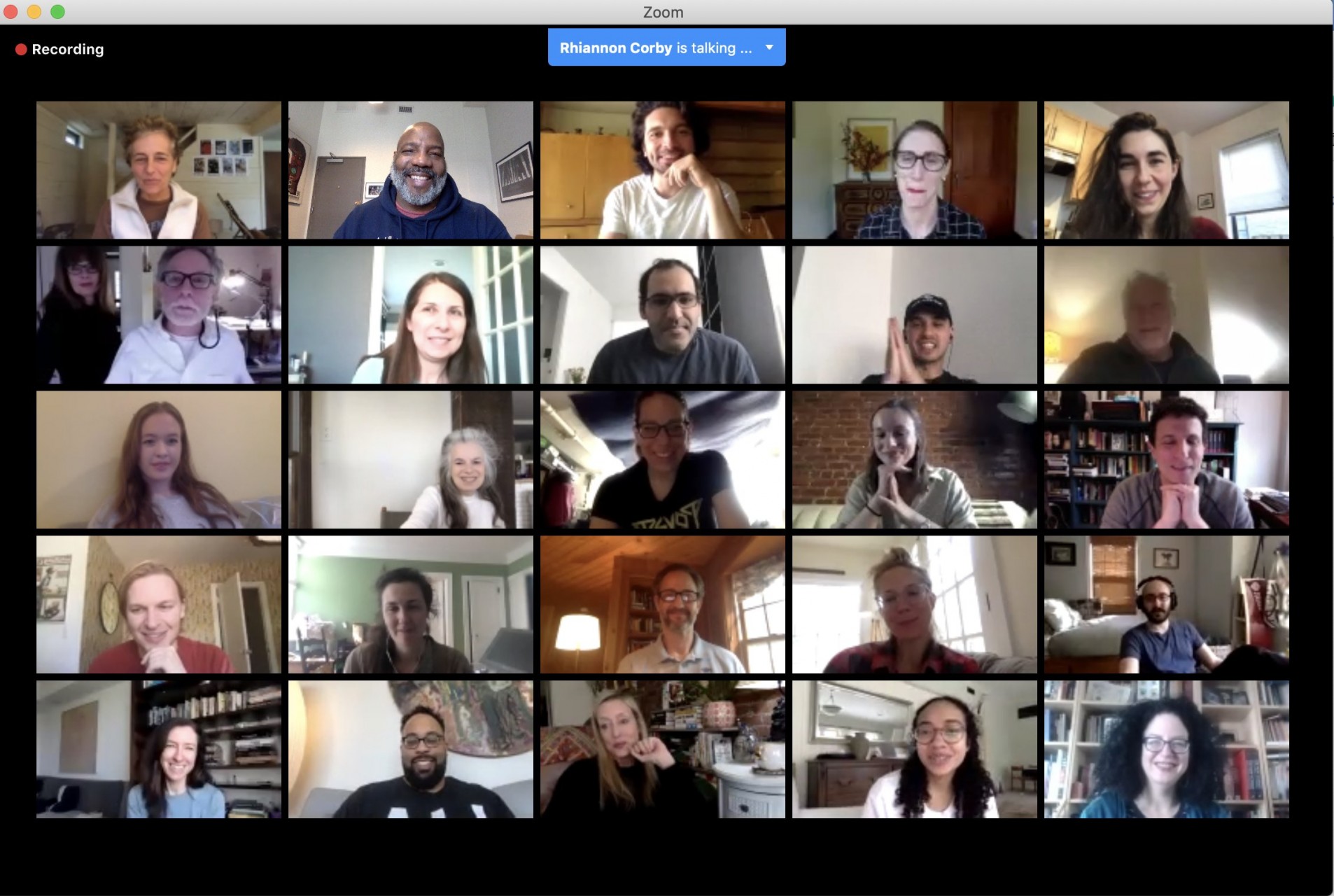
New Yorker Staff Writer Ben Taub received the Feature Writing Prize for "Guantánamo’s Darkest Secret," his account of the unlikely friendship that developed between Steve Wood (a member of the Oregon National Guard assigned to the facility as a guard) and falsely accused detainee Mohamedou Salahi. In a tweet thanking his subjects, Taub posted a screenshot from a video conference celebration with many colleagues, including Pulitzer Prize Board member David Remnick, 2016 Commentary winner Emily Nussbaum and 2018 Commentary finalist Jelani Cobb.
Chicago-based writer and educator Michelle Duster issued a statement on the Pulitzer Board's rare posthumous Special Citation to journalist Ida B. Wells, her great-grandmother, for Wells' "outstanding and courageous reporting on the horrific and vicious violence against African Americans during the era of lynching." The award "comes with a bequest [...] of at least $50,000 in support of her mission."
A .3gp video comment from Duster also is available here.
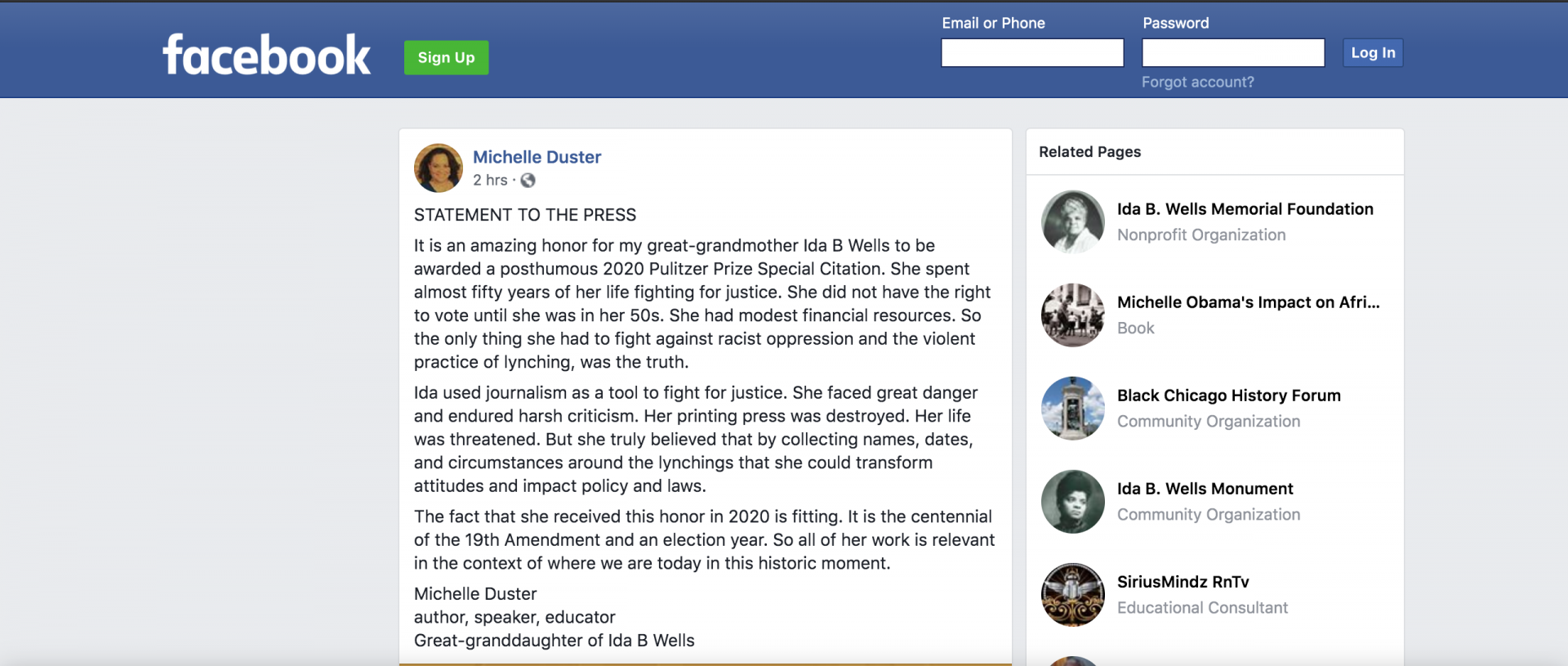
It is an amazing honor for my great-grandmother Ida B Wells to be awarded a posthumous 2020 Pulitzer Prize Special Citation. She spent almost fifty years of her life fighting for justice. She did not have the right to vote until she was in her 50s. She had modest financial resources. So the only thing she had to fight against racist oppression and the violent practice of lynching, was the truth.
Ida used journalism as a tool to fight for justice. She faced great danger and endured harsh criticism. Her printing press was destroyed. Her life was threatened. But she truly believed that by collecting names, dates, and circumstances around the lynchings that she could transform attitudes and impact policy and laws.
The fact that she received this honor in 2020 is fitting. It is the centennial of the 19th Amendment and an election year. So all of her work is relevant in the context of where we are today in this historic moment.
In 2019, Nikole Hannah-Jones (who received this year's Commentary Prize "for a sweeping, provocative and personal essay for the ground-breaking 1619 Project")* explored Wells' legacy in a video for The Root.
Hannah-Jones co-founded the Ida B. Wells Society for Investigative Reporting, envisioned to redress the "tiny number of journalists of color doing investigative reporting," in 2015. She also employs the nom de guerre "Ida Bae Wells," invoking the informal early 21st century descriptor for one's romantic partner, on Twitter.
New York Times Magazine Deputy Editor Jessica Lustig tweeted an excerpt of Hannah-Jones' reaction at the newspaper's annual internal celebration, held remotely this year. 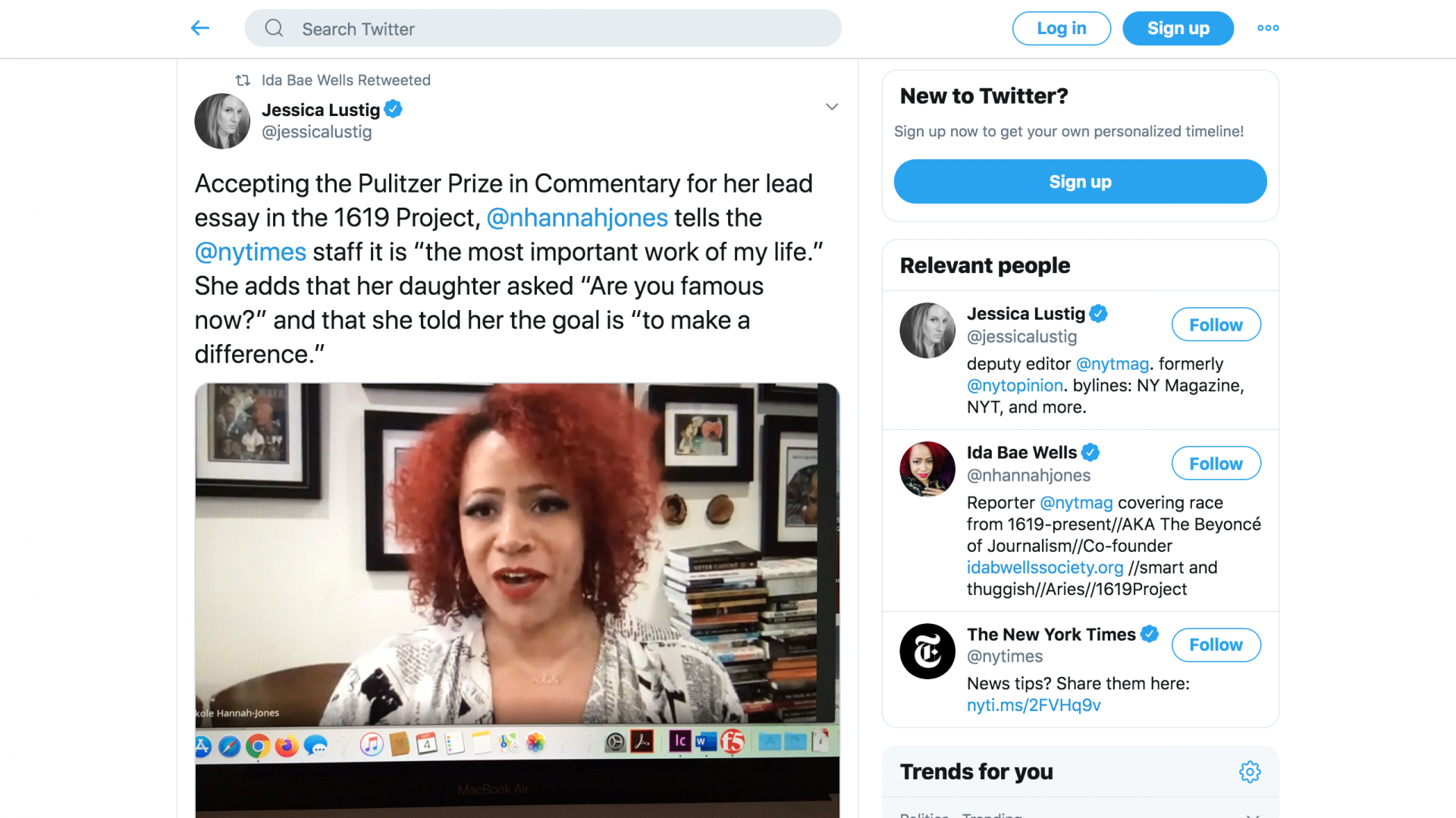
Baltimore Sun Investigative and Enterprise Reporter Jean Marbella covered the newspaper's Local Reporting Prize for its coverage of Mayor Catherine Pugh’s "Healthy Holly" book scandal, which prompted her resignation a year ago. Although The Sun has been a finalist multiple times in recent years, this marks its first Pulitzer since Diana K. Sugg's 2003 Beat Reporting Prize.
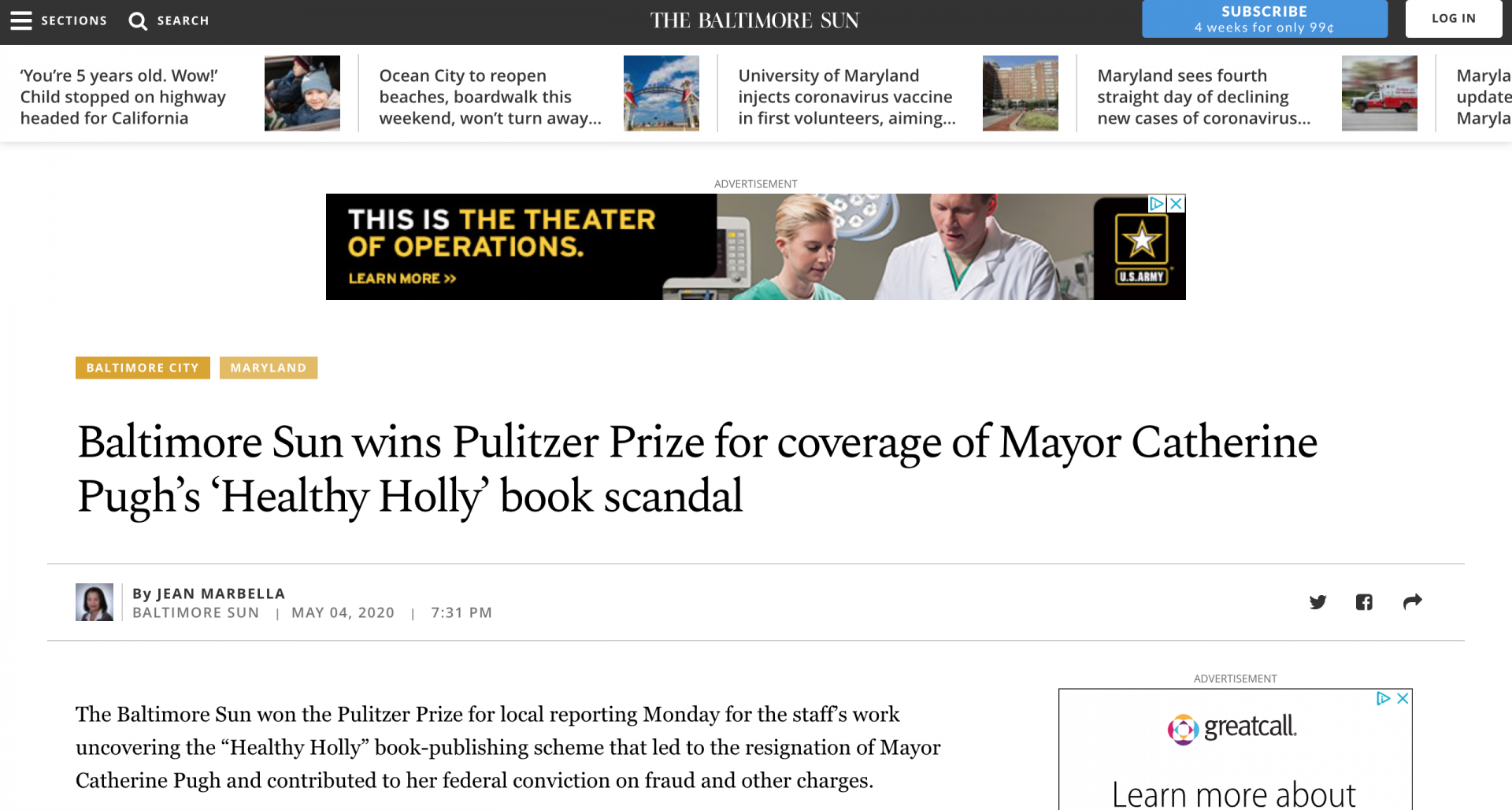
Editor/Publisher and past Pulitzer juror Trif Alatzas emphasized that the staff award, which encompassed eight bylines on 10 stories, embodied the collaborative spirit of the newsroom: "It was just an all-out effort — really, really great work by everybody, and I’m just glad to be a part of it,” he said.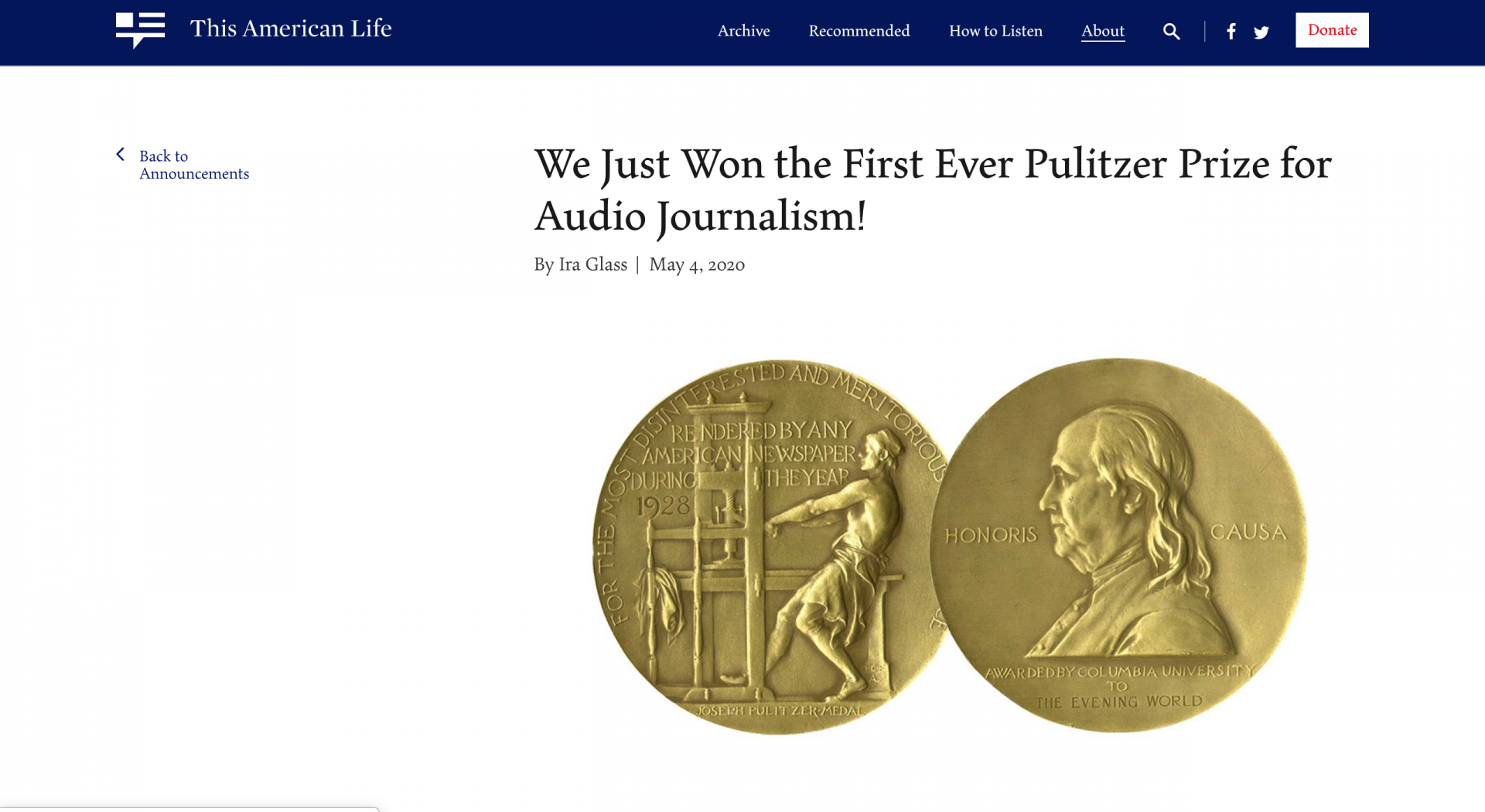
The inaugural Audio Reporting Prize was awarded to the staff of This American Life, Molly O'Toole of the Los Angeles Times and Vice News freelance reporter Emily Green "for revelatory, intimate journalism that illuminates the personal impact of the Trump Administration’s 'Remain in Mexico' policy."
Ira Glass, the host of This American Life, issued a statement on the radio program's website.
The episode that won, “The Out Crowd,” ran last November. When we started putting it together, we knew that elements of the "Remain in Mexico" policy had been covered by the press. But a lot of that coverage had come out in drips and drops, as the wonky specifics of the policy changed. Most listeners – hell, most of our own families and friends – had not put together what the policies really meant: tens of thousands of asylum seekers stranded on the other side of the border in shelters, on the streets, and in makeshift encampments. Many get kidnapped by the cartels, in areas the State Department classifies as being as violent and unsafe as Syria and Iraq.
We wanted to document the emotional truth of that, building stories around characters and scenes and story arcs like we have in all our shows. So the episode includes a piece of investigative reporting by Los Angeles Times reporter Molly O’Toole, produced by Nadia Reiman, where she interviewed asylum officers who talked about their discomfort enforcing the policy. She documented the fact that many of them were resigning. There’s also a story by Emily Green, produced by Lina Misitzis, built around remarkable recordings of cartels negotiating ransom for the release of a father and son who’d been kidnapped immediately after being returned to Mexico under the Trump administration’s policy. I reported, with Aviva DeKornfeld, at one of the squalid tent camps that’s sprung up just across the border.
Nadia Reiman produced the episode, with help from Aviva DeKornfeld. Editing from David Kestenbaum, Susan Burton, Ben Calhoun, and others. Fact-checking by Christopher Swetala, Michelle Harris, and Ben Phelan. Mixing by Matt Tierney, Stowe Nelson, and Katherine Rae Mondo. And it really was a group effort for the entire staff, including managers and administrative staff who handled logistics.

Jericho Brown was awarded the Poetry Prize for "The Tradition," his third book, "a collection of masterful lyrics that combine delicacy with historical urgency in their loving evocation of bodies vulnerable to hostility and violence." Brown is the Winship Distinguished Research Professor in Creative Writing at Emory University, which commemorated his achievement in a special news release.
"Understanding it as a possibility doesn't mean I ever expected to win [the Pulitzer], and getting the news that I won is the very best thing to happen to me in 2020 by far" he said. "I didn't expect to win it because when I write my poems I mean to be as subversive and radical as possible."
With music, lyrics and a playscript by Michael R. Jackson, "A Strange Loop" was cited by the Board as "a metafictional musical that tracks the creative process of an artist transforming issues of identity, race and sexuality that once pushed him to the margins of the cultural mainstream into a meditation on universal human fears and insecurities." Larry Owens, who starred in its 2019 Off-Broadway production at Playwrights Horizons, cried tears of joy in a video posted in the immediate aftermath of the announcement. "Thank you, God," he added.
A Rice University historian, W. Caleb McDaniel received the History Prize for "Sweet Taste of Liberty," a "masterfully researched meditation on reparations based on the remarkable story of a 19th century woman who survived kidnapping and re-enslavement to sue her captor." Teaching a full load of digital courses for the duration of the semester, he was succinct and sweet.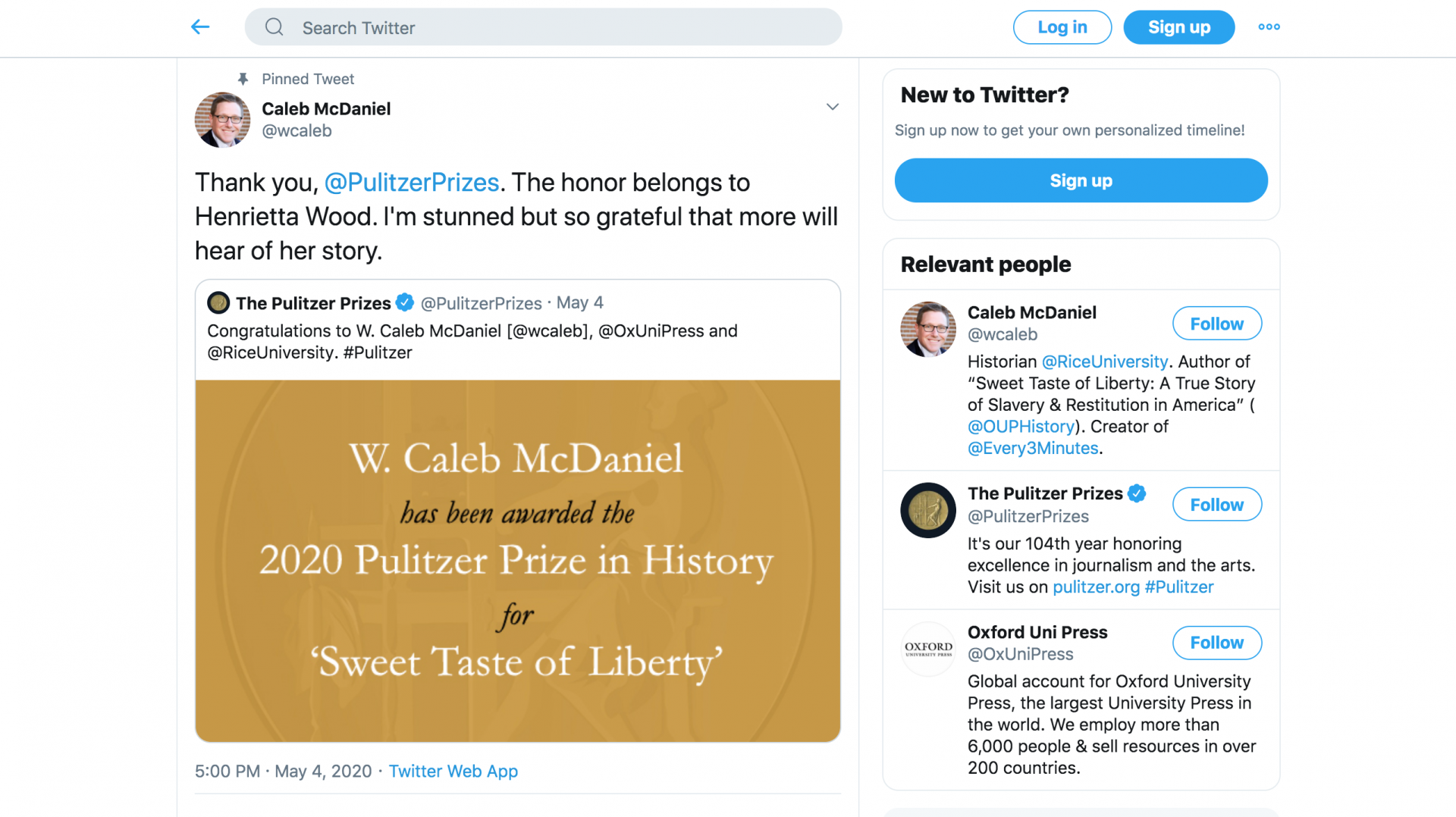
"Thank you, @PulitzerPrizes," he said. "The honor belongs to Henrietta Wood. I'm stunned but so grateful that more will hear of her story."
*This page has been updated to reflect the final language of the citation.