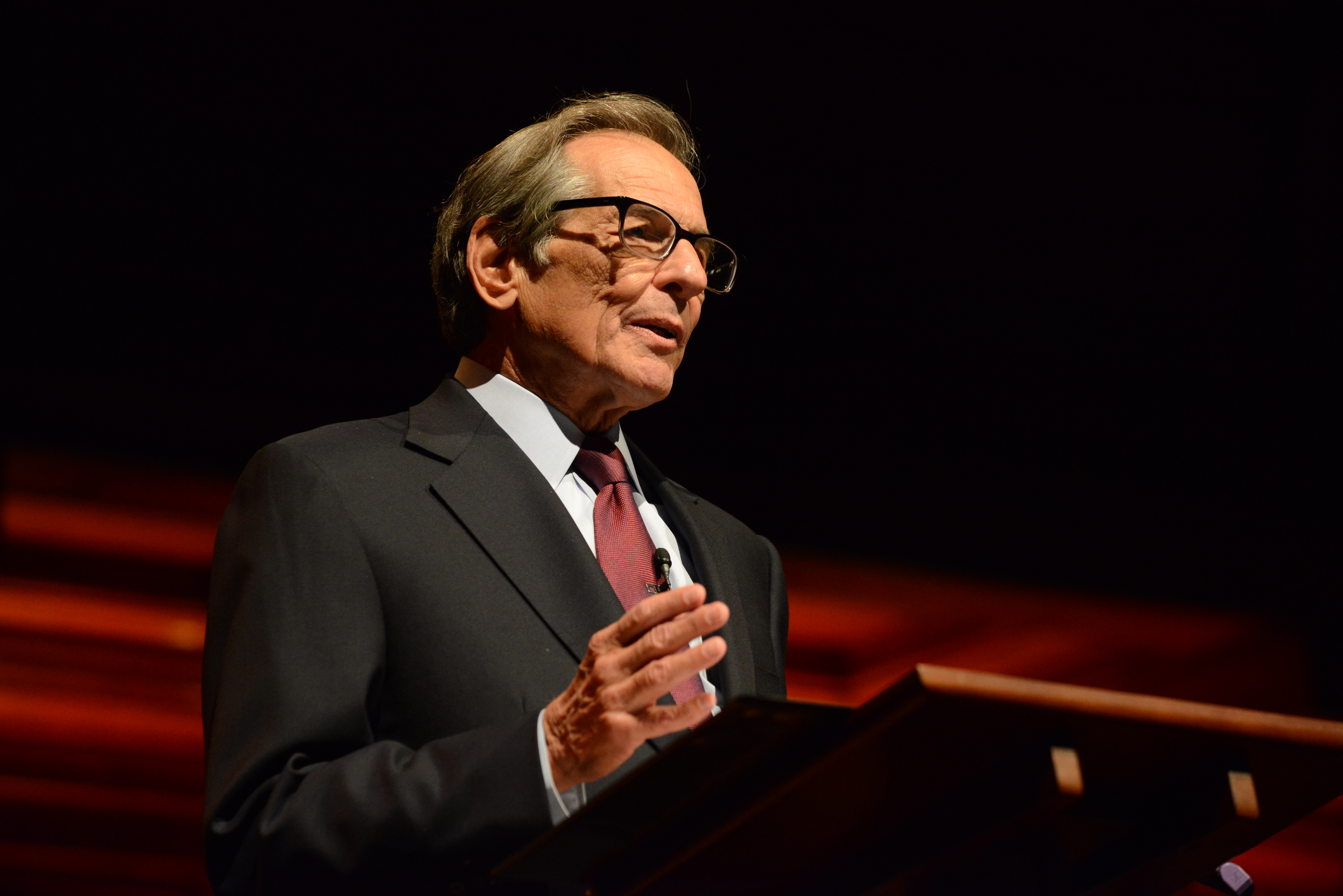
Robert Caro speaks during the fourth and final Pulitzer Centennial Marquee event at Harvard. Photo: Lisa Abitbol
“Regard for power implies disregard for those without power,” two-time Pulitzer winner Robert Caro said at the fourth and final Pulitzer Centennial Marquee event.
Caro was one of more than two dozen prize winners who traveled to Harvard University’s Sanders Theatre for an event hosted by the Nieman Foundation titled, “Power: Abuse and Accountability.” The lively and textured program included readings by 2008 Fiction winner Junot Díaz and 1994 Poetry winner Yusef Komunyakaa, an excerpt of Lynn Nottage’s 2009 prize-winning play Ruined, panel discussions, and musical performances by the Harvard-Radcliffe Orchestra and 1997 Music winner Wynton Marsalis.
During Caro’s talk, the The Power Broker author recalled getting the idea for his prize-winning book about urban planner Robert Moses during his 1965-66 Nieman year at Harvard. He went on to describe the moment at which he “came to feel that a book about power, at least my books about power, wouldn’t be really adequate if they were just about power. It has to be about other things, too. And the thing we’re talking about here, I came to feel, was justice and injustice”
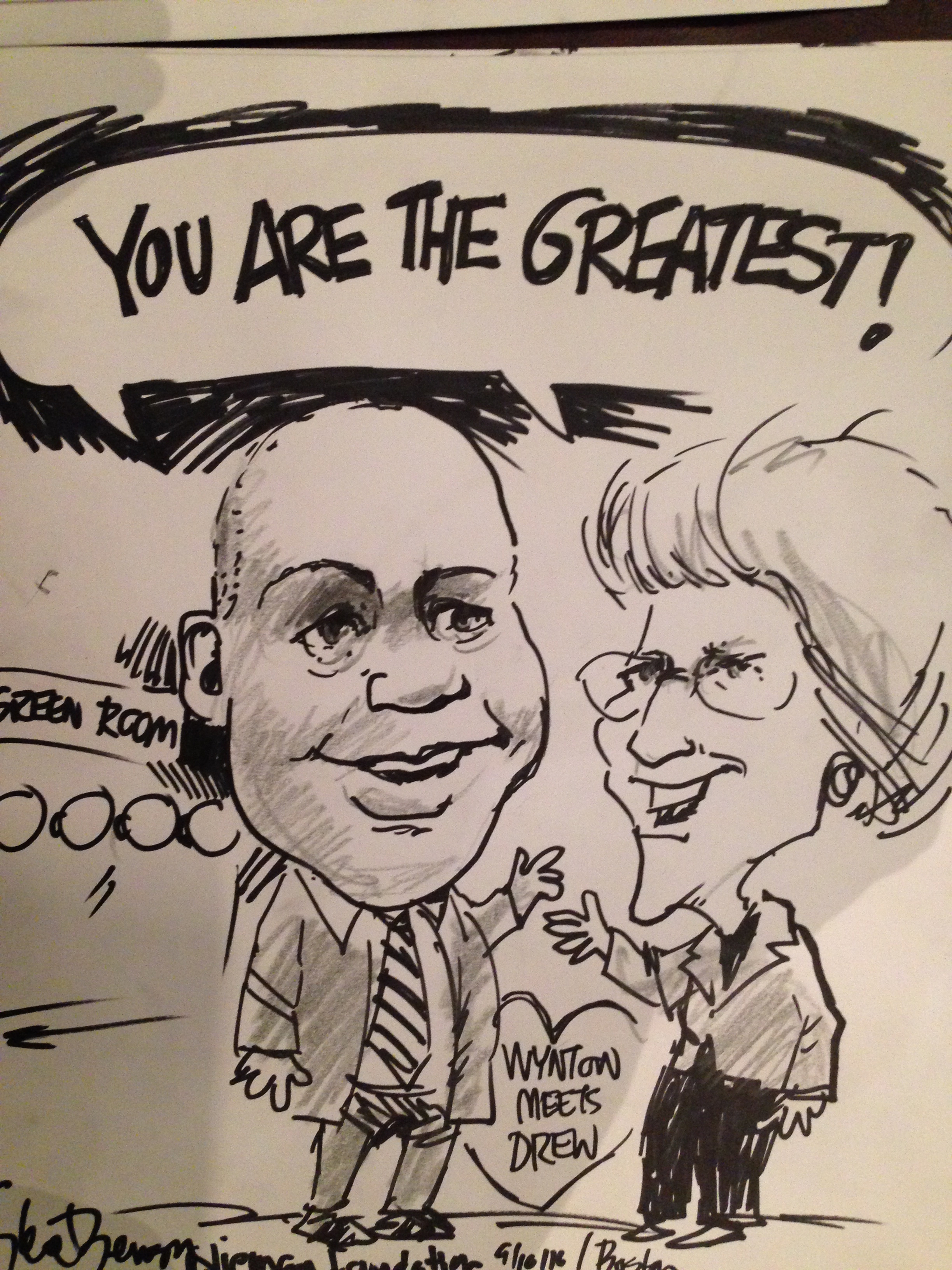
1993 Editorial Cartooning winner Steve Benson captured the event in pen and ink.
Variations on the theme of power versus powerlessness and justice versus injustice echoed throughout the weekend. The opening night performance by Marsalis and his band included excerpts from his winning composition, Blood on the Fields, which centers on a couple moving from slavery to freedom. The two “must move beyond a preoccupation with personal power and learn that true freedom is, and must be, shared."
Introducing Marsalis, Harvard University President Drew Gilpin Faust said, “In honoring the best of America, the Pulitzer Prizes embrace the same optimism that Wynton defines as the heart of music’s possibility — and human possibility.”
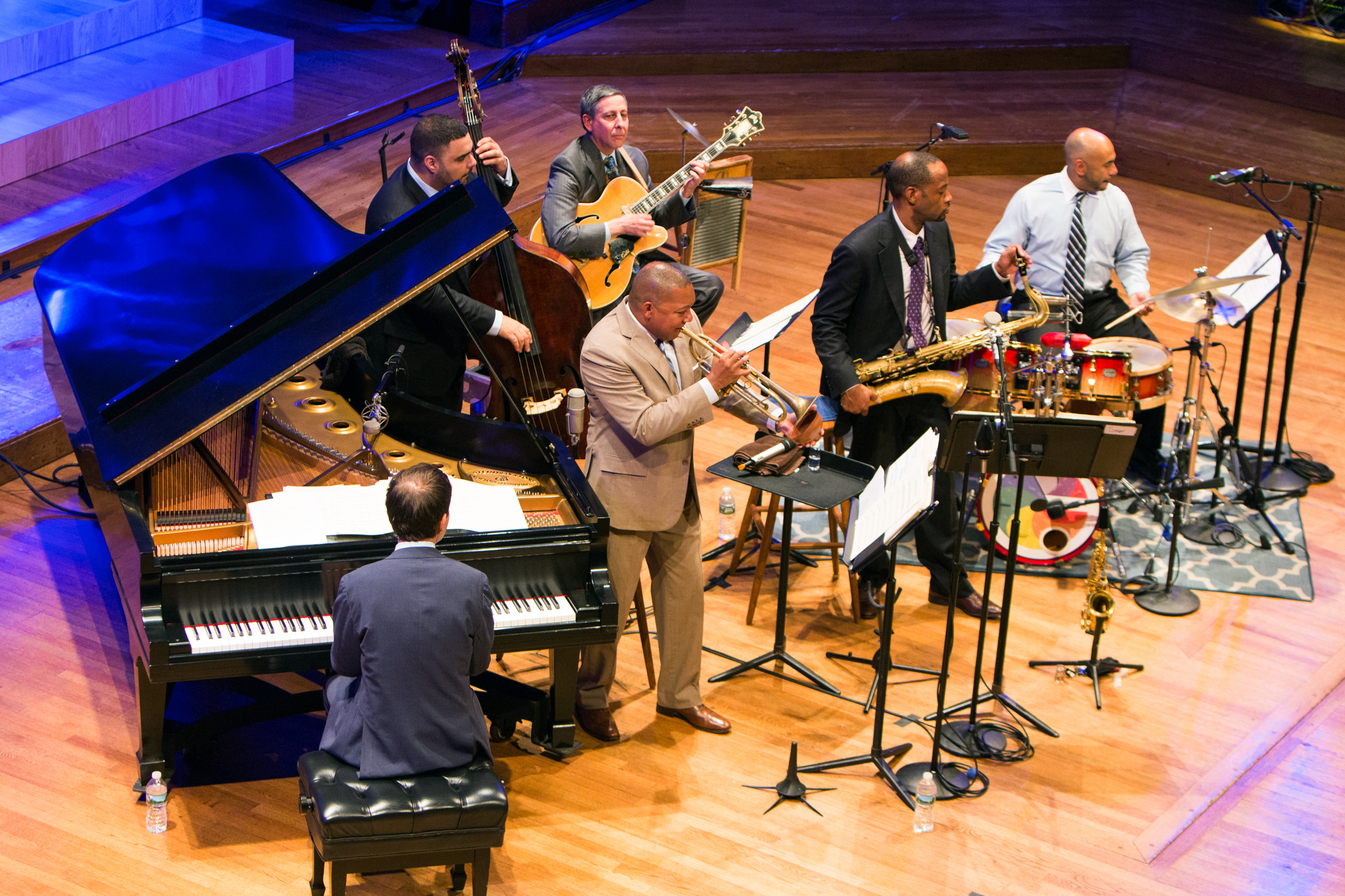
Wynton Marsalis and his band at Sanders Theatre. Photo: Lisa Abitbol
One of the musicians was overheard saying afterwards that he learned things about Blood on the Fields during the evening, which interspersed patter and performance, that he had never known during his 18 years in the band.
Following the concert on Saturday, Sept. 10, a full day of programming was broken into three sections on Sunday, Sept. 11: Power in the Home, Power in the Nation, and Power in the World.
In Power in the Home, 2009 History winner and Harvard professor Annette Gordon-Reed talked about the relationship between President Thomas Jefferson and his enslaved lover, Sally Hemings. Maria Henson, who won an Editorial Writing prize in 1992 for a series on domestic violence in Kentucky, talked about the frightening power dynamics that can exist within a couple — and the power of the press and the people to change the outcome in a bad situation.
“I learned the power of editorials, and I learned we don’t get this done alone. The women who let me tell their stories and show their faces and print their names did. The people who read the newspaper and made calls to lawmakers did. All these years later, at a time of such discouragement and disenchantment over our public life, I look back and remember the power of the press and ordinary citizens to effect change. Both of them out of a love of community and a passion for fairness,” Henson said.
Power in the Nation brought in the concept of abuses of government power in a panel moderated with Washington Post Watergate reporter Bob Woodward and filmmaker Laura Poitras, who received leaked NSA documents from Edward Snowden. Dean Baquet of The New York Times moderated the discussion, which veered into whether it was worth risking prison time to expose a presidential candidate’s tax returns.
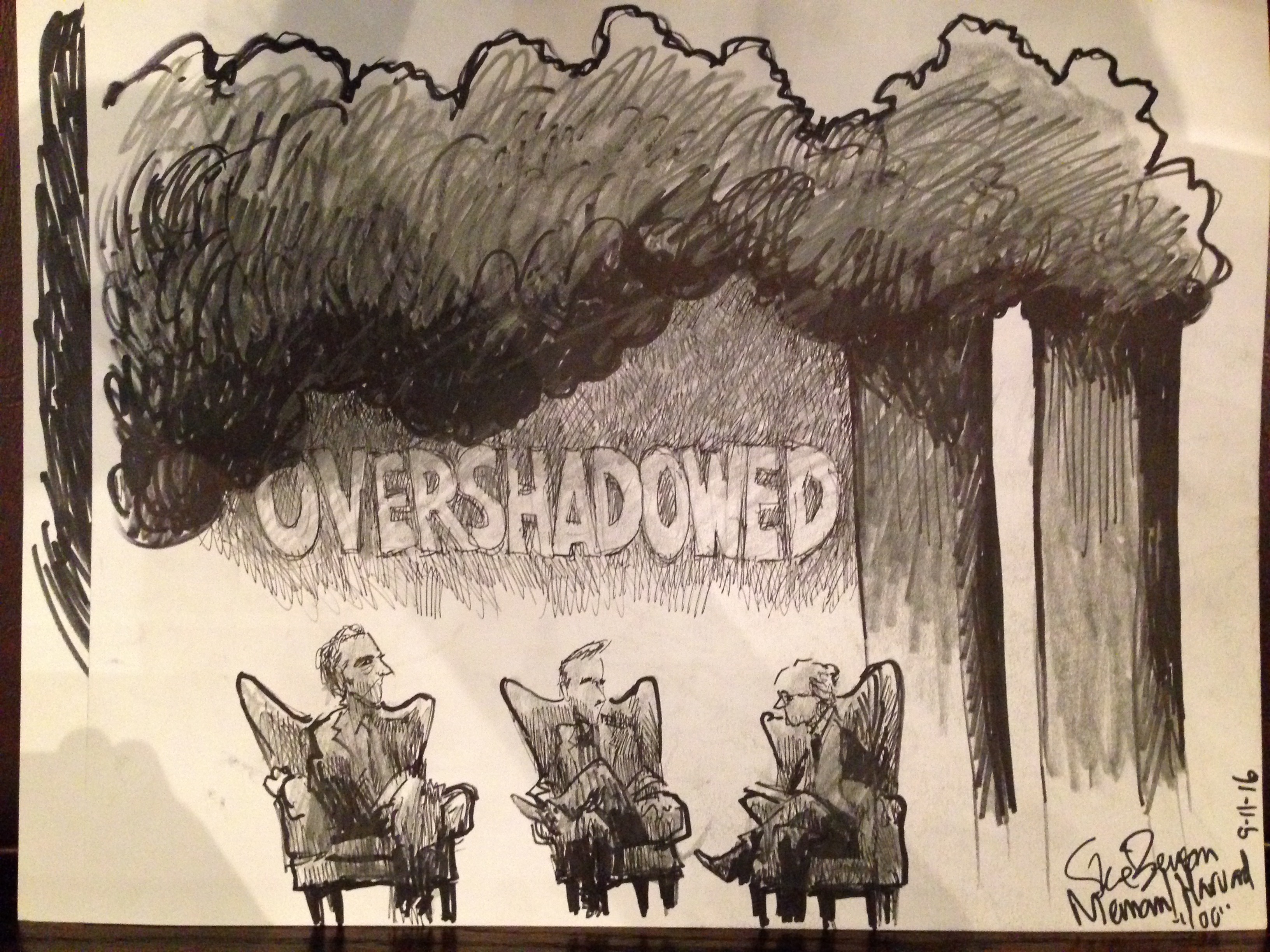
A Benson cartoon depicting the panelists on stage, 15 years after the Sept. 11, 2001 attacks on the World Trade Center.
Power in the World resonated on the 15th anniversary of the Sept. 11, 2001 attacks on the Pentagon and World Trade Center. This year’s General Nonfiction winner and author of Black Flags: The Rise of ISIS, Joby Warrick, sat on a panel with Lawrence Wright, 2007 Nonfiction winner for The Looming Tower: Al Qaeda and the Road to 9/11. Moderator Caroline Elkins, 2006 Nonfiction winner, asked whether 15 years ago Warrick or Wright could have predicted where we are today — they agreed they could not have.
“I never thought I’d be writing about terrorism 15 years later,” Wright said, recalling the emotional process of reporting on the attacks for the Sept. 24, 2001 issue of The New Yorker. “And yet I think that this world has really shifted. We’ve become different people because of this threat, which is not really such a profound threat to our existence. … But I think in part we feel entrapped in a movie not of our making, and that is what's so empowering to these young Muslims who are being drawn into this very exciting, historic enterprise, where in so many cases their own lives offer them so little.”
The program concluded with a performance of John Adams’ Transmigration of Souls, a piece he wrote commemorating the 9/11 attacks that won the Pulitzer Prize for Music in 2003. Voices Boston and the Tanglewood Festival Chorus joined Federico Cortese and the Harvard-Radcliffe Orchestra — bringing together more than 200 musicians.
Ann Marie Lipinski, 1988 Investigative Reporting winner and curator of the Nieman Foundation, noted that some orchestra members had only auditioned two weeks prior. Video of the final performance is coming soon, but most other segments are available online at the Nieman website, including Lipinski's interview with this year's Drama winner, Lin-Manuel Miranda.
Multimedia
Video of the speakers is available here: http://nieman.harvard.edu/sites/the-pulitzer-centennial/video/
Photos are available here: http://nieman.harvard.edu/sites/the-pulitzer-centennial/photo-gallery/
The full program line-up
Harvard University President Drew Gilpin Faust opened with an introduction of Pulitzer Prize winner Wynton Marsalis, who reflected on the themes raised by Blood on the Fields, his epic oratorio of one couple's journey from slavery to freedom. His piece was the first jazz composition to win the Pulitzer.
Danielle Allen, former chair of the Pulitzer Prize Board
Dean Baquet (Investigative Reporting, 1988)
Robert Caro (Biography, 2003 and 1975)
Junot Díaz (Fiction, 2008)
Caroline Elkins (General Nonfiction, 2006)
Mark Fiore (Editorial Cartooning, 2010)
Sara Ganim (Local Reporting, 2012)
Annette Gordon-Reed (History, 2009)
Donald Graham, former Washington Post publisher
Stan Grossfeld (Spot News Photography, 1984; Feature Photography, 1985)
Maria Henson (Editorial Writing, 1992)
Mary Jordan (International Reporting, 2003)
Julia Keller (Feature Writing, 2005)
Yusef Komunyakaa (Poetry, 1994)
Ann Marie Lipinski (Investigative Journalism, 1988)
Wesley Lowery (National Reporting, 2016)
Fredrik Logevall (History, 2013)
Lin-Manuel Miranda (Drama, 2016) (prerecorded)
Lynn Nottage (Drama, 2009)
Sacha Pfeiffer (Public Service, 2003)
Laura Poitras (Public Service, 2014)
Kevin Sullivan (International Reporting, 2003)
Joby Warrick (General Nonfiction, 2016; Public Service 1996)
Bob Woodward (Public Service, 1973; National Reporting, 2002)
Lawrence Wright (General Nonfiction, 2007)
The finale was a performance of On the Transmigration of Souls by John Adams, winner of the 2003 Pulitzer for Music, conducted by Federico Cortese of the Harvard-Radcliffe Orchestra with Voices Boston and the Tanglewood Festival Chorus