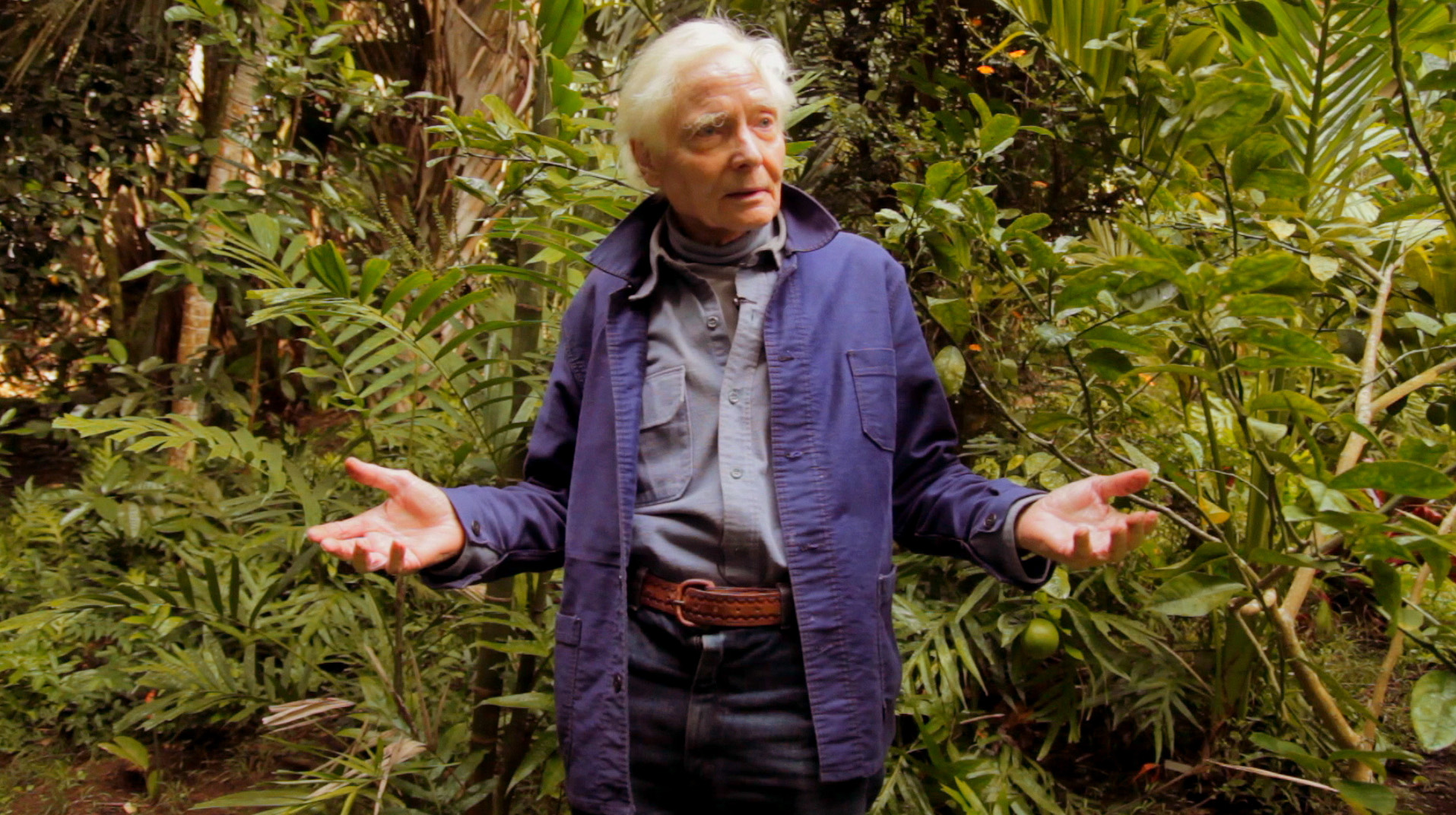
W. S. Merwin at his home in Hawaii. (WNET/Thirteen)
By Sean Murphy
W. S. Merwin died Friday at his home in Haiku, Maui, Hawaii. He was 91.
The recipient of the 1971 and 2009 Poetry Prizes, Merwin fused ecological, mythological and confessional concerns with strident pacifism. In 1971, he donated his Pulitzer monetary award to Alan Blanchard (a painter who was shot and blinded by police during the Berkeley People's Park protests on May 30, 1969) and a draft resistance organization, citing the pressure "of being an American to accept public congratulation with good grace, or to welcome it except as an occasion for expressing openly a shame which many Americans feel, day after day, helplessly and in silence" in a letter to the New York Review of Books.
Born to a Presbyterian minister and a homemaker in New York City, Merwin was raised in Union City, N.J. and Scranton, Pa. Graduating from Princeton University in 1948, he was a devotee of literary scholar R. P. Blackmur (the inspiration for the pedantic Sewell in Saul Bellow's Pulitzer-winning "Humboldt's Gift") and his protege, 1965 Poetry winner John Berryman. He also completed graduate studies in Romance languages, presaging a translation career that ran the gamut from "The Song of Roland" and "Sir Gawain and the Green Knight" to works by Nicolas Chamfort and Pablo Neurda.
From the 1950s to the 1970s, Merwin led a peripatetic life, living for spells in Majorca (where he tutored the son of Robert Graves and met Dido Milroy, his longtime wife), New York's Greenwich Village, Montana and Boston. In the late 1970s, he permanently relocated to Hawaii and divorced Milroy. His final wife, Paula Dunaway, predeceased him in 2017.
In addition to writing more than 25 collections of verse (including the Yale Younger Poets Prize-winning "A Mask for Janus" [1952] and "The Lice" [1967]) and nearly as many translations, Merwin wrote three plays and several collections of creative nonfiction. With failing eyesight toward the end of his life, he continued working, dictating to Dunaway and others. He devoted much time to the Merwin Conservancy, a nonprofit organization devoted to preserving his 18 acre property (formerly part of a pineapple plantation) in Haiku as a "Noah's ark" for rare palm trees.
Although he completed a term as United States Poet Laureate after his second Pulitzer win, Merwin left his own epitaph in that collection:
"the dead are not separate from the living
each has one foot in the unknown
and cannot speak for the other"
But he was careful to contextualize his work. "Poetry is like making a joke," he said. "If you get one word wrong at the end of a joke, you've lost the whole thing."