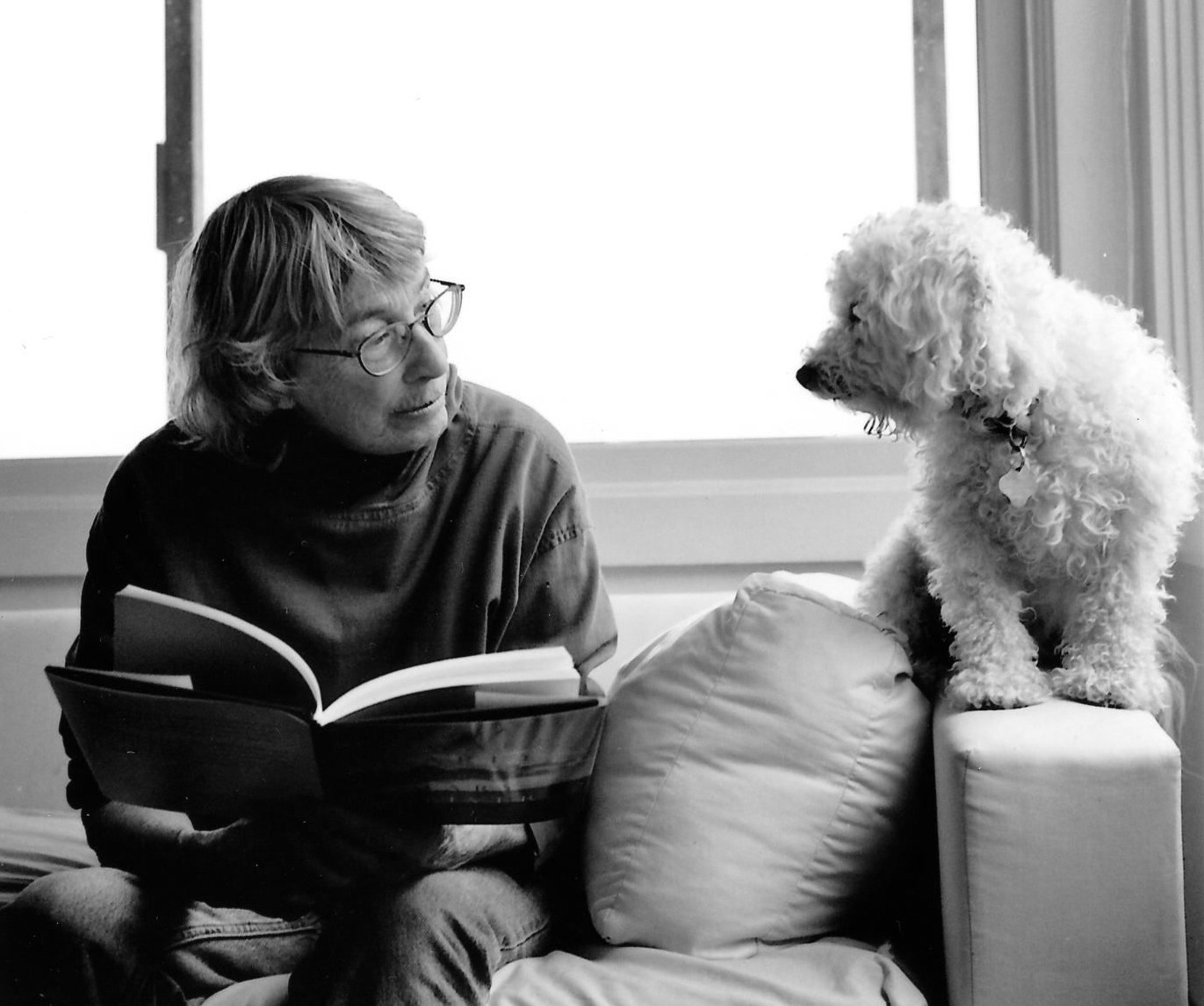
Mary Oliver in 2005. (Rachel Giese Brown/onbeing.org)
1984 Poetry winner Mary Oliver died Thursday at her home in Hobe Sound, Fla. She was 83. According to Bill Reichblum, her literary executor, the cause of death was lymphoma.
Known for her obstinance of mind ("[T]here’s never been a day that my friends haven’t been able to say, and at a distance, 'There’s Oliver, still standing around in the weeds. There she is, still scribbling in her notebook,'" she would recall in 2004), Oliver's poetics blended the Northeastern pastoralism of Walt Whitman (whom she identified as her closest antecedent) and Henry David Thoreau with the uncertainty of postwar life. Throughout the beaches of Provincetown, Mass., her longtime home, Oliver encountered flora, whales, water snakes, ponds — and the inner monologues that anchor life's quotidian dramas.
"A Meeting," included in her Prize-winning "American Primitive," embodied her approach:
She steps into the dark swamp
where the long wait ends.
The secret slippery package
drops to the weeds.
She leans her long neck and tongues it
between breaths slack with exhaustion
and after a while it rises and becomes a creature
like her, but much smaller.
So now there are two. And they walk together
like a dream under the trees.
In early June, at the edge of a field
thick with pink and yellow flowers
I meet them.
I can only stare.
She is the most beautiful woman
I have ever seen.
Her child leaps among the flowers,
the blue of the sky falls over me
like silk, the flowers burn, and I want
to live my life all over again, to begin again,
to be utterly
wild.
Born in Maple Heights, Ohio, in 1935, Oliver overcame a tumultuous childhood and sexual abuse to attain a percussion spot in the National High School Orchestra. While in high school, she befriended pioneering feminist and 1923 Poetry winner Edna St. Vincent Milay. Although she took classes at Ohio State University and Vassar College, Oliver largely eschewed a conventional postsecondary education in favor of organizing Milay's papers at her estate, Steepletop, in Austerlitz, N.Y.
Through Milay, Oliver met her life partner, photographer Molly Malone Cook, in 1958. They remained together until Cook's death in 2005.
Shortly after the publication of Oliver's first collection of poetry in 1963, they moved to Provincetown, a community of fishermen, summering New York thespians and members of the LGBT community on Cape Cod. There, Cook operated the lauded East End Bookshop, often encouraging one of her clerks, a young filmmaker named John Waters, to "to be rude to obnoxious tourist customers." For many years, she also served as the assistant to two-time Pulitzer winner Norman Mailer.
According to Philip Hoare, "Molly and Mary were at their best in Provincetown. Their house seemed to have grown around them. Its windows looked out from grey-shingled walls on to the limpid light of Cape Cod Bay and past the harbor breakwater, where schools of dolphins swam. At night they watched the blinking green light of Long Point lighthouse. Their rooms were filled with light, books, people and animals, all seemingly spilling in from the beach that ran outside their back door."
After publishing three full-length collections between 1963 and 1979, Oliver grew increasingly prolific in the 1980s and 1990s, eliciting critical disdain from those who objected to her traditional preoccupations ("nature, beauty and, worst of all, God") and a reputation (cemented by her Pulitzer and the 1991 National Book Award) as "the most beloved poet in America" — a figure who could scale the bestseller lists and be interviewed by Maria Shriver in O magazine long after her semiretirement from an academic teaching career.
In a 1997 article for the Harvard Gay and Lesbian Review, Sue Russell offered an approbative assessment of Oliver's uniquely liminal berth in American literature: "Mary Oliver will never be a balladeer of contemporary lesbian life in the vein of Marilyn Hacker, or an important political thinker like Adrienne Rich; but the fact that she chooses not to write from a similar political or narrative stance makes her all the more valuable to our collective culture."
By tirelessly observing the complex systems of natural life, Oliver found gnosis in a spirituality unburdened by institutions, and a colloquial vision resonant with the realities of the American experience.
"Poetry, to be understood, must be clear," she said. "It mustn't be fancy."
Read selected work spanning Oliver's career at the Poetry Foundation's website.