Finalist: The Buffalo News, by Staff
Nominated Work
The weather outside sure was frightful Tuesday, but all over the region, Western New Yorkers – and some unsuspecting guests – figured out how to make the best of it.
From good Samaritans to hot chocolate and babushkas, the City of Good Neighbors proved once again that it can weather even the stormiest conditions.
Here are some glimpses from across the region:
...
The best assignment
Western New Yorkers may shiver and groan at the thought of another season of lake-effect poundings.
But at least one group never grows weary of a good Northern storm – the Weather Channel meteorologists.
The Weather Channel set up for production Tuesday morning at the Main-Buffalo roundabout in Hamburg.
“This impresses us,” Weather Channel meteorologist Mike Bettes said of the snowstorm that pelted the Southtowns.
Lake-effect snow is something the Weather Channel’s on-air staff relishes covering, Bettes said, even leading to spirited debates about who gets the assignment. In fact, the region’s Snow Belt towns are part of the everyday vernacular at the Atlanta-based Weather Channel.
“Maybe not to the rest of the country, but among us meteorology nerds, yes,” Bettes said between live segments. “We know all of the typical lake-effect places.”
Bettes, who was considering switching from a winter hat to a babushka for his live update around 9 a.m., said the snowstorms make for great visuals and contrast the coverage of other forms of severe weather because everyday life goes on in snow.
And there are a few other perks. Namely star-struck onlookers who come bearing gifts of coffee and hot chocolate.
“I know there is a lot to be said for Southern hospitality,” Bettes said, “but I think people that live here and in the Midwest, they are the real deal.”
– Geoff Nason and Brian Connolly
...
A truly good neighbor
Dan Carpenter has had a great season kicking field goals for the Buffalo Bills.
But that’s not why Roy Noble called The Buffalo News’ sports department about Carpenter on Tuesday afternoon.
Noble, 88, is Carpenter’s next-door neighbor in Orchard Park’s Brompton Heights neighborhood, and he wanted to let someone know how Carpenter helped out Noble and his wife during Tuesday’s storm.
“The drifts in front were a peak of 5 feet high,” Noble said.
Noble’s wife, Lorraine, 87, noticed Carpenter assessing the snow outside his own home.
Noble said Carpenter shoveled himself a path as he headed over. “He had to cut through the snow from his driveway just to get to our front door … and he only had a small snow shovel.”
Noble was very thankful that Carpenter shoveled out his front and cleared his furnace’s horizontal vent. “He checked it out and made sure it was clear,” Noble said. “He’s going to check on it again whenever he checks his.”
The Nobles, who will be married for 69 years next March, are lifelong Western New Yorkers who have lived in Hamburg and Cheektowaga. They have been in Brompton Heights since April. They feel they ended up with pretty nice neighbors.
– Keith McShea
...
Open for business
Two feet of snow are cause for most businesses to close.
For Joel Best, owner of the Now Pizzeria in Hamburg, it is a reason to open early.
Normally open at 11 a.m., Best had the “Open” sign lit up at 10 a.m. Tuesday, even as the Southtowns endured an intense pummeling of snow.
The neon sign was a beacon of light in an otherwise ghost town in the Village of Hamburg.
Best puts on the sign early, wanting to make sure those nearby are aware he is open. He did a lot of business during one of Western New York’s blizzards last year, filling orders of 20 subs or multiple pizzas for the many maintenance workers or firefighters and police officers busy during the storm.
“I started shoveling the front walk but figured I would come inside and get things going,” Best said. “When some younger staff comes in later they can handle the shoveling.”
– Geoff Nason and Brian Connolly
...
Coach Marrone gains yardage
Bills coach Doug Marrone gained some unexpected yardage in South Buffalo on Tuesday, helping a hastily assembled team of good Samaritans push free a snowbound car blocking the center of Abbott Road.
A nurse believed to be headed to nearby Mercy Hospital found herself stuck at about 3 p.m. when Marrone stepped from his SUV, quickly attracting others willing to lend a hand in the midst of the snowstorm.
“Let a young man do this,” Marrone jokingly said to one of the older do-gooders.
Simultaneously rocking and raising the low-sitting car, the 50-year-old Marrone and company managed to shove the vehicle’s undercarriage from the hard-packed snow that had marooned it.
And what was Marrone doing in the drifts of South Buffalo?
“I’m on my way to the stadium.”
Marrone continued to score points by signing a few autographs before resuming his quest to make it to Ralph Wilson Stadium in Orchard Park.
– Lou Michel
...
An angel of mercy
The contrast between weather conditions downtown and in South Buffalo was so stark that John Little thought he actually had a chance of getting home from work without much trouble.
Little, who works at General Mills and lives on Spaulding Street near South Park Avenue, left work at 6:30 a.m. Tuesday.
“It looked like a regular 6-inch snowfall,” he said.
Within a few miles, he was stuck on the side of the road at the intersection of Hopkins and Tifft streets.
Little abandoned his car and walked a few blocks down Hopkins, looking for streets that had some ruts that would make walking through the snow easier. Once he reached Houston Street, just two blocks from his home, his clothes were frozen and snow-covered, and he was tired from wading through more than 3 feet of snow.
“I just decided to knock on the door at 34 Houston,” Little said. “An angel of mercy was there.”
He asked the woman who answered the door if he could warm up on her front porch, but she took him inside, dried his socks and jacket, gave him tea and spinach pie, and placed a small heater next to him to warm him up.
More than four hours after leaving work, Little arrived at his wife’s grandmother’s home.
– Sarah J. Velasquez
...
A heavy lift
So you think pushing your car out of a snow drift will make you sore?
Just imagine how Washington Lewis and several others feel after freeing an NFTA bus with shovels and their muscles.
The bus on the Fillmore 23 route got caught in a snow bank on Bailey Avenue near South Park Avenue in South Buffalo.
Lewis, the bus driver, got some help from an NFTA police officer, a couple of passengers and some men from the neighborhood. They started shoveling snow at about 6:50 a.m. to free the bus.
After an hour and a half digging, they started to push. The bus was free by about 9 a.m.
“These guys are fantastic. I was stuck in a snowbank, and they all helped,” Lewis said of the others.
“It’s the first time I ever pushed a bus out of a snowbank,” said NFTA Police Officer Nick Nesci. “We beat out the tow truck.”
Lewis gave away several Metro passes as thank-yous for those who assisted.
– Lou Michel
...
Can’t keep on truckin’
With travel bans in effect all over the county, and the Thruway closed to traffic, truck drivers were given pretty much one option – wait out the weather.
Some of them hunkered down at Jim’s Truck Plaza in Cheektowaga, chatting with one another, playing games and watching movies on their laptops, while occasionally checking weather forecasts to see when they could get back on the road.
“This weather is a little foreign to me,” said Tom Ackley, who had reached Buffalo from San Diego, en route to Gasport with household goods and furniture. “I’m just 20 miles away, and I can’t even get out of the back here.”
Brian Grissinger of Claremont, Fla., expected to have unloaded his cargo in New Hampshire by mid-morning, instead of watching blowing bands of snow across the street from theWalden Galleria. He had been off the road since 8 p.m. Monday.
“This seems to happen every time I head up north,” he said in a southern drawl.
There was an upside, though, Grissinger said.
“I enjoy this. A little time off, sit around,” he said. “They don’t want you out there if it’s really bad.”
– Mark Sommer
...
Rescue mission
Eight immigrants from Burma and Thailand probably weren’t expecting the weather that dogged the area Tuesday.
They became stranded while trying to make it home after their shift at a metal shredding and recycling facility. They started work at 4 a.m.
“We all came here from a refugee camp in Thailand between three and five years ago,” said Sella Myint. “We put in a good day’s work, and when we left, we couldn’t drive our cars.”
After receiving a call from one of them, Doug Wheeler, a fellow Buffalo Karen Baptist Church member, went looking for them in the streets of South Buffalo.
He found them near Bailey Avenue and McKinley Parkway. They piled into his SUV at about 9 a.m. and arrived at their West Side homes around noon.
They were not dressed for such a storm.
“They were stranded,” Wheeler told The News as he prepared to drive them home. “Their cars were piled in with snow. I’m going to take them back to the West Side to their homes.”
– Lou Michel
...
Excused absence
Miranda Hensen had no idea what she was heading into when she left her home in Tonawanda early Tuesday and headed southeast for her job at Target.
“I was supposed to be at work at 4 a.m.,” she said. “The Thruway was OK, it only got bad at the William Street exit.”
That’s where her Jeep got stuck at William Street and Union Road, but with help from her boyfriend, she was able to get going again. They didn’t get far.
“We’ve been stuck on Losson Road for four hours,” Hensen said. “We were in the Jeep so long we ran out of gas.”
Residents were coming out, but only to try to dig their way out of their own driveways, she said, and they couldn’t tow the Jeep because there was so much snow.
Finally, the two were able to get to the home of someone she knows – her boss.
Needless to say, she was absolved for not making it to work that morning.
– Melinda Miller
...
A close call
Residents who live on the shore of Lake Ontario are used to seeing giant oil freighters traveling way out in shipping lanes.
But not 100 yards from shore.
Reports came in Tuesday that a freighter got within a 100 yards of shore between Olcott Harbor and Golden Hill State Park in Barker.
Despite concerns the ship may have run aground, the Coast Guard reported around 11 a.m. that the freighter was not in any distress and was moving under its own power close to shore. The water in that area is deep enough for the freighter to maintain itself.
“We do not know definitely of why it came so close,” said a Coast Guard spokesman. “At this point, the weather is not an issue (on Lake Ontario), but we are experiencing some heavy winds.”
– Nancy A. Fischer
Snowbound residents begin to burrow out as second storm takes aim
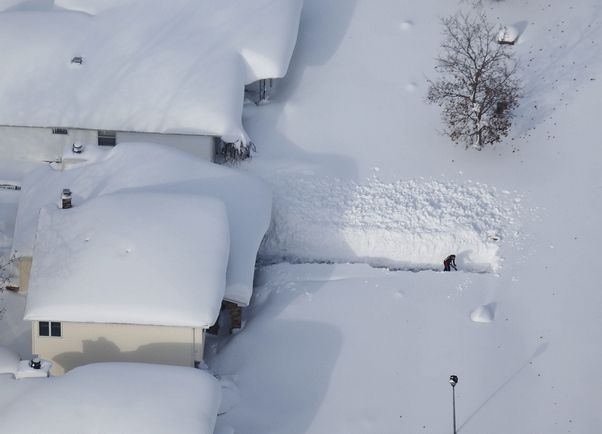
A resident of Depew clears a narrow path from his snow-engulfed house to his unplowed street during the brief calm between two lake-effect storms Wednesday. Derek Gee/Buffalo News
By Maki Becker
After a wall of snow buried neighborhoods and towns from South Buffalo to Alden, another lake-effect storm took wider aim on Wednesday, this time starting at Niagara County, then barreling its way over Buffalo and back down to the areas already buried by 5 feet and more of snow. Another several inches of snow had fallen in hard-hit Hamburg by 6:30 a.m. this morning.
The storm was expected to mound another 2 feet over Erie County’s snow-smothered heart by the end of today.
“You know what? It is what it is,” said Dan Amatura, highway superintendent for the Town of Lancaster, where 63 inches of snow fell during the first storm Monday night and Tuesday. With plows rendered useless in chest-high snow, his workers have worked tirelessly to clear streets using bulky high-lifts.
Beyond exhausted, Amatura, like many on his crew, has been home for about a half-hour total since the storm hit to shower and brush his teeth. He has barely slept. “Last night, I dozed off in the office for a few minutes,” he said. “I’ll just keep going.”
The thick, gray lake-effect bands dissipated by lunchtime Wednesday and for a few brief hours, the sun shined and snowbound Erie County residents burrowed their way out of their homes – some through their kitchen windows – to get a first look at the mountains of white all around them.
Tips of lampposts and street signs poked through snowdrifts. Strange mounds, when brushed off, turned out to be cars. Rooftops were draped in snow. People trudged through waist-high snow to find groceries.
A bird’s-eye view of the aftermath is even more astonishing.
A modern day Man of La Mancha, undaunted by snow towering far over his head, shoveling a narrow path to the invisible street in Depew.
Tractor-trailers, one after another, idling on the snow-covered Thruway.
Ralph Wilson Stadium looking like a bowl of vanilla ice cream.
But the storm left more than a snowy wake.
A seventh death was attributed to the storm Wednesday. The most recent was an elderly man who had a heart attack and couldn’t get to a hospital because of the heavy snow. In Genesee County, a county employee died Tuesday after suffering a heart attack while snowblowing, according to the Batavian. And in Alden, a 46-year-old man was found dead inside his car, which was buried under snow. Three others died of heart attacks while shoveling and another person died while helping to move a stuck car.
Early Wednesday morning, the roof of a Cheektowaga warehouse collapsed under the weight of the snow, causing a natural gas leak and forcing caregivers at a nursing facility to move some patients to a safer area past a set of fire doors.
The Thruway remained closed from the Pennsylvania state line to Henrietta as people who had been stranded in their cars for a day and a half were finally plowed out or rescued. Other major arteries throughout the region, including portions of the Niagara Thruway and Youngmann Highway, were shut down. Travel bans were in effect in many towns and South Buffalo, where tow trucks struggled to dislodge abandoned cars so that plows could get through.
Two hundred and fifty trucks hauled more than 5,000 tons of snow out of South Buffalo and dumped it by the Central Terminal.
The hunt was on for food as many restaurants and grocery stores, including three Wegmans in the Southtowns, were closed. Lines 45 minutes long were reported at the Tops Market on Seneca Street.
School districts, including Buffalo Public Schools, were closed for a second day. Buffalo will close again today and many others were expected to follow suit.
The U.S. Postal Service suspended mail deliveries in towns and villages where driving bans were in place, and National Fuel pleaded with customers to call their service lines with emergencies.
As the National Guard arrived with heavy equipment and Humvees to help clear out snow, Gov. Andrew M. Cuomo came to town to assess the situation and offer assistance to the roughly half-million people in the storm’s path.
“This is an extraordinarily difficult situation,” Cuomo said at one of several news conferences Wednesday. “The amount of snow, the rate at which the snow is falling, the rate of snowfall, the weight of the snow, all conspired to make this especially difficult. It is then further compounded by having stranded vehicles on the roads, which means now you can’t access that road and you can’t plow that road until you move the car, which is a time-consuming matter.”
He commended the emergency responders and highway crews for their hard work and asked the public to help by staying off the roads.
“When we say stay at home,” he said, “we really mean stay at home. You will get stuck and further complicate the situation. It is almost inevitable.”
Cuomo said state and other personnel are planning for a “four- or five-day workload.”
While Wednesday brought story after story about misery and exhaustion, there were also tales of hope and hardiness.
At least three babies were delivered with the help of emergency responders. At 1:45 a.m., the Jamison Road Fire Co. in Elma fielded a call about a woman in labor. They arrived at her house with two snowmobiles, a six-wheel unit with tracks and a four-wheel drive SUV, said Capt. Daryl Nolan.
They used the track vehicle to get the woman to the SUV, then headed for Mercy Hospital, with snowmobiles trailing. When they got stuck, they put the mother on a snowmobile. They were blocked by a stuck vehicle when a firefighter spotted a Rural/Metro Medical Services ambulance.
“Within five minutes of getting in the ambulance, she delivered the baby,” Nolan said. It was a boy.
And then there was bizarre tale of Jay Lloyds, 58, an Australian who now lives in Toronto. He was driving back from Daytona, Fla., on Tuesday in his 1981 Porsche with no heat when he was turned away from the Thruway – and from every road he tried. He somehow ended up on small country road in Brant when he spotted a couple clearing their driveway.
With all highways toward Canada blocked, Michael Weazer, 24, and his girlfriend, Brittany Leighbody, 23, invited him to stay at their home.
Lloyds was stunned by their generosity. “Amazing,” he said Wednesday night. “Sometimes, there are good things that happen in the world. It’s not always bad.”
By Barbara O'Brien and Tom Precious
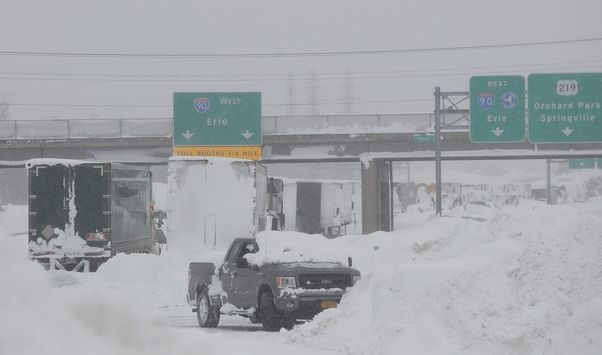
Gov. Andrew M. Cuomo came into town Wednesday to survey the hardest hit area of the Thruway between Walden Avenue in Cheektowaga and Ridge Road in West Seneca. Sharon Cantillon/Buffalo News
David Carr has driven the Thruway through Hamburg dozens of times from his home in Washington, D.C., to get to Toronto.
Samuel Martin of Oregon was on his way to Massachusetts.
Steven Ratcliff of Cheektowaga was headed to work in Hamburg.
They and dozens of others became stranded on the Thruway beginning Tuesday and spent two harrowing nights in their vehicles because of the lake effect storm that blasted the Snow Belt.
After being marooned, they were angry, saying they felt abandoned. Their family and friends were furious.
After a similar incident on the Thruway here four years ago, state officials had promised that motorists never again would be stranded on the Thruway during a snowstorm.
But it did happen again. And on top of that, when Gov. Andrew M. Cuomo arrived Wednesday, he blamed the “mistake” on the drivers.
“Part of it is citizen responsibility,” he said after arriving here Wednesday for an inspection of storm damage and before a trip to see some of the people stranded on the Thruway in Hamburg.
“People violated the closure of the Thruway,” Cuomo told reporters, saying the drivers could be ticketed for violating orders that the road was closed.
The stranded drivers interviewed Wednesday while still in their vehicles said there was no warning the interstate was closed, and no police cruisers or gates lowered to keep them from getting on at entrances.
And despite what the governor and other state officials said that personnel were checking on their welfare while stranded, the drivers and their passengers insisted no one checked on them for more than 30 hours.
“I know it’s a big storm ... It’s Buffalo, you get big storms,” said Carr, of Washington. “It’s embarrassing. If you’re an American, if you believe all that stuff about we’re No 1.”
Volunteers on snowmobiles brought Gatorade to some, water to others, tossing the nourishment over the median. But many drivers of the 100 or more vehicles marooned on the interstate had no water or food for 35 hours. Some ran out of gas. And all of those interviewed by The Buffalo News said no police officer or other Thruway official approached them until Wednesday morning, if at all.
Worried relatives, hundreds or even thousands of miles away, kept in touch with the marooned by cellphone, and tried to light a fire under public officials.
“I thought ‘My God, he’s going to freeze to death, because he’s not going to get rescued in time,’ ” said Carr’s sister, Adreinne, of Golden, Colo. “I’ve emailed the White House, I spoke with Andrew Cuomo’s office.”
While the Thruway was not the only local road where vehicles were abandoned and drivers stranded, the Thruway Authority system is certain to face more scrutiny over how it handled this latest crisis.
Thruway officials and the new Cuomo administration’s state operations staff in January 2011 promised to make sure no repeat occurred from the December 2010 snowstorm.
Cuomo said this storm was far worse than the December 2010 storm that stranded hundreds of vehicles on the Thruway in West Seneca but that it was handled better this time around. He also said the Thruway Authority, an agency his administration controls, shut down the highway at “an appropriate time,” but motorists ignored the notice.
“Even though it was closed, people still went on the Thruway,” he said.
But no one told the seven stranded drivers and relatives The News talked to that the Thruway was closed.
Martin, the Colorado trucker hauling two recreational vehicles on a flatbed truck from Indiana to the Boston area, noted that he had to get a paper ticket – at a toll booth with its green open light still on – when he entered the Thruway and there were no warnings at any point until he became stranded.
And while Thruway officials said that warning signs about the dangerous snowstorm were activated on highways in Ohio and Pennsylvania to alert New York-bound drivers, Martin said he saw no warning signs as he drove through those two states.
“If there was a warning of snow, I’d not have come this way,” he said, referring to an alternative route on I-80 south of Cleveland.
Cuomo said “virtually all” of the stranded drivers were approached to make sure occupants were OK, but some motorists and their families said they received no rescue offers through the two nights.
“I think they should have been monitored through the night, throughout the whole entire time,” said Martin’s wife, Wendy, at home with their four children in Oregon. “He just feels abandoned out there.”
Carr, the Washington resident who owns a business installing squash courts around the world, was taken from his pickup near the Blasdell exit to the Lackawanna toll booth building late Wednesday morning.
But he said it was not a relief to be out of his vehicle. Confusion reigned in the small area, with some authorities talking about a bus to take drivers to a warming shelter, another asking who wanted to go to a hotel. All he wanted was a little gas to get his truck down the road to get out of Buffalo, he said.
“You just see the left hand doesn’t know what the right hand is doing,” he said.
Ratcliff of Cheektowaga and Shawn Daley of Amherst were headed to work in separate vehicles early Tuesday morning, and didn’t know how dire the road had become.
Daley, 39, works at Mentholatum in Orchard Park, while Ratcliff, 40, was going to the Ford Stamping Plant in Woodlawn.
They both were stuck on the westbound Thruway just east of the Lackawanna toll barrier, about 4:30 a.m. Tuesday.
Daley’s car was running out of gas, and then his battery gave out. He walked to a few cars, asking if they had room for another passenger. Ratcliff opened his door. After more than 28 hours together, they became fast friends.
“Letting me in his car, pretty much saved my life,” Daley said, adding that several other motorists declined to let him.
A few hundred feet from them, Lisa and Paul Winter of Eden spent two nights in their Chevy Avalanche near the toll barrier. About 7 a.m. Wednesday, Paul Winter saw a car coming on the eastbound side of the road. He climbed over the median and flagged it down, and the driver took the couple to the toll barrier building.
“There are vending machines, and running water,” Lisa Winter said. “We are blessed, we leave it at that.”
They spent 30 hours in the pickup truck and did have enough gas to keep it running. A snowmobiler tossed a couple bottles of water to them Tuesday night, but no one came to the truck to check on them.
Michael Pinkoske of Lakeview is one of the lucky ones. He was able to drive his pickup truck down the Thruway after being hauled out about 9:30 a.m. Wednesday. He had been on the westbound Thruway, just past the split with Route 219, for 30 hours, bogged down when he was coming home from work at the Tops Market warehouse in Lancaster Tuesday morning.
“All of a sudden, it was just like a parking lot,” said his wife, Joanne, waiting for him at home.
A few motorists came to sit in his car. One was a man with a heart condition, who used Pinkoske’s phone to call his son, who was able to drive his truck, with a snowmobile, to the nearest exit. He then was able to get his father in the middle of the night.
“Somebody can reach his father like that with a snowmobile, but no one in the county could get people out to help these people,” Joanne Pinkoske said.
A senior administration official who asked not to be identified said the state learned from the 2010 experience and implemented several new procedures, including a “decentralized” command structure that allows local authorities rather than Albany to decide when to close the Thruway.
Staff was notified, activated and ready to be deployed with equipment during this week’s storm, the official said, and many – but not all – systems worked well. He said the state was also pleased that gates installed at some entrances kept traffic from entering the Thruway, though gates are not feasible at high-speed entrances such as from the Kensington Expressway and Niagara Thruway, so some motorists ventured onto the mainline anyway. A new review will occur in a few days.
“You learn from what these things are,” he said, adding that the new procedures prevented a recurrence of “wall to wall bumpers” of the 2010 emergency.
News Staff Reporter Robert J. McCarthy contributed to this story.
Storm-ravaged region sees death toll rise to 10 as roofs start caving in
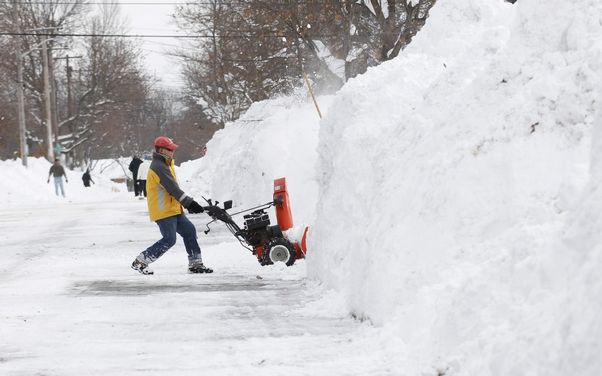
On Pardee Avenue in hard-hit Lancaster, where snow may reach the 7-foot level, a resident plows his driveway as Western New York awaits relief from historic lake-effect storm. Sharon Cantillon/Buffalo News
By Maki Becker and Matt Spina
Roofs caved in under the unbearable weight of 5, 6 even 7 feet of snow.
Food was scarce, people were running out of medicine and thousands lost power, at least for a few hours.
And the death toll from back-to-back blasts of a historic lake-effect storm rose to 12. The additional two deaths announced by county officials today were two residents of the Garden Gate nursing home in Cheektowaga during the evacuation process Thursday.
Police begged drivers to abide by driving bans. The county executive scolded the National Football League about reports the league was encouraging the Bills to play at Ralph Wilson Stadium this Sunday as scheduled, but Thursday night, it was announced that the game with the New York Jets would be played Monday night in Detroit.
Through it all, thousands of people remained snowbound in their homes, many of them unable to even open their doors because of snow piled up.
“Get us out!” pleaded Rosann Sessamen, 56, who shares a duplex with her sister, Colleen Roger, and their dog and two cats in Ridgewood Village, at Abbott and Ridge roads in Lackawanna.
Sessamen and about a half-million people who have endured the fury of the twin storms have reached a breaking point.
As of Thursday night, the sisters had been trapped in their home for two days with snow at least 5 feet high completely blocking their front and side doors and going halfway up the windows. They have food and water and the heat is on, but they were growing increasingly anxious as they hear the rumble of plows nearby.
“I know it’s an act of God,” said Sessamen, a former nurse who has multiple sclerosis. “But this is enough.”
Officials assured the public that they were doing everything they can.
More than 5,000 people were assisting in the recovery effort, the majority of them digging out and hauling away the snow, Erie County Executive Mark C. Poloncarz said an afternoon news conference. Gov. Andrew M. Cuomo even spent the night in the Buffalo area and continued to keep tabs on what he said was one of the biggest relief efforts in New York State history. Some roads were finally passable Thursday as high-lifts hauled away snow and plows were finally able to get into start clearing paths.
But after a second lake-effect storm dumped as much as an additional 3 feet on the snow-weary heart of Erie County where some areas had already logged 5 feet earlier in the week, there wasn’t much more people could take.
Roofs began to give way under the weight of the snow.
A “large collapse” was reported at the Flexovit plant by county officials reported shortly before 9 p.m.
Greenhouses at the Amos Zittel & Sons operations in Eden collapsed under the weight of the snow, causing millions of dollars in losses to plants being grown for spring that would be shipped all over the country. “We’ve lost so much,” said Paul Zittel, a third-generation member of the family. “There’s nothing we can grow right now. It’s millions of dollars we’re going to lose. I have never seen anything like this before.”
There were other unconfirmed reports of other barns collapsing and cows being trapped in the snow at farms throughout Eden.
Two dozen roof collapses have been reported throughout the county, including a home in Depew. An additional couple of dozen structures, among them an eight-unit apartment building in Lancaster, were believed to be in danger of having their roofs collapse.
The BJ’s Wholesale Club on Milestrip Road in Blasdell incurred structural damage, and the roof collapsed at Schmidt’s Collision & Glass on Camp Road in Hamburg.
Carports attached to mobile homes in West Seneca and Cheektowaga crumpled.
“In one case, we had to rip the door open,” Tom Held, a member of Union Fire Company, said after leaving a scene on Burgundy Lane. “Last night, we had to cut (a carport) away so we could get to the door.”
The same problem plagued Carefree Park Estates, also on Union Road, where Bellevue firefighters, aided by firefighters from outside the area, transported an injured 86-year-old Nick Buccirose from his home after his carport collapsed Thursday morning.
Ron Lindner pointed to a neighbor’s carport: “Hers went yesterday.” He pointed to another: “His went at 10:30 the day before.”
Volunteer firefighters aided Thursday in the evacuation of about 130 residents of the Garden Gate Health Care Facility on Union in Cheektowaga after the building showed signs of structural damage. A warehouse next door had collapsed the night before.
As reports of the roof collapses hit the media, some residents took matters into their own hands, risking injury by climbing onto peaks to shovel away the 6-foot layer that strains rafters and clogs vents.
In snow-clogged South Buffalo, a man fell 2½ stories in the 100 block of Stevenson Street. He was rushed to a hospital just before noon Thursday.
Some local professionals familiar with building codes and construction standards say homeowners in the hardest-hit areas, especially those with low-pitched roofs, should be wary of the weight atop their wood-frame houses.
“There’s a whole level of concerns here, for sure,” architect David Sutton said when reached at his office in Williamsville. Building codes are written with the heaviest storms in mind, he said, but this has been an uncommonly heavy storm.
“You are talking about 6 feet of snow on a roof,” said Larry LaDuca, general manager at Natale Builders, which builds houses with steeper pitches. LaDuca acknowledged that he is concerned about a house he owns in Cheektowaga, built in 1955.
The low-pitched roofs that are common in the post-World War II tracts in hard-hit Cheektowaga, Lancaster and West Seneca now support hundreds of extra pounds, Sutton and LaDuca said.
Then there’s the threat of rain this weekend, which will only add weight.
The county executive wasn’t mincing his words when he blasted the NFL over the possibility that the Bills game scheduled for Sunday in Orchard Park would go on as planned.
“If the NFL is trying to push the Bills – and I don’t think the Bills are trying to push it – if the NFL is trying to push the Bills to hold a football game, while we’re in the middle of an emergency, shame on the NFL,” Poloncarz said at a news conference in the County Emergency Operations Center in Cheektowaga. “Simple as that. We’re in a major emergency. We’ve had (10) deaths. We still might have people in their vehicles. We have roofs collapsing.”
But by evening, the league announced that the Bills-Jets game would be played Monday night in Detroit.
Officials also were venting their frustrations as residents bombarded them with complaints about delays in snow removal while they waited for help from outside.
A reverse 911 call went out from the Town of Hamburg, sent around 6:30 p.m.: “Our Highway Department has requested assistance, however, has received none … We requested additional resources quadrupling the capacity of our Highway Department. In as much as every other community in Erie County impacted by the storm had the same idea, we received no help.”
At a news conference earlier Thursday, Undersheriff Mark N. Wipperman called motorists who disobeyed driving bans and ended up having to be rescued from ditches “selfish.”
Cheektowaga police pleaded with the public on a Facebook post to abide by the travel ban south of Broadway. Many roads have been cleared, but emergency responders said they to be reserved for the snow removal operation. “We understand that many are frustrated but, please, obey the ban,” it read.
Dispatchers in Lancaster, where snow totals were expected to end up at least at the 7-foot level, fielded more than 100 requests for help for everything from collapsed roofs and clogged furnaces to carbon monoxide alarm activations, in addition to 25 ambulance calls. Police handled four car accidents, helped three stranded motorists and dealt with two men fighting on Lombardy Street.
They all knew more problems lay ahead as the lake-effect storm continued to blanket the lower Southtowns and the Southern Tier with heavy snow through midnight.
The Thruway from the Pennsylvania state line to Henrietta remained closed, as did Routes 5, 219 and 400 and portions of the Youngmann Highway and the Niagara Thruway. Travel bans stayed in effect and many school districts, including the Buffalo Public Schools and those in the hard-hit area, announced they would be closed for a fourth straight snow day today.
In Elma, there were worries of power failures as heavy snow fell late Thursday. “We’re starting to see tree branches breaking and hitting the power lines,” said Brian Caradori, president of the Elma Fire Company.
And then there was the flood watch beginning today as rain and temperatures in the 50s were expected to melt the deep snowpack. But small signs surfaced that things were returning to normal.
The National Weather Service’s lake-effect warning for the region was over as of 1 a.m. today.
Buffalo Public Works Commissioner Steven J. Stepniak said the city was hoping to have most, if not all, South Buffalo streets cleared this weekend. A 75-year-old South Buffalo woman who has been missing for three days was found safe and in good health, city officials announced Thursday.
Buffalo Niagara International Airport in Cheektowaga was expected to be in full operation today. Some Amtrak service was back Thursday.
And a new Twitter hashtag was competing with #snowvember, social media’s unofficial name for the double storms. The new one: #WeAreBuffalo.
News Staff Reporters James Staas, Janice L. Habuda, Karen Robinson and Jay Tokasz contributed to this report.
Snow Belt residents work to clear their roofs and driveways and to prepare for flooding
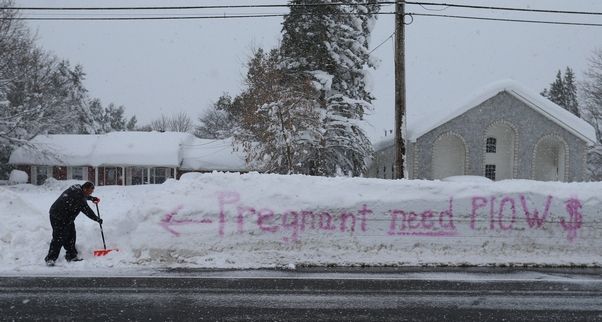
Chris Swanson looks for help digging out at his home on Rte 62/75 in Hamburg Friday, November 21, 2014. (Mark Mulville/Buffalo News)
By Maki Becker and Lou Michel
Amanda Enright and her husband, Joe, woke up Friday morning in their ranch home in Elma to find cracks along the walls where they meet the ceiling. Overnight, at least another foot of snow had fallen on top of the five to six feet that were already piled on their roof.
The fire department told them they had to do something fast. The Enrights got their three children out of the house and Amanda put out a plea for help on Facebook. Her nephew who lives nearby came. Then friends in Amherst rode down Transit Road to come to the rescue.
One by one, they climbed up and started heaving snow off the roof. In three hours, it was clear.
It was a day of digging out.
Across the Snow Belt on Friday people stripped down to their shirt sleeves and soldiered on with the endless, backbreaking work of shoveling snow that towered above their heads.
That’s no exaggeration.
New snow totals for the back-to-back storms this week were announced by the National Weather Service.
They’re officially over the 7-foot mark.
The highest logged in the area: a staggering 88 inches in Cowlesville in Wyoming County, just over the Erie County border near Marilla.
Hamburg took the dubious honor as Erie County’s snow capital, with 79.5 inches measured at 11 a.m. Friday morning. West Seneca was a close second, with 78 inches, and Lancaster logged 74.
As the snow removal slowly progressed, the devastation of the two storms became clearer.
The death toll from the storm climbed to 13.
Late Friday night officials announced that a 68-year-old Cheektowaga man died of a heart attack while clearing snow from his driveway.
Police investigations were underway into the deaths of two men who were found inside cars buried deep in snow, including one near a Cheektowaga parking lot Friday morning.
Both the victims had called AAA for help during the storm, but that help never arrived.
The storm cleanup has already cost Erie County government $2 million, County Executive Mark C. Poloncarz said Friday night, and the cost is rising.
As roads were cleared Friday, abandoned cars, some burned out, could be seen in ditches.
Poloncarz also said more than 500 cars have been towed from snow-clogged streets so far and taken to three different lots, where their owners can locate them by checking on the county’s website, www.erie.gov.
At least 30 major roof collapses were reported across the region, many of them on barns and other agricultural buildings.
But the ocean of snow seemed to be starting to subside Friday as high-lift front-loaders were able to make at least one if not two passes through many snow-clogged streets, and plows that had been powerless in chest-high snow were finally being put to use.
In South Buffalo alone, more than 35,000 tons of snow had been hauled away in trucks and dumped into an increasingly mountain-like mound by the Central Terminal on the East Side.
The Thruway, closed since Tuesday from the Pennsylvania border to Henrietta, reopened just before 3 p.m. Friday. Some exits remained inaccessible, confusing drivers who hopped on the moment they could. Traffic tie-ups were almost immediately reported, including congestion at Route 219 just after it had reopened.
Amazingly, almost all the major highways that had been shut down were back open. The only one to remain closed as of Friday night was Route 5 from Blasdell to the Niagara Thruway entrance in downtown Buffalo.
But travel bans remained in place for Marilla, Elma, the town and village of Orchard Park, Evans, the Village of Blasdell, the town and village of Hamburg, Lackawanna, the Town of Alden, South Buffalo, Brant, Eden, Aurora, East Aurora and Angola.
That had law enforcement officers pleading with residents to stay put if at all possible.
“Stay in your homes,” Gov. Andrew M. Cuomo asked increasingly impatient residents.
For some, there was no choice, as they remained snowbound in their homes. Some faced new frustrations as passing payloaders and plows barreled through streets, creating new walls of snow at the foot of driveways that had just been cleared.
“We are unable to get out to a store as we live on a major highway that we are not being allowed to walk on as it is unsafe,” wrote Debbie May of Big Tree Road in Orchard Park in an email begging for help. “No one can get in to help us. We have been literally barricaded in since Tuesday. The stadium a half mile down the road is getting a lot of press, but we are being ignored as the street is being considered as ‘cleared.’ We need help, yet none seems to be on the way.”
People put aside jitters about heights and hauled their shovels and snowblowers up onto their roofs. But it wasn’t just cracks in the walls and creaking, popping sounds that motivated them.
Weather forecasters were warning that rain was in the forecast and that the snow engulfing tens of thousands of homes across the heart of Erie County would act as a sponge, soaking up the water and adding even more weight to overtaxed roofs.
At the Garden Gate Health Care Facility on Union Road in Cheektowaga – where some 173 residents were evacuated Thursday and one elderly patient with health problems died after being relocated – two dozen Centimark Commercial Roofing workers manned shovels and snowblowers on the massive flat roof.
Sections of old roofing membrane were cut in oversized squares that were piled high with snow and then dragged to the edge of the roof and dumped into the parking lot below.
It was a slow job and work was expected to continue through Monday, according to assistant foreman Anthony Tidd.
At the U.S. Postal Service’s Lancaster-Depew Carrier Annex on Como Park Boulevard, where engineers found a half-inch structural bend in the roof, roofers heaved snow into a giant metal box, filling it one ton at a time. A crane lowered it to the ground so it could be emptied.
“I’ve lifted eight tons of snow off this roof in the last two hours and we’ve hardly made a dent,” said Jeff Peterson, operator of the Clark Rigging and Rental crane.
By Sunday as temperatures rise into the 50s, that monstrous snowpack is expected to start melting. A flood watch was issued starting at 1 p.m. Sunday.
Northtowns communities practically untouched by the twin lake-effect storms, including Williamsville and Clarence, began preparations for flooding, urging residents to keep storm drains clear and remove valuables from the basement.
Woman made tunnel to clear her tailpipe, waved a snow brush to attract attention
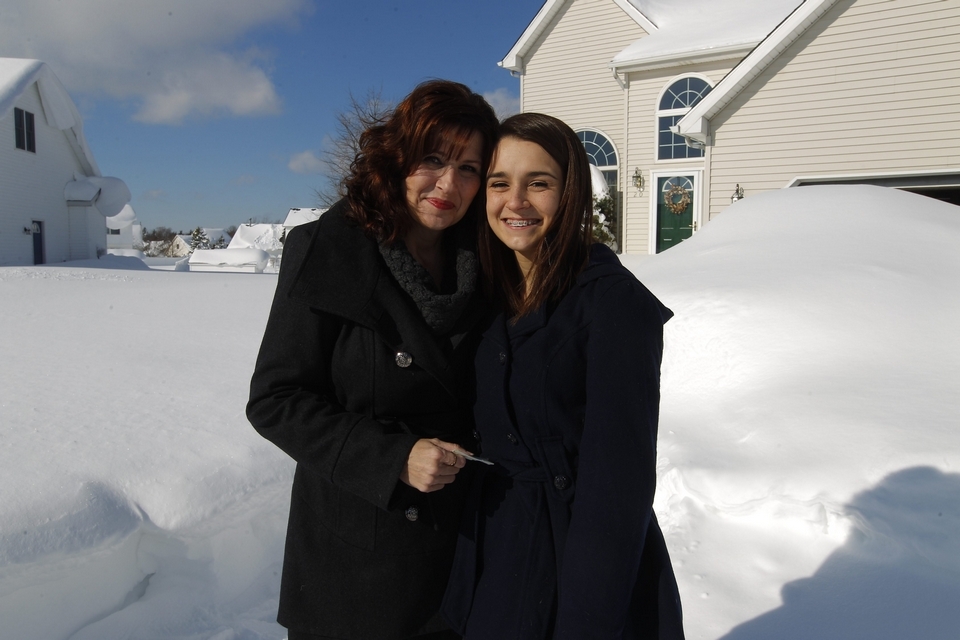
Karen Rossi was happily reunited with her daughter, Madelyn, 17, after spending 13 hours trapped in a snowbank in her car. John Hickey/Buffalo News
By Dale Anderson
At one point during her 13-hour ordeal, Karen Rossi got out a pen and paper and wrote farewell letters to her two daughters.
Her car became stuck in a snowbank at Transit Road and William Street in Lancaster, not far from home. A passing plow pushed her farther into the snowbank, and then the intense lake-effect storm completely buried the blue Chevy Cobalt.
Rossi couldn’t tell if it was day or night from inside the car.
“It felt like I was underground, buried in a casket,” she said. “It was surreal. It was just silent for hours. Nobody came. And my phone had died. I couldn’t charge it because I’d taken my daughter’s car to work.”
Rossi’s daughter had just cleaned the car, removing blankets, clothing and other items that might have come in handy.
As the hours went by, she became wet from trying to dig her way to daylight and her car was running out of fuel. As someone who had worked in an emergency room, she knew it didn’t look good.
Only a passing motorist prevented her from becoming yet another driver who died in a snow-buried car.
She credits him with saving her life.
Rossi had started out at 3 a.m. Tuesday from Mercy Hospital in South Buffalo, where she works as a pharmacy technician, for her home in Lancaster. Ordinarily, she would have left much earlier, but she put in an extra shift when the night technician couldn’t make it in.
“On a clear road, it takes me 20-plus minutes to get home,” she said, “but I didn’t get far before I started getting stuck. There always seemed to be someone behind me to push me out.”
At Transit and William, however, she had no such luck. In fact, her luck turned worse with the snowplow and more snow. She stayed in the car, and before her phone died, she called her daughter, who advised her to keep the car’s tailpipe clear of snow so she could run the engine to keep warm without poisoning herself with carbon monoxide.
“I kept watching the news, and it was freaking me out,” said Madelyn Rossi, 17. “I called my mother and told her she had to dig out the tailpipe so it doesn’t get clogged.”
Karen Rossi couldn’t open the car door.
“So I rolled the window down and used a sweatshirt to dig along the car to make a tunnel to keep the tailpipe clear,” she said. “Every hour and a half, I would go back. The tunnel would collapse, and I’d have to dig again.”
As her phone battery began to run out, she texted her daughter repeatedly, telling her, “My phone’s going to die. I love you.”
Eventually, Rossi decided she had to try to attract attention to her plight.
Once again, she climbed out through the car window. This time she dug upward with the sweatshirt and a snow brush.
“I finally got up to where I could see the sky,” she said. “I was standing on the window frame, but I couldn’t see out. I started waving the bright red snow brush. Little did I know, there was no one coming.”
She climbed back down into the front seat and waited.
“Sitting in the car, it’s funny what you think about,” she said. “You get punchy. You realize the magnitude of the situation. You never think this is the way you’re going to pass away. I started to think about my life and my family and my daughters.”
Rossi, who just turned 47, found a scrap of paper in her purse, tore it in half and started farewell notes to her daughters.
“I wrote letters to both of them,” she said.
Although she was wet, cold and exhausted, she continued to climb out the window, crawl her way up and wave the red snow brush out of the hole in the snowbank, hoping it would attract someone’s attention. Finally, it did.
“He saw me because I had decided to crawl out the window and started digging up and finally broke through with the red snow brush,” she said. “I waved that forever. My arm would get sore, and I would stop, and then start again.”
Then she heard a voice.
“I see you, I’m going to get you out,” a man’s voice yelled out. “I have a shovel.”
She realized she was going to make it.
“You get this shot of adrenalin,” she said.
The voice belonged to David Edwards, who was en route home from his job with the railroad.
“He climbed over everything. He dug me out,” she said. “He pulled me over the snowbank and put me in his truck. He had a big black monster truck thing with heated seats. He would never get stuck.
“I was disoriented and soaking wet and freezing cold. He stayed with me and he talked with me. I kept realizing he didn’t have to do any of this stuff, but he was just an amazing person. I’m so thankful that God sent him.”
Finding the street into Rossi’s housing development blocked with deep snow, Edwards drove her to his home in the Village of Lancaster, stopping to help motorists in distress along the way.
“He kept asking, ‘Do you mind if I help this one get out?’ ” she said. “He must have helped four other people.”
After getting Rossi dried and warmed at his house, Edwards tried again to take her home. The closest he could get was a friend’s house in a neighboring development, where a path had been opened. She stayed there overnight.
“Just having pajamas and warm, dry socks,” she said, “it felt like heaven.”
She eventually got home Wednesday afternoon, and later calculated that she was buried in snow from 3 a.m. Tuesday to 4 p.m. that afternoon.
“I’ll never think about things the same. I made so many promises to myself in the car. I’ll never sweat the small stuff again,” she said.
When the mother and daughter were reunited, both were overcome with emotion.
“We burst into tears and hugged each other,” Madelyn said.
And the farewell letters she wrote to her daughters?
“My kids don’t even want to see them,” Rossi said, because they don’t want to think about losing her.
But Rossi is keeping the two notes, thinking that some day her daughters may want to read what she once believed would be her last words.
Both men called repeatedly for aid
By Matt Spina and Tiffany Lankes
Two men were found dead in recent days inside their snowbound vehicles, and officials hope they do not find more bodies inside the numerous autos stranded on local roads.
Police agencies are investigating the deaths of Donald J. Abate in Alden and David M. Deneke in Cheektowaga. Both victims had spent hours calling for help, but aid never arrived.
Abate, 46, was on his way home to Blasdell from his job as an officer at the federal detention facility in Batavia when his customary route became impassable just after midnight Tuesday. Abate called his family to say he was pulling off Broadway in Alden to seek safe haven.
He rolled toward a Tops Supermarket, but ended up in a ditch, according to family members who talked to him during his ordeal. They learned he had called 911 and expected a response at any moment. As he waited, the snow piled up, and he was unable to get out of his vehicle.
Family members lost contact with Abate on Tuesday afternoon. His father, James Abate of Hamburg, then called 911 on his son’s behalf. But James Abate said his call landed with a Hamburg dispatcher who said he could do nothing for him.
James Abate said he also called the AAA to try to get a tow truck to his son, but was later told that law enforcement officers – possibly the state police – turned the truck away. Meanwhile, emergency vehicles may have passed Donald Abate’s stuck Kia but did not help, a law enforcement source said.
Abate’s widow, Jackie, said she, too, was told the tow truck had been turned away because of the driving ban. She last talked with her husband at 11 a.m. Tuesday, 10 hours after his vehicle slid into the ditch. While still trying to reach him around 3 p.m., she learned the mailbox on his cellphone was full.
Hours later, the state police called her for the make and model of her husband’s car, and his cellphone number. At 4 a.m. Wednesday, her phone rang.
Could she come to her front door?
There stood a state trooper, who told her that her husband did not make it. They had found him inside his snow-covered auto, with the car turned off. They weren’t sure of his cause of death, she said. He had been in good health.
“I’m just trying to get through day to day,” she told The Buffalo News. “I lost the love of my life. And my in-laws, I feel so bad for them.”
Donald Abate was the only son of James and Maryann Abate. To be closer to them, he chose to live in the Hamburg area, despite a 110-mile round-trip commute.
“We’re just disappointed that no one could come and help him,” James Abate said. “He was all alone. Maybe he died of fright.”
Steve Pacer, a spokesman for AAA in Western New York, had little to say about the death as AAA investigates its response to Abate’s calls.
“As a result of unprecedented and dangerous weather conditions and despite our best efforts, neither AAA – nor police and emergency personnel– were able to reach Mr. Abate,” Pacer said in a written statement. “Our thoughts and prayers go out to his wife and family during this difficult time."
Pacer didn’t return telephone messages to ask why AAA, when given Abate’s location, could not reach him.
The state police issued a similar statement.
“Our heart goes out to his family,” the agency said. “As is with any ongoing death investigation, all of the circumstances will be reviewed.”
Deneke, 51, of Depew, spent days in his white Chevrolet Cavalier. He, too, had tried to call for help more than once. Police, spurred to search for him by a concerned family member, found his body about 6:30 a.m. Friday in his auto, buried under snow on Innsbruck Drive near Union Road.
Deneke was on his way to work at a Christmas World facility Tuesday morning when his car became immobile just yards from his destination, a relative said. He may have been sideswiped by a plow.
As the snowstorm persisted, Deneke stayed with the car, calling for a tow truck and for police. He talked to his mother, too, but she lost contact with him after his cellphone battery died Tuesday afternoon.
Police acknowledged that Deneke called AAA and then the police dispatch center Tuesday morning. He was told it would take at least eight hours for a tow truck to reach him, but he was added to a list.
Late in the day his mother, Judith L. Bauer, called police to say she could not locate her son and asked if he had been found.
Then on Friday morning, town police were contacted by a AAA driver out looking for Deneke and other motorists who had called in prior days.
Had police heard from Deneke? They had not.
Then they called Deneke’s mother. She had not heard from him either.
A front-loader started clearing out the snow on Innsbruck Drive, and Deneke’s body was found. An autopsy is scheduled for Saturday.
“The Cheektowaga Police offer sincere condolences to the family and friends of David,” the department said.
“He was a fabulous employee,” said David Gordon, whose Christmas World business was dealt a blow this week when a warehouse roof caved in under the weight of lake-effect snow.
“He worked in our Christmascentral.com Internet shipping warehouse, I believe for about two years,” Gordon said of Deneke. “This guy was a troubleshooter. He would find orders that nobody else could. Just a very, very beloved employee.”
At a late-day news conference Thursday, Erie County Executive Mark C. Poloncarz expressed hope that no more storm victims are found inside snowbound vehicles.
The State Police announced that a Boston resident was found dead outside his home. Jon Barsam, 57, had not been heard from for a couple of days. After a neighbor alerted police, his body was found under several feet of snow at the base of his front porch steps on South Abbott Road. Police do not believe he died shoveling snow. An autopsy is expected.
Warm temperatures, rain and winds pose new threat
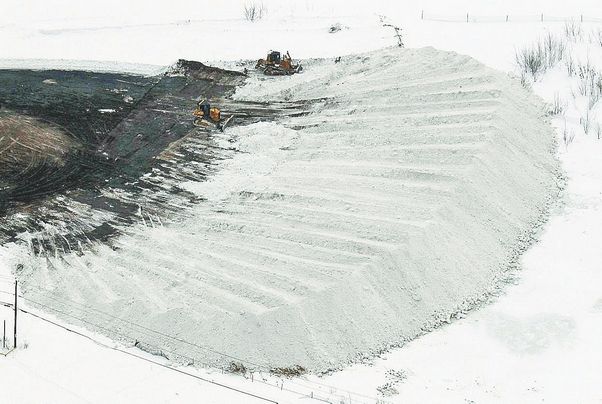
This is a dumping site for snow off Route 75 in Hamburg near the Thruway exit. Sharon Cantillon/Buffalo News
By Maki Becker and Robert J. McCarthy
Fifty-one boats.
375 pumps.
176,500 sandbags.
5,500 people on the ground, including 500 National Guardsmen.
69,000 bottles of water.
5,300 ready-to-eat MRE meals here and 13,000 more on the way.
All in preparation to do battle with 6- and 7-foot mountains of snow melting in heavy rain and 50-plus degree weather.
“Hopefully we need none of this and hopefully this was just an elaborate exercise in logistics that we have done and we will deconstruct and everything will go back and people will say, ‘Boy, the governor really made us waste our time bringing everything out there just to bring it all back,’ ” Gov. Andrew M. Cuomo said Saturday afternoon after he traveled to Buffalo for a third time during the weather crisis.
“I hope that happens. I hope the weather change is gradual. I hope we don’t have a flooding problem. I hope we don’t have a building-collapse problem. And I hope it was just a lot of long nights for nothing. That’s my prayer.”
It’s ours, too.
But at least some flooding seemed inevitable and more roof collapses were reported Saturday in Cheektowaga, West Seneca and South Buffalo.
After worrying about our roofs falling, we must also be concerned about what is rising in our basements.
A flood warning went into effect Saturday afternoon as temperatures steadily rose from the 20s in the morning to the low 40s overnight. The National Weather Service said it would get into the upper 40s today, and close to 60 by Monday.
Rain began to fall across the region, and a new weather worry arose; the weather service issued a watch for high winds, with sustained winds in the 25- to 35-mph range and gusts up to 60 mph on Monday.
“I’m just waiting for the locusts,” said Sheila Meegan, the Town Supervisor of West Seneca, where highway and sanitation crews spent Saturday clearing storm drains to make sure melting snow has somewhere to go.
“They’re using shovels and rakes,” she said. “Remember, we were still cleaning off leaves.”
In February, ice jams in the Buffalo Creek badly flooded the Lexington Green neighborhood of West Seneca, and authorities are concerned that the town, socked with 6½ feet of snow during last week’s back-to-back lake-effect storms, could see more flooding.
“You know what, we’re preparing for the worst,” Meegan said. “But we’re hopeful it’s a slow and steady meltdown.”
It’s not clear how severe the flooding will be.
Creeks, including Buffalo, Cazenovia, Cayuga and Ellicott, are all in danger of backing up and spilling over their banks, said Aaron Reynolds, a meteorologist with the National Weather Service in Buffalo.
“There’s potential for minor to moderate flooding,” he said.
The watch that the weather service issued was for areas including West Seneca, Lancaster, Lackawanna, Hamburg, East Aurora, Depew, Cheektowaga, Alden and South Buffalo.
Also on the list were northwestern Cattaraugus County, northern Chautauqua, including the lake shore, the southern half of Genesee and Wyoming County.
The weather service has taken core samples of the snow pack and found the equivalent of between four and six inches of water in the heaviest hit areas of the Snow Belt.
“So we have all this snow, all this water, rapidly melting into our creeks and causing them to rise,” Reynolds said.
But before it melts, Reynolds said, the rain will be absorbed into the snow, adding even more weight to roofs already on the verge of collapse.
As rain began to fall Saturday, reports of roof collapses and partial cave-ins began to trickle in. Meegan said at least 15 were reported Saturday and many more were expected. The town had logged between 20 and 30 collapses – a combination of carports, awnings and mobile homes, Cheektowaga Police Assistant Chief Jim Speyer said. At least two partial roof collapses were reported in South Buffalo, including one at a house on Salem Street.
And then comes the wind.
The wind watch is for all of Monday and covers Erie, Niagara, Orleans, Genesee, Wyoming and Monroe counties.
With the ground saturated by then with water, high winds could bring down trees and power lines, resulting in power failures, which have been mercifully few during the lake-effect blasts.
“These are serious, serious concerns,” Meegan said.
So on Saturday, all people could do was keep digging and getting ready for the next wave of the disaster.
Volunteers from as far away as Albany and Pittsburgh came to help shovel out snowbound neighborhoods.
And school officials huddled with engineers about the structural integrity of school buildings, many of them with wide, flat roofs. Frontier schools announced they wouldn’t be open until at least Tuesday, and Hamburg schools went ahead and canceled school through the Thanksgiving break.
In anticipation of the snowmelt, politicians and police officials rallied residents to help lessen the possibility of flooding by digging out storm drains. Cheektowaga police even provided a map of storm drains at www.tocny.org to help people locate them.
Deputy County Executive Richard M. Tobe on Saturday said the county has been planning since Tuesday for eventual flooding.
Part of the planning calls for towns and the state Department of Transportation to clean culverts and tunnels for the expected massive increase in water flow, though that effort remains essentially impossible in the areas hard hit by the storm.
He also said it will be several days before some flood waters hit the populated areas of Erie County.
“Tonawanda Creek rises in Wyoming County, and there was 7 feet of snow out there,” he said. “The places that not normally are flooded have snow, and the places now susceptible to flood don’t have snow.”
The deputy county executive said the snow pack will eventually disappear through either evaporation or runoff, and that forecasts for brisker winds in coming days may help the situation by contributing to evaporation. But major runoff is still expected.
“With the melt we expect some will go right into the ground,” he said. “That’s good, because the ground is not yet frozen, but much depends on the local geological conditions and how much is absorbed into the ground.”
Tobe said no area creeks have formed ice, so the ice jams that normally exacerbate spring flooding are not a factor in November.
Among those areas concerned about flooding were Williamsville and Clarence, which saw just a few inches of snow during the bizarre twin storms that ravaged so much of the county.
But those areas are both downstream of the Snow Belt.
Neighborhoods along Ellicott Creek in Williamsville are prone to flooding when Alden and Lancaster get heavy snow, said Mayor Brian Kulpa. So Williamsville crews spent the day clearing debris from the creek and removing dam gates in anticipation of a surge from the snowmelt.
“We’ve been worried about flooding for the past few days,” Kulpa said.
It’s likely that flooding would be limited to basements in the village, and Kulpa urged homeowners to clear their basements out and to make sure their sump pumps are working. He added that the pumps should be routed to their backyards – and not the sanitary system because that could cause a back up in the sewer system.
Clarence got ready with stockpiles of sandbags and new signs to alert drivers that a road is impassable, something the town has dealt with during previous flooding, when “sightseers” would drive into floods and get stuck.
“We’re all ready for it,” Town Supervisor David Hartzell said. “We’ll see what happens.”
Meanwhile, U.S. Sen. Charles E. Schumer and Rep. Chris Collins are laying the groundwork for the roughly half-million homeowners and small businesses – as well as municipalities – to get reimbursement for damages and losses from the historic snowstorm.
Homeowners, business owners, farmers and area towns all could receive federal aid to help cover the costs of storm damage and recovery if local leaders ask the federal government to declare Western New York a disaster area.
To qualify, the damage must meet certain federally set guidelines, and government officials expect that will be the case. The cost of recovery from the storm must reach $3.2 million for the county and about $27 million for the state.
“We have already talked to the top people in the White House and said ‘Get ready. We need help,’ ” Schumer said.
Warming trend caused freak storm
By Jerry Zremski
Brace yourself. November’s white nightmare could become a recurring bad dream of varying intensity.
While last week’s winter blast appears to be the freak offspring of a typhoon-blasted jet stream and a warm Lake Erie, it’s also part of a long-term pattern that shows no sign of changing.
Meteorologists and geographers say that lake-effect snows have increased as temperatures have warmed in recent decades. That means more bizarre early-season storms, though not necessarily as bad as last week’s, are likely in the future as the warming trend continues.
“The general notion is that, as the climate warms and the lakes hold their warmth longer into the fall, you’re going to see a lot more lake-effect snow until it’s too warm to have much snow,” said Mark Monmonier, distinguished professor of geography at Syracuse University and the author of the 2012 book “Lake Effect: Tales of Large Lakes, Arctic Winds, and Recurrent Snows.”
Keep your shovels handy, though, because that breaking point – when lake-effect snow is replaced by lake-effect rain – likely won’t come until mid-century, the New York State Energy Research and Development Authority said in its updated report on climate change in the state earlier this year.
For the next few decades, then, conditions will be increasingly ripe for the creation of winter white-outs, although meteorologists said most won’t be as bad as the one that buried South Buffalo and the Southtowns with snow piles that in some places were taller (or deeper) than many teen-age boys.
That doesn’t mean you can attribute last week’s storm to climate change. Meteorologists say that individual weather events just can’t be explained as the byproduct of a historical trend. Instead, each is the product of a recipe that nature seems to just throw together without regard for how it will turn out.
This month, sadly, the recipe appears to be: Create one super typhoon near Asia. Use super typhoon’s remnants to push the jet stream out of whack so it sends arctic air down across most of the United States – and directly across the relatively warm waters of Lake Erie.
Results: Lake-effect snow totals of between 3 and 7½ feet south of Buffalo.
The main ingredient – or culprit – appears to be Super Typhoon Nuri, which formed in the Philippines early this month before tracking northward to the Bering Sea.
There, Nuri “caused a ripple effect on the jet stream,” meteorologist Jeff Masters of the Weather Underground blog wrote last week. And as a result, strange things started happening very far away.
As Nuri moved north, it pushed arctic air south – way south. In Big Bend National Park on the Texas-Mexico border, nighttime temperatures plunged into the low 20s at mid-month. Temperatures in Charlotte, N.C., dropped into the teens. And last week, that rejiggered jet stream blew cold arctic air straight across the comparatively warm waters of Lake Erie – the classic combination for producing lake-effect snow, and lots of it, in Buffalo and points south.
Adding it all up, the National Aeronautics and Space Administration – which watched it all happening on its weather satellites – said on its website: “While the Bering Sea Superstorm did not directly cause the snow event in New York, it did set the stage for it by nudging the jet stream into an unusual shape that sent a pulse of cool Arctic air south over the central United States.”
The trouble is, the jet stream’s “unusual shape” isn’t all that unusual anymore – and that’s just one reason why big early-season lake-effect snows may become our new normal.
“We’ve seen an unusual number of extreme jet-stream patterns like this in the past fifteen years, which happens to coincide with the period of time we’ve been observing record loss of summertime Arctic sea ice and record retreat of springtime snow cover in the Arctic,” Masters, the weather blogger, wrote last week. “Could it be that these changes in the Arctic are causing the wacky jet-stream behavior of recent years? That’s the theory being advanced by a number of prominent climate scientists.”
The jet stream is driven by the temperature difference from the equator to the north pole, said David M. Wright, a graduate student at the University of Michigan who has studied lake-effect snow and the reasons behind it.
That temperature difference is narrowing as the planet warms, which means there is less energy available to change the course of the jet stream, Wright said. So when some extreme event like Nuri pushes the jet stream out of whack, it remains out of whack for what can seem like forever.
“This then allows for cold air (like what’s over the eastern United States) or warm air (like what’s over the western United States) to sit there for longer periods of time,” said Wright, the lead author of an American Meteorological Society Journal article called “Sensitivity of Lake-Effect Snowfall to Lake Ice Cover and Temperature in the Great Lakes Region.”
Those longer cold snaps are bad news for Buffalo, which sits at the eastern end of a warm – and warming – Lake Erie.
While Lake Erie was a degree colder than usual last week, according to the National Weather Service, it was still warm enough to produce tons of snow when it met the cold arctic winds being pushed across the lake surface by the jet stream.
Eric Holthaus, a meteorologist who writes for Slate, explained how it happened.
“Truly extreme lake-effect snows gather their energy from a wide temperature differential between the lake temperature and the air temperature,” he wrote last week. “That temperature contrast produces atmospheric instability – the warm air immediately over the lake wants to surge upward through the colder air on top, bringing with it heaps of evaporated moisture. That moisture is quickly converted to snowfall in massive quantities, and deposited squarely on the hills and towns at the far end of the lake.”
Holthaus is among the many meteorologists who believe that climate change is leading to more lake-effect snow – not just because of the changes in the jet stream, but also because the lakes are getting warmer.
For proof, just look at the ice pack, or lack thereof: New York State, in its recent climate report, noted that annual ice cover has decreased 71 percent on the Great Lakes since 1973.
“And if you extend the season when Lake Erie remains unfrozen, you’re going to get more snow,” Holthaus said, while acknowledging that it “seems so weird” to think that a warmer lake could produce worse winters in the region.
The trouble is, that already seems to be happening. Scientists are not much for anecdotal evidence like last week’s storm or the 2006 “October Surprise.” Instead, they point to data proving that lake-effect snow has been increasing as the climate, and the lakes, have grown warmer.
While showing wide year-by-year variations, a 2009 study in the Journal of Great Lakes Research, for example, showed the average annual lake-effect snow totals off of Lake Erie increasing by nearly 20 inches between 1925 and 2007.
Will that trend continue?
Many scientists think so. What’s more, they think early-season snowfalls like last week’s are increasingly likely just because that’s when the temperature differential between the lake and the upper atmosphere is at its greatest.
“The hypothesis is that as temperatures warm, the lakes are warming, and that sets up the possibility for cold air coming over warmer and warmer lakes,” said Adam Burnett, chair of the Department of Geography at Colgate University and the lead author of a 2003 paper making the connection between climate change and the increasing levels of lake-effect snow. “That will lead to increased lake-effect snow, although it may only be in the short term until temperatures get too warm for snow.”
For that short term, though, Buffalo area residents may want to heed Holthaus’ advice.
“If Slate suddenly transferred me to the Buffalo bureau,” he wrote last week, “I’d be investing in a snowblower.”