
Finalist: Still, by James Romig

Released by New World Records, a hypnotic solo-piano work comprised of 43 individual sections whose striking harmonic implications and subtly dramatic effects distill music to its barest essences.

Nominated Work

Still, for solo piano

Recording by Ashlee Mack. (New World Records)

Still, for solo piano, inspired by the paintings of Clyfford Still, was commissioned in 2016 by Ashlee Mack, Carl Patrick Bolleia, Louis Goldstein, Paola Savvidou, and Michiko Saiki, with additional support provided by the Clyfford Still Museum (Denver, Colorado). The work comprises 43 individual “Iterations” that may be performed in a continuous unbroken strand of music that lasts approximately 55 minutes, or it may be divided into smaller segments or suites. As the work unfolds, a strand of 24 notes (a contiguous string of 8 unique trichords) is gradually revealed in groups of three, four, five, or six pitches at a time. This results in a slow-moving alternation of sparse and dense textures over the course of the entire work. On a smaller scale, similar progressions from sparse to dense (and back again) inform each of the 43 individual iterations, resulting in a faster fluctuation of moment-to-moment density that interacts with the work’s large-scale background structure.

Music exists in time, and time moves in only one direction. A listener’s attention is temporally directed by the composer, and one is only able to revisit moments of music as much and as often as memory allows. Because of this, many works of music provide a listener with a relatively narrow aesthetic path, and the intention is for all listeners to have more or less the same experience. A viewer of visual art, on the other hand, is usually free to choose which artwork to observe, where to stand in relation to that artwork, where to look within the boundaries of the image, and for how long. When visiting the Clyfford Still Museum, one wanders intuitively from work to work, making connections between different paintings. Each visitor has a unique experience, but because all the works come from a single creator a Big Picture eventually emerges. The goal of this piano piece is to create a “museum of sound,” allowing a listener to develop a notion of the work’s entirety by listening to multiple iterative variations of harmony (color) and rhythm (form). Though an audience will of course be bound by temporality as the music unfolds over the course of an hour or so, it is hoped that the inner repetitions and variations within the 43 sections of music might provide each listener with a unique experience, determined by whichever musical features are noted and remembered from iteration to iteration.
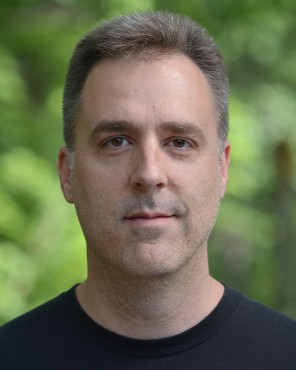
-- from the composer's website

Biography

James Romig endeavors to create music that reflects the intricate complexity of the natural world, where fundamental structures exert influence on both small-scale iteration and large-scale design, obscuring boundaries between form and content. His work has been described as "a complex quilt of sound" (Moline Dispatch), "the musical equivalent of fractal geometry" (Classical New Jersey), and "rapturous... sparse, slow-moving beauty" (San Francisco Chronicle). Early collegiate study in percussion performance led to an interest in minimalism, while doctoral study in composition with Charles Wuorinen and Milton Babbitt engendered a passion for serial structure and rigorous formal design. His music is further inspired by abstract expressionist painting, post-modern literature, doom/drone metal, and progressive rock. Notable performers of his work include the JACK Quartet, Talujon, Chronophonie, Collide-O-Scope, Due East, Duo Contour, Helix, Khasma Duo, New Muse Duo, Zodiac Trio, Duo Harpverk, Suono Mobile, the Quad City Symphony, pianists Ashlee Mack and Taka Kigawa, flutists John McMurtery and Harvey Sollberger, and many others. His music has been performed in 49 states and 33 countries, and his compositions for percussion have received hundreds of performances around the world. Recordings of his music have been released by New World, Navona, Blue Griffin, and Perspectives of New Music/Open Space. Guest-composer visits include Eastman, Buffalo, Cincinnati, Bowling Green, Minnesota, Tennessee, Colorado, Illinois, Northwestern, and the American Academy in Rome. Artist residencies include Copland House, Centrum, and National Parks (Everglades, Grand Canyon, Petrified Forest). He holds degrees from the University of Iowa (BM, MM) and Rutgers University (PhD), and has been on faculty at Western Illinois University since 2002. His music is published exclusively by Parallax Music Press (ASCAP).

Winners

Prize Winner in Music in 2019:

Ellen Reid

A bold new operatic work that uses sophisticated vocal writing and striking instrumental timbres to confront difficult subject matter: the effects of sexual and emotional abuse. Libretto by Roxie Perkins. Prism was commissioned and produced by Beth Morrison Projects in association with Trinity Wall Street, presented in a rolling world premiere with LA Opera and the PROTOTYPE Festival. Music

Finalists

Nominated as finalists in Music in 2019:

Andrew Norman

Premiered by the Los Angeles Philharmonic, an absorbing orchestral work rich with mesmerizing textures and color, including washes of clustered string sounds and cascading winds, creating a virtual sound installation in which perceptions of time are suspended (Schott Music).

The Jury

Scott Cantrell(Chair)

classical music critic, Dallas, Texas

John V. Brown, Jr.

Director, Jazz Program; Professor of the Practice of Music, Duke University

David Harrington

Artistic Director/Violinist

Raymond J. Lustig

composer and instructor of composition

Winners in Music

Kendrick Lamar

Recording released on April 14, 2017, a virtuosic song collection unified by its vernacular authenticity and rhythmic dynamism that offers affecting vignettes capturing the complexity of modern African-American life.

Du Yun

Premiered on January 6, 2016, at the Prototype Festival, 3LD Arts and Technology Center, New York City, a bold operatic work that integrates vocal and instrumental elements and a wide range of styles into a harrowing allegory for human trafficking in the modern world. Libretto by Royce Vavrek.

Henry Threadgill

Recording released on May 26, 2015 by Zooid, a highly original work in which notated music and improvisation mesh in a sonic tapestry that seems the very expression of modern American life (Pi Recordings).

Julia Wolfe

A powerful oratorio for chorus and sextet evoking Pennsylvania coal-mining life around the turn of the 20th Century.

2019 Prize Winners