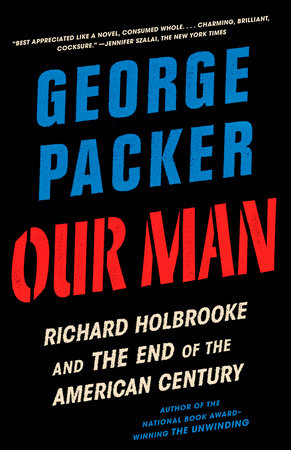
Finalist: Our Man: Richard Holbrooke and the End of the American Century, by George Packer (Alfred A. Knopf)

An inventive, compulsively readable life of a complicated man of considerable talents and personal failings that offers extraordinary insights into the inner workings of Washington's foreign policy establishment.

Nominated Work

Our Man

Richard Holbrooke was brilliant, utterly self-absorbed, and possessed of almost inhuman energy and appetites. Admired and detested, he was the force behind the Dayton Accords that ended the Balkan wars, America’s greatest diplomatic achievement in the post-Cold War era. His power lay in an utter belief in himself and his idea of a muscular, generous foreign policy. From his days as a young adviser in Vietnam to his last efforts to end the war in Afghanistan, Holbrooke embodied the postwar American impulse to take the lead on the global stage. But his sharp elbows and tireless self-promotion ensured that he never rose to the highest levels in government that he so desperately coveted. His story is thus the story of America during its era of supremacy: its strength, drive, and sense of possibility, as well as its penchant for overreach and heedless self-confidence. In Our Man, drawn from Holbrooke’s diaries and papers, we are given a nonfiction narrative that is both intimate and epic in its revelatory portrait of this extraordinary and deeply flawed man and the elite spheres of society and government he inhabited.

-- from the publisher
Biography

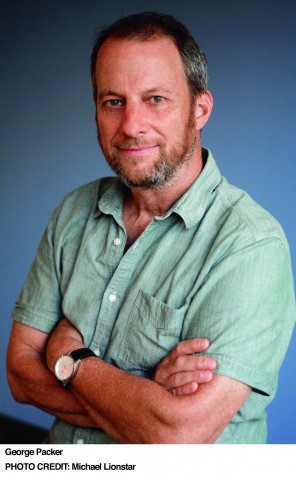
George Packer is a staff writer at The Atlantic and the author of The Unwinding: An Inner History of the New America, which was a New York Times best seller and winner of the 2013 National Book Award. His other nonfiction books include The Assassins’ Gate: America in Iraq, a finalist for the 2006 Pulitzer Prize, and Blood of the Liberals, winner of the 2001 Robert F. Kennedy Book Award. He is also the author of two novels and a play, Betrayed, winner of the 2008 Lucille Lortel Award, and the editor of a two-volume edition of the essays of George Orwell.

Winners

Prize Winner in Biography in 2020:

Benjamin Moser

An authoritatively constructed work told with pathos and grace, that captures the writer’s genius and humanity alongside her addictions, sexual ambiguities and volatile enthusiasms. Biography

Finalists

Nominated as finalists in Biography in 2020:

the late Deirdre Bair

A tale of authorial ambition, self-doubt and achievement that offers intriguing insight into the world of two of the 20th century’s literary giants and the art of biography itself.

The Jury

Kai Bird(Chair)*

Executive Director and Distinguished Lecturer, Leon Levy Center for Biography, CUNY Graduate Center

David I. Kertzer*

Paul Dupee, Jr. University Professor of Social Science, Brown University

Theodore Rosengarten

Zucker/Goldberg Chair of Holocaust Studies, College of Charleston

Winners in Biography

Jeffrey C. Stewart

A panoramic view of the personal trials and artistic triumphs of the father of the Harlem Renaissance and the movement he inspired.

Caroline Fraser

A deeply researched and elegantly written portrait of Laura Ingalls Wilder, author of the Little House on the Prairie series, that describes how Wilder transformed her family’s story of poverty, failure and struggle into an uplifting tale of self-reliance, familial love and perseverance.

Hisham Matar

For a first-person elegy for home and father that examines with controlled emotion the past and present of an embattled region.

William Finnegan

A finely crafted memoir of a youthful obsession that has propelled the author through a distinguished writing career.

2020 Prize Winners

Nikole Hannah-Jones of The New York Times

For a sweeping, provocative and personal essay for the ground-breaking 1619 Project, which seeks to place the enslavement of Africans at the center of America’s story, prompting public conversation about the nation’s founding and evolution.

Christopher Knight of the Los Angeles Times

For work demonstrating extraordinary community service by a critic, applying his expertise and enterprise to critique a proposed overhaul of the L.A. County Museum of Art and its effect on the institution’s mission.