Finalist: Tampa Bay Times, by Alexandra Zayas
For her probe into unlicensed religious group-homes where children were beaten and locked in closet-size rooms for violating senseless rules, prompting action by state authorities
Nominated Work
October 28, 2012
When parents turn to “Christian” group homes for help with a troubled child, religion can be an excuse for abuse and secrecy. Teenagers have been shackled, beaten, hurt so badly they nearly died. The Bible offers cover for extreme discipline. Florida officials say they are powerless to stop it.
By Alexandra Zayas
They shaved him bald that first morning in 2008, put him in an orange jumpsuit and made him exercise past dark. Through the night, as he slept on the floor, they forced him awake for more. The sun had not yet risen over the Christian military home when Samson Lehman collapsed for the sixth time. Still, he said, they made him run. The screaming, the endless exercise, it was all in the name of God, a necessary step at the Gateway Christian Military Academy on the path to righteousness. So when Samson vomited, they threw him a rag. When his urine turned red, they said that was normal. By Day 3, the 15-year-old was on the verge of death, his dehydrated organs shutting down. Slumped against a wall, cold and immobile, Lehman recalls men who recited Scripture calling him a wimp. And he thought: Maybe, if I die here, someone will shut this place down.
Not in Florida.
In this state, unlicensed religious homes can abuse children and go on operating for years. Almost 30 years ago, Florida legislators passed a law eliminating state oversight of children's homes that claim government rules hamper their religious practices.
Today, virtually anyone can claim a list of religious ideals, take in children and subject them to punishment and isolation that verge on torture — so long as they quote chapter and verse to justify it.
The Tampa Bay Times spent a year investigating more than 30 religious homes that have housed children in recent years across Florida. Some operate with a religious exemption, legally regulated by a private Christian organization instead of the state. Others lost their exemption and operate with no legal accreditation at all.
Although most drew few complaints, nearly a dozen have been hounded by allegations of abuse. A review of thousands of pages of investigative files and interviews with dozens of former residents found:
• State authorities have responded to at least 165 allegations of abuse and neglect in the past decade, but homes have remained open even after the state found evidence of sex abuse and physical injury.
• The religious exemption has for decades allowed homes to avoid state restrictions on corporal punishment. Homes have pinned children to the ground for hours, confined them in seclusion for days, made them stand until they wet themselves and exercised them until they vomited.
• Children have been bruised, bloodied and choked to unconsciousness in the name of Christian discipline. A few barely escaped with their lives. In addition, in two settled lawsuits, a mother said her son was forced to hike on broken feet; a father said his son was handcuffed, bound at the feet, locked away for three days and struck by other boys at the instruction of the home.
• Adults have ordered children to participate in the punishment, requiring them to act as jailers, to bully troublemakers or to chase, tackle and sit on their peers.
• Teens have been denounced as sinners, called "faggots" and "whores," and humiliated in front of their peers for menstrual stains and suspicions of masturbation.
• Parents share the blame. Some sign away their children for a year or more without first visiting a home or checking credentials. But state officials bear some responsibility because they have not warned the public about programs they believe are abusive.
• Florida taxpayers have supported some unlicensed homes with hundreds of thousands of dollars in McKay scholarships — a government program to help special needs students pay tuition at private schools.
In Florida, the vast majority of children's homes are regulated and inspected by the state Department of Children and Families. But under Florida law, a home can shield itself from that oversight by claiming a religious exemption.
Instead of state-trained child safety workers, these homes are regulated by the Florida Association of Christian Child Caring Agencies, a private, nonprofit group run almost entirely by the same people who run the homes.
FACCCA executive director Buddy Morrow said his organization condemns extended isolation, humiliation and the shackling of children. He also said the association aggressively monitors homes for abusive practices, but he refused to provide copies of inspection reports and other documentation.
In response to the Times investigation, he expects his board will strengthen restrictions on corporal punishment, limit seclusion and ban shackling.
Morrow would not talk about specific homes, but he said his association has revoked or refused to renew accreditation for at least three homes since 2005. Some continued to operate — without a state license or a religious exemption — the Times found.
At least four religious homes are accepting children without any legally recognized credentials. Foster children in state care have been illegally placed in at least two of those homes, the Times discovered.
In response, DCF officials have launched a statewide review to identify rogue children's homes and any state-dependent children who have been placed in them.
More must be done, says Robert Friedman, a psychologist and professor emeritus with the University of South Florida's Department of Child and Family Studies. Friedman founded an advocacy group to stop abuse in residential facilities and has given congressional testimony on the topic.
"For us not to be able to regulate these programs," he said, "for us not to be able to provide the oversight of these programs that's needed is just shameful.
"We don't know even the scope of the problem, and we allow these youngsters behind these closed doors."
For years the Florida Association of Christian Child Caring Agencies has listed its primary address as 2603 SW Brim St., a three-bedroom house in Lake City.
The agency's two full-time employees and two part-timers must process new applications and fan out across the state to monitor and investigate more than 20 Christian child care facilities.
Every year, association officials say, they check on the nearly 700 girls and boys whose parents have placed them in the homes. Many parents come to the homes in desperation, hoping religion or strict discipline can get their child off drugs or correct severe emotional problems.
"They've been through state-supported or state programs. None of the programs have worked for them," said Doug Smith, a former board member who runs Safe Harbor Maritime Academy with his wife. "And for some of these children, this is a last resort."
Parents who can afford it pay tuition that can reach $20,000 a year or more. Some must take out loans, dip into college funds, or accept scholarships provided by the homes. In addition, the state has paid more than $600,000 in McKay money to parents for use at FACCCA-accredited homes.
In Florida alone, unlicensed religious homes collected at least $13 million in 2010, according to available IRS filings.
Most of the homes pay a small portion of that income for membership in the Christian association. Those members get to vote on whether new programs will be granted a religious exemption.
Association leaders say they spend months vetting new homes. They visit multiple times and review a home's policies. They also are required by law to run a criminal background check on all employees. The head of the home must have at least a high school diploma and a few years' experience running a home.
There is no litmus test to determine whether a home is truly guided by religion. Morrow said FACCCA officials use their own judgment to determine that during inspections.
In the end, the association has a reason to stringently monitor its homes, officials said.
"We are here to help kids and our reputation of not helping kids hurts us all," Smith said. "So we're pretty reluctant to take someone that we're not really confident in. If we get a home that gets a black eye, we all get a black eye."
The Department of Children and Families takes complaints made against unlicensed religious homes when someone calls Florida's child abuse hotline. And it sends workers to investigate potential abuse and neglect.
But in the nearly 30 years since Florida began allowing religious exemptions, state officials have never tallied up how much abuse was occurring at the homes they stopped regulating.
The Times, in the first effort of its kind, requested public records noting abuse complaints for homes currently or formerly accredited by FACCCA. It also reviewed emergency dispatch records, police reports and court records.
The records show authorities have been called to the homes hundreds of times over the past decade for everything from runaways to suicide threats to child abuse allegations.
DCF alone has conducted at least 165 investigations into the mistreatment of children.
Its investigators found evidence to support allegations in more than a third of those cases — 63 incidents at 17 homes with a list of offenses that include physical injury, medical neglect, environmental hazards, threatened harm, bizarre punishment, inadequate supervision, mental injury, asphyxiation and sexual abuse.
Among the cases DCF "verified:" a 16-year-old girl in Orlando pressured to perform oral sex on a counselor she considered a father figure; a 15-year-old boy in Punta Gorda forced to lie facedown in the dirt for three hours as a 220-pound counselor lay on top of him; and a 16-year-old boy in Port St. Lucie, shackled for 12 days and berated by staff with racial slurs.
The most troubled programs are easy to see.
Of the 30 facilities reviewed by the Times, half had never been investigated by the state for abuse or neglect, and others had only a few, unsubstantiated allegations.
Seven facilities account for two-thirds of abuse hotline complaints over the past decade. Among them: Gateway Christian Military Academy, Camp Tracey near Jacksonville, Anderson Academy in Vero Beach, Southeastern Military Academy in Port St. Lucie and Lighthouse of Northwest Florida in Jay.
Several others, including New Beginnings Girls Academy, have few hotline complaints but show up in Internet message boards and "survivor" groups.
Jamie Lee Schmude said she was 16 when her parents sent her to New Beginnings to stop her drinking and pot smoking.
She recounts extreme punishments, including being forced to stand in one place so long she urinated on herself.
One day in 2003, she'd had enough. When she was made to stand at a wall for a deed she doesn't remember, she gave up and sat.
She said girls were ordered to take her to the preacher, who made them pin her to the ground as his wife unhooked a thin plastic rod from the blinds.
The wife started swinging.
"It didn't matter where she hit me," Schmude recalled. "I had bruises all over my butt and my lower back and my upper legs."
Two others told the Times they were forced to witness it all, made to hold her down as she wailed on the filthy floor, then made to sing once it was over: Amazing Grace, how sweet the sound …
Officials with New Beginnings Girls Academy did not respond to a phone call, emails or a letter sent by the Times. The home, which left Florida voluntarily in 2007, was last investigated in 2006 on allegations of sexual abuse. State officials found no evidence to support the claim, records show.
On the other side of the state, 16-year-old Cody Livingston found himself at Camp Tracey, a fundamentalist Baptist reform program on the rural outskirts of Jacksonville.
When Livingston got caught smoking cigarettes, they made him eat one. When he cursed, they made him swallow two spoonfuls of citrus-scented liquid soap, he said. "If I didn't do it, then I didn't get to eat that night."
But that paled in comparison to what he says happened when he got caught engaging in sexual activity with other boys in 2008.
They told him his mother didn't want him. They shaved his head. They made him carry two 5-gallon buckets of dirt everywhere he went, and at night, run laps around the dorm with a tire tied to his waist. They let him speak to no one but staff, and only if he was spoken to first, and they made him sleep on the floor of a mudroom for a week or more, giving him a bucket to use as a toilet.
"We got sprayed down with a water hose for our shower," Livingston said. "They made it very clear that we were not human; we were subhuman pieces of trash."
Officials at Camp Tracey declined to speak with a Times reporter.
Florida became a magnet for unlicensed religious homes in the mid 1980s, when a small group of preachers teamed up with a powerful Florida legislator and a lobbyist to successfully press for a law that exempted them from state control.
Now, the homes answer to FACCCA instead of state regulators.
By law, FACCCA standards of child care must be in "substantial compliance" with the state's. But the state has not made sure the association's rules keep up with current standards.
DCF officials could find no evidence of an agency review of FACCCA rules since 1984. They asked the Christian association for a copy of its corporal punishment guidelines only after the Times began asking questions earlier this year.
David Wilkins, DCF's top administrator, said it is not the state's responsibility to review the association's standards unless they change.
"I don't believe the statute tells us we ought to be going out and regulating them," Wilkins said. "They provide us their standards, and we review those. Quite frankly, it hasn't been reviewed in years."
Held side-by-side in 2012, there are significant differences between the rule books.
The state requires a doctor's order to shackle children. FACCCA does not.
The state bans spanking and severely limits the time children can be held in isolation. FACCCA does not.
State-licensed facilities cannot punish children by withholding communication with parents and must guarantee kids access to an abuse hotline.
FACCCA officials say children can report abuse, but former students said they had no way. They can be denied access to a phone for any reason.
Experts say this is a recipe for trouble.
Jack Levine, who has a master's degree in child and family development and for 25 years served as president of a statewide network of advocates called Voices for Florida's Children, opposed the exemption back in 1984.
He still does.
"The great fertile ground for abuse and neglect is isolation," Levine said. "If you are isolated and don't have an avenue to express what you know, what you see, that promises further problems."
In 1984, mainstream religious organizations, including Catholic Community Services, Southern Baptist Child Care Executives and others across the state, lined up to try to stop the exemption from becoming law. They echoed concerns from child advocates who predicted it would open the door to extremists.
"Any weirdo, any charlatan who has been kicked out of some other state could come into Florida and say, 'I'm a religious facility and I don't want to be licensed,' " Hugh Forsyth, director of a licensed girls' program in St. Petersburg, predicted to the Times in 1984.
"They just decide they're going to have a child care facility and away they go. There's nothing to stop them."
New Beginnings was the kind of children's home FACCCA was created to regulate. Its founder was Lester Roloff, a Baptist radio preacher among the first to use religion as a shield against the licensing of a reform home.
The subject of repeated abuse allegations over several decades, the program left Texas for good in 2001 when that state's Legislature decided religious homes were no longer exempt from licensing.
It settled in a Panhandle city called Pace and remained there until 2007.
At New Beginnings, teenage girls got a heavy dose of strict Christianity. They were forbidden to wear pants or hear news of the outside world or even make eye contact with crowds when they toured churches in the summer.
Brittany Campbell arrived at the home in 2001.
Her sister enrolled her, Campbell said, after the 15-year-old smoked pot for the first time and began dating girls.
She recalls Pastor Bill McNamara's introduction during the first sermon.
"He just looked right at me from the platform, ran at me, and all these girls jumped out of the way," Campbell remembers. "And he jumps, like, onto the pew in front of me and then bent down at his waist and told me I was a 'faggot.' 'God's not going to bless a bunch of faggots.' "
The Times interviewed nine women who attended the home in Florida from 2001 to 2007.
They say their menstrual-stained underwear was waved around to chastise them for being unclean and recall being timed when they went to the bathroom and rationed squares of toilet paper based on what they disclosed they needed to do. They remember being awakened in the night, as the preacher stormed into their dorm, screaming that the room stank and he could "smell masturbation."
"Every time he said it, I would just cringe," recalls Anni Leigh Smith, now 26.
Reporting abuse? Unlikely, former residents said.
New Beginnings, like many other unlicensed homes, monitored all phone conversations.
Several former New Beginnings residents said they were scared to speak out and were intimidated by adults at the home about talking to investigators.
Campbell said she witnessed the whipping of Jamie Schmude. She said before DCF came asking questions, she was coached by the stout, fiery McNamara.
"He would play that sort of thing from a classic cult angle," Campbell said. "Related them (investigators) to Satan. … 'These people don't know what we do here. The world doesn't support God's way' …
"We were under his authority, as ordained by God."
Today, the women have a 130-member Facebook group called "Proactive Survivors of New Beginnings Girls Academy." In recent years, there has been online talk about the new children's home that moved in after New Beginnings left Florida for Missouri.
Marvelous Grace Girls Academy now sits at the end of that long, clay driveway in Pace.
It is hard to tell where New Beginnings ends and Marvelous Grace begins.
The property has not been sold since its days under Pastor McNamara. It is still owned by a corporation that lists McNamara as an officer. And though the girls of New Beginnings recall moving to Missouri in 2007, back in Florida, police reports continued to call the home by the same name for years.
The home's website in 2009 called Steven Blankenship executive director for "New Beginnings Girls Academy." On that site, Blankenship — now director at Marvelous Grace — said he found God "after years of living as a Satanist and a Witch."
Another defunct site, truth4teens.org, showed photos of Blankenship preaching during radio broadcasts and revivals and listed his name under blog entries. The site called hatred "a family value."
It also showed what the site called a brain scan of a man hospitalized for voices in his head. The image contained a horned shape that the site suggested was the face of Satan caught by modern medical equipment. "It has been validated as authentic!" the site declared.
Marvelous Grace has no state license and is not accredited by FACCCA. DCF investigated an abuse allegation in 2010, finding no evidence.
Blankenship declined to be interviewed. In an email, he wrote: "Please do not call, email, text, send letter, or show up on Marvelous Grace Girls Academy's property."
He told the Times he will be accredited by January 2013.
Not everyone calls the children who pass through an unlicensed home "survivors." Many see the homes as saviors, when all else has failed.
Parents from across the country gathered one recent Friday on a remote Panhandle property, the home of Gateway Christian Military Academy, also known as Teen Challenge, in Bonifay.
Dozens sat in folding chairs outside the children's home and applauded their sons, once drug-addicted and defiant, as they marched in camouflage and recited in perfect unison this passage from Hebrews:
Obey them that have the rule over you, and submit yourselves.
A handful of rule-breakers were not allowed to participate. They stood off to the side in faded orange jumpsuits.
The jumpsuits, some missing buttons and held together by duct tape, are also worn by new recruits in the first days when drill instructors get in their faces and make them exercise; it's what Samson Lehman had on when he was made to run until he almost died.
Parents assembled for the monthly visit know this place is tough. That's why they chose it.
Sabrina and Lane Stromsnes, registered nurses from Plant City, almost lost their 13-year-old son to a progression of drugs that culminated in crack.
The parents thought they had covered their bases. They drug tested their son, took him to a counselor, even sat behind him in school.
The decision to send him away became clear the night they found him running through the woods, nearly naked and out of his mind. They believe if they hadn't taken him to Gateway, he would be dead.
Now, they see their son healthy. They know he can't sneak out like he used to. He is sober, alive.
"I just hugged my son," the father said. "I kissed him. I told him I loved him. And I know that next May, I'll get him back."
During a nighttime service, as Christian rock played, boys overcome by emotion fell to their knees and cried. Drill instructors hugged them, held them and whispered prayers into their ears.
Despite such tender moments, instructors' rough tactics have brought DCF investigators into the Panhandle group home 24 times in its 14-year history, with allegations of bizarre punishment, beatings, physical injury and medical neglect.
DCF had verified such claims in five cases and found credible evidence of similar mistreatment in three others by 2008, when a woman dropped off a 15-year-old son she suspected had been drinking.
Samson Lehman was a straight-A student enrolled in honors Algebra and English. He had no juvenile record, and his guidance counselor thought his friends were the "cream of the crop."
He said he was caught off-guard when men in camouflage patted him down, called him a mom beater and a drug addict and began a marathon of exercise that ended only when his body gave out.
Clammy. Pale. Changing colors. That's how staff members described Lehman's appearance more than 24 hours before they drove him to the hospital, a Holmes County sheriff's report shows.
Four other boys watched him vomit repeatedly. Boys watched him fall during seemingly endless laps inside the barracks, and they watched staff restrain him.
Counselors offered him ibuprofen, which his doctor would later say can cause kidney damage in a dehydrated person. Then they waited an entire day before driving him to the hospital, a sheriff's report shows.
Emergency room tests showed Lehman's organs were shutting down. He was airlifted to an intensive care unit at Children's Hospital in Alabama, where his doctor described a "race for time."
"Waste products had accumulated to a dangerous extent," nephrologist Dr. Frank Tenney wrote in a letter to DCF that Lehman gave the Times. "Left untreated, his heart would certainly have stopped in a short time."
DCF investigated and listed the case as "verified medical neglect," finding a "preponderance of credible evidence." But the State Attorney's Office in Holmes County did not pursue charges.
Pastor David Rutledge, director of the children's home, says Lehman's illness was the result of a young man arriving with mineral deficiencies. He points out the home now employs a registered nurse, has a doctor on its board and requires all incoming residents to pass a metabolic panel. He said boys are no longer forced to endure such long stretches of intense exercise.
Lehman is now 20 and majoring in engineering at the University of Florida.
He endured months of dialysis. Years of nightmares.
"The whole time, the thought is running through me, like, I don't deserve this, this sucks," Lehman said.
"You can't do anything as a child to protect yourself."
Times researcher John Martin contributed to this report.
About the reporting for this series:
The Tampa Bay Times spent a year gathering thousands of pages of public records and interviewing dozens of young adults who passed through the unlicensed group homes that operate in Florida.
The newspaper focused its investigation primarily on homes and reform programs for teens that are exempt from state oversight for religious reasons. Under state law, the authority over those facilities is the Florida Association of Christian Child Caring Agencies, a private, nonprofit group.
During its reporting, the newspaper also uncovered and included in its analysis several reform homes that had no state license or FACCCA accreditation. Some of those homes had previously been accredited by FACCCA. Others never had credentials.
For all the homes, the Times requested information on every abuse investigation prompted by calls to the Department of Children and Families’ abuse hotline. The newspaper also talked to dozens of former residents and gathered health inspection reports, 911 dispatch records, police reports and lawsuits related to the homes.
Rules vary
In Florida, the oversight of children’s homes can vary greatly depending on how the facility classifies itself.
OVERSIGHT AND INSPECTION
DCF licensed facilities: The Department of Children and Families runs background checks on employees, inspects annually and can order changes in a home’s practices.
FACCCA oversight: Homes with religious exemptions answer to this nonprofit group, which conducts its own inspections. They provide names of children’s home employees to the state, which runs background checks.
Unaccredited boarding schools: The state Department of Education registers these schools but does not inspect them or review their operations. Boarding schools must seek accreditation, but they have three years.
ABILITY TO REPORT ABUSE
DCF: All children must have access to a phone to call Florida’s child abuse hotline.
FACCCA: Officials say kids have a right to report abuse, but former residents said they had no way. Children can be denied access to phones for months at a time.
Unaccredited boarding schools: No guaranteed access or training.
CORPORAL PUNISHMENT
DCF: Banned.
FACCCA: Allowed, with guidelines.
Unaccredited boarding schools: No limits on corporal punishment.
SHACKLING AND CONFINEMENT
DCF: Rules vary from one type of facility to another, but mechanical restraints typically require permission from a doctor. Even confining a child to a room generally has a one hour limit.
FACCCA: Does not endorse mechanical restraints but allows it. No restriction onhow long a child can be secluded. FACCCA director expects board to toughen restrictions next month.
Unaccredited boarding schools: No limits.
RELIGIOUS SERVICES
DCF: Many programs offer prayer and church services, but children cannot be forced to attend.
FACCCA: Mandatory prayer and services are allowed. Children must be prayed with after corporal punishment.
Unaccredited boarding schools: No restrictions.
LEADER CREDENTIALS
DCF: Director must have a bachelor’s degree and at least three years’ experience in management.
FACCCA: Director must have at least a high school diploma or equivalent and four years with executive experience in child care and development.
Unaccredited boarding schools: No requirements.
October 28, 2012
By Alexandra Zayas
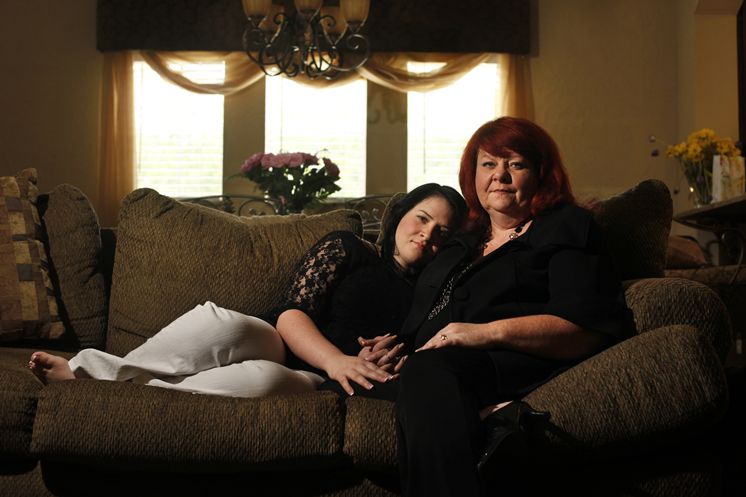
‘They sat on me’: Lindsay Brooks, shown with mother Michelle Brooks at their home in St. Petersburg, was “floored” by other girls while at Lighthouse of Northwest Florida.
In Florida, dozens of group homes for children have operated outside state regulation, granted a religious exemption from licensing. While many homes have had no complaints, more than a dozen have been accused of abuse or neglect over the past decade. Here are some of them. For more homes and accounts from former residents, go to www.tampabay.com/faccca.
Lighthouse of Northwest Florida, Jay • Status: FACCCA-accredited
At this Christian reform school, teen girls are not allowed to wear pants and can be punished for looking someone in the eye at the wrong moment or for using words like "yeah" and "cool."
The state has investigated Lighthouse for abuse 13 times, most recently in 2011. It found evidence only once, of inadequate supervision.
Girls at Lighthouse may go for months unable to contact their parents. Bad behavior sometimes lands them in the "Room of Grace," a small, barren room where children are kept in isolation almost every waking hour. Four former students interviewed by the Tampa Bay Times said they knew of girls sent to isolation daily for more than a month — an allegation school officials deny. The head pastor, Russell Cookston, said girls are confined for days, never weeks.
A dozen recent residents interviewed by the Times also described a system of discipline in which girls are called upon to physically restrain other girls by pinning them to the ground. They call it "flooring." The pastor says peer involvement in restraint is minimal.
Lindsay Brooks, 20:
"They sat on me like I was their mattress and they were having a slumber party," said Brooks, who girls recall was "floored" repeatedly in 2007 and 2008, by six to seven girls, sometimes, for hours. "My body would go numb after a while."
Marvelous Grace, Pace
Status: Unaccredited
On the old grounds of New Beginnings, Marvelous Grace Girls Academy is run by a street preacher once photographed outside a bar holding a sign about Sodom with a fellow protester who was dressed like Satan. Girls describe a program similar to New Beginnings, where teens are expected to strictly follow fundamentalist Christian ideals.
Marvelous Grace does not have a state license, does not have a religious exemption through FACCCA and is not accredited as a boarding school. By law, the school has three years to get accredited. The school's leader, Steven Blankenship, said the school would be accredited by January 2013.
In 2010, Santa Rosa County sheriff's deputies came upon two scratched and sunburned runaways who told them Blankenship had called them "faggots" and "bastards," forced them to street preach and shut girls who weren't "preaching hard enough" in a van. They threatened suicide if taken back to the school. DCF investigated and found no evidence to support their claims.
Camp Tracey, Glen St. Mary
Status: FACCCA-accredited
Police have been called to the facility more than 50 times in the past decade, most often to track down children who ran away. Some of them disappeared for several weeks or showed up on the other side of the state.
The co-ed program focuses on outdoor work and relies on paddling and other forms of corporal punishment. Children there in recent years say they have been made to "crab walk," carry two 5-gallon buckets full of dirt, swallow soap and eat the cigarettes they were caught smoking.
DCF has investigated the school 22 times since the 1980s and found evidence of abuse in a third of the cases.
The school's founder, Pastor Wilford McCormick, declined to be interviewed.
Sequoyah Ozorowsky, 20:
Ozorowsky said camp staff placed a video camera in the room when DCF came to ask questions. "They wanted to make sure DCF wasn't manipulating the kids," he said. "Some people say that there's people that deserve to go to hell. I wouldn't wish something like this on anybody."
Chris Hicks, 29:
Hicks was a student from 1998 to 2002 when, he alleges, he was sodomized by a former staff member mentioned in other lawsuits. He says he has retained an attorney to pursue his own case. "He kind of held me down and told me to be quiet, not to say anything," he said of the staff member. "I was more worried about the physical abuse than the sexual abuse. I could handle the sexual abuse. I could handle it out of fear."
October 28, 2012
By Alexandra Zayas
Samson Lehman lay in a hospital bed with quarter-sized blisters on his feet and a patch of raw skin on his face, plugged into a machine filtering the blood the 15-year-old's kidneys could not.
It was March 6, 2008, 10 days after he entered a Christian boot camp, seven days after he took off in a helicopter, hearing the word dialysis.
His uncle held a camera, asking for answers.
This is what Samson said:
On Feb. 24, a Sunday night, his mother took him to her new boyfriend's house, where she said she needed to wait for a friend. Samson walked out to find a stranger blocking his way:
"Sit in the chair, son. … Your mother loves you, it's for your own good."
Samson says his mom's boyfriend emerged and threatened him with duct tape, put him in a choke hold, slammed him and sat on him.
Samson looked up, struggling to breathe, and saw his mom with her arms folded, watching.
•
there is the American justice system, and then, there is this: An honors student is manhandled by a felon and sent somewhere the state can't legally send the worst of its foster kids.
Not because Samson did drugs or got drunk; his mother had no proof of that. Or because he was a criminal; teachers found him polite and responsible, and he had no juvenile record.
But because his older brother had gone to jail and she had heard rumors Samson had been seen drinking.
In her sons, Laura Ketchem sees the men of her past. Bad genes, she said. Samson, she believed, had them, too.
•
"Stand at attention," a camouflaged man at the Gateway Christian Military Academy, also known as Teen Challenge, told Samson. "Give me 20 laps."
It was 7:20 a.m. He was tired after the eight-hour ride north to Bonifay. He needed to brush his teeth.
Instead, Samson ran around the bunkhouse. He did 15 laps but failed to "sound off," so he got 20 more, then jumping jacks, then push-ups.
When another new "cadet" showed up, Samson had to join in that boy's exercises, too. More boys came. Samson lost track of the laps.
Boys held cups the size of Big Gulps, but couldn't drink until told to "consume." They ate lunch standing up, ate dinner standing up, were led to the showers, but made to exercise there.
Samson collapsed. Men forced him to the ground, pulled his hands behind his back and his elbows up. Samson felt both pain and relief.
For the first time all day, he wasn't standing.
Samson got to use the bathroom. He peed a stream so dark red, it looked black.
He reported it, but heard: "Everybody usually pisses blood the first couple of days."
•
Monday night, Samson slept fitfully between push-ups. He spent Tuesday night vomiting.
For more than 72 hours, Samson said he went without a healthy night's sleep, and in that time, was dragged with his cheek scraping the ground, tossed in a corner and called "useless," made to sleep in his sweaty jumpsuit and allowed to change only after he defecated himself.
He was taken to the emergency room, his doctor would later write to an investigator, on the brink of death.
In the hospital, Samson's mother gave up on raising her son. "If I'm such a sh---- parent," she remembers telling her father, "you do it." Samson went home from the hospital with his grandfather.
Ketchem said she spent four years assuming her son was at fault, believing he dehydrated himself by refusing to drink water or by crying too much, like the toddler who howled during haircuts.
She never asked for the Sheriff's Office report, which cited students and staff who watched Samson vomit, fall and turn yellow. But hearing it read recently, she wondered if she had misjudged her son.
"Had I known they were doing such unreasonable stuff," she said, "I would not have sent him."
Ketchem said she feels "a little guilty." But that subsides when she remembers the "positive" side of it all: "It took him almost dying to get his head out of his a--."
•
No, Samson says, it didn't.
He spent months in dialysis, thinking.
"Just sitting on that machine and knowing it was completely avoidable," Samson said. "That was extremely frustrating. …
"I would just get so mad. … And then, I don't know, you just feel kind of, like, helpless."
He is now 20, majoring in engineering at the University of Florida. Not because of his time away, he said. In spite of it.
Freshman year, he got a tattoo to commemorate his survival, to symbolize he was not a powerless victim, or the pawn of some greater order, but a man who would dictate his own fate:
Sum Mihi Dominus. I am my own master.
October 29, 2012
By Alexandra Zayas
PORT ST. LUCIE -- Anyone can run a program that houses troubled children in Florida. Even Alan Weierman. In the past decade, state officials have investigated an unlicensed military program run by the self-titled “colonel” 24 times and found evidence that kids were punched, kicked, slammed into hard objects and choked to unconsciousness. They know about a boy who left Weierman’s home in 2004 on the verge of kidney failure. And another boy who was shackled for 12 days in 2008 and called a “black monkey.” They say Weierman, a Christian minister, has repeatedly crossed the line of abuse in his three decades running religious group homes in this state. Regulators have tried to shut him down. The state license to operate his children’s home lasted only two years.
Eight years ago, he lost a religious exemption that had allowed him to keep his reform home open without government oversight.
So now he operates without any state-recognized accreditation at all.
He has even had to answer allegations of sexual abuse and of failing to report abuse alleged by a girl at his facility.
The facility staff engage in discipline that is harmful, DCF officials wrote in a report four years ago.
The risk to children is high.
Yet his home is still open and caring for a dozen boys.
Still collecting $28,600 per child from parents.
Still punishing kids in ways that trouble the state.
The story of Southeastern Military Academy exposes an ugly truth about Florida — you can get a license to open a group home, torment children for years and face few repercussions, so long as you are not convicted of a crime.
The Department of Children and Families can storm into licensed homes, order changes and remove children. But the department’s ultimate weapon — revoking a home’s license — is virtually meaningless.
Lose your state license and you can apply for a religious exemption. Lose that and you can register as a “boarding school.”
Each time, the process starts over. New regulators with different rules come to visit.
Each step down the regulatory ladder relaxes the standards required of a children’s home.
Or you can start out as a “boarding school” and skip the hassles of licensing and government oversight altogether.
State-licensed facilities are inspected by DCF; religious exempt homes are reviewed by a private, nonprofit agency with headquarters in Lake City.
No one in Florida monitors boarding schools, which are allowed three years to apply for accreditation by one of five organizations listed in statute. Those organizations focus largely on academics.
DCF investigators respond to abuse allegations at all children’s homes. But for years they did not routinely verify whether those facilities had their required credentials. DCF officials said that’s because state abuse investigators didn’t understand the “intricacies of the law.”
“That is not the duty of the DCF investigator,” DCF spokeswoman Erin Gillespie said in April. “If anyone had any concerns that these homes were running illegally, they would have to report that to DCF and our licensing staff or legal team would investigate.”
In response to the Times’ investigation, DCF is now making sure abuse investigators check a facility’s credentials.
But for years while DCF waited for the general public to make a complaint, homes fell through the cracks.
Southeastern Military Academy, which the state once took to court because it had no accreditation, has been operating without state-recognized oversight for years.
When asked about the academy earlier this year, a DCF spokesperson questioned whether the home remained open, hearing that the site “looked abandoned,” with a “For Sale” sign outside.
Southeastern Military Academy abuts Florida’s Turnpike on an unfenced property in Port St. Lucie where anyone can see boys sweat in a sand pit, counting exercises for a man in fatigues.
That man, 50-year-old Alan Weierman, is big and tall and wears his graying hair high and tight; “snow on top,” he calls the style.
Smiling, drinking coffee in his combat boots, he has been up for five hours when he greets visitors at 9 a.m. on a recent Wednesday. He hands them a business card emblazoned with a U.S. Army logo and the title “colonel.”
Weierman is not affiliated with any branch of the military. Nor has he ever been close to the rank of colonel. He says he tried to join the Army more than three decades ago but was dismissed after six weeks because he was allergic to bees.
“I’m not sorry where I’m at today,” he said. “It all comes around to where you still get to serve. Training young men is like being in the military. It’s like training soldiers all over again — kids with no respect for parents, no respect for police, or themselves.”
Weierman says he instills that respect in the dozen boys in his care.
He takes in “recruits” as young as 11, strips them of individuality, dictates rules and nitpicks for infractions. When they break and lose control, he says, he builds them back up.
His program is not about “breaking down” kids or creating “robots,” he says. It’s about shaping behavior that will last. He says the “mind, body and soul” approach includes daily spiritual devotions, Sunday worship and accommodations for boys of other religions.
“It doesn’t matter to me why he’s here. It doesn’t matter to me even what he thinks about being here,” Weierman said. “He understands there is compliance. He must understand there are rules.”
Weierman’s program is built around discipline that would never be allowed at a state licensed home.
Parents sign a contract allowing corporal punishment and giving up the right to sue, even if their child dies.
Weierman says he hasn’t had to shackle a boy in years, but reserves the right to do it when a boy presents a threat or tries to run away.
While the home has been accused by state child protection workers of abusive treatment, nothing has been proved to rise to criminal child abuse.
Still, even Weierman concedes there have been problems.
He stopped showing the war film Full Metal Jacket after he caught boys having “blanket parties,” mimicking a scene in the movie where a recruit is gang-beaten with bars of soap, wrapped in towels.
Over the years, child abuse investigators have found dozens of children with minor injuries and classified the cases as maltreatment stemming from out-of-control disciplinary efforts.
Weierman scoffs at the idea that the harsh discipline doled out at his group home amounts to child abuse. He says he knows real abuse.
“My dad shot me when I was 13 years old, trying to kill me,” he said. “I was ripped out of bed many nights and beaten bloody, simply because I failed to close a gate or shut a door.”
He grew up hard in Ohio in the 1970s. By 17, he said, he had racked up criminal charges, including armed robbery. A judge told him to choose between the military or jail.
Around that time, he met William Brink, a preacher who had an Ohio group home and ministered to delinquent youths. Brink invited Weierman to live at the religious home.
He showed up with long hair and a leather vest.
“I was just 12 ways of bad.”
But Weierman quickly gained Brink’s trust and at 19, he married the preacher’s daughter. They worked together at the children’s home in the early 1980s, when Ohio regulators required the home to stop using corporal punishment.
In 1984, Florida legislators passed a law that would allow religious homes to use corporal punishment if they could justify it with Scripture.
Weierman’s father-in-law was among the first to apply. In 1985, he opened Victory Children’s Home, a home for abused and abandoned children in Fort Pierce.
His son-in-law would soon work there.
But not before leaving behind an allegation in Ohio.
In 1986, a 16-year-old girl told police she had had sex with Weierman more than 30 times. The girl passed a lie-detector test and had kept a calendar of the sexual encounters, the local police chief told the Akron Beacon Journal at the time.
Weierman denied the allegations. And prosecutors declined to press charges, saying there wasn’t enough evidence.
Still, Brink and his home took criticism. After learning of the girl’s allegations months before the police, group home officials conducted their own investigation. They deemed the allegations false and never reported them to police.
Three years later, Weierman would find himself in a similar position. He investigated sex abuse claims against his new home’s director without informing police.
Police later arrested Weierman and accused him of tampering with a witness and failure to report child abuse. Although the charges were dropped, Weierman now says he should have called police as soon as he heard the girl’s allegation.
A few years later, his father-in-law was convicted in Ohio of sexual abuse involving a 14-year-old resident he took in as his daughter and a 16-year-old he made his wife.
Brink went to prison.
Weierman remained in charge of the Florida home, now split from the Ohio pastor.
Through the 1990s, Weierman would continue to have problems. State abuse investigators were called to his campus at least four times, finding evidence once that Victory Children’s Home was using excessive corporal punishment.
At the end of the decade, despite years of complaints, DCF granted Weierman a state license to run a foster home in Florida. The license meant more stringent rules and more state inspections, but it allowed Weierman’s home to accept children seized from parents by child protection workers.
Both sides soon had regrets.
In 2000 alone, DCF records show six child abuse allegations: a boy thrown by a staff member, one dragged and beaten by a peer then refused medical treatment, a boy abandoned in the parking lot of another youth shelter, and kids being hit with a belt and slammed against walls and the ground.
Reports show DCF investigators found credible evidence in four of the cases, including those involving asphyxiation and beatings.
Weierman denies all abuse allegations.
“If I said to you, ‘If you don’t straighten up, I’m going to kick the snot out of you,’ is that threatened harm? I don’t know,” he said. “Child abuse requires intent to commit harm. You have to intend to commit the harm.”
Weierman said he regrets getting a state license, saying the state’s requirement that his children have access to an abuse hotline led to a spate of false reports.
“If you’re a licensed facility, you have to make a phone available to any child,” Weierman said. “At times, I had eight investigators here at a time?…
“Children can lie.”
By the end of 2000, DCF had had enough.
On the day the agency was scheduled to present evidence to a judge to revoke Weierman’s license, he surrendered it.
But that wasn’t the end.
When a group home that calls itself Christian can’t or won’t get a license, when it is chased out of another state for refusing oversight, or, like Weierman’s, when it fails to meet government standards, Florida provides a fallback:
FACCCA accreditation.
Florida is among a handful of states that legally recognize a religious exemption when it comes to licensing children’s homes.
By law, exempted facilities must register with the Florida Association of Christian Child Caring Agencies, a nonprofit group that accredits homes. The association has long allowed homes to strike children with paddles, so long as they justify it with the Bible and pray with the child afterward.
Weierman surrendered his home’s state license on Feb. 12, 2001. The following month, DCF got a letter saying FACCCA had accredited his home.
Under FACCCA, Weierman was able to shut down direct access to the state’s child abuse hotline, which was created to dispatch authorities any time allegations are reported.
Longtime child advocate Jack Levine, who opposed the religious exemption when it was voted into law in 1984, says such safeguards exist for a reason. To complain that kids lie is just a way of avoiding scrutiny, he said.
“It’s so easy to find an excuse for doing the wrong thing,” he said. “You can blame the child. You can blame the system. You can sit around and make excuses for any kind of malfeasance, but that doesn’t make it right.”
Weierman’s home was accredited by FACCCA for three years. The complaints kept coming.
2002: The facility has been locking kids up in chains to keep them from running.
2002: Many of the children have current bruises or have had bruises in the past.
2003: Alan Weierman grabbed a child by the neck and slammed him against the wall with force.
2004: A staff member punched (a child) in the mouth and kneed him in the chest... As a result, his mouth was bleeding.
Investigating these cases, DCF found credible evidence of beatings, inappropriate or excessive restraints, bruises or welts and physical injury.
Michele Muccigrosso sued Weierman’s corporation, saying her 12-year-old son, Dillon, was made to hike on broken feet.
“Our insurance company settled,” Weierman said. “That’s the learning curve. ... We marched them a lot, younger guys, 10, 11, 12 years old. Plates are still growing in their feet. We cut back the marching.”
Muccigrosso said the home disregarded a doctor’s order that her son not hike.
“He was in a wheelchair for five months.”
FACCCA cut ties with Weierman in June 2004. Its executive director later told police it was because the religious home had become a boot camp.
FACCCA officials have declined to provide the Times records of inspections, complaints or investigations at any of the homes it has accredited. They said they do not accredit boot camps because they are “not appropriate.”
After failing under two separate forms of oversight in less than four years, Weierman was not shut down.
Instead, he took advantage of a loophole in state law that allows children’s homes to skirt oversight by calling themselves “boarding schools.”
Department of Education officials keep a list of boarding schools, but do not police them. They do not inspect the campuses or establish discipline standards for the schools.
A state law passed in 2006 says boarding schools must be accredited by one of five scholastic organizations.
But those groups focus on academics. And no one has been checking to make sure the schools meet the requirement.
Weierman’s program has not been accredited under the boarding school rules since it registered as one, under the name Victory Forge, in 2004.
With the new name, came new complaints.
In July 2004, Weierman says, a boy left on the verge of kidney failure after being forced to endure what the colonel called an “extreme” amount of exercise.
Weierman said the boy’s kidneys were not functioning correctly and staff at the home made it worse by forcing him to drink a quart of water an hour.
“The more we did that, the more damage was caused by doing that,” Weierman said. “There was no way we could know.”
Weierman said a detective gave him “accolades” for catching the damage on time.
DCF made a “verified” finding of medical neglect.
Then, on April 6, 2008, Port St. Lucie police officers came upon the aftermath of a capture.
A runaway sat shirtless on a bench outside a middle school, cuffed at the hands, shackled at the ankles, surrounded by Weierman’s staff and the boys who had taken him down. He bore a 5-inch red mark on his neck.
“Please take me to jail,” 16-year-old Lochane Smith told the officers. “I don’t want to go back.”
When an officer questioned the home’s authority to shackle the student, Weierman cursed and yelled, police reports show. “If you had a black kid like that,” he told police, “you would put him in handcuffs also.”
The police took Smith to the station, where they got his story.
He said he had been shackled for 12 days, chained at the wrists even as he slept on his top bunk and released only to shower.
Employees had punched him, choked him, thrown him against the walls.
He ran when he got a chance, vaulting over the fence, darting across the highway.
The home sent a search party, including boys.
He told police a recruit named Tango ran toward him yelling “I’m going to get you, black boy,” then tackling him and choking him, until an employee told Tango, “You better stop, the police are coming.”
DCF interviewed the 15 other boys at the facility and determined all had been in some way mistreated — bruised, bloodied, choked, shackled, subjected to “cruel and unusual punishment.”
One had been called an “Iraqi” and a “rag head.”
Smith had been called a “black monkey.”
Soon after the incident, DCF called parents to take their boys home.
Police spoke to those same boys, who reported they saw Smith being pushed, dragged and “tossed around.” But the police determined none of his injuries rose to child abuse.
St. Lucie County Assistant State Attorney Jeff Hendriks wrote a letter saying no charges would be filed, in part, because parents had consented to corporal punishment.
In an interview from the jail where he landed years later on robbery charges, Smith, now 21, said the abuse was worse than that police report suggests.
He said staff slammed his head into the walls on the first day because he cried and pushed his face in the sand.
Smith said he was made to stand all day and allowed to urinate on himself.
“Some boot camps help people,” he said, “but Victory Forge made me worse.
“Look how I ended up.
“I pray nothing like what happened to me happens to someone else.”
In 2009, DCF tried to force Weierman to submit to oversight or shut down for good.
By then, he was calling his home Southeastern Military Academy and had registered it as a boarding school.
DCF sued, saying the registration and name changes were “evidence of his intent to circumvent and subvert” statute. The lawsuit summarized a history that included 35 prior child abuse allegations.
The staff at this facility, DCF wrote, continues to cross the line between acceptable discipline and abuse.
DCF attorneys argued that Weierman had no license or accreditation. Under state law, he should be considered a rogue foster home and be barred from accepting children.
But in a March 2011 order, St. Lucie Circuit Judge Dan L. Vaughn found that Weierman was making a “good faith effort” to get accredited and denied DCF’s request for an injunction.
A year later, Weierman is still trying to get accredited. He has applied with the Southern Association of Colleges and Schools, which accredits public and private schools. The process takes a couple of years. Weierman says his home is up for review in March.
“I’m hoping and I’m praying they don’t look at the politics of it,” he said.
For now, Southeastern Military Academy continues its daily routine.
Weierman still doesn’t have a problem threatening to beat a kid into a “bloody mud puddle.”
He needs to let them know he’s in charge.
When they threaten to fight him, he threatens them back — “I’m going to hurt you,” “I’m going to send you to the hospital,” “With my dying breath, I’m going to take you with me.”
“It’s all bull,” he said. “It’s all just a facade.”
But that facade is how Weierman molds his rebellious young boys.
At the academy, every action is scrutinized. A wrinkle in a bedsheet, a boot misplaced by 2 inches — all are worthy of punishment, because, to Weierman, all indicate something inside the boy is still defiant. Throughout the day, recruits get lists of orders they must follow. But instructors switch up orders to cause confusion and create a reason to dole out punishment.
Any excuse is good enough. If a student asks permission to do something that’s already on his to-do list, he is punished.
Twenty-five push-ups here, 150 side-straddle hops there. Boys spend many hours in the “pit.”
They can also can get swats and lose family visits.
Michaela Mattox turned to Weierman to deal with the 14-year-old son she couldn’t control. He was defiant, running away, smoking marijuana.
She left him at the academy five months ago without touring the home and now has regrets. She doesn’t even know the names of the “captains” on the phone.
She has read about other boys’ allegations online.
And when she speaks to her son on the phone, with staff listening, he cries so hard, she can barely understand what he says.
Your son may complain to you about unbearable pain, crying that it’s too hard, says parent literature. DON’T BE FOOLED!
Among the most feared punishments is being sentenced to bowls of “stuff.”
Boys on “stuff” must down soggy bowls of vegetables, swimming in vinegar and designed not to go down easy.
They get “stuff” every meal, every day until they complete their sentence. Some go more than a week with nothing else to eat. If they don’t finish a bowl, it gets served up at the next meal.
Forcing kids to eat “stuff” may sound like juvenile hazing, but state child safety regulators have labeled it “bizarre punishment.”
Weierman doesn’t buy it.
“It’s mind over matter,” Weierman recently told a few boys, who had 15 minutes to shovel the peas and corn into their mouths.
“It’s just vegetables.”
They lifted their bowls to drink the acidic dregs.
One gagged.
Another vomited.
Times researcher John Martin contributed to this report.
October 29, 2012
By Alexandra Zayas
Child care workers have violated Florida law by sending foster children to unlicensed religious homes, a Tampa Bay Times investigation has found.
The Times discovered at least four state children living this year in three separate unlicensed religious homes. Two homes told the Times about the transfers. The third published information about the children in its newsletter.
Department of Children and Families officials are investigating how the transfers occurred.
"It's a mistake," said DCF spokeswoman Erin Gillespie. "We're owning up to it. Everyone's owning up to it."
Teen Challenge Vero Beach, also known as Anderson Academy, is among the unlicensed programs that took in foster children.
The reform home for boys was once accredited under Florida's religious exemption, but now operates as a boarding school without any state-recognized accreditation.
In the past decade, DCF has investigated 20 allegations of abuse at the home, finding credible evidence in eight cases involving physical injury, medical neglect and "bizarre punishment."
The home's director, Maynard Sweigard, denies any abuse occurred, but says his program once used more aggressive disciplinary methods. The ranch no longer relies on "hands-on" tactics, Sweigard said.
Sweigard said more than half of the abuse allegations came from children who transferred in from state-licensed facilities.
"These kids were trained to ring a bell and get attention from the DCF," he said.
One allegation involved a boy sent from a state-licensed home who "feigned suicide," attempting to hang himself, Sweigard said.
"He didn't succeed," Sweigard said. "As soon as the words, 'I'm going to kill myself' came out of his mouth, he was stopped."
But the school did not immediately call police because the boy had a history of faking suicide attempts, Sweigard said.
"The next thing I know is there is a DCF investigation and I'm being charged with abuse by neglect."
Prosecutors did not pursue the case.
In September, Sweigard told the Times that he had one child from the state and that his program has been paid more than once in the past to take children licensed homes could not handle.
"When you have a horse you can't train," Sweigard said, "you pay somebody that's better at it than you are. We always looked at it as a compliment."
Other unlicensed homes say they have received state-dependent children, as well. The director of another Teen Challenge program, Gateway Christian Military Academy in Bonifay, said an 18-year-old once in state care wound up at his facility.
Earlier in the year, the Times found two additional foster children placed in another home that had taken a religious exemption in lieu of a license. When the children were discovered, the home immediately applied for and received a state license.
After hearing of the boy at Teen Challenge Vero Beach, DCF sent a mass email warning providers of the misdemeanors and felonies they could face if they broke the law.
The boy was removed, Sweigard said.
DCF also called upon the inspector general to start a statewide investigation to identify how many other state children wound up in unlicensed care.
"We feel like we need an in-depth investigation from an external party to determine exactly what happened," Gillespie said. "How do we ensure this doesn't happen again and where these kids are now?"
October 30, 2012
By Alexandra Zayas
Lighthouse of Northwest Florida offers refuge to parents terrified of losing their daughters to the tempest of a sinful world.
It promises an oasis where teenagers wear nylons and say "yes, ma'am," where Scripture is sung and words are spoken only in turn.
Alcohol, drugs, promiscuity, self-mutilation, eating disorders — the reform home approaches all ills with heavy doses of punishment and God.
The home's doors lock shut, to keep the girls in, and the sin out.
But within that isolation, strange things happen.
Girls say they have been ordered to tackle, pin down and sit on their out-of-control peers. They describe being confined to a time-out room the size of a walk-in closet, almost every waking hour, for days at a time.
Police reports filed over the years give glimpses of desperation. A girl slits her wrists with a razor blade. One grabs a butter knife. One tries to make a noose with her tights.
A girl bangs her head on the floor, screaming of murder and suicide, telling a police officer, "I will find a way to kill myself if you don't get me out of here."
Much of what goes on inside remains secret.
Lighthouse is one of about two dozen children's homes shielded from state oversight under a religious exemption created by Florida lawmakers in 1984. The homes are closed to state licensing officials and monitored instead by the Florida Association of Christian Child Caring Agencies, a private nonprofit organization whose inspection records are not made public.
Russell Cookston, head pastor at Lighthouse, offered no religious justification for restraining girls or putting them in isolation. He first said those measures were rare and used only to calm girls who were endangering others.
However, he went on to describe how multiple-day sentences in the Room of Grace are handed out on a sliding scale depending on the "offense" a girl committed.
Restraint and isolation, he said, are the last resort. They are followed by counseling sessions. The goal, he said, is to have a "therapeutic rapport."
"When a child goes ballistic they can do a lot of damage," Cookston said. "That's the last thing that we want."
What he wants, Cookston said, is for girls to learn how to be polite and do what they're told.
"We want them to get to the point that parents can work with them again. . . .
"God actually put the program together," he said. "We're teaching his word and that never changes. …
"It's a liberal world. And we show them how they can live conservatively."
A two-lane road slices through the cotton and peanut fields of Jay, a one-stoplight farm town in the western end of the Panhandle, just south of Alabama.
For two decades, girls from as far as California have found themselves here, following a long driveway toward a manicured compound, unaware of what awaits them in their minimum 12-month stay.
The home had fewer than 20 girls when the Times visited in August. Monthly tuition is $1,500 paid for privately by parents and donations. The home advertises for girls as young as 10.
Most days at Lighthouse start before sunrise and are filled with self-directed study and sermons. Girls pledge allegiance to the American flag, the Bible and the Christian flag.
The home is clean, the pantry well-stocked. On Friday nights, girls play games like balloon volleyball. "We bring students in here that are trying to be older than they really are, trying to have their body cash checks that they can't right now," Cookston said. "To be a kid again is refreshing."
Little filters in. No radio, no TV, no Internet.
Girls who behave get their first phone conversation with parents 90 days in; calls are monitored, letters reviewed. Girls who break the rules — which include uttering the words "yeah" or "cool" — must copy hundreds of lines from the Bible.
Reach 5,000 lines and you're on detention, stripped of privileges like shaving, speaking and making eye contact, former residents say.
It is not uncommon for girls to have to work off tens of thousands of lines before they can get off restriction, though Cookston says in the past three years, he has sometimes granted "grace," resetting punishment to a goal with a realistic end.
Good girls rise in the ranks to become "helpers." Troublemakers are isolated, or worse.
In 2007, Lindsay Brooks was a 15-year-old with a neurological condition she could not control. She was prone to violent outbursts and her mother had run out of options.
Brooks, of St. Petersburg, had been in and out of treatment in four different counties. None was like Lighthouse, where Brooks said she was gang-tackled and sat on by as many as six girls at a time.
The Times interviewed a dozen residents who spent time at Lighthouse in the past five years, 10 of them in the past two. Those who went on the record: Ali Reichle, Allie Crawford, Brittani Stoffregen, Cheyenne Homminga, Hannah Kilfoyle, Felisha Ibanez, Jennifer McKee, Jessica Albanes, Lindsay Brooks and Rachel Beaton.
Some said they benefited from the program.
All described a practice in which the same troubled girls the program sets out to help are used to restrain others.
Some recall "flooring" sessions that lasted an hour or longer, with helpers having to switch out in shifts, even after the legs of the girl beneath them had begun to numb and purple.
Residents at Lighthouse when Brooks was there in 2007 and 2008 recall her being floored frequently, by six to seven other girls, sometimes for hours.
"Six girls sitting on top of you is like those silent movies where they're running through the park and they stop under a window and a piano is dropped on top of them," said Brooks, now 20. "Your body is functioning the way it should be, then bam, you've got, like, 3,000 pounds on you. …
"You could take little tiny breaths, because there was so much weight on you."
Girls recall others being floored not only for violence, but for walking away or giving attitude.
Rachel Beaton, now 20, said she was once floored for crying too loud. "When they get off of you, your body is so numb. I used to have bruises on my ribs, my hip bones."
One allegation about flooring is documented in a 2008 Santa Rosa County Sheriff's Office report. Parents showed up at the station with a daughter who had a human bite mark on her leg, an injury she said she sustained while restraining a disobedient girl.
When DCF investigated, Cookston said the girls restrained each other on their own, not at the direction of the home.
Cookston repeated that explanation even after the Times told him former residents said they had been ordered by adults to tackle or sit on other girls.
Cheyenne Homminga said she was made to physically "put down" other girls when she was at Lighthouse from January 2011 to January 2012. The 15-year-old said she was given the task because she was bigger than the others.
"They wanted you to sit on their thighs and then to hold with your hands their hands on their back," she said. "It's never like you lightly hold their hands together. You're really violent and you're forcing them. . . . I hated putting girls down. A bunch of the girls didn't like me anymore.
"I never wanted to hurt them."
"But it was like I had to, I was commanded to."
Robert Friedman, a psychologist and professor emeritus at the University of South Florida Department of Child and Family Studies, said the practice described by former residents is harmful to everyone involved. It makes the girl on the floor angrier and adds to the sense that she's worthless, he said.
"The act of holding down a friend, a bunk mate, a roommate, it leaves the youngsters feeling bad about themselves," he said. "It turns them against each other instead of creating a supportive peer environment where they help each other and they listen to each other."
After a girl is floored, her likely destination is a white, windowless cell called the "Room of Grace."
The room, the size of a small bathroom or walk-in closet, has no bed, no chairs, just a thin carpet for girls confined all day, from the time they wake until bed.
Former residents complain they would be held there for days, with limited bathroom breaks, nothing to do and no one to talk to.
Other girls, they said, had soiled the carpet, out of necessity or spite.
"It was a disgusting little box," 18-year-old Ali Reichle said. "Whenever you walked in that room, you could smell just the puke and the urine."
The makeshift cell has an opening where a door would have hung. When a girl is banished, the opening is blocked with a table and manned by someone who makes sure the troublemaker stays put. Cookston said an adult is always present; residents said girls were often watched over by other children.
When the Times visited in August, the room was barren, the only sign of its purpose walls scarred by years of punches. There was no smell.
On the wall just outside the empty doorjamb, officials have hung an inspirational poster — Oh, cheer up!
The irony is not lost on girls who passed through Lighthouse. Many say they spent hours stuck in the room, seething and being forced to listen to taped evangelical sermons:
"There was yelling in them," recalled 16-year-old Allie Crawford. "Some girls would plug their ears. Some girls would kick walls. I was definitely sick of it."
Even a few days in isolation is unacceptable, experts say.
"Incredibly abusive," Friedman said. "Absolutely, totally inappropriate."
Five former residents recall girls being confined for more than a week at a time. Four said they remember girls who were kept away for more than a month.
Cookston denied such lengthy stays. He said the worst offenses net a girl three days in the room, and if she misbehaves inside, she can get another three days. Girls are given adequate bathroom breaks, he said, and taken to chapel. Although he remembers one girl being kept in the room overnight, he said "no one's been in there a month or weeks."
But if Cookston wanted to hold girls that long in isolation, there was little to stop him.
During its 28-year history, FACCCA, the private, nonprofit agency that oversees Lighthouse, has had no limit on how long its facilities could hold children in seclusion.
After the Times visited the home, FACCCA inspectors went to the campus and told Cookston he had to cap seclusion time to one day. The association plans to adjust its standards, executive director Buddy Morrow said.
FACCCA officials also told Lighthouse it could not use children to watch or restrain others.
"That was not acceptable," Morrow said.
Lighthouse's story goes back long before Cookston and stretches far beyond Jay. It even meanders through Mexico. But it begins with the name on a Panhandle property deed:
Pastor Michael Palmer.
In 1985, at a gated compound in Ramona, Calif., the Baptist preacher founded Victory Christian Academy, a home to reform troubled girls. It was never licensed.
In 1988, a student working on a campus construction project was killed by falling lumber. After that, California officials saw the "Get Right Room," where girls told them they were confined for up to 12 days, made to listen to hours of taped sermons.
In 1992, a judge ordered that Palmer apply for a state license or shut down.
Instead, Palmer moved to Florida, where a religious exemption meant he could run Victory without government hassle.
That very year, Victory was up and running in Jay.
Although Florida child abuse investigators reviewed allegations several times, they never found evidence of abuse, and Palmer's girls' home operated without public incident for years.
Then in 2004, a former resident showed up outside the home and caused a stir in this sleepy town. She carried a sign calling Palmer a rapist.
In November of that year, Rebecca Ramirez, 36, told Santa Rosa sheriff's deputies the pastor raped her in 1992 while she was 16 at the home in Florida. The Times does not typically name alleged victims of sexual abuse, but Ramirez gave permission to identify her, believing it will give validity to her story.
She told the Times the abuse began with private, lights-off sermons in his office. She said he told her God wanted him to make her his wife, and when she reminded him he already had a wife, he said that marriage didn't count because it happened before he was a Christian.
"He was kissing on me," she said. "And then he told me to lay down on the floor.
"And so I did. …
"I didn't make a noise. I didn't say anything. …
"You don't talk back to him."
Palmer has denied it all. A statute of limitations prevented the case from moving forward.
Palmer left Lighthouse not long after Ramirez's report. He did not respond to a letter the Times mailed to a home he owns in Fort Dodge, Iowa. He no longer appears to be running the girl's home in Florida.
He left that to Pastor Cookston, whose daughter had lived at Palmer's home.
Cookston said he started working at the home in 1996 and soon after moved to Mexico, where Palmer had started Genesis by the Sea, a girls' home near Rosarito Beach.
Cookston was head pastor when the home was shut down by Mexican authorities in 2004.
At the time, officials said the home was not properly licensed. They were concerned by the electric fence surrounding Genesis and told the Copley News Service that neighbors had reported hearing "cries in the night."
The Times spoke with three former Genesis residents who said "flooring" was common under Cookston's leadership and recalled a girl who slept bound to her bed.
That former resident, Melanie Villaruel, 26, told the Times that when she was caught after running away, she was made to walk barefoot for weeks, bound in plastic zip-ties.
Cookston denies any abuse occurred in Mexico and said authorities there shut him down for technical infractions, including not having a permit for a sign on a wall and not having business hours posted.
And Palmer?
"The only reason he holds onto a house here is so he feels he still has it or has claim to it," Cookston said. "I let the parents know that he's not here. He's not a part of this ministry. He's gone.
"But what do you do about stories from the past?"
In 2007, St. Petersburg mother Michelle Brooks needed help with her daughter's uncontrollable violence. She was disillusioned by state-licensed group homes, where she felt Lindsay didn't get adequate supervision and staff was just there for a paycheck.
She was drawn to Lighthouse because it shared her Christian ideals. She spoke to Cookston and his wife and she saw misty eyes and heard trembling voices when they spoke of changing girls' lives.
She still feels they care.
But had she known what would happen to her daughter, she said she would never have agreed to send Lindsay to Lighthouse.
Lindsay had been there for almost two years when Brooks called the pastor from the hospital the second time her daughter was taken in under the Baker Act, a Florida law that allows for the temporary detention of a person having a mental health emergency.
She had some serious questions.
Lindsay had told hospital workers she had been hog-tied.
Brooks knew Lindsay might be restrained.
But she didn't expect this.
Lindsay had been kicking people, she remembers the pastor told her. "Well, I know she can do that," Brooks said.
"But then he's telling me that she wouldn't stop screaming for eight to 10 hours solid. Solid.
"How they weren't feeding her because she would throw the plate, so they stopped bringing her food.
"Her feet and her hands were bound because she was trying to hurt other people.
"And I said, why didn't you have her Baker Acted before you bound her hands and her feet?
"He says, 'Because we're trying to handle her.' "
She remembers he acknowledged, in that conversation, that his group home was not equipped to deal with Lindsay.
"I was done," the mother said. "I didn't know where we were going from here. I didn't know what all of this meant. But all I knew was that wasn't okay."
Lindsay is doing better now, in her social abilities and behavior.
Her mother says she connected with some good staff members at Lighthouse and, like some others who spoke with the Times, left with a deeper sense of faith. She was also weaned off of medications that did her more harm than good.
But something needs to change, Michelle Brooks said.
"There absolutely needs to be regulation somewhere," she said. "There needs to be outside eyes. These children have emotional difficulties. So there should absolutely be someone there, in the mental health field that's licensed by the state, monitored by the state and who is also reporting back to state agencies what's taking place."
Michelle Brooks listened to Lindsay describe it all to a reporter this past summer, and the mother had to pause at one point, saying she couldn't breathe.
At the end of the interview, she hugged her daughter and whispered, "I'm so sorry."
Times researcher John Martin contributed to this report
WHAT THEY ARE SAYING
A dozen former students spoke with the Times about what happened to them at Lighthouse. Some had fond memories. Some remembered pain and frustration.
Jessica Albanes, 17:
"You can't talk without a helper listening. … We can't talk about the program. … There were some girls you could really relate to, you really liked. You couldn't call someone your friend because that was 'deceitful.' In the program they say you're there to focus on yourself and you're not here to make friends."
Ali Reichle, 18:
"Sometimes, being a helper, they would abuse their power and make other girls' lives miserable. Slam her with lines. She would get lines after lines after lines after lines."
Jennifer McKee, 19:
"Every Saturday night, they would write little bullet points and point out something about a girl. That girl would get stood up in front of the whole school. … If a girl had a hygiene problem, let's just say they didn't clean themselves right or left pads out, they would get stood up."
Felisha Ibanez, 21:
"If you did not eat your meal … you were given the same meal back, straight out of the fridge, every meal time until it was finished. Sometimes they had their mouth washed out with a bar of soap if they were being vulgar."
Hannah Kilfoyle, 19:
"We could not floor without a staff. … Typically, if it prolonged, they wiggled out of grip, kicked someone, bit someone. As long as they kept showing that psycho attitude, we couldn't just let them go."
Brittani Stoffregen, 20:
“I didn't really get into trouble. I just kind of played along with the whole I love Jesus thing. They like to call it floating through."
Cheyenne Homminga, 15:
"All the girls even at one time, they can get all their stuff from storage — cellphones, old boyfriend pictures, old jewelry that your boyfriends gave you. … I had clothes in there, they were whorish clothes. … You go throw this stuff. And it burns. And you watch it burn. It feels so good. You feel you don't have to worry about that when you go home."
October 30, 2012
By Alexandra Zayas
Young boys wind up at the Gator Wilderness Camp School because they lash out in anger or run away from home.
They must survive outdoors on this private property off a dirt road in Punta Gorda, building their own huts, cooking their own food. Every Sunday, they are required to go to chapel.
But, unlike more than a dozen other Christian children's homes examined by the Tampa Bay Times, children here do not complain of abuse or neglect.
Director Gregg Kanagy does things differently.
No corporal punishment. No threats or name-calling. No confinement or shackling.
Boys who live here tour the facility first and stay only if they agree to it.
Kanagy's program and other religious children's homes like it are fundamentally different from the troubled homes uncovered by the Times in a yearlong investigation:
While all of the programs fall outside of state standards because of a religious exemption, many still ban the use of corporal punishment and extreme punishment techniques.
Kanagy, who has a master's degree in education and is certified to teach emotionally and mentally handicapped students, said paddling kids does not work.
"Corporal punishment is about external controls," he said. "We're about internal controls."
Kanagy said he avoided a state license so he could require his campers to attend a chapel on Sundays; he doesn't want them to be able to opt out. "We always stick together as a group."
He does not use the reduced oversight to punish boys for every little mistake. "It's not about performance," he said. "It's about them being able to get to the point where they can talk about the hurts in their lives."
New boys are treated the same as the others.
If one boy punches another, the group talks it out, and if that takes time out of their fishing trip, they deal with it.
A boy once ran away and climbed a tree. He wasn't shackled or secluded for days. The boy decided he wanted to cut down the tree, so he wouldn't have to look at it and remember. So they did.
The camp did not always work this way. Under other leaders in 2008, a 15-year-old who had mouthed off was laid on by a 220-pound counselor for three hours. Other boys witnessed and participated in the restraint.
State investigators verified the incident and found such treatment was not unusual at the camp. The director at the time was charged with neglect, but died before trial. The counselor pleaded guilty to a lesser charge, contributing to the delinquency of a minor; he got probation. The school closed.
"My guess," Kanagy said, "is there was some pretty unhealthy group culture."
Kanagy reopened the home in 2009 after pledging a change its rough tactics. Since then, the state has not had to respond to a claim of mistreatment.
November 1, 2012
By Alexandra Zayas
Child care workers have violated Florida law by sending foster children to unlicensed religious homes, a Tampa Bay Times investigation has found.
The Times discovered at least four state children living this year in three separate unlicensed religious homes. Two homes told the Times about the transfers. The third published information about the children in its newsletter.
Department of Children and Families officials are investigating how the transfers occurred.
"It's a mistake," said DCF spokeswoman Erin Gillespie. "We're owning up to it. Everyone's owning up to it."
Teen Challenge Vero Beach, also known as Anderson Academy, is among the unlicensed programs that took in foster children.
The reform home for boys was once accredited under Florida's religious exemption, but now operates as a boarding school without any state-recognized accreditation.
In the past decade, DCF has investigated 20 allegations of abuse at the home, finding credible evidence in eight cases involving physical injury, medical neglect and "bizarre punishment."
The home's director, Maynard Sweigard, denies any abuse occurred, but says his program once used more aggressive disciplinary methods. The ranch no longer relies on "hands-on" tactics, Sweigard said.
Sweigard said more than half of the abuse allegations came from children who transferred in from state-licensed facilities.
"These kids were trained to ring a bell and get attention from the DCF," he said.
One allegation involved a boy sent from a state-licensed home who "feigned suicide," attempting to hang himself, Sweigard said.
"He didn't succeed," Sweigard said. "As soon as the words, 'I'm going to kill myself' came out of his mouth, he was stopped."
But the school did not immediately call police because the boy had a history of faking suicide attempts, Sweigard said.
"The next thing I know is there is a DCF investigation and I'm being charged with abuse by neglect."
Prosecutors did not pursue the case.
In September, Sweigard told the Times that he had one child from the state and that his program has been paid more than once in the past to take children licensed homes could not handle.
"When you have a horse you can't train," Sweigard said, "you pay somebody that's better at it than you are. We always looked at it as a compliment."
Other unlicensed homes say they have received state-dependent children, as well. The director of another Teen Challenge program, Gateway Christian Military Academy in Bonifay, said an 18-year-old once in state care wound up at his facility.
Earlier in the year, the Times found two additional foster children placed in another home that had taken a religious exemption in lieu of a license. When the children were discovered, the home immediately applied for and received a state license.
After hearing of the boy at Teen Challenge Vero Beach, DCF sent a mass email warning providers of the misdemeanors and felonies they could face if they broke the law.
The boy was removed, Sweigard said.
DCF also called upon the inspector general to start a statewide investigation to identify how many other state children wound up in unlicensed care.
"We feel like we need an in-depth investigation from an external party to determine exactly what happened," Gillespie said. "How do we ensure this doesn't happen again and where these kids are now?"
December 2, 2012
By Alexandra Zayas
PANAMA CITY -- For 15 years, parents sent their troubled boys to a secluded compound, to be whipped into submission by a preacher wielding a switch. He kept a log recording their sins, including "wicked writings" and "peeing in bed." When deputies descended in 2010 to examine bruised bodies and confiscate bloody underwear, they learned one boy had been lashed 1,330 times. Heritage Boys Academy closed. But that was not the end. The Tampa Bay Times has learned that preacher Clayton "Buddy" Maynard is once again caring for children — at least two boys, whose parents have signed over guardianship. State officials confirmed that during a recent visit prompted by the Times' questions about the facility.
Maynard and his Truth Baptist Church have been advertising online for students ages 13 to 17 for a "semi-military" boarding school to teach boys how to "be and behave like a man."
An Oct. 31 post on Maynard's Facebook page says his ministry for troubled youth has five boys "in residence."
But what is now called Truth Baptist Academy is not licensed as a children's home or accredited as a boarding school. None of the state agencies that oversee such facilities were aware the church was caring for children.
No one responded to an e-mail or repeated phone messages left on the academy's number or Maynard's cell phone.
But on their web site, the home's operators are unapologetic for avoiding oversight.
"Unlike the 'accredited' schools," the school's site says, "we don't water down these subjects by allowing them to be taught drugs, fornication, homosexuality and other perversion …"
Maynard summed up state requirements in two words on his Facebook page: "Government tyranny."
Truth Baptist Academy is one of more than 30 unlicensed religious children's homes the Times examined during a year-long investigation. The newspaper found more than 100 allegations of abuse in homes operating outside state standards, places where children have been chained and secluded for days, sexually abused and medically neglected to near death.
DCF is cracking down on illegal boarding schools in a statewide effort prompted by the Times investigation. Maynard's home is now among those on a watch list. DCF officials gave him 30 days to show proof that he would submit to oversight.
The clock runs out next week.
• • •
Maynard's military school was called Heritage Boys Academy back in June 2010, when Bay County Sheriff's deputies came upon a runaway with a bloody nose surrounded by boys who set out from the school to capture him.
The scene concerned authorities, who had gotten a call that day from a woman who saw a search party carrying a rope through a neighborhood.
DCF had investigated allegations earlier that year that kids had been choked for using profanity. They found credible evidence of asphyxiation and physical injury, but not enough to verify abuse. In seven investigations of the school through the years, DCF made one verified finding in 2006, of inappropriate or excessive restraints.
Authorities would soon find more evidence of mistreatment.
Two days after they saw the bloody runaway, investigators showed up at the school to interview the boys. One appeared tense to the investigator, who felt he answered questions as if they had been rehearsed.
Another began to cry.
A black boy said staff had called him Rosa Parks and Malcolm X and made him sit through a sermon about how black people were only good as slaves or servants.
Boys recounted day after day of being whipped with a stick seven, eight, nine fists long. At least one said he bled.
"I wanted to kill all of them," a 16-year-old boy later said in a deposition. He had been ordered to attend Heritage by a Hillsborough County judge as a provision of his probation; his mother chose the school.
"They were abusing me to a point that I wanted to actually kill them."
Investigators snapped photos of Confederate flags and camouflage, and a bumper sticker that said, "Spank your child! Or they may grow up to be a Democrat."
They learned all about whippings called "corporal corrections" — CC for short, Maynard told an investigator, "carrot cake to be jokeful."
Boys got a CC for each "serious" offense, which included "talking on silence," "eating in the dorm" and "rap music lyrics." Rap was catalogued on a list of 30 "evils," "heresies" and "cults" on the Heritage Boys Academy web site to be opposed and preached against.
Other ills: "So-called women's liberation," "so-called Christian rock" and more than a dozen religious doctrines.
Each CC consisted of five licks, a daily maximum for most boys. For two students, parents signed slips allowing them to be struck 25 times a day.
From May 2009 to May 2010, logs seized by deputies show one boy received 1,330 licks.
To take their licks, boys had to change out of their uniforms and into thinner pajama pants. Maynard told deputies he used to make boys pull down their pants, but years ago, DCF advised him to stop.
"We want 'em to feel it," Maynard told deputies.
"I felt mine when I was a kid."
When investigators examined the boys, they found backsides striped and blotched with bruises, welts and scars.
Maynard told an investigator the marks might have come from fresh whippings, but that boys may also have been injured by other boys. He said sometimes the switch would wrap around a boy's leg and leave a welt but said he tried to make sure his staff was careful.
"If there were injuries of what you say," Maynard told an investigator, "I did not know about it, number one. Number two, it's not my policy to cause those injuries, and if those injuries were caused by our staff, then I will do anything I can to correct what's being done because it's not right. We never have ever wanted to hurt these boys in any way."
After their interviews, the boys who had been transported for medical examinations wrote a letter to investigators to say thanks.
Maynard, his 20-year-old son Russell Maynard and 40-year-old Robert Unger, another school disciplinarian, were arrested and charged with abuse.
But prosecutors started to lose witnesses.
One mother would not let them speak to her son. Another did not return calls or letters. One said the punishment was no different from what she would have done at home.
Another problem for the state: There was evidence a boy had contacted others online about getting stories straight.
"These kids were troubled kids," Assistant State Attorney Megan Ford told the Times. "To the parents, I don't think they ever considered them victims because they were bad kids and they were sending them to a bad kid place."
After a judge dismissed the case in April 2011, members of the Maynard family provided a television news station with footage from outside the courthouse, where more than 100 supporters gathered to sing in celebration.
Women in long skirts and little boys with buzz cuts held signs about freedom.
Some quoted a verse from Romans:
If God be for us, who can be against us?
• • •
Last month, after inquiries from the Times, the state sent a worker past a Private Property sign, down a wooded road named Maynard Drive and onto the compound to ask the preacher some questions about how he was running his school.
Maynard said two boys were living there, sleeping in a church loft, and that their parents had signed over guardianship. He was not receiving money, he told the state. Parents could donate.
He said he was using corporal punishment, and that he would e-mail regulators his disciplinary policy.
The state has not gotten it, and does not believe the custody arrangement exempts Maynard from oversight.
DCF sent him a letter Nov. 9, giving him 30 days to prove he was applying for accreditation.
In recent weeks, seven other boarding schools have gotten similar letters. One, a Port St. Lucie military academy further along in the DCF review, has been threatened with prosecution and legal action if it does not get licensed by late December.
Along with blasting the president and the "oil producing diaper heads" who "love" him, Maynard has devoted recent Facebook posts to a more immediate enemy:
Government oversight of his school.
The day after a state official paid him a visit, he wrote, "I gave her about 8-10 reasons why we should be the ones investigating them. …
"She hung her head most of the time and left pretty quickly."
DCF officials said they had no authority to inspect or monitor Maynard's school outside of a specific abuse complaint until they were notified it was operating without a license.
After the 2010 investigation, they could have scrutinized Maynard's credentials to see whether they could seek a permanent injunction to keep him from running a home. But at the time of the arrests, the school was closed, said DCF spokeswoman Erin Gillespie. "There was no need for DCF to pursue any other action."
Now, she said, the department will make sure the facility follows the law or stops housing children.
In recent months, state regulators have begun keeping tabs on children's homes that apply for but do not qualify for state-recognized credentials.
But regulators have no program to spot homes that secretly operate by ignoring registration requirements.
Instead, DCF investigators almost exclusively rely on complaints from the public.
"There is nothing we can do to stop people from running illegal group homes if we are unaware of them," Gillespie said.
Times researcher John Martin contributed to this report.
January 25, 2013
January 25, 2013
To the judges:
Twenty-nine years ago, Florida signed away its power to regulate religious children's homes. Since then, virtually anyone claiming a list of religious ideals has been able to open a home for unwanted children and start collecting money with no government oversight.
Instead of state social workers, monitoring is left to the Florida Association of Christian Child Caring Agencies, a religious group run by the same people who run the homes.
The sad product of this history -- unlicensed homes, operating for years in rural areas out of plain sight and run by zealous operators who believe they answer only to God -was revealed by the Tampa Bay Times in its series "In God's Name."
In the name of religion, preachers beholden to no one locked children away in rooms for weeks at a time. They whipped them with sticks, chained them in their beds at night and forced them to exercise to the verge of death.
Black children were told they were only good for slavery. Girls were taught menstruation made them unclean. Gay teens were berated as sinners; one boy forced to live on the floor and hosed down like an animal.
Until Tampa Bay Times reporter Alexandra Zayas shone a light on the darkest corners of our child welfare system, these homes were largely forgotten, the extent of abuse unknown. That unlicensed religious homes existed at all came as a surprise to some top officials at the state Department of Children and Families.
No longer.
Zayas' yearlong investigation cataloged years of abuse at unlicensed religious homes and revealed that some homes stripped of their religious exemptions continued operating illegally with no credentials at all. State child safety workers could easily have shut down rogue programs if they had asked the most basic of questions.
Instead, they regularly investigated alleged crimes on campuses and didn't bother to check if the homes had their required credentials. As a result, Zayas revealed, abusive homes stayed in business for years or remade themselves under new names.
Changes prompted by her reporting have been swift:
Based on Zayas' questions, the state launched an unprecedented search for illegal children's homes and ordered abuse investigators to start checking credentials when they visit a home. For the first time, the state is tracking abuse complaints against exempted religious facilities.
A Christian home that nearly killed one boy and shackled another for weeks is on the cusp of being shut down. Six more homes face similar fates if they fail to get licensed in coming weeks.
Florida launched a statewide search to find foster children in state care who had been placed illegally in unlicensed homes. Officials removed children or forced the homes to get licensed. They discovered more than a dozen had been illegally placed since 2000.
Even the non-profit organization that oversees many religious homes was forced to act. It ordered one home to stop confining children for long periods and has pledged to ban the use of mechanical restraints. For the first time, the group is considering a ban on corporal punishment.
The reporting that led to these changes was not easy. Government records about the homes are scarce. Most of what does exist, including the details of abuse investigations, is secret under state law.
The reporter was forced to spend months tracking down and interviewing adults who spent their childhood at the homes. When someone described an incident, Zayas painstakingly tracked down others who could confirm it.
Zayas crisscrossed Florida to convince group homes to let her in. She was confronted by preachers - mostly men - who had spent a career telling girls in their care they could not wear pants and should not speak unless spoken to. She was bullied by school officials who personally attacked her for questioning God's work. One girls home began a campaign to disrupt the Times investigation by pressuring former residents to remain silent or recant their statements.
Even so, Zayas found her way inside five group homes and was able to witness the extreme discipline and questionable treatment of children. She made the most of these moments, successfully arguing in some cases that she be allowed to interview children in private.
When she witnessed boys being force-fed bowls of mushy, vinegar-soaked vegetables as punishment, she demanded to eat a bowl. When she was led to a make-shift cell for girls, she crawled on the floor to verify the smell of urine and vomit reported by former residents. Her extraordinary pursuit of information generated compelling stories, but it also allowed the newspaper to provide a first-of-its-kind resource to desperate parents. Online, the paper published a searchable database of all unlicensed religious homes in Florida, along with their abuse complaints and testimonials from former residents.
Parents -- and the rest of Florida -- are no longer in the dark.
Sincerely,
Neil Brown
Winners
Prize Winner in Investigative Reporting in 2013:
David Barstow and Alejandra Xanic von Bertrab
For their reports on how Wal-Mart used widespread bribery to dominate the market in Mexico, resulting in changes in company practices.
Investigative Reporting
Finalists
Nominated as finalists in Investigative Reporting in 2013:
Patricia Callahan, Sam Roe and Michael Hawthorne
For their exposure of manufacturers that imperil public health by continuing to use toxic fire retardants in household furniture and crib mattresses, triggering reform efforts at the state and national level.
The Jury
The Jury
Louise Kiernan(Chair )
associate professor, Medill School of Journalism
Kathleen L. Best
managing editor, content creation
Ziva Branstetter
enterprise editor
Sheila Coronel
director, Stabile Center for Investigative Journalism
Paul D'Ambrosio
director, news and investigation
Charles Ornstein
senior reporter
Walter Robinson
distinguished professor of journalism
Winners in Investigative Reporting
Matt Apuzzo, Adam Goldman, Eileen Sullivan and Chris Hawley
For their spotlighting of the New York Police Department's clandestine spying program that monitored daily life in Muslim communities, resulting in congressional calls for a federal investigation, and a debate over the proper role of domestic intelligence gathering.
Paige St. John
For her examination of weaknesses in the murky property-insurance system vital to Florida homeowners, providing handy data to assess insurer reliability and stirring regulatory action.
Barbara Laker and Wendy Ruderman
For their resourceful reporting that exposed a rogue police narcotics squad, resulting in an FBI probe and the review of hundreds of criminal cases tainted by the scandal.
David Barstow
For his tenacious reporting that revealed how some retired generals, working as radio and television analysts, had been co-opted by the Pentagon to make its case for the war in Iraq, and how many of them also had undisclosed ties to companies that benefited from policies they defended.
2013 Prize Winners
Adam Johnson
An exquisitely crafted novel that carries the reader on an adventuresome journey into the depths of totalitarian North Korea and into the most intimate spaces of the human heart.
Ayad Akhtar
A moving play that depicts a successful corporate lawyer painfully forced to consider why he has for so long camouflaged his Pakistani Muslim heritage.
Sharon Olds
A book of unflinching poems on the author's divorce that examine love, sorrow and the limits of self-knowledge.
Caroline Shaw
A highly polished and inventive a cappella work uniquely embracing speech, whispers, sighs, murmurs, wordless melodies and novel vocal effects (New Amsterdam Records).