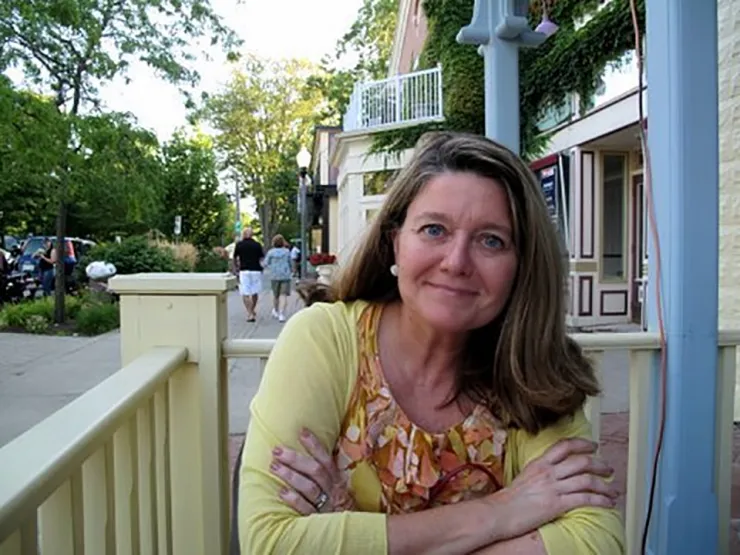
After years of my pleading for the chance, an editor who assured me he didn’t need another columnist decided I could go ahead and be one anyway.
This was in 2002. I was a 45-year-old feature writer for The Plain Dealer. I was also a single mother, and so my first two calls from the newsroom were to my grown son and my 15-year-old daughter, who pretended to be as excited as their mother, bless their hearts. Then I walked outside to the parking garage so that I could sit in my car and call my father, who lived in Ashtabula, an hour east of Cleveland.
My mother had died three years earlier, at age 62, and ever since, phone conversations with my father had been a two-step process. First, I would call and listen to the recording on his answering machine: “Hello. Leave a message.” I’d wait for the beep and then give him the heads-up: “Dad. I know you’re there. I’m calling right back. Please answer the phone.”
I’d count – one thousand one, one thousand two – up to ten, and then call again. He always answered as if he had no idea who was on the other end of the phone.
“Hel-lo.”
“Dad. It’s me.”
“Who’s ‘me’?”
“Connie?”
“Thought it might be.”
This was our ritual, every time.
“I’ve got some good news,” I told him that day.
Silence.
“Dad?”
“Yep.”
“Dad!” I said, trying to create a sense of ceremony worthy of the moment. “I got it. I got the job. I am going to be a columnist.”
“Huh,” he said. “Finally. You’re going to get paid for what you’ve been throwing around for free for 45 years.”
He didn’t fool me. I could hear it in his voice. Years later, I found out that Dad drove to the Crow’s Nest that evening to tell all his buddies at the bar that Chuck Schultz’s oldest daughter was going to get paid to give her opinion.
That’s how he described it for the four years he lived to read my columns. “Yep, she gets paid to do that,” he’d say whenever someone mentioned one of my columns. “Imagine that. Getting a paycheck to give everyone a piece of her mind.”
For my father, this was a big deal, in part because of what it told the world about him. He had spent 36 years as a utility worker in a plant he hated, but he and my mom had sent all four of us kids to college. I was the first to go. Now, there I was, his daughter, earning a living with a laptop and permission to talk back to power.
For me, becoming a columnist was a combustible mix of roots and opportunity. I was a working-class girl emboldened in my teens by Bruce Springsteen, who set our struggles to music and turned them into poetry. To this day, whenever I hear him sing “The River,” I think about how my mother’s teenage pregnancy (with me) forced my parents to elope and launched my dad’s life as a worker with a union card.No wedding day smiles no walk down the aisle
No flowers no wedding dress
I still remember the first time my mother heard that song. I had just graduated from Kent State, and she and I were in her car headed for Hills Department Store when “The River” came on the radio.
“I love this,” I said, turning up the volume.
After the song finished, she reached over and shut off the radio. “It’ll be different for you,” she said, staring straight ahead. “Everything will be different for you.”
Hope stated as fact. That was my mother.
Not only was I a blue-collar kid; I was a woman, too, and a mouthy one — a feminist as soon I learned what the word meant. By the time I became a columnist, I was long accustomed to fighting low expectations for my gender. Now I was about to join an overwhelmingly male team, across the nation and in my own newsroom.
It wouldn’t take long for me to understand that a certain small but loud percentage of male readers would always hate me, not for my opinions, but for having the forum in which to share them. Their rage has always been wasted on me, unless you count the times it has egged me on.
Kurt Vonnegut advised writers to imagine we are writing for one reader, because it’s impossible to please everyone. Most of the time, in my head, I am writing for a person who is as wise as she is timid. She is often an hourly wage earner in one of those jobs that make her invisible even when she’s standing right in front of us.
Sometimes, though, imagining that reader to be one of those braying bullies is just the nudge I need to have a little fun at the keyboard.
I am having the time of my life.
I got a lucky break early in my career as a columnist, thanks to a tired, middle-aged black woman standing behind a coat-check counter.
My husband and I were standing in the long line at the end of a charitable event to pick up my coat when I noticed a large glass jar on the counter labeled “TIPS.” I recognized the woman handing people their coats to be one of the servers at our dinner. We were a large crowd, and it was easy to understand her obvious weariness at the end of the long night.
Being my mother’s daughter, I tried to make small talk with her when it was my turn to hand over the coat-check ticket. I pointed to the jar brimming with dollar bills and said, “Well, at least you get a decent amount of tips for standing here.”
She shook her head. “Oh, we don’t get to keep those.”
“What?” I thought I had misheard her.
“We don’t keep the tips,” she said.
“Who does?” I asked.
“Management.”
Reporting that column — management said no one cared who got the tips — and watching how quickly reader response forced those bosses to change their tip-jar policy taught me an early lesson that, 14 years later, still fuels my journalism. Most people are decent and fair-minded, and they want to make a difference in the world. But so often, they can see no path because they see themselves as too small and insignificant.
As a columnist, I quickly learned, I could take my reporting to the next level and suggest solutions. On my best days, I help readers see how they can help. At the very least, I can start a conversation, week after week, that might make a lot of them feel a little less alone.
When you’re a columnist in Cleveland, Ohio, winning the Pulitzer Prize changes your life. For one thing, you become everybody’s sister, aunt or daughter in the city of Cleveland. I kept every letter and greeting card and printed more than a thousand of those emails.
My favorite phone message came from a factory worker. He told me he always made his three school-age girls read my column. His final words, delivered in a trembling voice, broke my heart: “I told them, ‘Her daddy’s a factory worker, and look how she turned out.’ ”
Nationally, all kinds of people who had never heard of me suddenly wanted to know what was on my mind. It was an exhilarating feeling, and a fleeting one. There’s only so much you can say about yourself before you get bored with the sound of your own voice.
My editor and friend, Stuart Warner, offered his usual brand of great advice: “As soon as possible, get back to the work. That’s why you’re here.”
Eleven years later, I still feel the need to keep earning the honor, one column at a time.