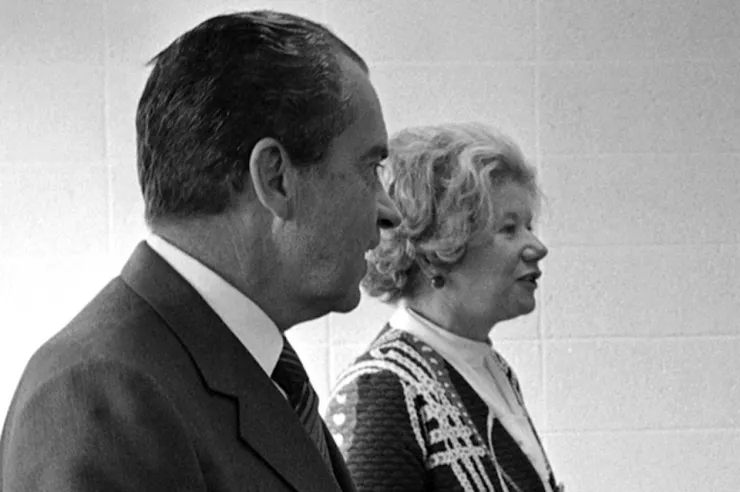
Growing up in Boston, Mary McGrory was an Irish girl who came to love politics and the written word. Ethnically and politically, President Kennedy was a natural hero to her. In 1963 she wrote movingly of his death and funeral. In one column was this paragraph:
“He was just home from the Pacific when I first saw him in 1946. He was thin as a match and still yellow from malaria. But he was blithe and determined and wherever he went he was surrounded by young men who felt with him that the Irish had something more to give to American political life than a last hurrah.”
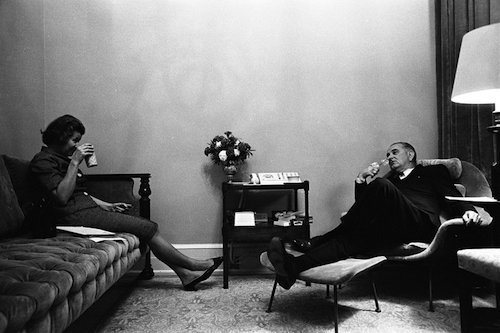
McGrory knew every president for 50 years, including LBJ, talking with her here outside the Oval Office in 1965. (Photo courtesy of LBJ Presidential Library)
McGrory was a book reviewer for The Washington Star in 1954 when her editor sent her to write columns about the Army-McCarthy hearings. This launched her into a career during which she wrote about every president and every big Washington story for nearly half a century. For many of those years she wrote four columns a week.
Along the way McGrory made Richard Nixon’s enemies list – and had she kept one, he would no doubt have made hers.
In 1975, she won the Pulitzer Prize in Commentary for her columns on the Watergate scandal. This one ran on Feb. 3, 1974. It is all about Nixon, even though his name appears in it only once – in the final sentence.
Situation comedy
By MARY McGRORY
The town needed a laugh, heaven knows, but who would have thought that the president, of all people, would provide us with 45 minutes of low comedy in, of all things, his State of the Union message?
Basically, it was situation comedy. Here was a president facing impeachment, waiting for the multiple indictments of his closest aides, fighting off a court summons from one of the “two finest public servants” he has ever known, hanging onto his great office by his fingernails.
This heavily made-up man on the podium spoke of himself as a miracle worker. He has cleaned the air and made peace. He has reduced subsidies. He will bid the waters of recession recede, and they will obey. He will heal the sick with a health plan that will not require new taxes.
The only possible reason for turning him out of office, as he told it, would be that he is too good for us.
The Republican members of the Congress, who know that his persistence spells their ruin, went along with the gag, clapping wildly at every opportunity. They heard him patiently and encouragingly as one would listen to a man who has been declared bankrupt telling of his plans for a new killing on the market or the purchase of the state of Florida.
The great joke of the evening, however, was the president’s straight-faced declaration of his promise to protect the privacy of the individual citizen.
Here is the man who authorized the larcenous plumbers, taped his every unsuspecting visitor until discovered, who shocked even J. Edgar Hoover with his spy schemes, whose staff bugged each other. Here he is announcing “a major initiative to define the nature and extent of the basic rights of privacy and to erect new safeguards to insure those rights are respected.”
It was as if Dracula had suddenly proposed to establish a blood bank.
The chairman of the Joint Chiefs of Staff, Admiral Thomas Moorer, looked unconcernedly off into space during the passage. He had lately been revealed as the receiver of documents stolen from the office of his commander-in-chief. Perhaps he thought it had nothing to do with him, since the president was inveighing against “electronic surveillance” and the admiral had used human agents for his espionage.
The new attorney general, William O. Saxbe, who authorized three new wiretaps in his first week in office and hopes others will require less fuss, applauded lustily.
The secretary of state, Henry Kissinger, who was into wiretapping himself, had the grace to look faintly amused.
In the postscript to the speech, the president’s newfound concern for the privacy of individuals was revealed in its full dimension. Obviously, his own will be protected first.
He called for an end to investigations of what he always refers to as “the so-called Watergate affair” – the Republicans again interrupted him with possibly heartfelt applause. He recognized patronizingly that the House Judiciary Committee has a “special responsibility,” and he declared that he would cooperate in “any way I consider consistent with my responsibilities” – by which it was generally understood they could go fish.
The sound of hissing was heard in the chamber, a historic first, and it came from people who by this time had wearied of the travesty.
The Republicans gave him a standing ovation. If it wasn’t his swan song, it was theirs. If he survives to give another January Fantasy, they don’t expect to be around to hear it.
That was the reality that was carefully blotted out in the chamber. So the Republicans chatted, smiled and clapped for what every last one of them hopes will be Richard Nixon’s last State of the Union.