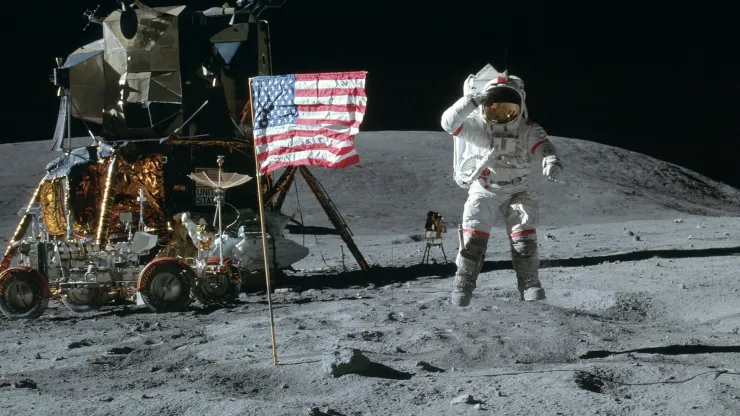
On July 20, 1969, Apollo 11 Commander Neil Armstrong and Lunar Module Pilot Buzz Aldrin became the first humans to walk on the surface of another world. While the former test pilot and aerospace engineer emerged from the lunar module Eagle with the objective-oriented precision that had defined their respective careers since the Korean War, a future Pulitzer winner and White House staffer was forced to prepare for the worst case scenario.
One of only a handful of Pulitzer recipients (including Katharine Graham, Abe Rosenthal and Walter Lippmann) to also receive the Presidential Medal of Freedom, 1978 Commentary winner and former Pulitzer Prize Board member William Safire followed a unique and varied career path.
Combining an interest in linguistics and etymology — his "On Language" column was a mainstay of the New York Times Magazine — with libertarian-conservative politics on the newspaper's opinion pages, Safire was lauded for "his thoughtful analysis of our national discourse and, of course, his wonderful sermons on the use and abuse of language" by former New York Times Publisher Arthur Sulzberger Jr. following his death in 2009.
Raised in New York City, Safire graduated from the elite Bronx High School of Science before pursuing two years of studies at Syracuse University. After dropping out, he worked as a journalist for the New York Herald-Tribune, WNYC-TV and the Armed Forces Radio Network, cultivating a range of contacts from Lucky Luciano to Ingrid Bergman.
Upon completing his military service obligation, Safire moved into the nascent field of public relations. Representing a consortium of entities that furnished a model American suburban house at the 1959 American National Exhibition in Moscow, he snagged a major coup when Vice President Richard Nixon initiated an impromptu debate with Soviet First Secretary Nikita Khrushchev at the home.
That "Kitchen Debate" was recorded on videotape (a novel technology embedded in the house) and broadcast on the three major networks of the era. It also provided Safire's entree into politics; over the next decade, he worked as a speechwriter and public relations consultant for the liberal wing of the Republican Party, including New York Governor Nelson Rockefeller and New York City Mayor John Lindsay.
After Nixon vanquished Hubert Humphrey in the 1968 presidential election, Safire joined the White House speechwriting staff alongside rising media stars such as Pat Buchanan and David Gergen. Despite his past associations with Rockefeller and Lindsay, he became known for early culture-war invectives in his work for Vice President Spiro Agnew, characterizing the media as "nattering nabobs of negativism" in a 1970 speech. (Following the Vietnam War Moratorium protests of November 1969, Agnew would lambaste the "national masochism [...] encouraged by an effete corps of impudent snobs who characterize themselves as intellectuals" in a statement that may have been drafted by Safire.)
In the summer of 1969, he was offered an altogether different kind of assignment by White House Chief of Staff H. R. Haldeman.
When Apollo 11 was launched on July 16, 1969, the inherent dangers of the undertaking were subordinated by the overarching objective articulated by 1957 Biography winner John F. Kennedy years earlier — to send an American astronaut to the moon by the end of 1969. Yet four astronauts died in training jet crashes throughout the decade, while the Apollo 1 disaster of January 27, 1967 prompted a 22-month delay in the program as design and logistical flaws were rectified.
During that period, Brian O'Leary — a young planetary scientist and protégé of 1978 General Nonfiction winner Carl Sagan who had been selected as an astronaut in 1967 for his expertise on a potential manned mission to Mars, then tentatively envisaged for the 1980s — resigned from the astronaut corps after determining that the risks were simply too high.
Safire was assigned to draft an address that would have been delivered by President Nixon to the American people if Armstrong and Aldrin had been marooned on the satellite after the failure of the lunar module Eagle's ascent stage.
"[T]hey'd have to be abandoned on the moon, left to die there," Safire told NBC's Tim Russert in 1999. "The men would either have to starve to death or commit suicide." After cutting off contact with the crew following Nixon's address, a member of the clergy would have overseen an on-air funeral adapted from the Navy's sea burial protocol.
Although Nixon was ambivalent toward the space program — long-range Apollo Applications Program survey missions and the Mars program were sacrificed for the Vietnam War, while Tom Paine, a Johnson administration holdover, was retained as NASA administrator to deflect the blame for any failure onto the Democratic Party — Safire's speech offered an understated eloquence.
"Man's search will not be denied," the never-delivered speech concluded. "But these men were first, and they will remain foremost in our hearts. For every human being who looks up at the moon in the nights to come will know that there is some corner of another work."
At 21:35 UTC on July 21, the ascent stage of Eagle successfully docked with the command module Columbia, making Safire's speech extraneous. While the subsequent "successful failure" of Apollo 13 (stemming from an oxygen tank explosion in the unmanned service module that forced the crew to seek shelter in the lunar module for much of their abbreviated journey) was the only lunar mission that did not fulfill its basic objectives, there is no evidence that the administration revised Safire's speech. In contrast to the anticipated events of Apollo 11, any fatal event would have been largely contingent on a spontaneous systems failure.
Shortly before his death, Deke Slayton — the medically-grounded Mercury 7 astronaut who selected the Apollo crews as NASA's director of flight crew operations before returning to flight status in 1971 — reflected on a career that stretched from World War II dogfights to the dawn of the private space industry. "I don't recommend that you stop taking risks — even the turtle cannot proceed without sticking out his neck," he said. "But recognize that the good Lord has your number, and when it comes up, be prepared. You may not get as many chances as I've had."
While Safire's recollections of his White House tenure ultimately were clouded by the revelation that his conversations with the president, like so many others, had been taped without his consent, his preternatural comprehension of the existential terror underlying every successful spaceflight resulted in one of the finest examples of presidential speechwriting.
Read the full speech at the National Archives' website.
Related
Shortly after receiving the 1969 General Nonfiction Prize, Norman Mailer wrote "Of a Fire on the Moon," his account of the Apollo 11 mission, as a serial for Life magazine between August 1969 and January 1970. It was collected in book form in 1971.