
To launch a Society of Professional Journalists project squarely aimed at answering why another record high of news consumers doubt the veracity of journalism and journalists, veteran newsman Rod Hicks in January 2019 made Casper, Wyoming his first stop for a series of listening sessions with local residents.
“Wyoming has the highest level of media distrust in the country,” said Hicks, the first news professional to be tapped as SPJ’s Journalist on Call, created in 2018 to serve as a troubleshooter and bridge-builder between newsrooms and their audiences. “We’re hoping that, when this is over, we will have a better understanding of why people distrust the news and some strategies to help news organizations win those people back.”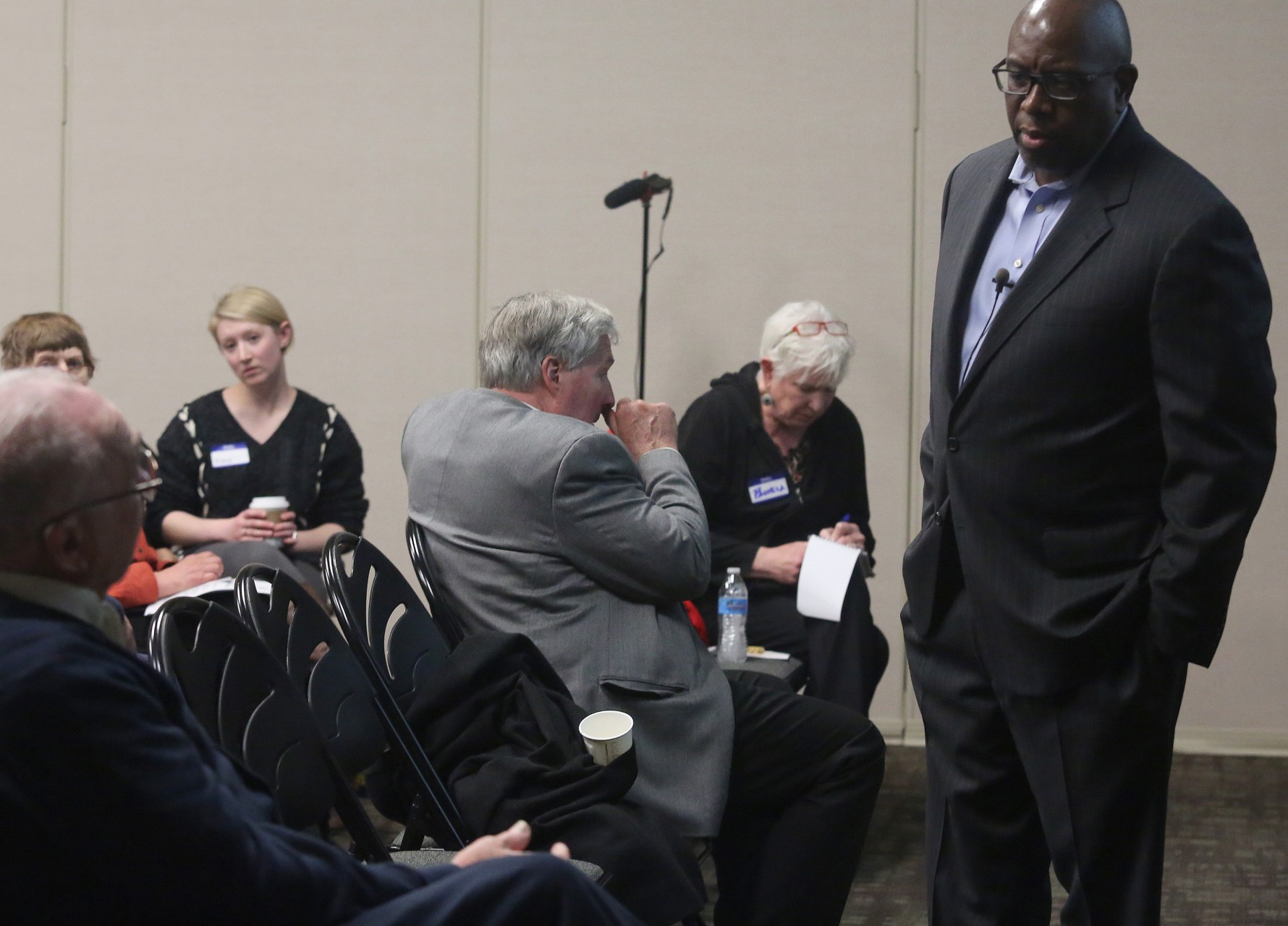
Rod Hicks speaks with Casper, Wyoming residents. Photo: Elysia Conner/Casper Star-Tribune
A former editor, most recently, at the Associated Press, Hicks — speaking to the Pulitzers on the eve of his second trip to meet with those Casper residents — is leading one of several endeavors to shore up trust in the news industry and what it delivers. Those efforts aim to hone the news-consuming public’s capacity to distinguish straight-ahead news from the 24/7 news cycle’s pervasive commentaries, and to separate facts from fictions in a broad media-scape where news organizations, without merit, often get lumped in with information purveyors who don’t do journalism and are not bona fide journalists. Apart from SPJ’s Journalist on Call, those endeavors include The Trust Project, Duke University’s DeWitt Wallace Center for Media & Democracy, Trusting News and others.
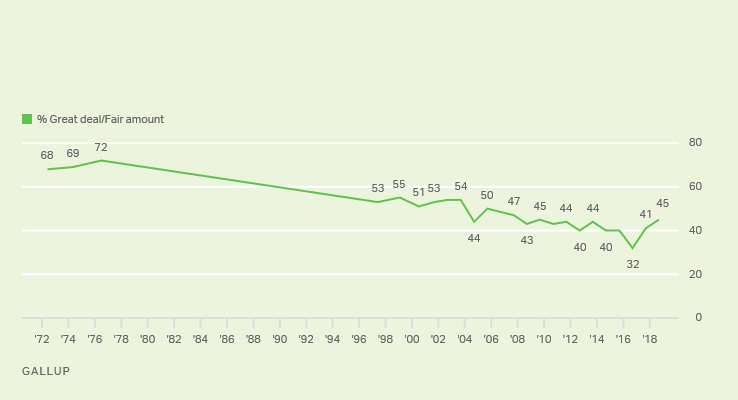
Answer to the question, "How much do you trust the press?"
Lately, there’s been plenty of caution about the dangers of deferring to, say, a White House trafficking in a run-on of untruths. Indeed, CNN’s Facts First ad campaign, with its “Lies can become truth, if we let them” refrain, and The Washington Post’s “Democracy Dies in the Dark” 2019 Super Bowl ad, spotlighting world-altering headlines and murdered journalists, have been employed in that fight to defend the newsrooms that are upholding the highest standards of their craft.
But well-serving both news consumers and news distributors, in these times, demands additional, protracted measures, said former journalist Sally Lehrman, senior director of the Trust Project and director of Santa Clara University’s Markkula School of Applied Ethics, where the project is based.
The Trust Project, partnering with Google, Facebook and Bing, is giving The Washington Post and 74 other large and small, broadcast, online and legacy print newsrooms in the United States, Canada, United Kingdom, Germany, Spain, Italy and Greece tools to be more deeply engaged and more transparent with their audiences. Called “trust indicators,” those best-practices tools can make a real difference, said Lehrman, adding that several Brazilian news organizations, this summer, will join The Trust Project.
The Daily Mirror, for example, Lehrman said, saw readers’ trust in what that U.K. newsroom publishes surge by 8 percent after the Mirror plainly posted some indicators on its website. Those indicators, she added, give news consumers answers to such questions such as “What are your news policies and standards?” “Who owns your organization?”
“Maybe a newsroom will choose to write information about who authors their news, which may seem a little more difficult to do. But even that can be put out there,” said Lehrman, who wrote “News in a New America,” among other books. “We work closely with newsrooms to implement these things.”
As a current John S. Knight Foundation Fellow at Stanford University, Online News Association President Mandy Jenkins is researching distrust of the news media and plans to submit her findings — and the solutions they prompt — to newsrooms. Among other tasks, she is conducting hours-long, in-depth interviews with skeptical news consumers. It’s critical for them and news providers alike to expand their two-way conversation, she said. Journalists, especially, must earnestly lend more of an ear to what their critics have to say.
“The trust people have in media affects what kind of news they will seek out,” said Jenkins, a former editor at Storyful, which bills itself as a “social media intelligence” entity, analyzing digital content. “It isn’t just political partisanship that’s driving this distrust. There are lots of people who don’t like seeing opinion in their news and having all of that mixed together … And they don’t feel like journalists — many of whom don’t live in their communities — have skin in the game. A lot of that is driven by the lack of local [coverage by local journalists] … A lot of its driven by national journalists parachuting in, then leaving town.”
Rebuilding trusts, Jenkins added, requires teaching average citizens what’s what, especially as perpetually available online news continues to disrupt longstanding industry conventions.
“The Washington Post used to [only] put out a newspaper where everything was labeled by section,” Jenkins said. “The way things are broken apart online, the separations are much less distinct … which leaves readers left on their own when it comes to consuming all this stuff … I wouldn’t call them lazy for using digital tools to wade through the thousands and thousands of pieces of information. It’s just much harder for people to find the best version of what they landed on. Sometimes people just don’t know what they’re looking at.”
She noted, for example, an assiduous news consumer she’d interviewed for her Knight Fellowship research. He was a reasonably savvy guy, trying to stay informed, but had been wrongly convinced that Hillary Clinton was somehow connected to Democratic National Committee employee Seth Rich’s murder: “He completely bought into the conspiracy theory. And that’s because this guy originally saw that story in his Apple News app feed. He didn’t think about the source … His original source was from Fox, which Apple would say is a mainstream news source. Bad actors, even in mainstream media, are putting out these stories. And Fox isn’t the only bad actor.”
Said 2009 Pulitzer winner Bill Adair, the founder of PolitiFact, the fact-checking website, and director of the DeWitt Wallace Center at Duke: “We have to recognize that we live in such a chaotic information age. People need trusted brokers to help them figure out what’s true and what’s not.”
For its part, he added, the audience relying on fact-checking like that conducted by PolitiFact is “way too small.” That reality, Adair said, prompted the DeWitt Wallace Center, with Duke students, to create Squash, a tool that is being beta-tested. Squash will “put the fact-check right in front of you, on the video screen, as you see what’s being claimed in some [purported] news story. … We’re now improving the voice-to-text and search algorithm part of this … Within six months, we’ll have a pretty good product to release to the public. This has long been the dream of many of us.”
Those who hold the news industry suspect shouldn’t be punished for their distrust, SPJ’s Hicks said. “I hesitate to blame the public for any of this. People are who they are. And we must, we just have to figure out how to serve them.”
“If we, as journalists,” said investigative journalist Lynn Walsh, assistant director of Trusting News, “take a moment to explain what we’re doing, talk about what we’re doing, listen to our audience more … these trust issues can take a 180-degree turn and we can regain some of the trust we’ve lost.”
“Journalists,” said Aaron Sharockman, PolitiFact’s executive director, “can do a much better job of telling their story. We’re good at other people’s stories. But we sometimes fail at explaining what we do. At PolitiFact, we take time to explain that what we do is not willy-nilly, that no fact-check is done by one person, but it’s done by three editors. Every story includes a source list of people we spoke with, the experts.”
That’s a vital undertaking, he added: “A typical journalist might quote the president or governor or mayor accurately but they don’t necessarily fact-check those quotes. Some good journalists will take the time to figure if the stuff inside the quote marks is true. But some don’t have the time or don’t know how … We know that lots of journalists also rely on the work we’re doing.”