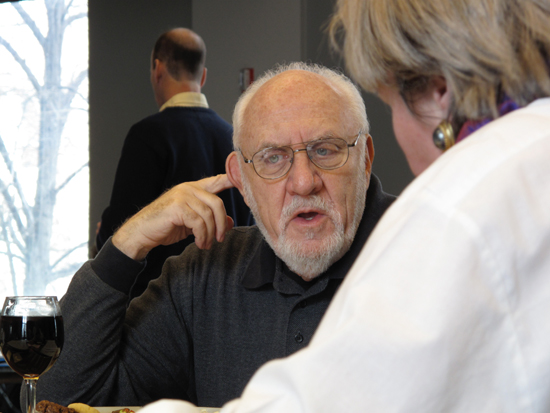
Martin Bernheimer
Martin Bernheimer, the chief music and dance critic of the Los Angeles Times for 31 years, faced this question in 1981 when he set out to write the obligatory reflection on the 80th birthday of Jascha Heifetz, the legendary violinist. Heifetz lived in the neighborhood (Beverly Hills), but he had not made a major public performance in years and declined interview requests.
Bernheimer’s challenge was to write an appreciation that was honest, balanced and engaging without falling into an obituary tone. After all, Heifetz was absent, not dead.
Bernheimer went to work with what he had, which turned out to be plenty. He succeeded well enough that the piece, published on Feb. 1, 1981, was part of a portfolio that won him the 1982 Pulitzer Prize in Criticism.
Heifetz at 80: a legend in seclusion
It was Sept. 20, 1970. Jascha Heifetz — at that point in his career he preferred to be billed simply as Heifetz, and it was enough — was playing the violin at the Théâtre des Champs-Elysées in Paris.
An excited, select audience watched in the auditorium. Before long, much of the world would watch via a television documentary destined to become an instant historical landmark.
Heifetz, then 69, played the Bruch “Scottish Fantasy.” Not everyone would regard its gentle romantic clichés and harmonic platitudes and pyrotechnical indulgences as the stuff of which great music is made. That didn’t matter. When Heifetz played it, it sounded like great music. The gift of elevating trivia to art had always been one of his specialties.
When the concert was over, the audience did what it had to do. It rose and cheered. With Heifetz, standing ovations were, without doubt, deserved. They were expected, too.
Courtly and fastidious as always, Heifetz returned to the stage for five calls. Although it wasn’t his style, he managed a reasonable facsimile of a smile. Then he raised an imperious hand and spoke to the Parisians, in English:
“For those of you who liked it, thanks. For those of you who didn’t, perhaps we’ll catch you next time.”
There weren’t many who didn’t like it. And there weren’t many next times.
Heifetz did join his old friend and colleague Gregor Piatigorsky for some chamber music at a USC benefit in April 1972. Six months later, he gave what was to be his final recital, a taxing program at the Dorothy Chandler Pavilion. At the end, he offered a single encore and an eloquent confession: “I am pooped.”In 1974, he showed off some of his students at a deceptively modest USC concert. It was billed, and punctuated, as an “Evening of Music and Surprise!?” Everyone knew, of course, what the surprise would be: Heifetz, Piatigorsky and the pianist Brooks Smith, plus assorted students taking turns, in the Dvorak A-major Quintet.
A month later, Heifetz materialized at USC to play the soprano part of Villa-Lobos’ “Bachianas Brasileiras” No. 5 on his violin, while Piatigorsky and his scholarly entourage attended to the conventional cello duties. Later, Heifetz and Piatigorsky volunteered the Handel-Halvorsen “Chaconne” as an encore.
Then it was over. No fanfares. No farewells. Jascha Heifetz would continue to teach, after his fashion. He would turn up in public places from time to time, to support pet ecological causes, to campaign for the implementation of the emergency telephone number 911, to demonstrate his smogless electric automobile, to bestow benediction upon a favored student ...
But the days of performing for an audience, the days of fiddling superstardom, the days that revealed Heifetz as a functioning metaphor for supreme virtuosity — these were days of the past. In 1975, he underwent shoulder surgery that made a career cadence imperative. As befits a legend, Heifetz withdrew to his own secluded hilltop, in Beverly Hills, and observed a changing world.
He issued occasional pronouncements, when, where and to whom he pleased. He did not just refuse interviews, he refused even to decline invitations for interviews. He ignored requests for photo sessions. He continued to do some teaching — token teaching, his critics might say — and to guard his sacred privacy.
Monday, Feb. 2, we will celebrate his 80th birthday. Virtually no one seems to know where Heifetz will be on this potentially festive occasion, or how — even if — he will celebrate. That, no doubt, is the way he wants it.
“My last party was a big one,” he told a favored reporter a year ago. “It started early in the morning and lasted until quite late in the evening. That was when I was 50. I said then, that was it, and I think I have kept my word.”
The violinist’s friends, admirers and self-appointed boosters have never really accepted their hero’s Garboesque demand for solitude.
“People, Heifetz has said, “try to break (my word) for me, but they haven’t been very successful. I’m sure they mean well, but I don’t want to be put on a pedestal.”
He doesn’t have much choice in the matter.
All — repeat, all — experts agree that Heifetz, in his prime, was one of the greatest violinists of the century, perhaps even one of the greatest in history. Some experts regard him unequivocally as the greatest.
Other violinists play, or have played, with greater warmth, with loftier taste, with more concern for musicological purity or expressive profundity. Few, if any, play, or have played, with comparable perfection.
Heifetz commanded his instrument, totally. He could do anything, and do it with diabolical ease and even with a semblance of cool disdain. He never let his listeners know that the violin could be prone to pitch problems. His tone always was a model of purity, his phrasing a model of suavity.
Heifetz was magical and magnetic, whether assaying the noblest concertos or the most insignificant circus miniature. He brought the same fierce concentration, the same finesse, the same aesthetic dedication to both.
He was, fundamentally, a romantic. Anyone who started playing at the age of 3 in the Russia of 1902 would have to be. Anyone who studied with Auer at the St. Petersburg Conservatory would have to be.
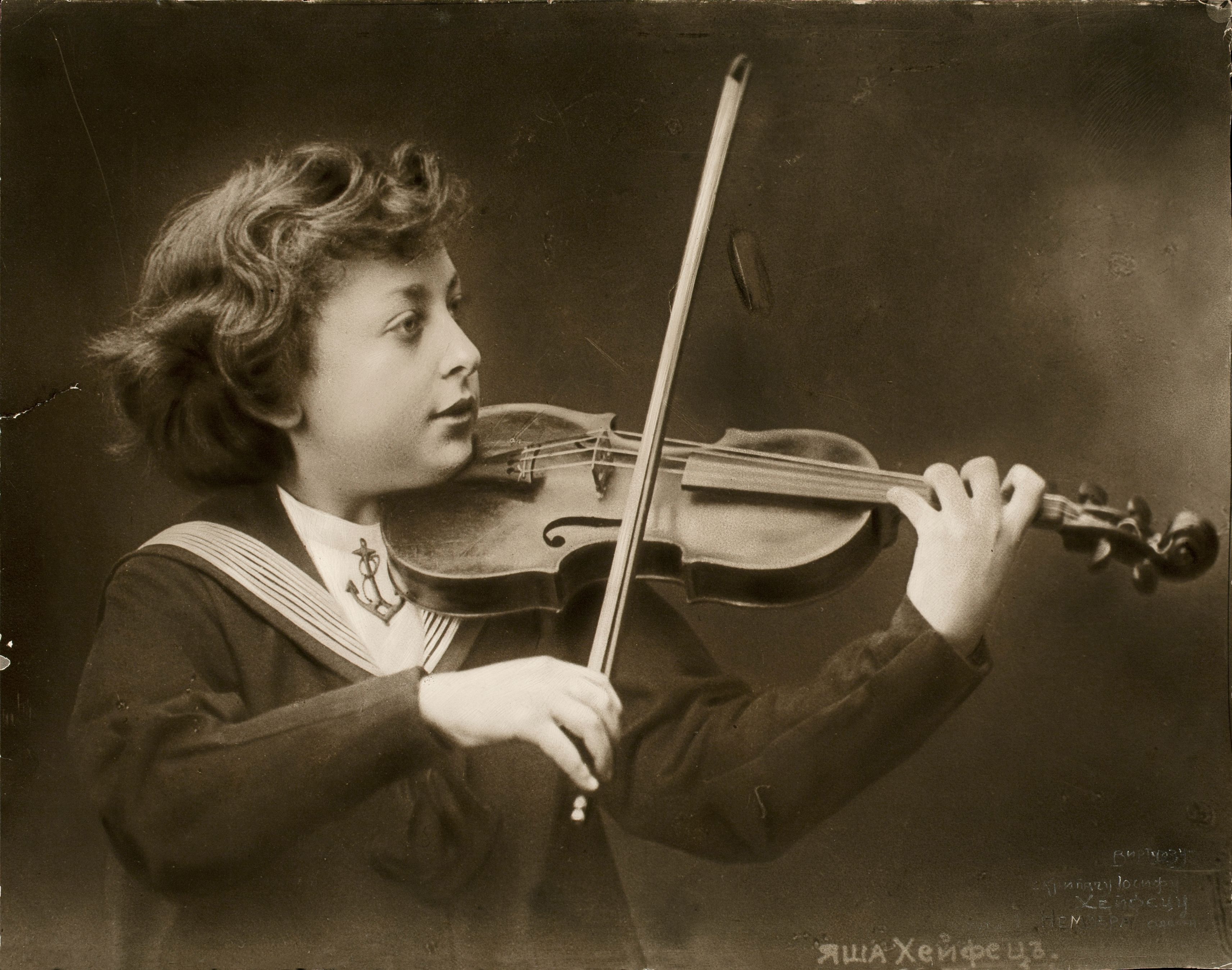
Heifetz at age 6.
Heifetz made his official St. Petersburg debut in 1911. He triumphed with the Tchaikovsky Concerto under Nikisch in Berlin a year later. In 1917 he made his Carnegie Hall debut.
That was the famous afternoon when Mischa Elman, another celebrated violinist, reportedly complained that the hall was hot. “Not,” replied Leopold Godowsky, “for pianists!”
“Hats off, Gentlemen, a Genius!” gushed the headline for one of the more restrained reviews. The writer went on to discuss a “transcendentally great violinist,” an “element almost preternatural enveloping his art,” a “huge audience that seemed to hold every violinist within a radius of 200 miles,” and “hearers transported with joy.”
Critical lingo became somewhat deflowered over the succeeding decades; still, the aura of critical approval remained constant. Heifetz visited a recording studio in New York within days of his New York debut, and the distant sounding mementos of that visit confirm that the ecstasy stirred by the 16-year-old was justified.
Over the decades, as the violinist turned into a veritable institution, Heifetz delighted in breaking rules. He championed relatively adventurous music by Walton, Prokofiev, Rozsa, Castelnuovo-Tedesco, Korngold and Gruenberg while many of his would-be peers concentrated on hum-along favorites. He joined Piatigorsky, Feuermann, Rubinstein, Primrose and other comparable giants for inspired chamber music while other star violinists limited themselves to solo exposures. He transcribed anything from Gershwin’s “Porgy” to Dinicu’s “Hora Staccato” in quest of individualistic showpiece-morsels. He welcomed technological advances and once actually played both solo parts in a recording of the Bach D-minor Concerto for two violins.
He was, like him or not, an original, a force, a wizard.
Those who didn’t invariably like him complained of a certain slickness in his interpretations, of a quest for speed for its own sake, of a penchant for the glittery effect. Virgil Thomson, in his notorious Herald Tribune review of Oct. 31, 1940, discovered “silk-underwear music.”
The New York critic complained that Heifetz “sacrifices everything to polish.”
“To ask anything of him,” Thomson added, “is like asking tenderness of the ocelot.”
Even Thomson, however, had to make one crucial admission: “The fellow can fiddle.”
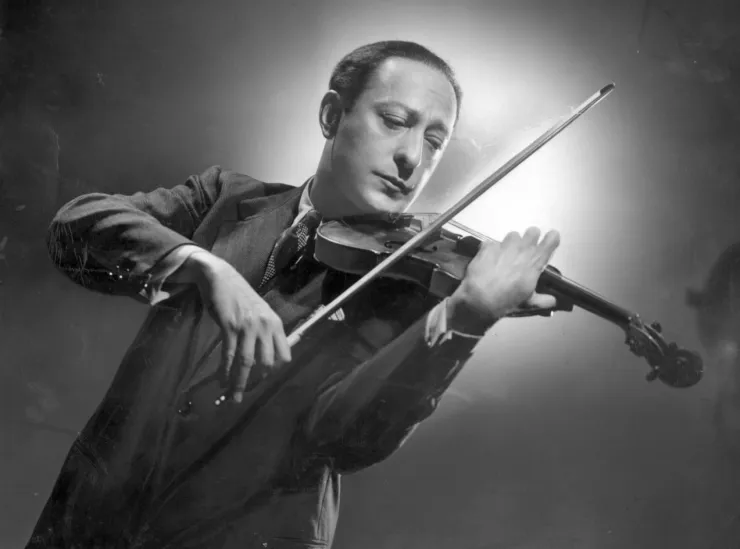
Heifetz fiddled without fuss. He did not swoop and swoon and sweat like so many of his rivals. He held his right elbow high, turned his head to gaze intently at his fingers while playing. He did not smile, could not play overtly to an audience. For him, making music meant control and discipline.
He tries, no doubt, to impart similar attitudes to his hand-picked students. He discourages them from making premature debuts, from indulging in glamorous jet-propelled pursuits, even from following the short-cut lure of the big contests. This has not made him universally popular and, ironically, he has not yet produced a notable number of successful protégés. Perhaps he is too demanding.
Or too intimidating.
Even now, nine years after Heifetz’s last major appearance in concert, his standard remains the gauge of any violinist’s achievement. Even now, he is a formidable influence, and a symbol.
“Kreisler is king,” wrote Herbert F. Peyser in 1918, “Heifetz is the prophet, and all the rest, violinists.”
Long live the prophet.