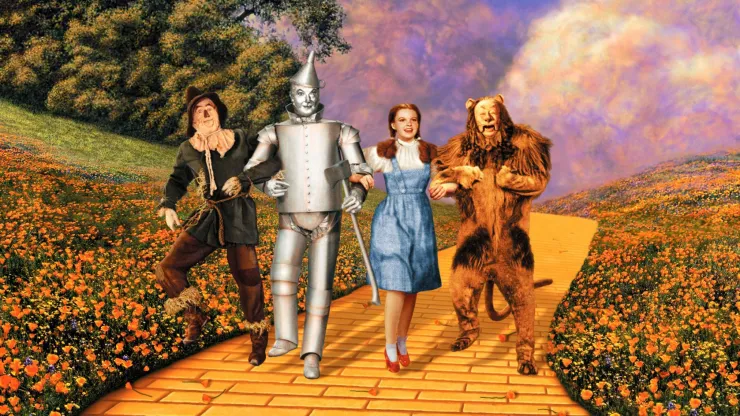
Before streaming, before DVDs, before VCRs, Hollywood guarded some of its treasures, releasing them only at intervals for theater or television revivals. One of these was The Wizard of Oz.
On the day of the 1979 televising of Dorothy’s pilgrimage, the critic William A. Henry III took a fresh look at the classic film.
Henry grew up in New Jersey and graduated from Yale University. As a reporter at The Boston Globe, he was part of the team that won the 1975 Pulitzer Public Service medal for coverage of the city’s integration crisis. His television reviews won him the 1980 Criticism prize. He died of a heart attack 14 years later at the age of 44.
Here is his March 23, 1979, preview of America’s trip down the yellow brick road.
‘As in all magical places no one seems to have a job’
By WILLIAM A. HENRY III
The most successful program in the history of television returns tonight. Its cumulative audience over two decades is nearing one billion. Its popularity is undiminished despite annual exposure. It appeals across lines of age, race, class and politics. Remakes only enhance its status as “the original.”
And in a medium fervid for the new, the sexy, the trendy, and the specially-made-for-TV, The Wizard of Oz (Channel 7, 8 p.m.) is all the more remarkable because it is a 40-year-old sentimental movie musical about a little girl’s bad dream.
Its dialogue created catchphrases that circulate still — “follow the yellow brick road,” “over the rainbow,” “wicked witch of the West” (used for everyone from Jane Fonda to Phyllis Schlafly).
Its characters — the Tin Woodman, the Cowardly Lion and the title figure, a vast inflated balloon and voice machine operated by a timid little fraud of a man — have become archetypes, honored in a thousand parodies.
Its star, Judy Garland, seems all the more poignant as a plain farm girl thrust into a glittering city because we remember how the adult Garland was dazzled, morally blinded, by life.
Though devoid of bloodshed the plot is as full of terror as any, in part because the Wicked Witch’s flying monkeys look and sound so much like the devils in John Milton’s Paradise Lost, primal incarnations of pure evil.
The themes — that the purest place in America is the Heartland, that city life and authority figures are dreams and only the land is real, that for all its pains and pallid pleasures there is no place like home — are the themes of our great national myth, the myth of the Frontier.But there are other movies with archetypes, other movies imprinted with the heroism of the Western, other movies about good and evil. There are equally tuneful musicals.
But none has held a television audience for so long.
The Wizard of Oz has special appeal because it is, or seems, sexless. Dorothy is too young to feel passion. The witches and Munchkins are non-human (although by all accounts the dwarfs and midgets in the cast were friskier than chorus girls and sugar daddies). The Tin Woodman, Cowardly Lion and Scarecrow lack the brains, nerve and heart to love. And in all Oz there appears no mate for Toto, the dog.
The sexlessness may make parents comfortable about having children watch The Wizard. The children are made eager — and remain that way into adulthood — because of the unique magic of the place, Oz.
Like medieval England, Oz is divided into north, south, east and west territories administered by the equivalents of dukes, the witches, and a central city ruled by an all-powerful unseen king, the Wizard. He in turn is a sort of Connecticut Yankee, using the primitive technology of vaudeville to hoodwink the true believers.
As in all magical places no one seems to have a job. No one goes to a factory or tills the soil all day. But when we finally get behind the curtain of the great chamber of Oz, we discover that the most privileged figure of all has the most onerous duties in the kingdom, puffing and straining to make Oz billow and bellow, maintaining the fraud that lets politics work.
The magic rarely depends on henbane, toad of newt, eye of bat. The most potent spell of all is cast with water, which melts the wicked witch as quickly and effectively as it undoes a wanton child struggling against taking a bath.
The whole world is in primary colors. The yellow brick road is almost luminous. The Emerald City pulsates with applegreen light. The buildings have the arched ornament of art deco, save for the castles, which are all battlements, turrets and perilous outdoor stairs. Somehow the designers managed to place people into a child’s picture book of the past, the present and the Kansas notion of the future.
The people of these faraway places, the Cowardly Lion, the dancing Scarecrow, the witches and Munchkins and the all-powerful Oz himself, want nothing more than to be plain folks, like Dorothy, like us. They believe there is no place more enchanted than a white frame farmhouse.
They cannot come with Dorothy, except in her mind’s eye, and when she awakens from her travels, as we awaken from the narcotics of a movie, she tells herself it is only a dream, if a persistent one. For us it persists yearly, and deludes us that our fantasies haven’t changed.