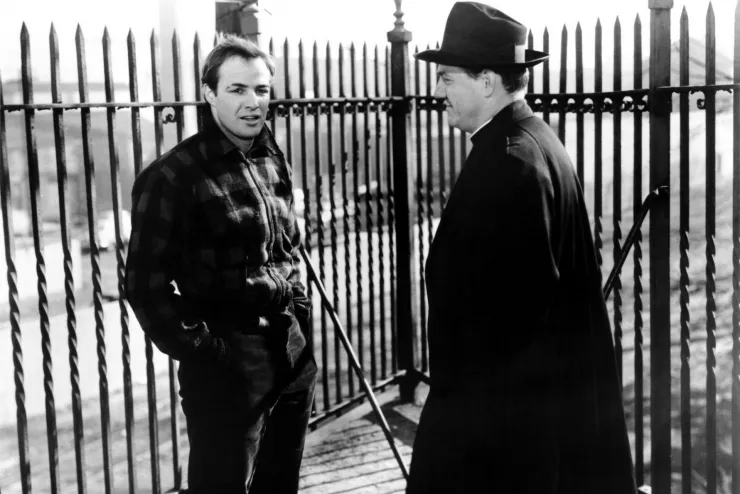
Released 65 years ago this fall, Elia Kazan's "On the Waterfront" transcended the controversies surrounding the director's cooperation with the House Un-American Activities Committee at the height of the Second Red Scare to emerge as a canonical work of postwar American cinema.
An exploration of violence and corruption among dockworkers in Hoboken, N.J., the film features performances from Marlon Brando (who delivered the memorable "I coulda been a contender" monologue), Karl Malden, Rod Steiger and Eva Marie Saint.
Envisaged by Kazan as an allegory for his reputation among his peers, the film turns away from a Hollywood establishment that was ambivalent toward the project, an attitude encapsulated by Darryl F. Zanuck's barb on declining to finance the film: "Who's going to care about a bunch of sweaty longshoremen?"
Even devoted fans of classic American cinema may be surprised to learn that "On the Waterfront" is an adaptation of Pulitzer Prize-winning work: namely, "Crime on the Waterfront," a 24-article series by the New York Sun's Malcolm Johnson that received the second prize ever awarded for Local Reporting, in 1949.
The father of 1966 National Reporting winner Haynes, Johnson — known to his family, friends and colleagues as Mike — first cultivated his reputation as an indefatigable foe of the Ku Klux Klan in his native Georgia shortly after graduating from Mercer University in 1926.
Upon relocating to New York for a tour at The Sun that was to have led to the managing editorship of the Macon Telegraph, he was immediately seduced by both the newspaper and the city. Johnson soon emerged as a venerable presence at The Sun and in the broader New York media, co-founding the Newspaper Guild with Heywood Broun (a legacy that reverberates in the current epoch's commitment to media unionization) and writing a popular column centered on Broadway and the city's nightlife in the 1930s. During World War II, he proffered indispensable coverage of the Pacific theater and was one of the first American journalists to tour Hiroshima following the nuclear detonation.
Belying his swashbuckling mien, Johnson remained a steadfast exponent of shoe-leather reporting, and it was this reputation — atypical in an era that saw jobs and beats endure for decades — that led his editor to assign him an investigation of a murder and the ensuing "commotion" among longshoremen on the Manhattan waterfront in 1948.
The timing was fortuitous. Although the New York port (including berths in Manhattan, Brooklyn and New Jersey) accounted for as much as one-third of foreign manufacturing and general cargo trade in the 1940s, it remained a numinous expanse to all but the 100,000 residents who directly depended on it for their livelihood.
In contrast to the seaports of cities such as Baltimore and Seattle, operations at New York's closest analog — South Brooklyn's Bush Terminal, initially characterized as "Bush's Folly" by the circumspect during its construction in the early 1900s — were still predicated to a large degree on costly rail floats (at a subsidized rate set by the Interstate Commerce Commission) to the termini of major rail lines in New Jersey.
While the port had facilitated significant manufacturing and warehousing industries (accounting for about 400,000 additional jobs) and indirectly supported two military installations in Brooklyn during the first half of the 20th century, the advent of cheaper alternatives in the South and West during the war — codified in law by the 1948 Taft-Hartley Act, which allowed states to pass right-to-work laws banning union shops — had all but assured that the old paradigm could not be sustained.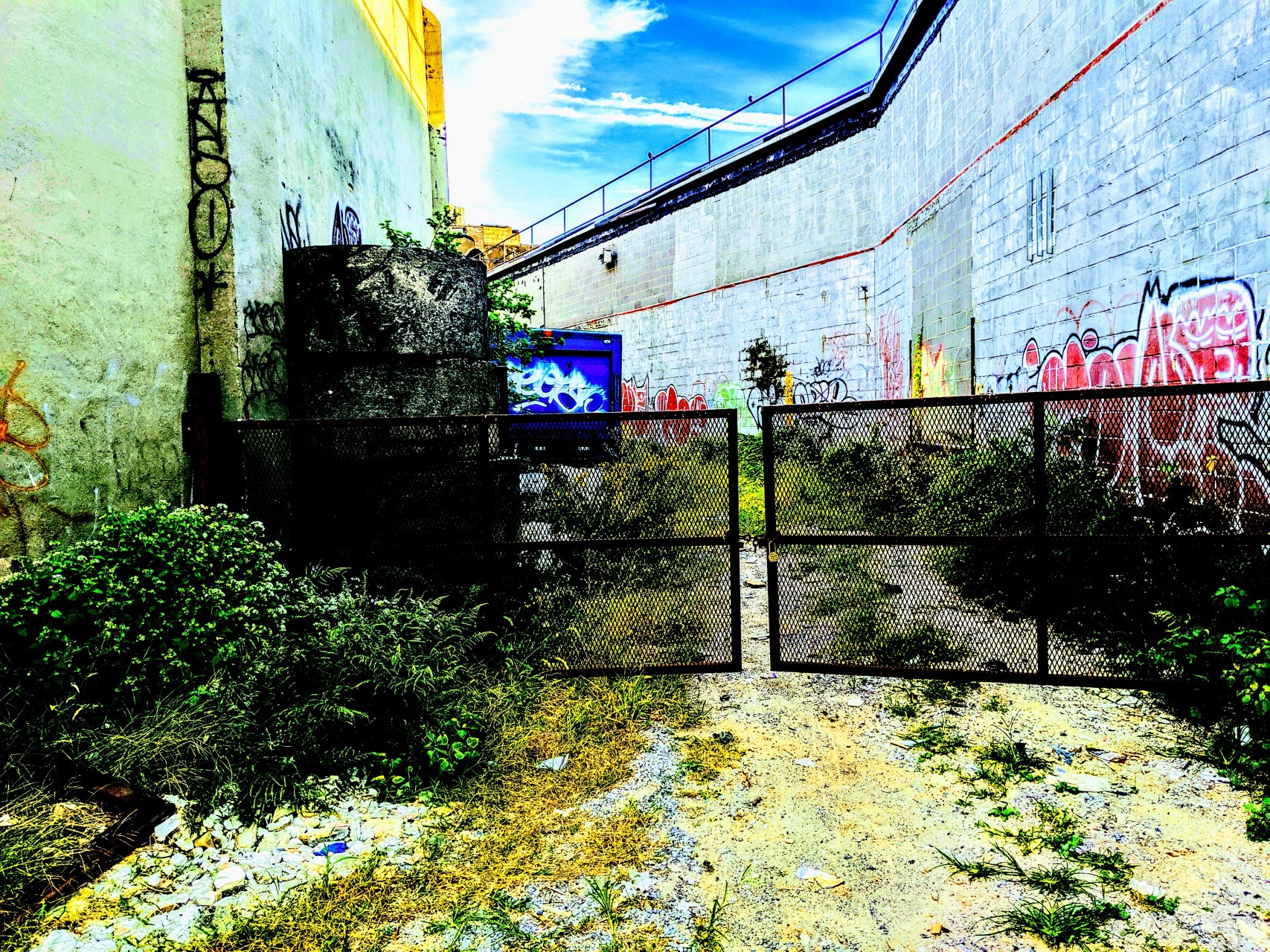
Now often utilized by trucks, rail sidings (such as this berth in Brooklyn's Sunset Park) linked warehouses to car floats and the piers. (Photo/rotoscoping by Sean Murphy)
What Johnson discovered in his meticulous beat reporting (encompassing the original, Pulitzer-winning series and nearly 175 additional articles published by The Sun and Hearst's wire service after the newspaper ceased publication in 1950) ranked among the most astonishing journalistic revelations of the century.
Under the aegis of International Longshoremen's Association (ILA) President Joseph Ryan and a coterie of others, including Meyer Lansky and Albert "Mad Hatter" Anastasia, the docks and the attendant unions has become completely beholden to a criminal syndicate whose very existence was still denied by the FBI.
In a vocation where loss of limb (and even life) was not uncommon, prospective workers — in a field disproportionately comprised of working-class African-Americans and whites of Italian and Irish descent who did not benefit from the upward mobility of the G.I. Bill — were forced to offer kickbacks to syndicate representatives at the daily "shape-up," in which prospective workers were forced to compete against each other to secure work irrespective of union membership. At any time, workers could be virtually blacklisted from subsequent employment for arbitrary purposes in the union's "blue books," their jobs often requisitioned by members of the syndicate who were completing prison sentences.
Persevering against red-baiting from Ryan and his conspirators, Johnson managed to initiate a national conversation on the existence of organized crime. This precipitated the formation of the United States Senate Special Committee to Investigate Crime in Interstate Commerce, whose hearings were dramatized by Francis Ford Coppola in "The Godfather Part II." However, FBI Director J. Edgar Hoover would assign a handful of agents to track the criminal syndicate in the years thereafter, continuing to divert much of the agency's labor to the putative Communist threat.
It was not until the historic Apalachin meeting of 1957, which ultimately resulted in the indictments of more than 60 underworld figures, that the FBI began to investigate organized crime in earnest. Hoover's unabashed inattentiveness remains among the most startling lapses in American history; while speculation ranging from blackmail pertaining to his alleged sexuality and penchant for gambling to the intelligence community's alleged toleration of the drug trade has been furnished by scores of writers, a definitive explanation remains elusive.
Despite these difficulties, Johnson's reporting ultimately succeeded in inspiring tangible reforms (including the establishment of a Waterfront Commission by the Port Authority) while drawing attention to the yeoman work of Father John Corrigan, the activist and "waterfront priest" who inspired Malden's character in "On the Waterfront."
Within a decade of Johnson's reporting, traditional longshoring in the New York port would meet the pangs of its death knell at the hands of the first containerization facility in Elizabeth, N.J. By the mid-1960s, nearly all of Manhattan's piers had been or were in the process of being decommissioned. A 1967 royalty agreement between the ILA and the Port Authority ensured that union members were granted full-time, no-work salaries contingent on their continuing participation in an ersatz shape-up. With large swaths of waterfront-adjacent housing (most notably in Brooklyn's Sunset Park) unable to comply with a 1961 zoning regulation, many workers relocated to Staten Island and the inner suburbs, returning to their past haunts only for the weekday ritual.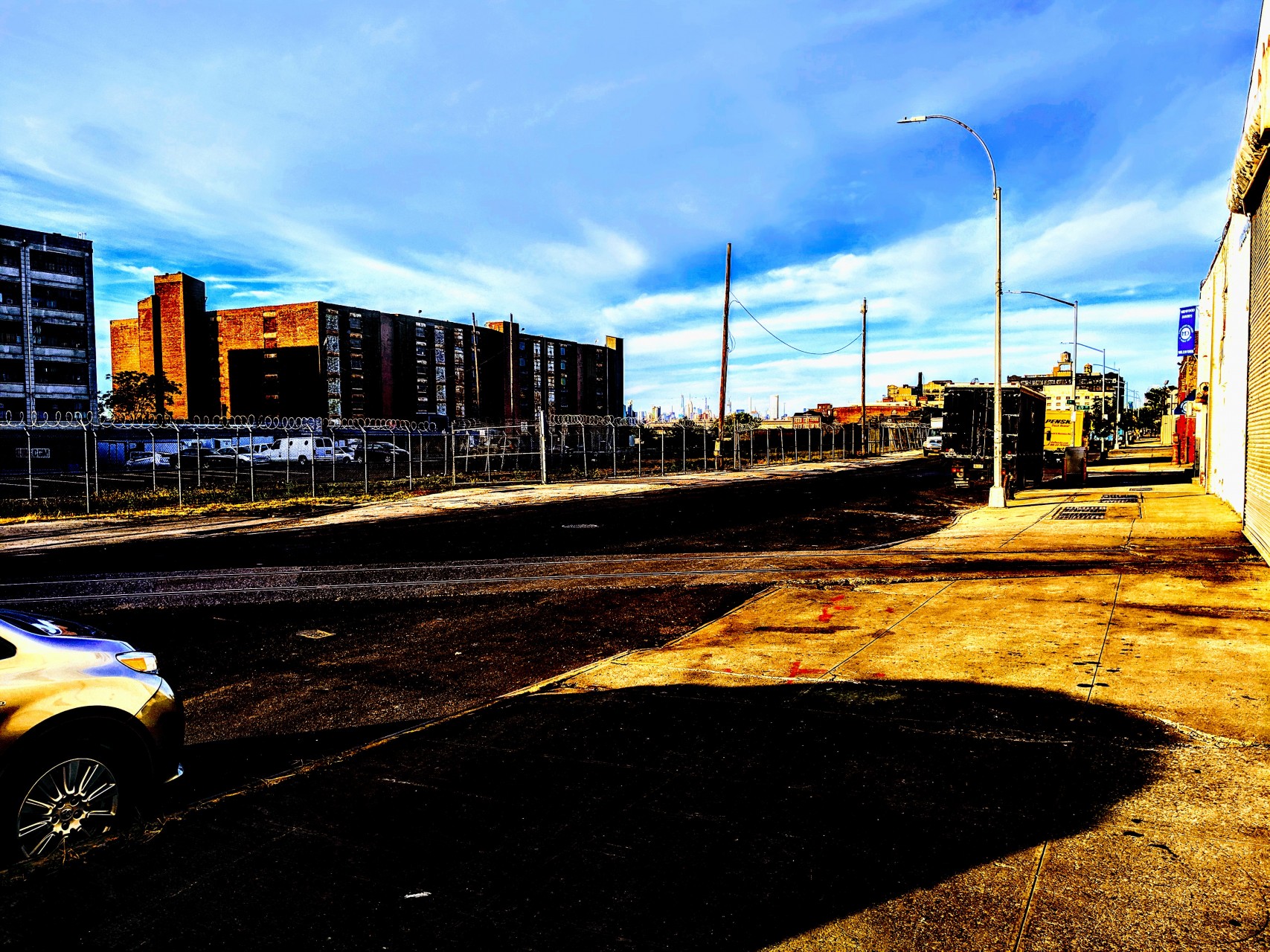
Brooklyn's Sunset Park waterfront retains a modicum of shipping and industrial activity to this day. (Photo/rotoscoping by Sean Murphy)
As the pseudo-shape endured for two decades amid the city's economic struggles, the New York waterfront evolved into a living Rorschach test for adjoining communities. Following a tumultuous era exemplified by a federal mortgage scandal, Sunset Park's waterfront housing stock was refurbished by the post-1965 wave of working-class immigrants from the Caribbean, Mexico and Central America. However, because many of New York's newspapers had shut down by the late 1960s, large swaths of this story remain fragmentary, consigned to the realm of fading memories and Buildings Department records.
Today, the waterfront demystified by Johnson has evolved into a locus for two of the most pressing issues of this decade: hypergentrification and climate change. In revisiting his work, one finds not just the commemorative nostalgia or the quaint vistas of old New York, but a vital blueprint for the forceful coverage of tomorrow. We are proud to present excerpts of his winning work for the first time on Pulitzer.org.