
Introduction by Paul Harding
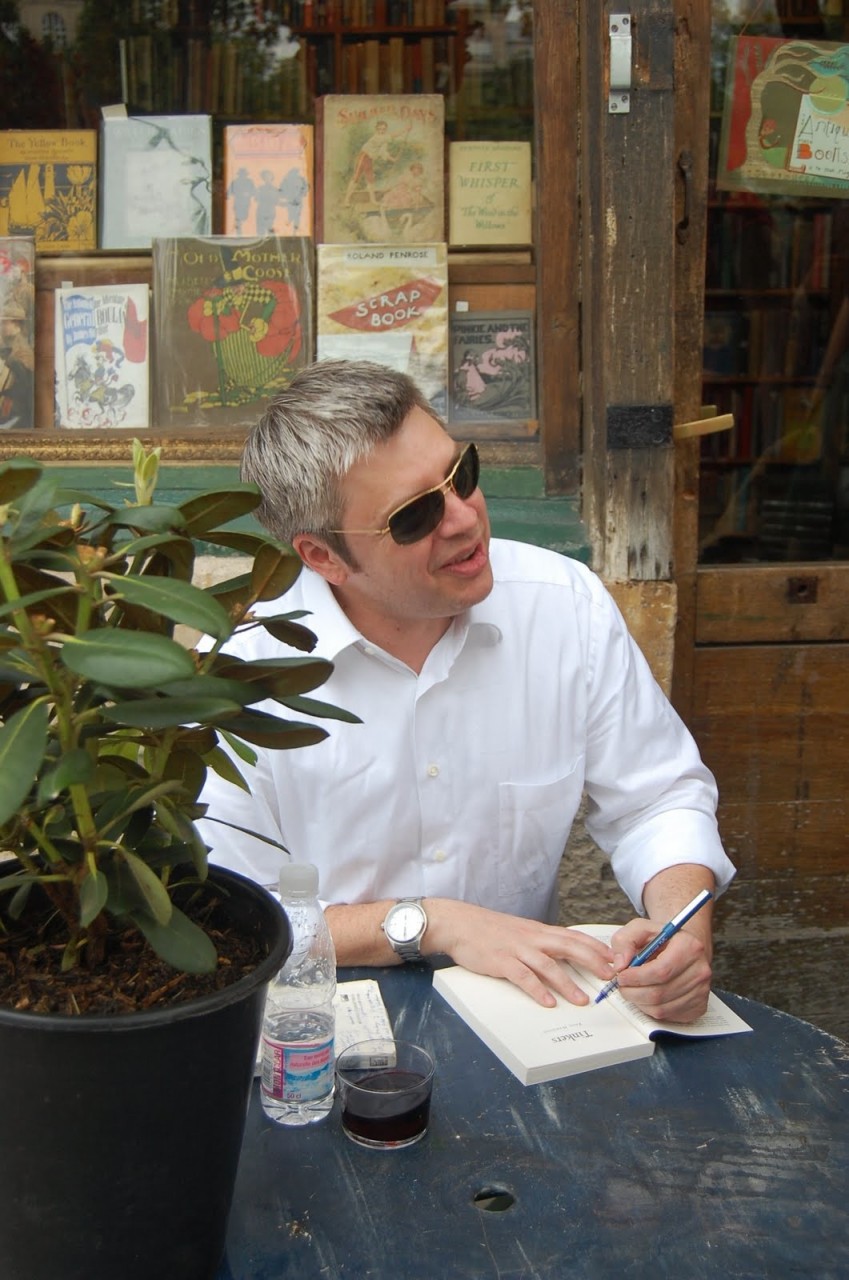
Paul Harding. Photo: Lauren Goldenberg
"Tinkers" is based on a handful of factual premises from my family history. The vigil at the deathbed of George Washington Crosby, one of the novel’s main characters, is founded in the facts of my own grandfather’s passing. A big, early task writing the book was figuring out how to seamlessly grow the story from a few terse, factual seeds into a self-sustaining work of fiction, that is, how to extend the story from the realm of factual truth into that of imaginative truth. One day, I wrote a couple sentences describing an actual episode during my grandfather’s final illness, when he had hallucinations of cracks running through the perfectly sound plaster in the ceiling of his living room (the family had rented a hospital bed and put it in the living room so he could be at his home when he died). When I got to the end of the perhaps three- or four-sentence paragraph that captured the entire episode, I was confounded by how to continue. I thought about the cracks my grandfather saw and simply asked myself, What would have happened if they had progressed? I wrote a sentence about the cracks lengthening and widening. I asked, What would happen next? They’d appear in the floor, too. And next? They’d widen, too. And then? The wheels of the hospital bed would drop into them. Then? The floor would collapse. And? Well, my grandfather on his bed would be in the rubble of the collapsed floor in his basement workshop. What else? The ceiling would have continued to split open and it would fall on through the house onto him and the bed.
I simply kept pushing on the same idea, parsing the elements of the scene and images in the most literal, concrete terms. Although the passage was already wholly figurative, at a certain point it transformed from the mundane details of a collapsing house into a more emblematic, cosmic sort of mystery. I ran out of house to give way and fall, but I just kept pushing in exactly the same direction, in the same literal manner. If the roof collapsed, what would he see? The sky and the clouds. So, down came the clouds. How could the sky itself come down? All the blue drains into the basement. Then the dark, starry heavens. Cue the stars tumbling loose. Finally, the very gloom of the lightless universe was left and it seemed, literally, like a black velvet curtain, like the very perfect funeral drapery to lower and cover the entire fallen affair.
At its best, writing feels selfless, as if the world is expressing itself and I am merely its amanuensis, taking dictation. The thrill of such experiences is that they produce elegance and beauty — art — that I never could deliberately muster or invent on my own. It is a sort of applied method of revelation. Each step in composing that passage was in itself straightforward, concrete, deliberate, plodding, even, but cumulatively, the pursuit of each next logical thing led to something unanticipated and true and entirely unexpected. In the case of the opening of "Tinkers," I lucked into being able to take the imagery all the way from the intimacy of my character’s deathbed to the very ends of creation.
Excerpt from Tinkers: 10th Anniversary Edition
Excerpt from Tinkers: 10th Anniversary Edition. Copyright © 2009/2019 by Paul Harding. Published by Bellevue Literary Press: www.blpress.org. Reprinted by permission of the publisher. All rights reserved.

The 10th Anniversary Edition of Tinkers.
George Washington Crosby began to hallucinate eight days before he died. From the rented hospital bed, placed in the middle of his own living room, he saw insects running in and out of imaginary cracks in the ceiling plaster. The panes in the windows, once snugly pointed and glazed, stood loose in their sashes. The next stiff breeze would topple them all and they would flop onto the heads of his family, who sat on the couch and the love seat and the kitchen chairs his wife had brought in to accommodate everyone. The torrent of panes would drive everyone from the room, his grandchildren in from Kansas and Atlanta and Seattle, his sister in from Florida, and he would be marooned on his bed in a moat of shattered glass. Pollen and sparrows, rain and the intrepid squirrels he had spent half of his life keeping out of the bird feeders would breach the house.
He had built the house himself — poured the foundation, raised the frame, joined the pipes, run the wires, plastered the walls, and painted the rooms. Lightning struck once when he was in the open foundation, soldering the last joint of the hot-water tank. It threw him to the opposite wall. He got up and finished the joint. Cracks in his plaster did not stay cracks; clogged pipes got routed; peeling clapboard got scraped and slathered with a new coat of paint.
Get some plaster, he said, propped up in the bed, which looked odd and institutional among the Persian rugs and Colonial furniture and dozens of antique clocks. Get some plaster. Jesus, some plaster and some wires and a couple of hooks. You’d be all set for about five bucks.
Yes, Gramp, they said.
Yes, Dad. A breeze blew through the open window behind him and cleared exhausted heads. Bocce balls clicked out on the lawn.
Noon found him momentarily alone, while the family prepared lunch in the kitchen. The cracks in the ceiling widened into gaps. The locked wheels of his bed sank into new fault lines opening in the oak floor beneath the rug. At any moment, the floor was going to give. His useless stomach would jump in his chest as if he were on a ride at the Topsfield Fair and with a spine-snapping jolt he and the bed would land in the basement, on top of the crushed ruins of his workshop. George imagined what he would see, as if the collapse had, in fact, already happened: the living room ceiling, now two stories high, a ragged funnel of splintered floorboards, bent copper pipes, and electrical wires that looked like severed veins bordering the walls and pointing towards him in the center of all of that sudden ruin. Voices murmured out in the kitchen.
George turned his head, hoping someone might be sitting just out of view, with a paper plate of potato salad and rolled slices of roast beef on her lap and a plastic cup of ginger ale in her hand. But the ruin persisted. He thought he called out, but the women’s voices in the kitchen and the men’s voices in the yard hummed uninterrupted. He lay on his heap of wreckage, looking up.
The second floor fell on him, with its unfinished pine framing and dead-end plumbing (the capped pipes never joined to the sink and toilet he had once intended to install) and racks of old coats and boxes of forgotten board games and puzzles and broken toys and bags of family pictures—some so old they were exposed on tin plates—all of it came crashing down into the cellar, he unable to even raise a hand to protect his face.
But he was nearly a ghost, almost made of nothing, and so the wood and metal and sheaves of brightly printed cardboard and paper (MOVE FORWARD SIX SPACES TO EASY STREET! Great-Grammy Noddin, shawled and stiff and frowning at the camera, absurd with her hat that looked like a sailor’s funeral mound, heaped with flowers and netting), which otherwise would have crushed his bones, dropped on him and fell away like movie props, he or they facsimiles of former, actual things.
There he lay among the graduation photos and old wool jackets and rusted tools and newspaper clippings about his promotion to head of the mechanical-drawing department at the local high school, and then about his appointment as director of guidance, and then about his retirement and subsequent life as a trader and repairer of antique clocks. The mangled brass works of the clocks he had been repairing were strewn among the mess. He looked up three stories to the exposed support beams of the roof and the plump silver-backed batts of insulation that ran between them. One grandson or another (which?) had stapled the insulation into place years ago and now two or three lengths of it had come loose and lolled down like pink woolly tongues.
The roof collapsed, sending down a fresh avalanche of wood and nails, tarpaper and shingles and insulation. There was the sky, filled with flat-topped clouds, cruising like a fleet of anvils across the blue. George had the watery, raw feeling of being outdoors when you are sick. The clouds halted, paused for an instant, and plummeted onto his head.
The very blue of the sky followed, draining from the heights into that cluttered concrete socket. Next fell the stars, tinkling about him like the ornaments of heaven shaken loose. Finally, the black vastation itself came untacked and draped over the entire heap, covering George’s confused obliteration.