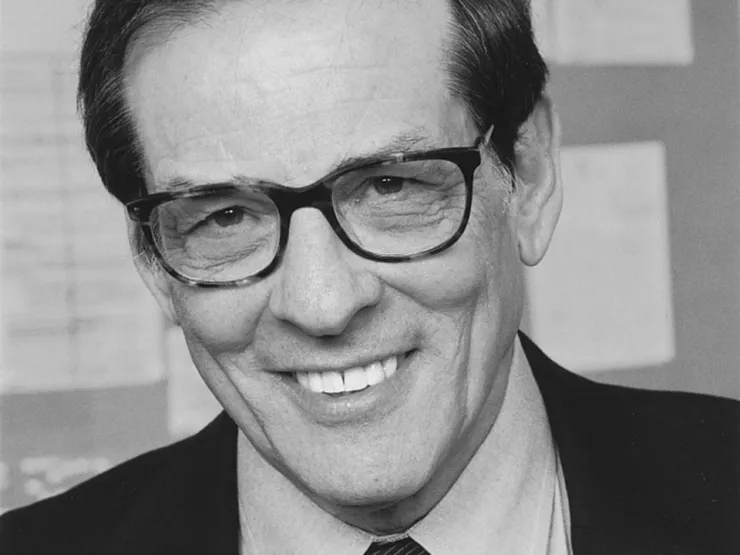
What makes a Pulitzer Prize-winning biography or autobiography?
The greatest source of information in pondering this question comes from the reports of Pulitzer Prize juries. Here, drawn from those files, are jury recommendations for books that won seven of the prizes awarded between 1966 and 1991, the third quarter of the Pulitzer century.
Taken together they not only provide a good idea of what makes a Pulitzer winner but also comprise a book list that will keep even the most avid reader happily engaged for some time.
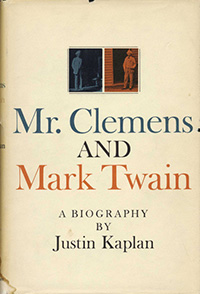 1967 (Mr. Clemens and Mark Twain, by Justin Kaplan)
A distinguished accomplishment – a biography which shattered the stereotype of Mark Twain as the rugged iconoclast of the Gilded Age and presented him instead as an artist who (in the author’s words) “discovered the usable past.” Mark Twain’s was a complex personality often torn in inner conflicts: Justin Kaplan is lucidly persuasively overlooking none of the eccentricities but placing them in correct perspective. The narrative skillfully suggests the flow and development of the writer’s life, and the scholarship is always apparent in the allusiveness of the prose. In sum this biography is a continuous drama of self-revelation based on sound and sophisticated scholarship.
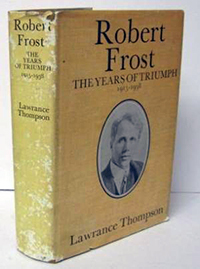 1970 (Robert Frost: The Years of Triumph, 1915-1938, by Lawrance Thompson)
Thompson’s Frost seems to me [Barbara Tuchman] unquestionably the outstanding biographical work of the year and the clearly indicated choice for the Prize for a number of reasons, both intrinsic and comparative. It is the only one of the major contenders which ploughs new ground, represents new and original research and puts on the record hitherto unknown material. It is the only one that takes a major and modern figure in American life and reveals in intimate, meticulous, undeniable and documented detail the true person inside the public image (was there ever such a gap? Between the tortured, driven, jealous, conniving, yet always creative and sympathetic figure and the sturdy homespun New England poet of hard-carved Vermont marble that the image-makers made him appear). Thompson’s work in bringing this utterly believable figure to life so that one is confident one is as near as possible to knowing him, is an exciting process in itself and one which I found (despite often clumsy writing) fascinating reading.
Besides being a major and important biography, it makes an important contribution in exhibiting – and following over a long life – the creative process at work in a great artist, along with its human toll, not to mention the petty and deplorable aspects. Nevertheless, in some defiant way, Frost rises above himself and vindicates his biographer in putting in so unsparingly all the warts.
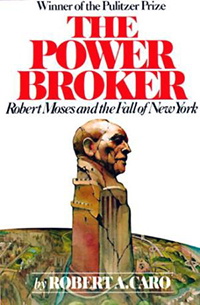 1975 (The Power Broker, by Robert Caro)
The Power Broker is gargantuan in theme and impact as well as size. It is shattering, enormously vital and original in a sense that no book is. . . . Although a journalist writing on a man who is alive, Caro has also done everything a scholar should to get at his subject; his research exhausted virginal manuscript collections, municipal records, personal files of political leaders and other rarely used sources, and he conducted over 500 interviews. The research is as impressive, prodigious and thorough as it could be.
Caro’s achievement goes well beyond that of comparatively conventional biographies: he has excelled at the interpretative level by brilliantly analyzing the role of a master urban planner-and-builder who worked outside the normal democratic process and used the “public authority” device as a force in the growth and management of the city. . . .
[Robert] Moses was the greatest builder of public works in American history. Caro describes how he developed the “public authority” as a means of achieving enormous power and influence without being accountable to the electorate. The public authority is a self-perpetuating, self-governing public corporation whose records, unlike those of other public agencies, are as private as those of a private corporation, yet whose activities are founded on sovereign powers lubricated by public tolls amounting to hundreds and hundreds of millions of dollars. Moses’s mastery of the public authority was the lever by which he shaped New York and made himself a political czar who could manipulate and compete with public officials; by his power to award contracts, commissions, and fees, he exercised a behind-the-scenes control over unions, contractors, banks, insurance companies, investment firms, real estate companies, great retail merchandisers, public relations companies and politicians.
The book has many faults. It is too long; its use of information obtained by interviews is questionable; it has a pugnacious and prosecutorial tone; it is filled with righteous indignation, scorn, and bitterness. Still more important, it seeks to prove too much: though Moses did not lead New York City and its environs to the promised land, as Caro demonstrates by techniques of overkill, almost everything wrong with the City is probably the result of forces well beyond Moses’s ability to have controlled. . . . Caro makes too much of the devil theory of history, with Moses cast in the role of the devil.
Nevertheless his book is alive, it throbs and screams and clutches, and it tells a tremendously fascinating and crucially important story, never before revealed. . . . There is no better illustration in all our literature of the theme that power tends to corrupt. [Leonard W. Levy]
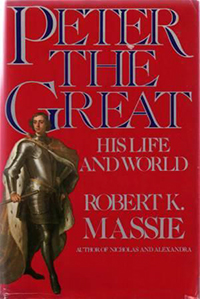 1981 (Peter the Great, by Robert K. Massie)
This is biography – and history as well – on a heroic scale, the story of a “world-historic” figure, as Hegel would have said, seen against the vast panorama of late-seventeenth and early-eighteenth century Russia and Europe. In intricate and massive detail, Massie portrays a man as complicated as his times, whose personal life was as dramatic as his military conquests, who imposed his will not only upon Russia but upon the balance of power in Europe, who still plays an ambiguous role in the memory of his countrymen, and who invites endless speculation upon the differences between pre-modern and modern dictators.
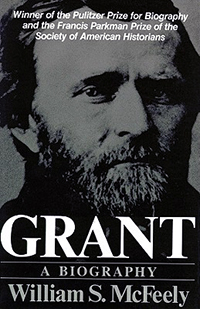 1982 (Grant, by William S. McFeely)
William S. McFeely’s Grant is preeminent in two essential ways. First, it authoritatively establishes a new place in our historic memory of an important American [and] deepens our understanding of his private character as well as of his public experience. Second, it is exemplary in its exploitation of the biographer’s art – governed by an informed and persuasive viewpoint, it does not coerce its material into arbitrary forms and evokes a living character. The general and the President have been treated repeatedly before this, but the whole man and the whole life have not been given to us before in a coherent way.
McFeely presents complex details with superb clarity while he retains a sense of drama. Above all McFeely presents throughout the stubbornly surviving quality of this extraordinary-ordinary man which surfaced in his autobiography. McFeely offers an historian-biographer’s study that fully appreciates not only events but the human actor at the center.
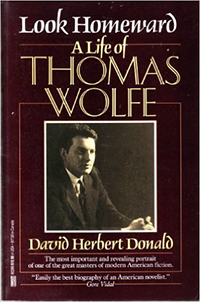 1988 (Look Homeward: A Life of Thomas Wolfe, by David Herbert Donald)
A classic biography: judicious, graphic, balanced and perceptive. Donald paints Wolfe with infinite nuance; he emerges as complex, many-sided, hateful, tremendously gifted, sadly flawed. Donald is relentless in his pursuit of the truth about Wolfe – the result is a remarkably rounded life of the writer as artist and tormented personality. It is Donald’s stance vis-à-vis Wolfe that particularly marks Look Homeward as a superb biography. He is neither beguiled by Wolfe nor superior toward him; he simply sees, with clear detachment, who and what Wolfe was and presents what he sees in highly articulate prose.
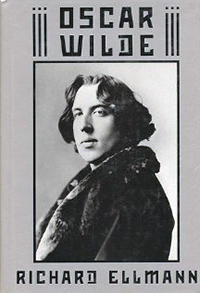 1989 (Oscar Wilde, by Richard Ellmann)
A masterly achievement in biography, composed with high literary skill and the intellectual profundity needed to express his subject’s complexity and cultural meaning. As a portrait, it is compellingly vivid; as narrative, it is both energetic and witty, precisely factual yet elegantly shaped by Ellmann’s dramatic sense, and making use of much new material. Before us, consequently, stands a man previously seen only in caricature, a complex personality whose contradictions and extravagances can now be understood in the context of his private history. But Ellmann also establishes Wilde’s crucial position in the crowded social milieu and the worlds of arts and letters of his time.