The architecture critic must find language to match the nobility, or lack thereof, of the structure under review. When the structure is an old one, the piece must make the familiar look new. The writing must be perceptive.
Paul Goldberger met these challenges in celebrating the Brooklyn Bridge at its centenary. His retrospective brought the reader back to the beginning, when the bridge was the first skyscraper in a city just emerging as “the center of the world.” The bridge reflected this vibrant period, Goldberger wrote. It was also monumental, beautiful and useful — built to last.
Goldberger’s piece ran in The New York Times on May 24, 1983, the 100th anniversary of the dedication of the bridge. It was part of a portfolio that won him the 1984 Pulitzer Prize in Criticism.
Goldberger has been an architecture critic for decades, including long stints at The Times and The New Yorker. He currently writes for Vanity Fair. He has also taught for many years and is the former dean of the Parsons School of Design, a college of the New School in New York City.
Here is his piece on the bridge.
A masterpiece of art, technology, utility

Paul Goldberger
By PAUL GOLDBERGER
Few things in New York last for 100 years, and fewer still mean as much at the end of a century in this city as they did at the beginning. But the Brooklyn Bridge seems only to grow in importance. It no longer seems as daring an act of engineering as it did in the 19th century, or as overwhelming a presence on the skyline, but on its 100th birthday it remains as potent, and as beloved, an icon as New York City has. It has always been something apart from other bridges. It was, of course, the first great bridge, the first roadway anywhere in the world to leap across so much water. But now that bigger suspension bridges are commonplace, the Brooklyn Bridge still holds sway over our imaginations.
It stands for so many things — for movement, for thrust, for the triumph of man over nature and, ultimately, for a city that prized these guidelines over all other things. It is important to remember that the Brooklyn Bridge was completed at the beginning of New York's great and heroic age. The 1880s were the beginning of the modern New York of skyscrapers and mass immigration, of explosive growth and intense creativity, and the bridge is the embodiment of that age’s spirit.The bridge did not make modern New York happen, of course, but the fact that the bridge itself happened – that New York City could build a monument that was so brilliant a synthesis of art and technology – served as a convenient symbol of the city’s new power as a world capital. At the end of the 19th century, New York was a city that felt itself rapidly becoming the center of the world, and the bridge that joined it to its neighbor, Brooklyn – then a separate city – seemed to epitomize its potential.
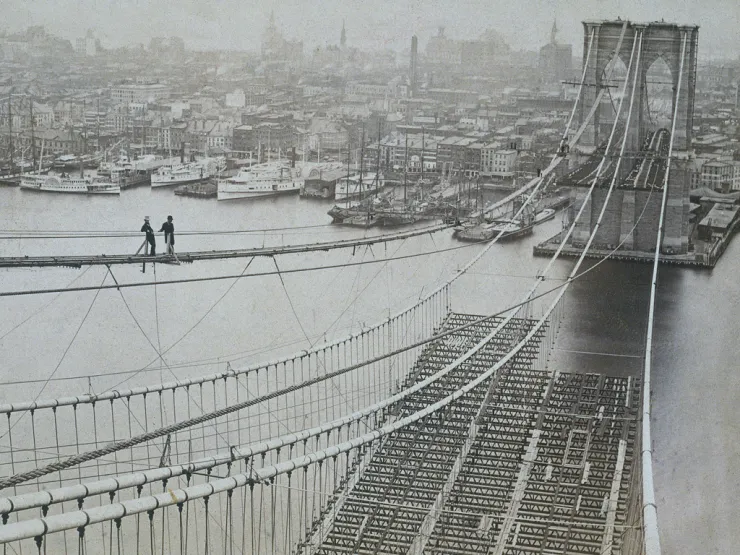
It was not merely that the bridge crossed the East River and suddenly made ferries obsolete. A lesser structure might have done the same. The bridge was so much more than a roadway; it was, by itself, the tallest and grandest manmade thing in the city. The bridge's Gothic towers of granite were New York’s first skyscrapers, for in 1883 they stood high above everything else on the skyline; its roadway provided a spectacular panorama of the city that could be obtained nowhere else. To see the city and the river from the Brooklyn Bridge was like flying.
But the genius of John Roebling’s design goes beyond even this. The bridge is an object of startling beauty. As suspension bridges go, it was not even approached until the George Washington Bridge half a century later and the Golden Gate Bridge a few years after that. It is not quite as graceful as these newer bridges; one could not say of the Brooklyn Bridge, as Le Corbusier said of the George Washington, “Here, finally, steel architecture begins to laugh.” The Brooklyn Bridge is more somber, more blunt and hard; those towers of stone do not laugh, and neither do the steel cables in their exquisite, lyrical webbed pattern.
What makes it magic is the way the towers, the cables and the roadway all play off against one another. The towers stand like great, majestic gateways to Manhattan and Brooklyn, bringing civic grandeur as complete as anything the Beaux-Arts ever dreamed of.
The cables offer a gentle counterpoint, so delicate that they look like harp strings, and though they are, in fact, made of heavy strands of steel bound together, they make us feel that if we plucked them they would respond with beautiful music. And the roadway lifts in a gentle curve, animating the entire composition.
When the bridge was new, serious architecture critics took issue with the Gothic form of the towers. Montgomery Schuyler, the leading critic of the day, found the Gothic arches needlessly Romantic and wrote that the towers should have been in metal to reflect the modern technology of the bridge. It is easy to see how Schuyler found the stone towers retrogressive, but it is harder now to agree that this was a mistake.
For if the Romanticism of the towers is unnecessary in terms of their role as supporters of the bridge’s cables, it is perfectly suited to their function as symbolic gateways to the city.
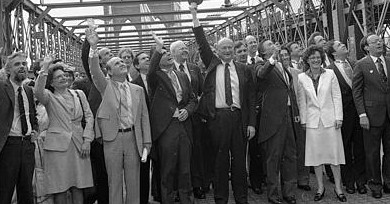
Mayor Ed Koch leads a centennial parade across the Brooklyn Bridge in 1983.
A great bridge is, after all, a romantic object as well as a technological one; it brings a kind of ceremony to the act of crossing a river that nothing else, surely not a tunnel, can ever have.
And the stone arches remind us that the Brooklyn Bridge, for all the brilliant advances in engineering it represented, was still very much a structure of the 19th century, a structure built more by men than by machines, a structure erected piece by piece, by hand. The bridge does not seem to have whirred out of a computer, to have been made by some mysterious process that the average person can respect but not understand.
In another sense, too, the bridge is different from the great technological achievements of our own day. When the bridge was being built, it was an effort that mobilized the entire city; watching and celebrating its construction concerned all of New York, in a way that almost suggests how the making of the cathedrals preoccupied whole villages in the Middle Ages.
It is hard to imagine any effort, any kind of public work, having quite such an impact today. So the bridge also symbolizes a kind of common cause, a shared effort of a sort that we find it harder and harder to achieve.
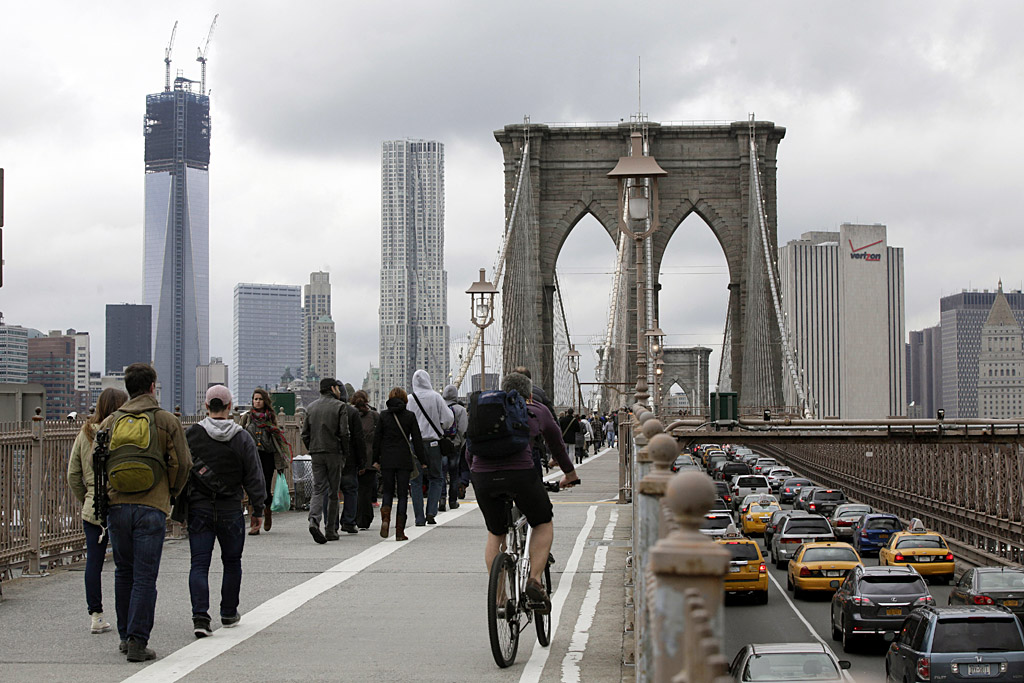
Commuters on the Brooklyn Bridge.
For a true monument — and there is nothing in New York more truly a monument than the Brooklyn Bridge — must represent a kind of shared ground that unites different elements of society. A monument is not simply a big structure, or a grandiose one. It is a structure that has, or acquires over time, a shared meaning, and a sense that it connects in some way to the daily lives of the people who see it.
It is the special quality of the Brooklyn Bridge to be as great and noble as any monument, yet tied intimately to the normal, everyday life of New York. That the Brooklyn Bridge is how one goes to Brooklyn, or how one goes to Manhattan, is a crucial fact of its success as a monument, for its usefulness brings it into constant touch with thousands of lives each day.