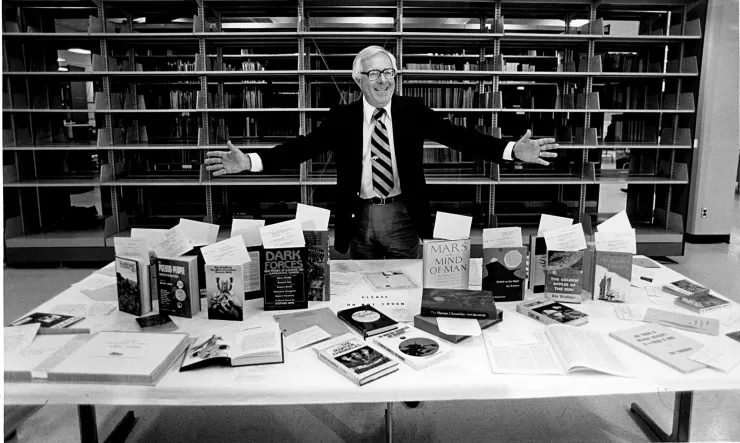
2007 Special Citation recipient Ray Bradbury emerged from Los Angeles' Depression-era libraries and the earliest stirrings of science fiction fandom to become one of the most recognizable writers of his generation.
Lacking the scientific mien of such contemporaries as Isaac Asimov and Robert A. Heinlein, Bradbury honed his unique style in dozens of pulp magazine sales, becoming one of the only writers from the Golden Age of genre fiction who remains consistently assigned reading in secondary schools. Throughout it all, he retained an idiosyncratic sensibility, refusing to earn a driver's license and lending a friendly ear to David Bowie during the singer's troubled years in southern California.
With the possible exception of Scientology founder L. Ron Hubbard, Bradbury was the most mutable pulp writer of his era, transitioning between science fiction, supernatural horror and mystery. But he was most adept at what has been retrospectively characterized as "dark fantasy" — an amorphous blend of various genres bridging horror, suspense and the fantastic. The following three works embody Bradbury's eclectic approach in wildly imaginative ways — and are well worth your perusal as the leaves fall.
1) "Something Wicked This Way Comes" (Simon & Schuster, 1962)
Derived from a failed film project developed in collaboration with Gene Kelly (who moved away from dance-oriented musicals toward eclectic roles during the late 1950s), "Something Wicked This Way Comes" is a gallery of nearly all of his quintessential tropes: a languid Midwestern burg (the fictitious Green Town, Ill., site of "Dandelion Wine" and other works), a traveling carnival, benevolent father Charles Halloway — and the almost primeval thrust between ruination and positive thought in this particular vision of Bradbury's October Country
From the broader perspective of supernatural horror, "Something Wicked" was sui generis at the time of its publication, imbued with few of the dominant motifs of the post-Lovecraft era. While John Langan has favorably compared the novel to the "small-town horror" of such contemporaneous works as Jack Finney's "The Body Snatchers" (1955) and John Wyndham's "The Midwich Cuckoos" (1957), Bradbury sidesteps the postwar alien invasion-as-Red Scare milieu for tremulous malediction (best embodied by Miss Foley, a middle-aged schoolteacher whose strange fate is left unresolved); as a commentary on demagoguery through the carnival's reigning nemesis, the almost vampiric "illustrated man" G. M. Dark, it is strangely reminiscent of the kitchen-sink drama of Elia Kazan and Budd Schamberg's "A Face in the Crowd" (1957).
Yet its coming-of-age structure (protagonists Jim Nightshade and William Halloway have just entered their teenage years), progenitive piety (the elder Halloway's impulses were seldom seen outside of sitcoms in the "Mad Men" era) and sheer atmospherics exerted a pivotal influence throughout the career of Stephen King and later exponents of the literary thrills of idyllic terror. 1975 Criticism winner Roger Ebert, a lifelong devotee of genre fiction, favorably compared Bradbury's "strange hybrid of craftsmanship and lyricism" to Thomas Wolfe in a review of the novel's Bradbury-scripted 1983 film adaptation.
Without "Something Wicked," it's hard to envision the small-town horrors of "Carrie" or "Pet Semetary" — let alone "Stranger Things."
2) "The Martian Chronicles" (Doubleday, 1950)
Benefiting from a rave review by fellow Angelino Christopher Isherwood in Tomorrow (a magazine that published literary criticism from the likes of Columbia Core Curriculum pioneer John Erskine alongside occult content), "The Martian Chronicles" bifurcated Bradbury's career.
While he never cast aspersions on his pulpy background in the manner of Kurt Vonnegut, the unexpected success of the book opened hitherto unlikely vistas for the writer, including the screenplay for John Huston's adaptation of "Moby-Dick" (1956) and consultancies for Disney on the 1964 World's Fair and EPCOT. But his success elicited a tinge of envy from his peers, with fantasy luminary L. Sprague de Camp bemoaning that Bradbury had become an "anti-science fiction writer" overly indebted to 1953 Fiction winner Ernest Hemingway and 1940 Drama winner William Saroyan. 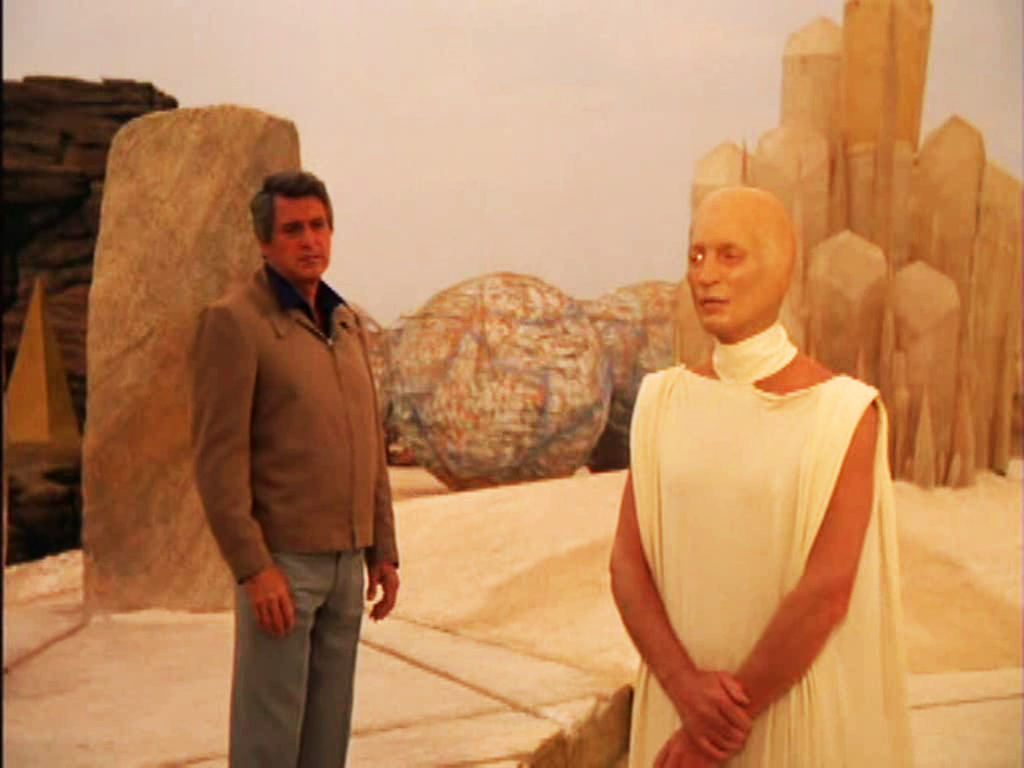
Following the unexpected success of "Star Wars," NBC tapped "Logan's Run" director Michael Anderson and horror writer Richard Matheson ("I Am Legend") to adapt "The Martian Chronicles" as a three-part event miniseries. The production, which deviated substantially from the novel and was publicly disowned by Bradbury, starred Rock Hudson (left), Roddy McDowell and Bernadette Peters.
Although Bradbury cited Edgar Rice Burroughs' swashbuckling Barsoom adventures and Sherwood Anderson's "Winesburg, Ohio" as influences, his Mars does not so much resemble those works as much as it serves as a powerful allegory of the American frontier, embodied by the genocide of the native Martians and internecine conflicts between the colonists. Racism and censorship endure as scourges in the face of technological progress. Save for a handful of holdouts, the colony is abandoned after four years when nuclear war commences on an Earth governed by fascists. Compiled as the first of Bradbury's "fix-ups" (a then-common practice in the genre fiction industry of assembling novels from previously published short stories with newly-written interstitial material), the narrative unfurls with elliptical power.
Set 20 years after the war began, "There Will Come Soft Rains" (its title derived from a 1920 poem by Sara Teasdale, who received the 1918 Columbia University Poetry Prize) marks the emotional crescendo of the novel. Abandoned during the war, an automated house in Allendale, Calif. endowed with features reminiscent of today's smart homes continues to prepare food, wash dishes and announce birthdays. But the thermonuclear "rain of fire and timber" soon manifests:
"The crash. The attic smashing into kitchen and parlour. The parlour into cellar, cellar into sub-cellar. Deep freeze, armchair, film tapes, circuits, beds, and all like skeletons thrown in a cluttered mound deep under.
"Smoke and silence. A great quantity of smoke.
"Dawn showed faintly in the east. Among the ruins, one wall stood alone. Within the wall, a last voice said, over and over again and again, even as the sun rose to shine upon the heaped rubble and steam:
"Today is August 5, 2026, today is August 5, 2026, today is ..."
Although the passage demonstrates unequivocally that Bradbury was a science fiction writer, his was not so much a reflection of a comprehensive ideal (Asimov's predictive "psychohistory," or the libertarian utopianism of Heinlein's "The Moon is a Harsh Mistress") as a harbinger of existential decisions. While time has (mostly) quelled the likelihood of total annihilation, Bradbury was a lone voice among his contemporaries in contemplating the potentialities of such horrors.
3) "It Came From Outer Space" (dir. Jack Arnold, 1953)
Nearly 70 years after its release, "It Came From Outer Space" remains one of Bradbury's most powerful works. A seemingly peripheral story credit on the Jack Arnold-directed film obscured the fact that Bradbury was its true auteur, having written a 119-page treatment that greatly resembled the finished project. Film historian Tom Weaver discussed the possibility that credited screenwriter Harry Essex simply modified some of Bradbury's dialogue and took credit for his work in a DVD commentary; in a 2004 interview (embedded below), Bradbury confirmed that Essex "retyped" many of his contributions (based on "The Meteor," an unpublished story of early Forties vintage) while adding the requisite dialogue.
"I found out in Hollywood that it just doesn't pay," he added ruefully. "[T]hey promise to take you into the woods and you never get there."
Set in the desertified byways of rural Arizona (a critical component of the story in Bradbury's treatment), the film traces author and amateur astronomer John Putnam (Richard Carlson) and his fiancée, schoolteacher Ellen Fields (Barbara Rush), as they discover a purported meteorite that turns out to be an otherworldly craft. After several townspeople exhibit a range of peculiar behaviors, Putnam succeeds in making contact with a member of the craft's non-anthropomorphic crew — designed to take advantage of the film's release as Universal's first 3D effort — who reveals that the aliens inadvertently crashed on Earth and are utilizing human forms to gather the materials to complete their repairs. Ultimately, Putnam must ward off a sheriff's posse (recalling the torch-bearing villagers of earlier Universal horror efforts) to ensure the safety of the visitors.
Whereas most science fiction films of the era were didactic affairs marketed toward fandom and the scientific community (Irving Pichel's "Destination Moon" [1950]) or enchantingly slick cousins of A-list productions (Robert Wise's "The Day the Earth Stood Still" [1951]), "Outer Space" is comfortable and strident in its suspense, anticipating the later flowering that would include such comparatively mature efforts as Fred Wilcox's "Forbidden Planet" (1956) and Byron Haskin's "Robinson Crusoe on Mars" (1964). Despite its contested authorship, it retains all of Bradbury's central preoccupations: a concern for the local, compassion for the other and a tinge of melancholy, particularly in its surprise ending. It is easy to see why Bradbury mustered so much pride for the movie in his late interview.