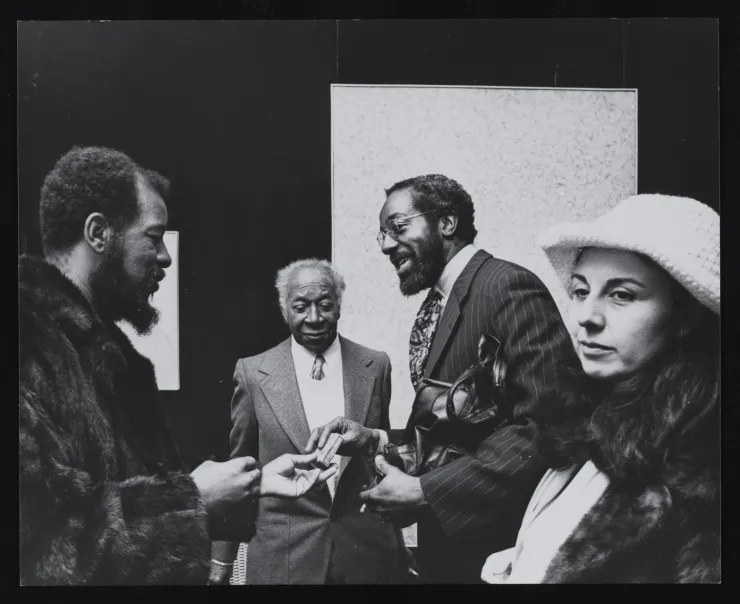
Long recognized as a transformational figure, Ornette Coleman remains one of the most enigmatic figures in American music. After starting out as an itinerant R&B saxophonist in the 1940s, Coleman presided over the avant-garde (or "free") jazz revolution on such albums as "The Shape of Jazz to Come," "Free Jazz" and "Ornette!"
A mere decade after the bebop revolution overtook the melodicism and danceable beat of swing (exemplified by the harmonic innovations of 2006 Special Citation recipient Thelonious Monk), Coleman took the daring step of completely abandoning conventional harmonies.
The result was an atonal maelstrom of sound that anticipated contemporary advances in Western art music while harkening back to the earliest forms of New Orleans-style collective improvisation.
Coleman’s style sharply divided generations of jazz musicians and enthusiasts. For noted critic Albert Murray, "This music was called free jazz but what is freer than jazz? … [Y]ou can’t embrace entropy, you can’t embrace chaos." Conversely, 2007 Special Citation recipient John Coltrane was an early fan, often sitting in with Coleman before working exclusively in avant-garde terrain after "Ascension" (1965).
Throughout the 1970s, Coleman’s influence slowly seeped into the underground rock scene, while contemporaries like Archie Shepp employed the new form as a metaphor for political expression and social justice.
Even though a litany of awards would ultimately culminate in the 2007 Pulitzer, Coleman never had a crossover moment akin to Coltrane’s "My Favorite Things" or Miles Davis’s "Bitches Brew." He remained sui generis until the end.
The following five tracks offer an introduction to Coleman’s vast output while representing intriguing interstices with such forces as eclectic bassist Charlie Haden, fellow Prize winner Gunther Schuller and New York's fabled 1970s music scene.
In this context, we can see Coleman for who he really was: a generously collaborative force who helped to steer the course of American music for six decades.
1. "Chronology"
From "The Shape of Jazz to Come" (Atlantic Records; 1959)
Titled by producer Neshui Ertegun, who wanted to convey the importance of the unorthodox work to potential listeners, "The Shape of Jazz to Come" is auspicious on all fronts.
Prior to his discovery by John Lewis of the Modern Jazz Quartet (who introduced Coleman to Ertegun and his family business, Atlantic Records), Coleman spent much of the 1950s supporting his artistry as an elevator operator in Los Angeles and other cities.
During this period, the saxophonist began to develop his emergent theory of "harmolodics," a musical philosophy in which "harmony, melody, speed, rhythm, time and phrases all have equal position in the results that come from the placing and spacing of ideas."
His ensuing penchant for blues-based emotiveness and disregard for chord progressions earned many detractors in the buttoned-down, predominantly white West Coast jazz scene.
But after arriving New York as a member of Paul Bley’s quintet, Coleman found his niche in a city galvanized by such disparate (yet boundary-pushing) artistic movements as abstract expressionism, the Beat Generation and serialism.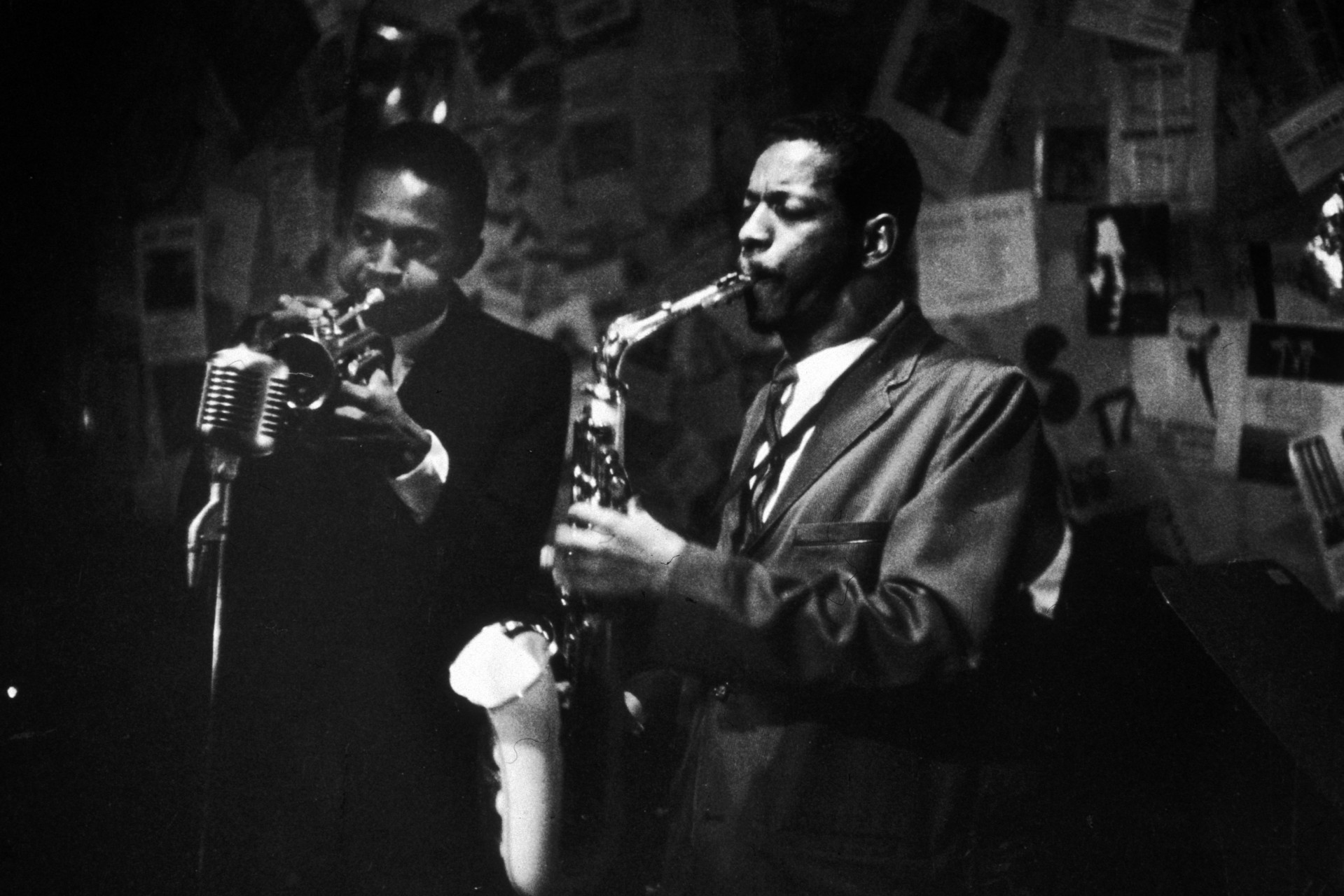
The Ornette Coleman Quartet's November 1959 residency at the Five Spot in Manhattan's East Village signaled the arrival of free jazz as a disruptive cultural force, drawing such luminaries as Leonard Bernstein and two-time Pulitzer winner Norman Mailer to the downtown hotspot. Here, Coleman (right; performing with his iconic Grafton saxophone) duets with trumpeter Don Cherry. Bassist Charlie Haden and drummer Billy Higgins rounded out the ensemble. (File)
Unlike Coleman’s later work, "The Shape of Jazz…" incorporates brief melodic themes (repeated at the end of each piece) to orient the listener. Though improvised on the fly and minimally anchored to Charlie Haden’s bass riffs instead of the customary piano or guitar, the quartet’s excursions are mostly tonal.
Although the leadoff "Lonely Woman" became Coleman’s enduring contribution to the canon of jazz standards, the rollicking, squawky "Chronology" is a gem. An abstract take on the early R&B that he played as a teenager in Fort Worth and in the Silas Green minstrel show, it unwittingly marked the end of an era — and the beginning of something new.
2. "Variants On A Theme Of Thelonious Monk (Criss Cross): Variant 1"
From "Jazz Abstractions" (credited to "John Lewis Presents Contemporary Music: Compositions by Gunther Schuller and Jim Hall"; Atlantic Records; 1959)
Before he embarked on a compositional career that led to the 1994 Pulitzer Prize, Gunther Schuller was the eminence grise of '50s jazz, the unlikely common denominator between Miles Davis ("Birth of the Cool"), Frank Sinatra ("April in Paris"), Charles Mingus and Johnny Mathis.
At a time when the form veered between numerous subgenres, Schuller became one of the leading proponents of what he termed "third stream": a strain of jazz infused with the compositional rigor of Western art music. Although his contemporaries (including the Modern Jazz Quartet and Dave Brubeck) soon brought the concept into the mainstream, he remained one of its purest exponents.
Accordingly, Schuller's "Jazz Abstractions" (1961) is not for the faint-hearted. "Abstraction" and "Variants on a Theme of Thelonious Monk (Criss-Cross)" feature Schuller and Coleman leading a palpably tense one-off ensemble of Bill Evans, Eddie Costa and Eric Dolphy. Decades before Schuller, Monk and Coleman received their Pulitzer Prizes, a mutual sense of adventure is strikingly evident.
3. "Skies of America"
From "Skies of America" (Columbia Records; 1972)
By the early 1970s, jazz was everywhere and nowhere in American culture. As his contemporaries either retreated to the European concert circuit and artist-operated loft venues like Sam Rivers’s Studio Rivbea or embraced the commercial implications of fusion, funk and even krautrock, Coleman continued to position himself against the grain.
Recorded under acrimonious circumstances with the London Symphony Orchestra, "Skies of America" (1972) is a symphony indebted to the concerto grosso, a Baroque form in which a smaller ensemble alternates with an orchestra.
The Master Musicians of Joujouka, 2013 (riadzany.blogspot.com)
In a manner recalling the modular compositional methods of the rock era and beyond, the "Skies of America" theme would become an enduring preoccupation for Coleman. He would go on to interpolate it in "Theme from a Symphony" (his first electric effort) and "Midnight Sunrise," a collaboration with the Master Musicians of Joujouka, a Moroccan Sufi group that enjoyed worldwide bohemian cachet after meeting William Burroughs and Brion Gysin in the late 1950s.
4. "Times Square"
From "Of Human Feelings" (Antilles Records; 1982)
During the 1970s, the innovations of Coleman's classic period trickled down to the fringes of contemporary pop.
Mercurial artist and free jazz devotee Don Van Vilet (best known for recording as Captain Beefheart) was the first notable rock musician to embrace Coleman, characterizing him as "one of the greatest artists today" in a 1973 interview.
When Coleman belatedly went electric on "Dancing in Your Head" (1977), Bern Nix’s angular guitar parts were all but indistinguishable from Zoot Horn Rollo’s work on Van Vilet’s "Trout Mask Replica" (1969).
Van Vilet’s experimental ethos heralded the development of downtown New York's no wave scene in the late 1970s. Characterized by Luc Sante as "anything at all + disco bottom," groups like James Chance and the Contortions began to experiment with Colemanesque noise and dissonance in a danceable context. 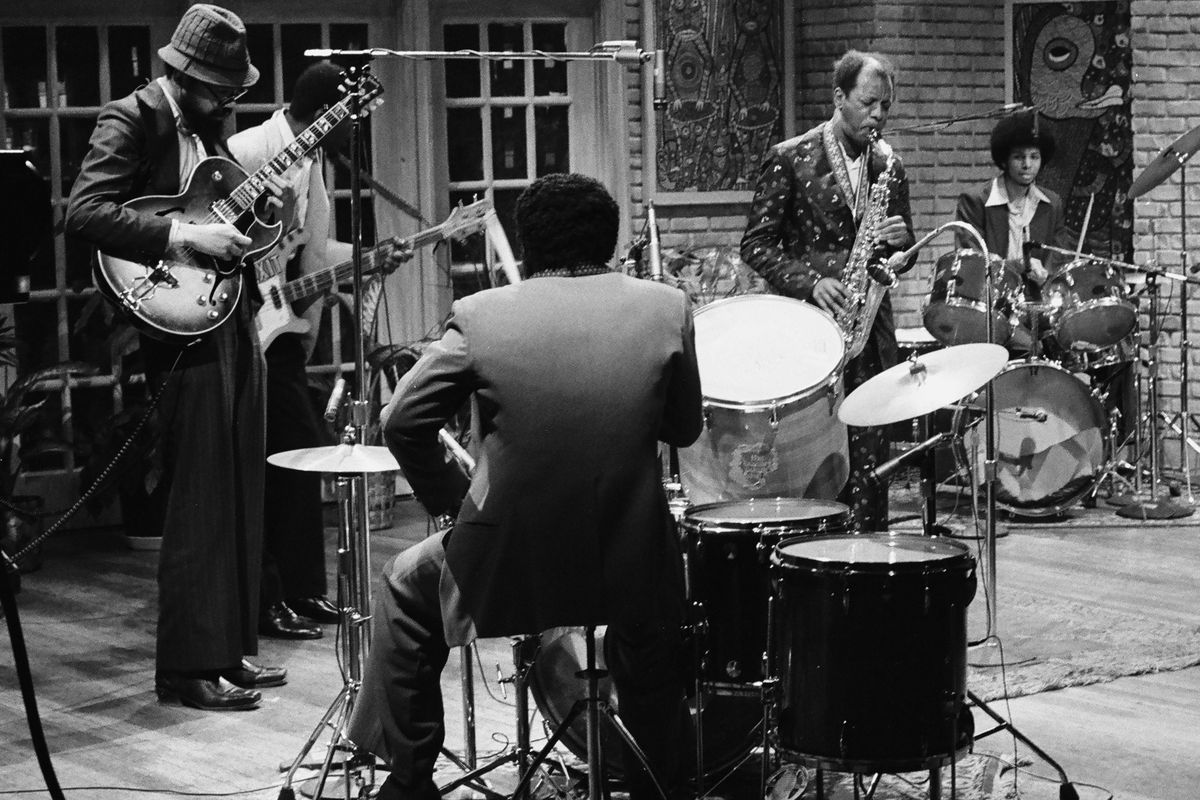
Ornette Coleman and Prime Time perform "Times Square" on "Saturday Night Live", April 14, 1979 (NBC/NBCU)
This heterogeneous milieu was the impetus for "Of Human Feelings" (1979; released in 1982), perhaps Coleman's most underrated effort.
Revitalized by his new band, Prime Time, Coleman successfully melded his harmolodic vision to abrasive punk-funk arrangements after an artistically fallow decade. Powered by his son Denardo on drums, "Times Square" remains a four-on-the-floor evocation of one of New York’s most tumultuous eras. (Appropriately, the group performed the piece in a surreal 1979 "Saturday Night Live" episode hosted by Milton Berle.)
5. "Turnaround"
From "Sound Grammar" (self-released; 2006)
After recording the soundtrack for David Cronenberg's appropriately freewheeling adaptation of William Burroughs's "Naked Lunch" in 1991, Coleman became less prolific.
Aside from a flurry of activity in the mid-1990s (including his first conventional jazz quartet album since 1958), he seldom recorded in the final decades of his life.
Nevertheless, he maintained a schedule of live performances that were audaciously intertextual in their scope — a radically rearranged standard could segue at a moment’s notice into snippets of Stravinsky or a hitherto unrecorded piece.
In this respect, he differed from fellow innovators such as Miles Davis (who continued to leave his mark on the prevailing trends in popular music until his death in 1991) and other contemporaries who found solace in exploring past glories.
Recorded live in Ludwigshafen, Germany on October 14, 2005, the Pulitzer-winning "Sound Grammar" (2006) was Coleman’s final recording prior to his death in 2015. It reflected the neoclassicist impulses of his later oeuvre: in a homage to his most revolutionary albums, there was no piano or guitar, while two acoustic basses supplanted the electric slap that was so integral to Prime Time.
In this environment, Coleman recast his "Turnaround" (originally recorded in 1959) into a virtual microcosm of the American musical canon, including quotes from fellow Pulitzer winner Richard Rodgers's "If I Loved You" and Stephen Foster's "Beautiful Dreamer."
Lacking a trove of unreleased recordings or unrealized projects a la Charles Mingus’s "Epitaph," Coleman rewarded his audience with the greatest gift: he completed his artistic enterprise and, in his own inimitable way, came full circle.