I’ll be honest: You’ve caught me at a bad time.
Had I been asked me to share my thoughts on the Pulitzer Prize for biography two or three years ago, say, I’d have offered up a paean to the Pulitzer Prize as an inspirational beacon of democratic aspiration and artistic excellence. I’d have praised its rare union of populist heart and rigorous intellect, of old-fashioned citizenship and unfettered imagination. I’d have spoken of its special importance in the field of biography, a maverick genre that has few institutional anchors or canonical standards. I’d have called the Pulitzer Prizes a magnificent national treasure that has helped America see itself more clearly for a century. But at the moment, I am feeling ill-tempered.
It was the Pulitzer vision of what a biography could be — a sweeping story of America told through the intimate perspective of a single life — that lured me out of the ivory tower and into the perilous path of an “independent scholar.” I thought my subject — a once famous but now forgotten 19th-century minister named Henry Ward Beecher — would fit the model beautifully. After all, biographies of his favorite sister Harriet Beecher Stowe had twice won the prize, which I took as a good omen. Carried away by this noble vision, I convinced a trade publisher that, together, Beecher and I would make a book to raise the dead, bringing this fascinating man and his equally fascinating culture back to life in a way that would appeal to both scholars and a general audience.
These lofty ambitions carried me through the first year or so, as I toiled in the libraries and archives. But as I prepared to turn my research into an actual book, I began to suspect, with increasing alarm, that that noble beacon was actually a devilish will-o’the-wisp that had lured me unwittingly into a dark and dismal swamp that I would not find my way out of. This suspicion was confirmed some months later when my book contract was abruptly canceled. I can’t blame the publisher one whit — I believe we were all in agreement that I didn’t have the slightest idea how to write a biography.
This shouldn’t have been surprising, in retrospect. I had acquired an excellent education as an academic historian, but I’d never had a single lesson, formal or informal, in this new craft I had so blithely chosen. There were myriad schools to teach the skills of poetry, journalism, history, fiction, photography and playwriting, but until recently, you would have been hard-pressed to find a single class on biography-writing.
I’d have quit the whole enterprise entirely at that point, had I not had to pay back my advance from the publisher, which meant I had to resell the book. Which meant that I had to teach myself how to write. Since I had no classes to take or how-to books to read, I turned once again to the Pulitzer Prize as my beacon. I checked out armloads of prize-winners from the library, from every decade, and took them apart, piece by piece. I analyzed, outlined and imitated them, trying to figure out what set them apart. And it worked well enough. I managed to convince a new publisher to take a chance on me and Beecher.
But as I moved into the final stretch of the new contract, with a deadline looming and so many chapters still to be written, again I found myself lost and discouraged. Every morning, I sat down at my desk and gazed miserably at the blank pages, my mind emptied and addled by suppressed panic. After several weeks of this, I again turned my eyes to the prize in desperation. Saying it now, it sounds absurd, but it is true: As I picked up my pencil every morning in that last gloomy year of writing, I asked myself aloud: “What do I need to do today to win the Pulitzer Prize?”
In retrospect, I hear how audacious, how arrogant this sounds. In truth, it was the wail of a drowning soul. Most days, my answer was simply some variation on: “Figure out how to get a reader to turn the page.” I certainly didn't expect to win; I barely hoped to finish the manuscript. But every day the question cleared my head, focused my thoughts and brought me one stroke closer to shore.
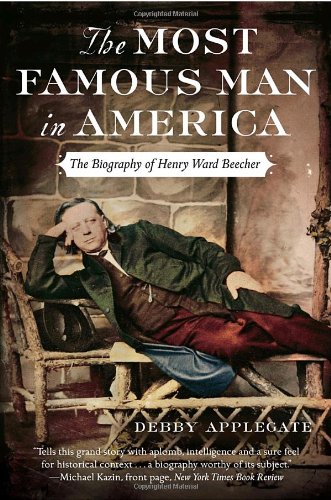
Applegate's The Most Famous Man in America
My feelings upon hearing the news that I had been awarded the prize were exactly as you would expect. I had all the emotions every winner describes: shock, disbelief, an unworldly sense of having been touched by something grand and mysterious, a not unpleasant collision of humility and vanity and, at least for us tyros, genuine surprise at the abrupt shift in status. For me, however, there was an extra, ridiculous, layer of incredulity. For weeks it rang through my head: “That silly mantra actually worked! Who’d have thunk it?”
All through that last miserable year of writing, I’d sworn, with every fiber of my being, that I would never be fool enough to write another book. At first the prize did nothing to shake that conviction. Indeed, it opened up all sorts of unexpected opportunities to escape the archives and shake off the smell of the lamp. More tempting still, perhaps I’d just rest lazily on my laurel — you’d be surprised how many people suggested it quite seriously. My resolution was only reinforced by the humbling privilege of serving as a Pulitzer jurist. Plowing through the towering stacks of entries, I was taken aback to discover that there were easily a dozen that year worthy of taking the top honor. Whatever I’d done right, it was sheer luck that mine had been the one plucked from the pile.
But then, slowly but surely, the will o’ the wisp again began to work its wicked magic. All the flattering attention and surprising stature the prize brought started to soften my resolve. “Gee,” I began to think, “that whole business worked out so well, maybe I ought to at least consider another book.” Innocently strolling the library stacks, I stumbled upon yet another big, bewitching American character — a once infamous but now forgotten madam named Polly Adler. Before I knew it, I’d signed another contract and marched back into the swamp.
And thus, here you find me now, once again in that final miserable stretch, once again staring disconsolately at blank pages and a rapidly approaching deadline, my mind emptied and addled. But now, instead of serving as a beacon or a bolster to my confidence, that prize seems to mock me. Perhaps its brilliance is simply exacerbating the sophomore jitters; surely a Pulitzer Prize winner should be more skillful, smooth and speedy than I feel. Maybe I’m just consternated that I allowed the prize to bamboozle me again, against my better judgment.
But do not mistake this crying poor-mouth for ingratitude or disenchantment. To win the Pulitzer Prize is, indeed, a magical experience, even for the most cynical of souls. For biographers like me, who often spend years alone communing only with the ashes of the dead, it is a little like Cinderella being offered that second glass slipper. If she occasionally longed to kick off her shoes and skip away from her fairy tale ending, I imagine she just smiled and kept it to herself.