The temptation is always to say, “I did it myself,” but of course, literature is a fluid world. No one writes anything without reading many things, without being infected by the virus of Black Beauty or Agatha Christie or David Copperfield or Giants in the Earth (all of which infected me early and often). But what I would like to note here is not that I read a lot of books, many required and many not. It is that I came of age at a favorable moment, when girls were getting the same educations as boys, when feminism had set in, and when, because of the Vietnam War and the draft, the boys we knew were preoccupied by whether they would go to graduate school or into the army, whether they would live or die.
Many of my fellow Vassar students spoke idly of what was next – medical school, Yale School of Drama, graduate school. The girls who were planning to get married and settle down were scarce. Because of the draft, our chances of getting into prestigious programs were higher than they had ever been – we looked at our solitary female professors, for the most part single and childless, and we did not identify with them. The professional world seemed to be opening up, just like the world of higher education.
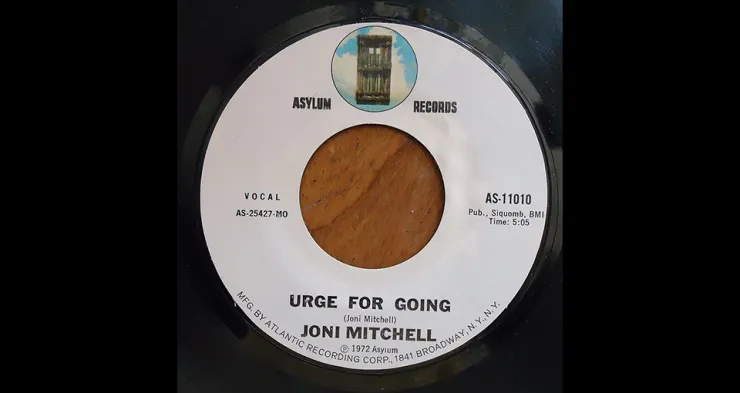
One of my favorite songs from my late adolescence (when I had my own record player and listened to music in the dark every night, the same songs over and over so that they engraved themselves into my brain) was the "Urge for Going,” by Joni Mitchell, but sung, the first time I heard it (and for many times thereafter) by Tom Rush. The line that stuck in my mind, and still does, was, “She got the urge for going, and I had to let her go.” Perhaps if I had heard the Joni Mitchell version first, I would not have perceived her song as a recognition of female freedom that bolstered our sense of opportunity, which was equal to and as interesting as the male urge for going.
As soon as I left high school in St. Louis, I had the urge for going and they had to let me go. My mother was a model for this. I knew she had grown up ambling about the West, Idaho to Texas to Illinois to Missouri, when she was a small child. I knew she’d been a WAC, spent years in Europe after the war, gone to New York for fashion shows in her capacity as Women’s Page editor for the St. Louis Globe-Democrat. I knew she and my stepfather subsequently went to Barbados, Venezuela, and Europe.
When I got to Vassar, going was a way of life – to New York City (to see “Rosencrantz and Guilderstern are Dead” in my best $175 outfit, matching dress and coat), to New Haven, even to Boston and Albany, by car, by bus, by train, by thumb.
And then I met my boyfriend, who was from Casper, Wyoming. He thought nothing of a four-hour ride to the family cabin in the Big Horn Mountains for a weekend. If we didn’t have a car and there was no train or bus, we hitchhiked or went to Rent-a-Wreck. We had the urge for going and there was no reason not to go.
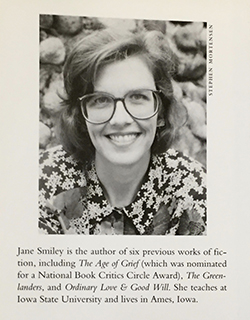
Photo of Jane Smiley from A Thousand Acres dust jacket
But there was that other way of going, the intellectual adventure, and every day it was all around us. For me, the adventurers were Mary Shelley, writing Frankenstein at Lake Geneva, Geoffrey Chaucer and the other pilgrims making their slow way to Canterbury, and, most importantly, Shakespeare, whose real travels we knew little about, but whose literary travels were always in our minds – from sonnet to comedy to tragedy to romance, setting the example of why not try it? My boyfriend wasn’t terribly impressed with Shakespeare – he preferred Charlemagne and Pepin the Short, Karl Marx and Barbara Tuchman.
We both graduated. There were no jobs, no likely careers. We went to Europe and worked on an archeological dig in Winchester, then hitchhiked around England, France, the Pyrenees, Italy, Greece, Crete, Yugoslavia, Austria, Switzerland, Denmark, France again, England again. It was easy and cheap. We were hardly adventurous – our peers were everywhere, making use of the jobless baby boom to feel a little freedom, a little independence.
For me, there they were – Shakespeare’s birthplace, Stonehenge, the setting of “Hamlet,” the Forest of Arden, Wordsworth’s very own house, Yorkminster, the Forum, the Tower of Pisa, the recently cleaned mosaics in Ravenna, as brilliantly colorful as they had been when they were brand new in the 6th century. And here was not only the Acropolis, but also Beehive Tombs from 1500 BC, the remains of the Minoan Empire on Crete (the spookiest – Hagia Triada, where we encountered only one other person), Delphi. I wrote about it all in a journal and in letters home. But our parents had almost no idea where we were or what we were doing.
When we decided to go to graduate school, we chose Iowa because of the urge for going – easy to get from there to Wyoming, only a thirteen or fourteen hour drive out interstate 80 – not even a day. When we looked for place to live, we found a farmhouse thirty miles into farm country – all of these choices seemed automatic at the time, but I see now that they were exercises in venturing into the landscape, looking around, choosing emptiness over company.
My eventual friends in the Iowa Writers’ Workshop felt, I think, that there might be something to be said for New York, for meeting and greeting, but when the important editors from New York came for a visit, I shrank into a corner. They were loud and possibly drunk. They reminded me of my parents and their friends.
And so the next lucky thing happened. When I was ready for an editor, she was my age and my friend, a woman who went from Iowa City to Harper and Row, flowing neatly into the rise of women in publishing (some of the others went east, too; I went to Iceland). By the time I'd written my first novel, my friend’s boss was being psychoanalyzed five days a week, and so he let her acquire the books she wanted as long as they were cheap. A friend of hers became my agent. After the Workshop, the only job I could find in academia was once again out in the boonies – Ames, Iowa, where housing was affordable, daycare was excellent, inspirations abounded, and the administration ignored the English Department, a gift of indifference.
Not long ago, I read an obituary of Pat Kavanaugh, the prominent English literary agent and wife of Julian Barnes. According to the obituary, Kavanaugh was at the center of contemporary English literature. She gave great dinner parties where all the important writers gathered and had wonderful conversations. She lived in, and cultivated, a social world that I have never lived in, or even, I think, entered. For a few minutes after reading the obituary, I was sorry I had missed something – a Dickens-type thing, a Norman Mailer-type thing, a Shakespeare-type thing, a simmering literary and social stew of interesting personalities and fascinating interactions, and then I looked out the window.
Many places I’ve lived in have inspired a book. That old farmhouse southwest of Iowa City had a well, and as I was drinking from it, I was reading Barry Commoner’s The Closing Circle, about farm chemicals and water pollution. When that connected in my mind with my longstanding annoyance that in King Lear, Goneril and Regan did not get to say what they were thinking, while the old man yammered on and on and on, and with my pleasure in Stoppard's play, A Thousand Acres was hatched. When I was in Iceland, I started imagining what the westernmost edge of Medieval Europe might have been like on the southern tip of Greenland. When I got to California, I wondered about my great aunt living with a crackpot on Mare Island and here came Private Life. In 2002, I was visiting a house in the Hollywood Hills at the same time that I was reading The Decameron, and Ten Days in the Hills presented itself, almost fully fleshed out.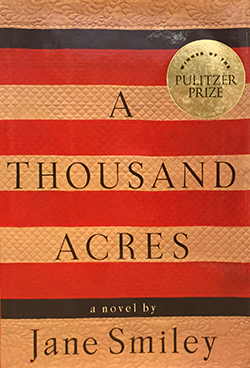 I know there are writers who use their work to relate to their own lives, to solve the riddles of their own experience, but for me, writing has always been an exercise in exploration and therefore, an exercise in freedom. When I started A Thousand Acres, it was because I was on I-35, in the pot-hole prairie in northern Iowa. It was late winter, gloomy, wet, isolated. I looked from horizon to horizon and knew I had found my setting. I proposed it to my agent. She said, “No one wants to read a novel about farming.” I thought, try and stop me.
Several times, lately, I have been driving down the road, and it’s happened suddenly, in a moment – I turn my head and see some small thing – sunlight flickering across newly green, moist grass, or misty ridge lines receding into the clouds. A feeling pierces me that is not sadness or joy or surprise, but a sharp blend of all three, triggered by something I am seeing, but I don’t know what, exactly. It feels deep and old, as if all the images I retain in my mind from my own travels, from my travels into books I have read and have written, from songs I have come to know, from conversations I have had, are a treasury of feelings ready to come alive at the merest reminder.
Every literary career is made up of predisposition, timing, and luck. I have a theory of how these made me, but my only conclusion is that curiosity and pleasure shaped my work, and luck took over from there.