The native Kentuckian Robert Penn Warren won three Pulitzer Prizes in two categories — the 1947 prize in the Novel for "All the King’s Men" and the 1958 and 1979 prizes in Poetry for "Promises: Poems 1954-1956" and "Now and Then: Poems 1976-1978."
The 1958 jury report written by Louis Untermeyer said that Warren’s "Promises," “tops all the others. ... Warren is essentially a storyteller, a narrator who knows how to make his stories sing. In his suggestion of a kind of rough balladry, he revives the almost lost art of the ballad-making poet.”
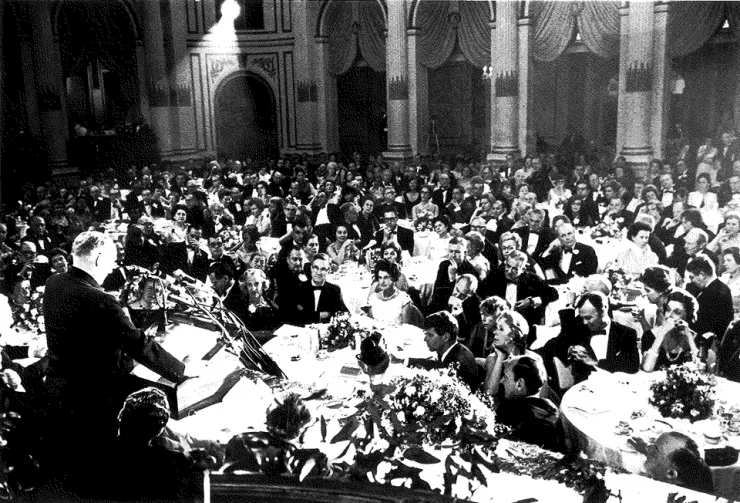
In 1966, for the 50th anniversary banquet for the prizes, Warren was chosen as the speaker on trends in fiction, not poetry. But clearly, for him, the same devotion to storytelling was critical to both genres.
His speech was one of five given on May 10 at the Plaza Hotel in Manhattan before a large audience of Pulitzer Prize winners.
The novel may even leave the printed page, but it could still be a novel
The only trend of the novel is, we are told, toward death. The novel is dying. We have been told that for a long time. In the 1920s — just before "The Sound and the Fury" and "Finnegan’s Wake" — it was widely reported to be dying. Santayana said so. Even D.H. Lawrence wrote: “It becomes harder and harder to read the whole of any modern novel. One reads a bit and knows the rest; or else doesn’t want to know any more.” He himself was, he frankly admitted, bored.
Now I admit that I am bored by a good many novels. I am even bored by some that stand high on the bestseller lists and in critical esteem — and that makes me feel out of step with the march of civilization and chitchat. But there are other novels, some also high on the bestseller lists, that do not bore me — that, in fact, compel and fascinate me. But I find it hard to put these fascinating novels in a single package marked “Trend.” The trouble is that a good novel is apt to rear up on its hind legs and shout, “Leave me alone! If you call me a trend again I’ll spit in your eye.”
It is easy enough to look back, or into a textbook, and see trends — in, say, the 1920s or 1930s. Yes, I remember a big book published in 1941 by a then eminent professor, for whom all writers were divided up into Naturalists, Decadents, Primitivists, Intelligentsia (with a sub-trend for Modern Cynicism) and Freudians. By the way, this trend-hugging professor found that the Decadents, including of course T.S. Eliot, had “exerted an enfeebling influence on the American character.”
What I am getting at is this: if I look back to my school days in the 1920s, I don’t remember Naturalists and Decadents, etc. I remember books. After the books exist we make the trends and the categories, but we must always remember that the books themselves, in their cranky, arrogant, individual integrity, had what the poet Pierre Emmanuel calls, in relation to Faulkner, “the powerful obscurity of genius.” We can use the trend and the labels, but if we are wise we never forget the moment of the first pure Eden morning before we gave names to the animals.
Now looking at the novels around me I don’t feel quite ready to give names. I see some groupings and vague constellations, but I don’t see any large overarching trend to define an age. What I do see is a rich pluralism, some inspired improvisations, a groping toward a notion of what the age may be behind the veil of appearances. Or is this pluralism merely, at its deepest, the mark of an Alexandria Age, marked not by true individualism but by false strivings after originality? Is such striving itself the trend — manifesting itself in a mere inversion of the conventional?
Such an inversion may be of form — as in a recently published loose-leaf novel which the readers may constantly reshuffle for new sequences and suggestions — a glorified game of solitaire. Or it may be an inversion of values in the content — for instance, a transvaluation of taboos, as in the mandatory use of what used to be pornographic materials, with the fact that the emphasis on shock after shock inevitably leads to a recurring effort to overreach the last shock by gimmick, décor and programmatic pathology. The paradox of the new pornography is that we are converted, not into participants, but into voyeurs. We get a fiction that cannot make reader or writer into an Antony, whose delights were, as Cleopatra dreamed, “dolphin-backed,” but into Faulkner’s Popeye manipulating the famous corncob.
Is the trend of the novel toward extinction? In saying so, some people mean that it is being absorbed into history, journalism or the psychological case study — those things which indeed it lies so close to. Certainly the novel will change, as it discovers new insights and encounters new materials. But this is only to say that it will be renewed by the continuing challenge of life.The novel may even leave the printed page — if the age of Gutenberg is really over — but it could still be a novel; if, that is, the medium remains an image of human life rendered in language, in language because the deepest reality of the novel is in a story sustained by the interplay between what psychologists call the primary language of imagery and the ordinary verbal language of narration and comment.
The uninspected life is, we know, not worth living, and the novel is one way which we have developed for inspecting life in its inwardness. The discovery of inwardness can be made by – and only by — the act of artistic imagination. Which is radical, central, and to be distinguished from the historical imagination. There is no substitute for it, and as long as it can, in proper humility, be cultivated, the novel will not die. It will not even get very, very sick.
As D.H. Lawrence put it some 40 years ago, if there is trouble, it is not with the novel, it is with the novelists. If they listen hard enough they will catch what James called “the very note and trick, the strange irregular rhythm of life.” What they make of what they hear will be known only, as it has always been known, after the fact.