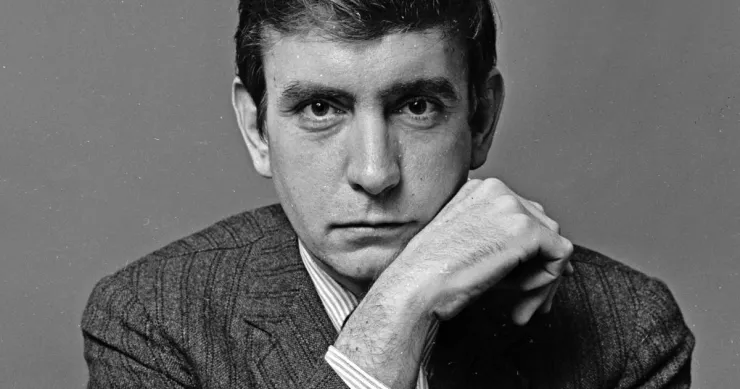
After three-time Pulitzer Prize-winning dramatist Edward Albee died on Friday at the age of 88, most obituaries mentioned the failure of the Pulitzer Advisory Board to give him the 1963 prize for Who’s Afraid of Virginia Woolf? The jury nominated the play, Albee’s Broadway debut, but the board awarded no prize. Albee subsequently won for A Delicate Balance (1967), Seascape (1975) and Three Tall Women (1994).
John Hohenberg, the Pulitzer Prize administrator from 1953 to 1975, wrote about the Who’s Afraid of Virginia Woolf? controversy in The Pulitzer Prize Story (1974). His account begins with the disappointment in the 1962 season of the two veteran Drama jurors, John Mason Brown and John Gassner, who nominated Albee’s play. At the time Drama jurors served multiple years in succession. Brown was in his eighth year as a juror, Gassner in his sixth.
Here is Hohenberg’s account:
‘An unblinking view of life’
The stock of native American drama on Broadway was sinking. Messrs. Brown and Gassner recognized all the symptoms in their report for 1963, calling the season “drably undistinguished” and mourning that “most of the new American plays have wallowed in every form of despair, drug addiction and deviation.” After such an unpromising beginning, however, he joined with Gassner in recommending Edward Albee’s Who’s Afraid of Virginia Woolf? and offering no second choice. The play, by an outstanding new American dramatist, was an alcoholic embellishment of a searing marital conflict, a theme celebrated with European flourishes by August Strindberg in The Dance of Death. Brown wrote:
“Although I can’t pretend that Who’s Afraid makes for a pleasant evening at the theater, I do know that it presents an unforgettable one. If it is an experience which is in part an ordeal, this is precisely what Mr. Albee meant it to be. With his unblinking view of life, he slashes savagely into his characters’ innermost selves. Some critics have described him as being a new Strindberg or O’Neill. Like O’Neill, he shrinks from no horror; like Strindberg, the war he declares between men and women is brutally fierce. But Mr. Albee already has an identity of his own.
“His play is a game played with undismayed candor by an older couple in the presence of a younger couple, all four of whom are drenched in alcohol. In terms of dialogue that is at times hilariously funny and at times abrasively revealing, it is a study in hatreds and frustrations, of impotence and jealousy, and with doing away with illusion (in this case, an imaginary son who is at last killed off). In the course of this, Mr. Albee proves to have a power for summoning extraordinary interest and excitement in a play which is both over-long and weak in its pivotal point.
“Although I have my reservations, these by no means keep me from recognizing the rare qualities of Who’s Afraid of Virginia Woolf? In it, Mr. Albee proves to be a young man who, having already done much, will unquestionably do more and has just now done a great deal.”
Gassner’s verdict was even more positive, for he wrote: “Although Mr. Albee’s play has easily detectable flaws, it is a slashing and penetrating work by the most eminent of our new American playwrights . ... I see no insuperable objection to the work on the grounds of immorality, lubricity, or scatology once one reflects that we cannot expect the vital plays of our period, whether we like this period or not, to abide by Victorian standards.”
When the Advisory Board met on April 25, 1963, there was a predictable split. The terms of the Drama Prize still were: “For the American play, preferably original in its source and dealing with American life, which shall represent in marked fashion the educational value and power of the stage.” Although the so-called “uplift” provision had been tacitly ignored in awarding the Prize to Cat on a Hot Tin Roof eight years earlier, only President [Grayson L.] Kirk [of Columbia Univesity], Chairman [Joseph] Pulitzer [Jr.] and Benjamin McKelway of the Washington Evening Star remained on the Board in 1963 — and McKelway had been absent at the 1955 meeting. The reconstituted Board debated the issue earnestly, with the opponents of the Albee play pointing out that it did not match up with the terms of the award and the advocates basing themselves on the jury’s recommendation. But in the end, Who’s Afraid of Virginia Woolf? lost by a narrow margin and the Board decided against any other award, hoping the jurors would not be displeased. But they were.
About thirty minutes after the announcement on May 6, 1963, that there had been no drama award, Brown telephoned me to say that he and Gassner were resigning from the Drama jury. Both were naturally displeased over the rejection of Who’s Afraid of Virginia Woolf? in such abrupt fashion. But in addition, Brown pointed out that the theater was in a difficult position and the prize therefore could well have been awarded to the Albee play as an “encouragement.” Gassner, equally polite, telegraphed his resignation, but there the amenities ended.
To the press, Brown announced his resignation and Gassner’s in these terms: “This is a case of advice without consent. They have made a farce out of the drama award.” To which Gassner added: “After we were overruled in 1960, we stipulated that if the Trustees overruled us on future occasions and gave the award to a play other than the one we selected, then the Trustees would have to announce what our selection was. This year’s decision does seem to be an indirect way of getting around our vote.”
Of course there was no secret about Toys in the Attic being the selection of the jurors in 1960. Nor did the deliberations of the Advisory Board itself remain a private matter, for the Board members quickly enough talked back to the angry jurors. Sevellon Brown III, associate editor of the Providence Journal-Bulletin and a Board member since 1961, argued for the Board’s majority that the play “was pretentious, did not conform to the terms of the award and was not a good play.” He added, “We did not vote against it because it was controversial or shocking.” However, W.D. Maxwell, editor of the Chicago Tribune, left no doubt of his own position. The Albee work, he said, was “a filthy play.” And Louis B. Seltzer, editor of the Cleveland Press, made a general attack on all plays that “reek with obscenity” and “offend good taste.” It was like a page out of the Board’s Butlerian past [This is a reference to the long tenure of Columbia President Nicholas Butler as an enforcer of good taste and patriotism in Pulitzer-winning work.]
Reporters for some years had been polling all members of the Board after controversial decisions and this time was no exception. In this manner, it came to the public’s attention that Benjamin M. McKelway of the Washington Evening Star had voted against the Albee play without having seen it, a circumstance that further inflamed the Board’s inveterate critics. They brushed aside McKelway’s explanation that he had every right to accept the judgment of some of his colleagues on the Board who had seen the play. It wasn’t right, they insisted; no one should condemn a play without seeing it.
The formalities of a severance of relations between the jurors and the Board were accomplished in a quieter atmosphere. As a purely technical matter, John Mason Brown and John Gassner both recognized that their appointments as jurors had lapsed on March 1, 1963, so they actually didn’t have anything from which to resign. However, Brown wrote to the Board:
“Since I have not been reappointed, I realize I am in no position to resign as a Pulitzer Prize Drama juror. Even so, I ask you not to reconsider me. I do not challenge the right of the Advisory Board or the Trustees of Columbia University to ignore a juror’s recommendation. It was with full knowledge of this right that I have served. But, inasmuch as my recommendations have been disregarded twice since 1956, it seems to me that my usefulness to the Board has ceased. Clearly, its approach to the theatre and mine are different.
“I have enjoyed serving as a juror and working with John Hohenberg and John Gassner. I believe deeply in the Pulitzer Prize for Drama and all that the prestige carries can mean for the theatre. Hence, it is with genuine regret that I send you this letter.”
There were two consequences of the unpleasantness over Who’s Afraid of Virginia Woolf? The first was a recommendation by a Special Committee on the Drama Award to drop the “uplift” clause, beginning with the 1964 season, and wording the terms of the Drama Prize as follows:
“For a distinguished play by an American author, preferably original in its source and dealing with American life.”
The committee — President Kirk, Chairman Pulitzer, and Erwin D. Canham of the Christian Science Monitor — concluded with a reference to the provisions of the Pulitzer will: “Your committee recommends the change in the wording of the Drama Award and believes it to be fully in keeping with the testator’s long-range purpose since it would, in the testator’s language, be ‘conducive to the public good’ and it is ‘rendered advisable ... by reason of change in time.’”
The second consequence was not as formal and it wasn’t intended to be binding, but it was first suggested by Barry Bingham of the Louisville Courier-Journal at the 1964 meeting as a helpful procedure and later endorsed by Chairman Pulitzer and several others. Put very briefly, what all Board members were expected to do henceforth was to abstain from passing judgment on any book they had not read and any play they had not seen. This procedure was nowhere noted as a formal resolution, but over the ensuing decade it was accepted by all Board members as readily as the custom of leaving the room during discussion and action on any matter involving a conflict of interest.
Source: John Hohenberg, The Pulitzer Prizes, pg. 266-69