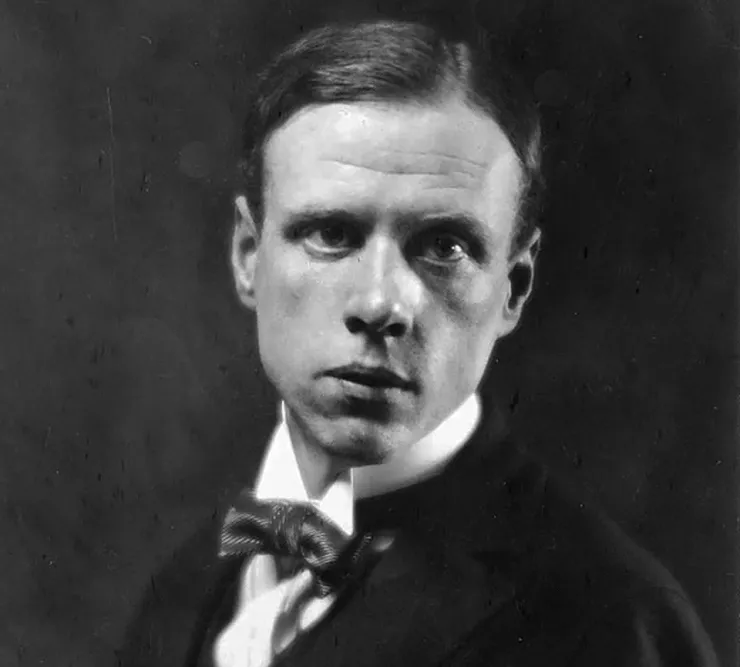
Columbia University Secretary Frank D. Fackenthal wrote to Sinclair Lewis a few days before the 1926 Pulitzer Prizes were to be announced to congratulate him on winning the Novel prize for Arrowsmith. On May 6, three days after the announcement, Lewis refused the prize and told the world why. (His rejection letter is below.)
Lewis was born in 1885 in Sauk Centre, Minn. After college he spent several years as a newspaper reporter and editor. He published four unsuccessful novels before achieving wide recognition with his fifth, Main Street. This 1920 work was about a gifted young girl married to a dull village doctor. She tries to bring culture and imagination to her dreary small town.
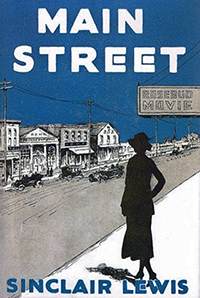 The 1921 Novel jury recommended Main Street for the prize, but the Columbia University trustees decided the book failed the “wholesome” requirement in the Pulitzer Plan of Awards and gave the prize to The Age of Innocence by Edith Wharton.
Lewis’s next novel, Babbitt in 1922, lampooned rampant materialism in middle-class America and became a bestseller. The Pulitzer Novel jury knew better than to select an unwholesome Sinclair Lewis novel. Writing that it understood that the trustees wanted a prize awarded each year, the jurors recommended, “without enthusiasm,” One of Ours by Willa Cather. The book won.
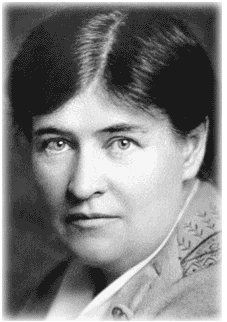
Willa Cather
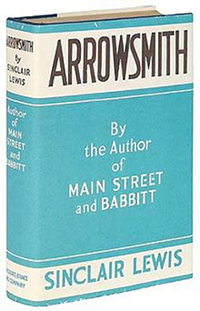
Arrowsmith was thus the third Lewis novel considered for a Pulitzer. It told the story of Martin Arrowsmith, a young man interested in science and recent reforms in medicine who makes his way from a small town in the Midwest to medical school and then wins acclaim in the scientific community. The 1926 Pulitzer jury unanimously favored Arrowsmith.
Fackenthal informed Lewis and his publisher, Harcourt Brace & Co., that the award was coming. Lewis told Harcourt he intended to turn it down because of “the Main Street burglary.”
Lewis’s letter of refusal made headlines around the country. A May 6 front-page headline in The New York Times read: “LEWIS REFUSES PULITZER PRIZE: Author, in Declining $1,000, Declares Such Awards Are Objectionable, Dangerous: ASSAILS MORAL STANDARD: Says Terms Are Misrepresented and They Really Demand a Compliance With ‘Good Form.’“
Richard Burton, chair of the Novel jury, contacted Fackenthal to offer either The Smiths by Janet Ayer Fairbank or Porgy by DuBose Heyward in lieu of Arrowswith. But Fackenthal decided Arrowsmith “was nominated by the publishers and as the award goes to the book, it will stand. If the author does not desire to accept the money which goes to the author of the successful book, why of course he is at liberty to return it, but the award itself will stand.”
Arrowsmith is still considered the 1926 Pulitzer Prize Novel winner.
 In 1930, Lewis accepted the Nobel Prize and its $46,350 prize. He titled his Nobel lecture “The American Fear of Literature.” While airing no complaints about his own life in America, he said: “For American literature in general, and its standing in a country where industrialism and finance and science flourish and the only arts that are vital and respected are architecture and the film, I have a considerable complaint.”
He did not mention his rejection of the Pulitzer Prize, but he did say: “I believe that Strindberg rarely sang the ‘Star-Spangled Banner’ or addressed Rotary Clubs, yet Sweden seems to have survived him.”
In ensuing years the requirement that the Novel prize be given to a book “which shall best present the wholesome atmosphere of American life” quietly disappeared from the Pulitzer Plan of Award.
Here is Lewis’s letter to the Pulitzer Prize Committee:
Sirs: –
I wish to acknowledge your choice of my novel "Arrowsmith" for the Pulitzer Prize. That prize I must refuse, and my refusal would be meaningless unless I explained the reasons.
All prizes, like all titles, are dangerous. The seekers for prizes tend to labor not for inherent excellence but for alien rewards: they tend to write this, or timorously to avoid writing that, in order to tickle the prejudices of a haphazard committee. And the Pulitzer Prize for novels is peculiarly objectionable because the terms of it have been constantly and grievously misrepresented.
Those terms are that the prize shall be given “for the American novel published during the year which shall best present the wholesome atmosphere of American life, and the highest standard of American manners and manhood.” This phrase, if it means anything whatever, would appear to mean that the appraisal of the novels shall be made not according to their actual literary merit but in obedience to whatever code of Good Form may chance to be popular at the moment.
That there is such a limitation of the award is little understood. Because of the condensed manner in which the announcement is usually reported, and because certain publishers have trumpeted that any novel which has received the Pulitzer Prize has thus been established without qualification as the best novel, the public has come to believe that the prize is the highest honor which an American novelist can receive.
The Pulitzer Prize for Novels signifies, already, much more than a convenient thousand dollars to be accepted even by such writers as smile secretly at the actual wording of the terms. It is tending to become a sanctified tradition. There is a general belief that the administrators of the prize are a pontifical body with the discernment and power to grant the prize as the ultimate proof of merit. It is believed that they are always guided by a committee of responsible critics, though in the case both of this and other Pulitzer Prizes, the administrators can, and sometimes do, quite arbitrarily reject the recommendations of their supposed advisers.
If already the Pulitzer Prize is so important, it is not absurd to suggest that in another generation it may, with the actual terms of the award ignored, become the one thing for which any ambitious novelist will strive; and the administrators of the prize may become a supreme court, a college of cardinals, so rooted and so sacred that to challenge them will be to commit blasphemy. Such is the French Academy, and we have had the spectacle of even an Anatole France intriguing for election.
Only by regularly refusing the Pulitzer Prize can novelists keep such a power from being permanently set up over them.
Between the Pulitzer Prizes, the American Academy of Arts and Letters and its training-school, the National Institute of Arts and Letters, amateur boards of censorship, and the inquisition of earnest literary ladies, every compulsion is put upon writers to become safe, polite, obedient, and sterile. In protest, I declined election to the National Institute of Arts and Letters some years ago, and now I must decline the Pulitzer Prize.
I invite other writers to consider the fact that by accepting the prizes and approval of these vague institutions we are admitting their authority, publicly confirming them as the final judges of literary excellence, and I inquire whether any prize is worth that subservience.
I am, sirs,
Yours sincerely,
Sinclair Lewis
Sources: Pulitzer files: The Pulitzer Prizes by John Hohenberg (New York, NY: Columbia University Press, 1974), http://www.notablebiographies.com/Ki-Lo/Lewis-Sinclair.html