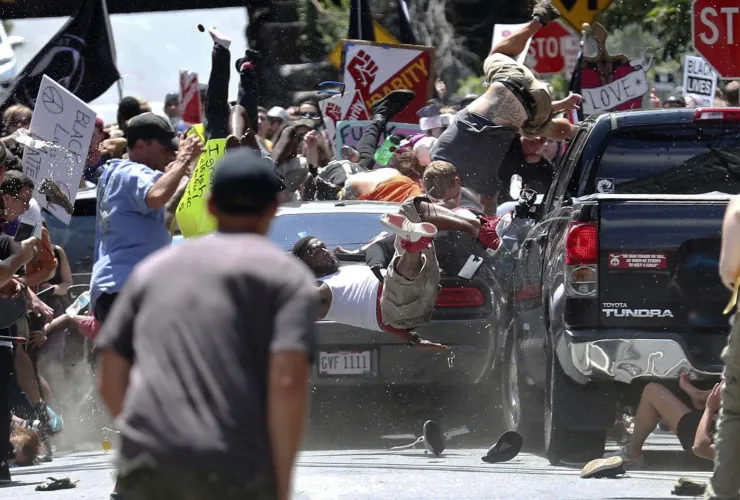
Ryan Kelly's "chilling image" of a car plowing through a crowd at during a racially charged protest in Charlottesville, Va. "reflected the photographer’s reflexes and concentration," and earned him the 2018 Pulitzer Prize in Breaking News Photography. He talks about how the day impacted him and his work, and how he feels about transitioning out of journalism.
You’ve said that it made a difference that The Daily Progress’s staff had been following the story of White supremacists in the years before their 2017 march in Charlottesville? Explain.
RYAN KELLY: There were a couple storylines in the thread leading up to what happened last summer. Wes Bellamy, at the time, was Charlottesville’s vice mayor, a young black man who was the first significant voice to call for the Charlottesville’s Confederate statues to come down. He became a target. Even a year or two before the [2017] rally, [its white supremacist organizer] Jason Kessler would come out and argue with Bellamy at public events. Kessler made it his life’s mission to go after Bellamy … That is the broad stroke. The statues were the start of it. But it spiraled, ending up with this fringe of supremacists, carrying the Nazi flag, and the KKK arriving in Charlottesville. The paper had been covering those storylines as part of a daily news beat.
How did you decide where to position yourself, and your camera, on the day counter-protester Heather Heyer was deliberately struck by a car and killed?
RK: I’d been all over town early that morning and afternoon. I would say it was dumb luck that I was there.
But my general knowledge of Charlottesville meant I had a better familiarity of what was going on and places to check out than many of the out-of-town journalists who were covering this … It was tough, though, honestly. Because there was so much chaos and so many people so spread out. Throughout Charlottesville, and especially downtown, it was just scattered chaos.
Were you afraid, at any point, during your months of helping to tell this story?
RK: Not really, not leading up to the march.
The day of the march was probably the most fear I’d ever had. The morning of August 12, things were pretty gnarly. People were pushing each other and punching other. My eyes got burned by tear gas or pepper spray or whatever was in the air. More than fear, it was a respect for the heightening emotions. I didn’t want do anything dumb that I couldn’t get out of. I tried to make sure I had an escape if I needed one.
Where were you, physically, when that car sped into the crowd?
RK: Maybe five or 10 feet at the most from that car. If you’ve never been on that street, it’s tough to imagine. It’s a street meant for one vehicle at time to use to cross the mall. [Counter-] protesters had filled out the entire street. It left nowhere to go when a car is barreling down.
When I first got there, it was a calm protest and as joyous as anything had felt all day. When the car sped by, I immediately knew it was an attack. There are all these conspiracy theories about how [the driver] was being attacked. He absolutely was not.
What were the settings on your camera? Did you just press and hold, in that moment?
RK: I was shooting manually like I always do. I was using a 70-200 lens, which is my go-to, standard lens. Once the car sped past me, I didn’t have a chance to make any decision, change settings or look for composition. It just followed the car and mashed the shutter.
After shooting that mayhem, mashing the shutter, non-stop, what did you do?
RK: I actually chased the car, thinking he would get pulled over or get in a wreck or arrested. I thought I would capture that. But none of that happened. So, I walked back toward the paper’s other photographer, who also was working that day and following the aftermath of what had just happened. I uploaded to my laptop and started going through what I had.
What placed your prize-winning shot a cut above the ones you didn’t publish?
RK: A lot of them were out of focus, just a blurry mess. There were all these people darting and dashing in front of me.
You just pick the moments that show the most of what’s happening. The one that won the Pulitzer, we all agreed, had the most details. It was the sharpest. A lot of these details may, individually, have been in the other pictures. But that was the one where everything, just everything, was happening at once. Bodies flying, legs, limbs … everything.
How well acquainted are you with Heather Heyer’s family?
RK: I met her [mother, Susan Bro] the first time at the wedding of Marcus Martin and his fiancé. He was the one in the middle of the photo in the red shoes … I shot the wedding for The New York Times. Susan released some butterflies on Heather’s behalf. That was a beautiful moment.
Susan and I are Facebook friends. We don’t talk every day … But we are connected in way that I can never be connected with other people. Slowly, I’m coming to terms with that and with what has been a really bizarre year. Heather’s death is the worst thing I have ever covered, the worst thing I have witnessed but also the most recognized thing I’ve done professionally. It is hard to balance all, but I have come to terms with it better as time has passed.
You’d left journalism before you won the Pulitzer and now are a freelance photographer, working full-time in a brewery.
RK: The new job at the brewery in Richmond is exactly what I wanted. Low stress, conventional hours. And it’s beer. What’s not to love about that?
But I do miss the excitement and camaraderie of a newsroom, which is why I continue to freelance — though that’s still not the same. There is something about doing journalism all day, every day that lets you really get to know a place. I learned the city, when I got to Charlottesville, by working news assignments there … I don’t have that in Richmond. But I have to remind myself that I wanted this change for a reason.
Some of the deepest cuts in the run-on of news staff cuts seem to have been among photographers. In these retrenching times, is photojournalism getting a fair shake?
RK: It probably varies, place to place. But, yes, photojournalism has been squeezed everywhere. The last decade or so I’ve seen … around the state of Virginia, fewer photojournalists on news staffs, doing work … My whole career has only known the tough times of journalism … That being said, people value good photographers and photography. That photo from Charlottesville set off such a discussion. It’s proof of the power of photography.
Where’d you put your Pulitzer award?
It’s actually sitting in a cardboard box but I have a wall picked out where it will be on a hanging shelf. It’s a glorified spot … for special things, including the Sports Illustrated cover, from earlier this year, with one of my photos. University of Virginia men’s basketball was No. 1 seed last year.
You’ve said you were glad that “Daily Progress has a Pulitzer,” crediting your old newspaper. Why?
The prize is mine, but I was a photographer working for the Daily Progress. I was doing my part for a team effort. Anytime the Pulitzers recognize — and I don’t mean this as an offense to The New York Times or AP or any of the big places — that there is so much beautiful work being done … at a small newspaper in a small market, I’m glad about that. I am so proud of the Daily Progress. I couldn’t do what I do if the whole newsroom wasn’t doing its part.