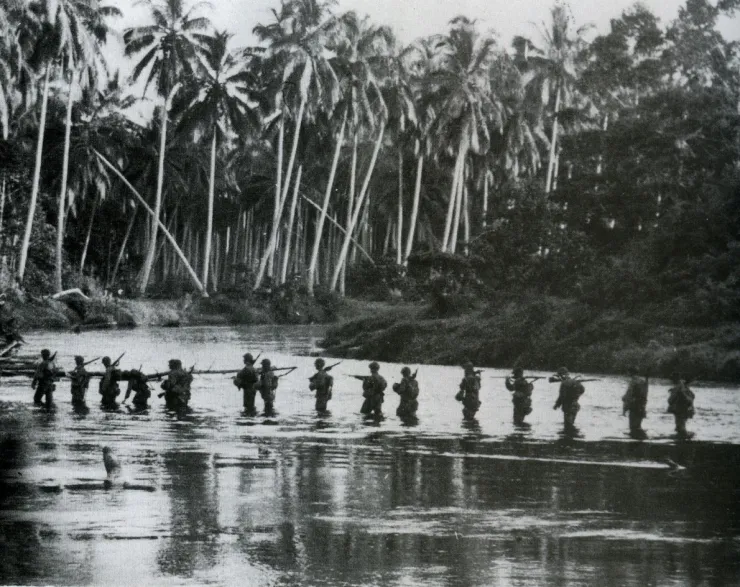
Arthur Sulzberger, publisher of The New York Times, assigned Hanson W. Baldwin to the military beat in 1937. War in Europe was imminent, Baldwin was a Naval Academy grad, and Sulzberger told him to pick his own stories.
Five years later, with the American focus still on Europe, Baldwin had a chance to travel to the Solomon Islands to report on what was happening in the Pacific. His reporting won him the 1943 Pulitzer Prize for Correspondence.
Here is his account of how the story came about, as told to Karen Rothmyer for her 1991 book Winning Pulitzers, followed by an excerpt from his prize-winning reporting.
‘I knew I had a story and I had to get it out’
By HANSON W. BALDWIN
On my trip to the Solomon Islands I got into Guadalcanal on a Marine DC-3 crammed with gasoline drums and ammunition flown by a classmate of mine, a Marine officer. We had to dodge enemy planes along the way. What surprised me when I got there was that we held so little territory — about the equivalent of LaGuardia Field. The impression back in the States was that we had the whole island.
I found out about the number of ships that had been sunk and about how badly our forces were beaten and how the Japanese torpedoes were deadly and ours missed their marks. I heard the people from one service cussing out the other service; there was a serious lack of coordination. At Henderson Field the night before I arrived, the Japanese had made a counterattack and gotten right into the headquarters itself. When I got there they even had the chief cook carrying a rifle.
Vice Admiral Robert Ghormley, who was in charge of that part of the Pacific, was a planner but not a doer. There was an air of defeatism about his headquarters. He himself said, “We’re doing this on a shoestring” — he used that expression. He was, but that attitude isn’t the way you win wars. You’ve got to imbue an air of confidence.
I found the situation in the Solomons was so much different from what the American people at home thought it was that I knew I had a story and I had to get it out. I couldn’t get it out down there, though, because of the censorship. Censorship was very heavy at the beginning of the war and very inept in the Pacific. A lot of failed submarine commanders were made censors. I remember once I used the term ack-ack for antiaircraft fire. It was a well-known term in World War I, but the censor struck it out. I asked him why and he said, “Well, I thought you were writing in code.”
So I came back to Washington and New York, wrote my stories, fought them through censorship, and was lucky enough to have a worldwide scoop when they were published. I was actually called before one of the committees of the Joint Chiefs of Staff, made up of generals and admirals, to tell them privately what was happening in the South Pacific. The Navy had kept it so quiet that the Army and Air Force members of the committee really didn’t know.
Our own mistakes are our worst enemy
From “Japan’s Hold on West Pacific Not Broken in Almost a Year,” The New York Times, Oct. 23, 1942:
Japanese domination of most of the Western Pacific and much of Eastern Asia has not yet been seriously challenged in almost a year of war.
But the United States, aided by a clear-cut qualitative air superiority, has assumed the offensive. And if we can hold our Solomons foothold, we shall have taken the first small step in a campaign that may someday lead to the gates of Tokyo.
The struggle in the Pacific, as viewed by this correspondent during the course of a 14,000-mile flight over the Pacific from San Francisco to Hawaii to the Solomons and return, is a bitter, relentless “no-quarter” war that cannot be won quickly or easily. In the opinion of most of the men who are fighting this war the Japanese are more dangerous foes than the Germans, and they consider Japan, rather than Germany, the primary adversary.
Others, with a broader global view of the conflict, agree with the prevailing strategic concept that our main effort must first be directed against Hitler-dominated Europe, but emphasize that the Pacific cannot safely be considered a secondary, or minor “front.”
. . .
The enemy is tough and hard and relentless; as the men who are doing the fighting say, he is a “very dangerous and worthy foe.” But we probably have as much to fear from our own weaknesses and our own mistakes as we do from the enemy. We can “take” the enemy and solve the gigantic problems that the Pacific campaign presents if we eliminate past and present frictions and handicaps and learn from our past mistakes.
We are now trying to do in the Solomons the first small part of a major job in the Pacific. We have done some of it well, some of it brilliantly, some of it very badly. How quickly we can do the major part of the job and at what cost depends primarily upon ourselves.
Recent operations in the Solomons — part of an oceanic campaign unprecedented in the history of war — have been costly to both sides and well illustrate the problems that confront us in the Pacific.
Perhaps our greatest problem, as is the problem of any peace-loving nation flung suddenly into war against a nation of professional militarists, is leadership. Errors of judgment or professional mistakes on the part of some, but by no means all, of our naval leaders — errors that stem in large measure from over-caution and the defensive complex — have resulted in costly and unnecessary losses.
There still exists, too, though rarely in the front “lines,” an underlying bitterness of feeling between the services, usually expressed by officers of the medium and junior grades, in criticism of the Navy by the Army air forces, and vice versa. This has been exacerbated by many of the more virulent and vocal writers and critics at home. Secretary of War Stimson wisely commented when he silenced one of the Army spokesmen that the Army was fighting the enemy, not the Navy.