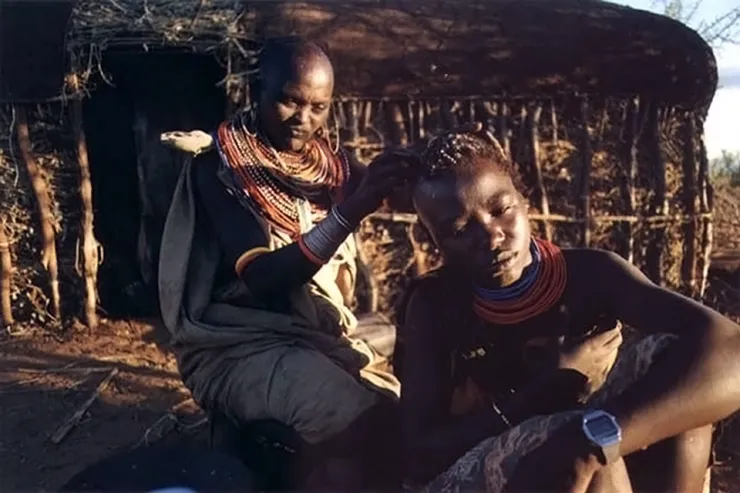
I am often asked how I went from being a photojournalist to being a midwife. The short answer is simple and obvious to me: I do the same thing.
The long answer starts with a naïve 21-year-old on her way to Africa with an idealistic notion that a photojournalism student should learn about the roots of journalism. I wanted to live in a developing democracy with an emerging free press and to work with people who were fighting for what we in the United States take for granted.
My personal goal was to discover why I wanted to be a journalist, but I was waylaid by a novel I read on the plane to Kenya. Alice Walker’s Possessing the Secret of Joy tells the story of Tashi, an African girl who submits to female circumcision out of loyalty to the customs of her tribe. I read with fascination about this brutal rite of passage, presuming that it could not be real or that it must be a relic. I did not know I was on my way to a place where it is very real.
At the Nation, Kenya’s largest daily newspaper, where I had a yearlong internship, the journalism focused mainly on politics and corruption. The reporters, photographers and editors were subjected to harassment, detention and abuse, but they were fearless in challenging an oppressive and corrupt government.
Although female circumcision (now commonly called female genital cutting or FGC) is widespread in Kenya, it is technically illegal. Despite this, there was little mention of it in the press. Still, one could not ignore hushed conversations about the practice: rumors of a secretary who could never return to her tribal home because she would be forcibly circumcised, or a girl who bled to death because her parents would not bring her to a hospital for fear of arrest.
It is estimated that 5 million Kenyan women live with the consequences of FGC. It remains the most primal act of violence against women and girls, and it is ingrained in the cultures that maintain the practice. Its consequences are more than the pain, risk, infection and bloodshed; it robs women of their femininity. It cuts the very heart of womanhood.
My editors in Kenya were not interested in a story about FGC and offered me little time to work on one. But the practice haunted me. It occupied my every waking thought. I visited Nairobi libraries, hospitals and women’s health organizations to learn about it. I traveled in rickety buses and taxis to the countryside where FGC occurs in villages at certain times of the year.
Over time I began to understand the cultural context in which the practice takes place. A woman who tries to avoid it is turning her back on her culture and becomes an outcast. My hope as a journalist was not to condemn the practice but to help people understand the power of the cultural forces that allowed it to continue.
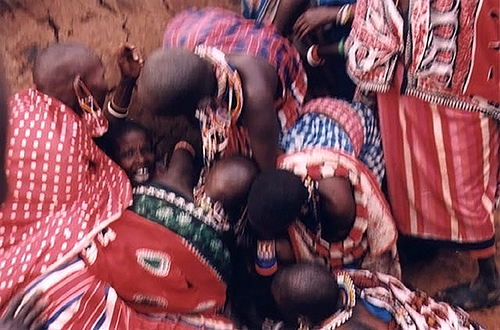
Seita Lengila screams as women hold down her legs and stifle her cries.
In Kenya, the tribes that still circumcise girls do so at ages 10 to 15. Afterward, the girl symbolically enters adulthood and becomes marriageable. It is the most important rite of passage in a girl’s life and eagerly anticipated by the entire family. Extended family members and friends come from far and wide to celebrate the rite. They bring the girl’s father gifts of money and livestock.
The word for “adult” in Swahili – mtu mzima – literally means “whole person.” A girl who had just been circumcised asked if I could help her because she thought she was dying. The girl’s drunken father patted me on the back jovially and said, “Don’t worry, she is fine. Look at her, she is beautiful now, she is a woman.” The ultimate irony is that to become a “whole person,” a girl must lose this part of herself.
While reporting, I wanted to witness childbirth because this is when you see the most severe consequences of the practice. Scar tissue often impedes normal birth, causing obstructed labor, extensive tearing, hemorrhage, infection and, later, obstetric fistula. I was allowed to photograph women bearing children at a small hospital in the town of Wamba in the Samburu district, where many women walk after hours or days of labor.
My mother was a labor and delivery nurse. I never had any interest in doing the work she did. I considered myself squeamish, and I chose my career path in part because it was un-messy (or so I thought).
When I saw a birth for the first time, it was just a footnote in the research for my story, but what I witnessed astonished me. In that room, there were few of us – a doctor, a nurse, the mother, me – you could count them on your hand. Suddenly, without a door opening, there was another person in the room. But for me a door opened. To see the violence the female body can withstand and survive and thrive, to see the life-giving ability endure, changed my life.
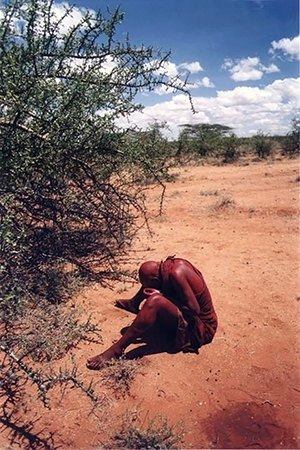
Seita Lengila examines herself
I continued to work on the story. The Nation published a watered-down version. After I returned home to finish college, the story was published in the United States. I was fortunate enough to have it recognized and to have the issue enter the public consciousness and become part of a conversation that I hope will save girls from the practice someday. I returned to Kenya to work on a story about child prostitution. In my daily job as a U.S. newspaper photographer, I gravitated to stories about women’s health and bodily integrity.
But that revelation in the delivery room – that footnote to my story – kept coming back to me, just as the issue of FGC had occupied my thoughts years earlier. I knew a journalist’s necessary distance from her subject prevented me from doing all I could to advocate for women’s health. If I wanted to do that, I had to be in health care, preferably as a physician.
My mother referred me to an obstetrician to shadow. The question I took into my day with him was this: Could I give up advocating for women’s health on a large scale through the stories I chose in order to work person to person and influence individual lives? The obstetrician and I rushed from room to room as he solved problems on the fly. He was a wonderful man, full of passion for the work and compassion for the women he cared for, but I never took a breath or saw him sit down with a mother.
That day I met a certified nurse-midwife in the hospital’s break room. She was calm and relaxed. She talked to me about her role caring for women. She took me across the street to the birth center where some of her clients chose to deliver. There I met other midwives and learned about the advocacy roots of midwifery in the United States.
And I thought: These are my people. This is what I should do next.
A few months later, I began the midwifery program at Yale University School of Nursing. During the 13 years since, I have been fortunate enough to assist more than 700 babies into the world, each time as a rapt observer of this extraordinary moment.
At the center of most of these events is ritual, and for me the ultimate rite of passage in Kenya – that cut at the heart of womanhood – proved to be transforming. I am grateful to the women who taught me about resilience and who let me tell their stories. Then as now, I am amazed that anyone would allow this. Because of them, my life’s work is devoted to caring for women.