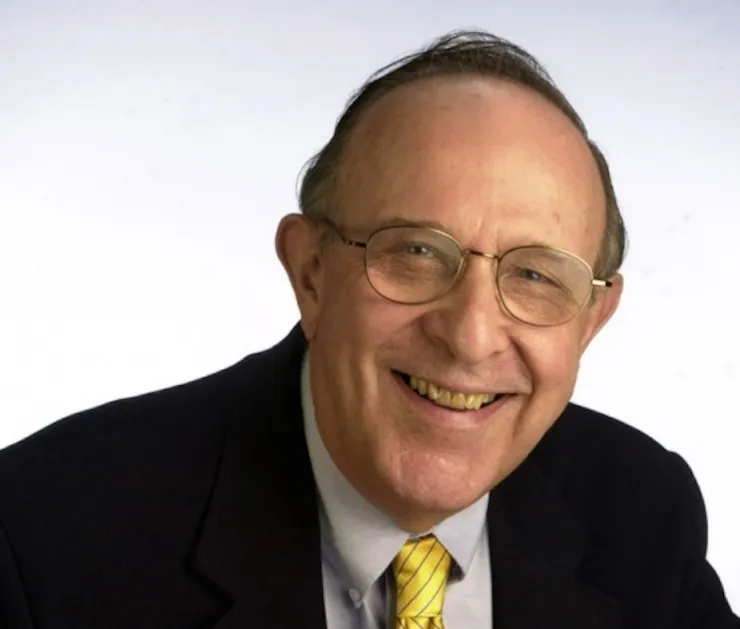
Like many wannabe journalists, Edwin A. Roberts Jr. graduated from writing for free to being paid by the inch – in his case a dime an inch. This, naturally, encouraged weaving together stories so that each sentence seemed essential and nothing could be cut.
He learned well enough that the Asbury Park Press in his native New Jersey hired him as a reporter. From there it was on to The Wall Street Journal, where Vermont Royster mentored him on the editorial pages.
When Dow Jones Co., owner of The Journal, started a sister paper, The National Observer, Roberts moved there as a reporter. Years later, after trips to Latin America and the Soviet Union for in-depth reporting projects, he began writing a column called “Mainstreams.” Among other subjects he interviewed Benny Goodman and Maria Rasputin, daughter of Grigori, for the column.
Ten columns he wrote in 1973 won Roberts the Pulitzer Prize in Commentary.
For the last 20 years of his half century in journalism, Roberts was editorial page editor of The Tampa Tribune. Most of the biographical details in this introduction come from the story The Tribune ran announcing Roberts’s retirement in 2003. The story also contained this bit of wisdom from its subject:
“No matter how many birthdays you've had, the key to happiness is a self-induced optimism. That is, it involves an act of will. The world has too much horror in it to permit, on a regular basis, an unassisted rising of cheerfulness.”
Here is “Mainstreams: The Quiet Revolution” from The National Observer of Feb. 17, 1973, one of the pieces that won Ed Roberts the Pulitzer Prize.
Keeping the ship steady no matter how winds and waves flail
By EDWIN A. ROBERTS Jr.
It is frequently remarked that the United States, no less than France and Russia, has its political roots in revolution. What is sometimes overlooked by laymen is that the American uprising of the late 1770s was completely different from the revolutions that brought Napoleon and Lenin to power.
The goal of the American rebels was not to overthrow the British monarchy. On the contrary, the aristocrats who engineered the break with Britain were conservatives who wanted only the same rights for the people of the colonies that Englishmen in England enjoyed. Theirs was a conservative revolution that did not destroy the social structure.
Nevertheless there are still many impatient voices in this country, particularly in the academy, in the left-liberal press and on public television, who implicitly look forward to another American revolution, one that would redesign society according to the leftist’s stock ideas about egalitarianism and the redistribution of wealth.
Part of this rationale is that America was born in revolution so some more of the same in the 1970s would only be fitting. The thunder on the left is comprised of two principal arguments – that the United States is drifting into an era of repression and neo-fascism and that the economy of the nation is so programmed that the rich get richer and the poor don’t.
What this school fails, perhaps refuses, to perceive is that since the early 1960s the United States has been experiencing a quiet revolution of historic importance. Granted, it is another conservative revolution, and a nonviolent one, but it is just this fact that distinguishes the American political system from all others.
Let’s review some of the popular complaints from the left and see how the quiet revolution has dealt with them.
A particularly common complaint is racism. We are told we live in a racist society that is polarizing whites and blacks. That was true in the 1930s when we didn’t hear much about racism, but it is not true now. Congress has passed a host of laws designed to reduce racism, and generally those laws have worked. No longer is there legally sanctioned segregation, the income of blacks has risen faster than the income of whites, and a variety of social measures have been introduced to compensate in part for the mistreatment of Negroes in the past.
What is happening is that instead of becoming polarized, the races are coming together. Such a coming together, unprecedented in all of history, has naturally caused friction. But the friction is a measure of the nation’s success, not its failure. The government’s lead, moreover, has been followed in private sectors. Blacks are getting preferential treatment in the hiring practices of hundreds of universities and companies. The nation has made a huge, if diffused, commitment to help blacks boost themselves into first-class citizenship.
But such observations are met with a weary grimace on the left. We are not moving fast enough, say the liberals, comparing present-day America with their own utopian visions. If that is a reasonable comparison, the liberals are right. But in an extremely diverse and complex society, such a comparison is manifestly unreasonable.
The progress the United States has made in solving its racial problems is draped in large ironies. The more the country does to remedy the inequalities of the past, the louder the complaints become.
There is a way to look at the matter in microcosm. No newspaper in the country has been a stauncher advocate of black interests than the Washington Post, nor has any general-circulation newspaper made a greater effort to hire black journalists. Yet it was the black journalists on staff who recently charged the newspaper’s management with not hiring enough blacks, even though the Post probably employs proportionately more black writers than any other general circulation paper.
Rising expectations and the passions they release are understandable, but they must be seen for what they are.
Many newly integrated schools are experiencing “racial incidents.” These usually take the form of scuffles between black and white pupils, not infrequently because some young blacks have a chip on their shoulder and can gain a measure of status among their black friends by leaning on white children. This situation is not helped by the reluctance of white school administrators to discipline the black offenders.
Such school problems simply reflect the tensions in society. But those tensions arise precisely because efforts are being made to bring the races together. If the total segregation of yesteryear remained the tale, we would be without those frictions. Blacks and whites would almost never come into contact. It is because blacks and whites are coming into contact on a scale never imagined 20 years ago that sparks occasionally fly. The sparks are troublesome but their real meaning is that racial integration is becoming a living, breathing fact.
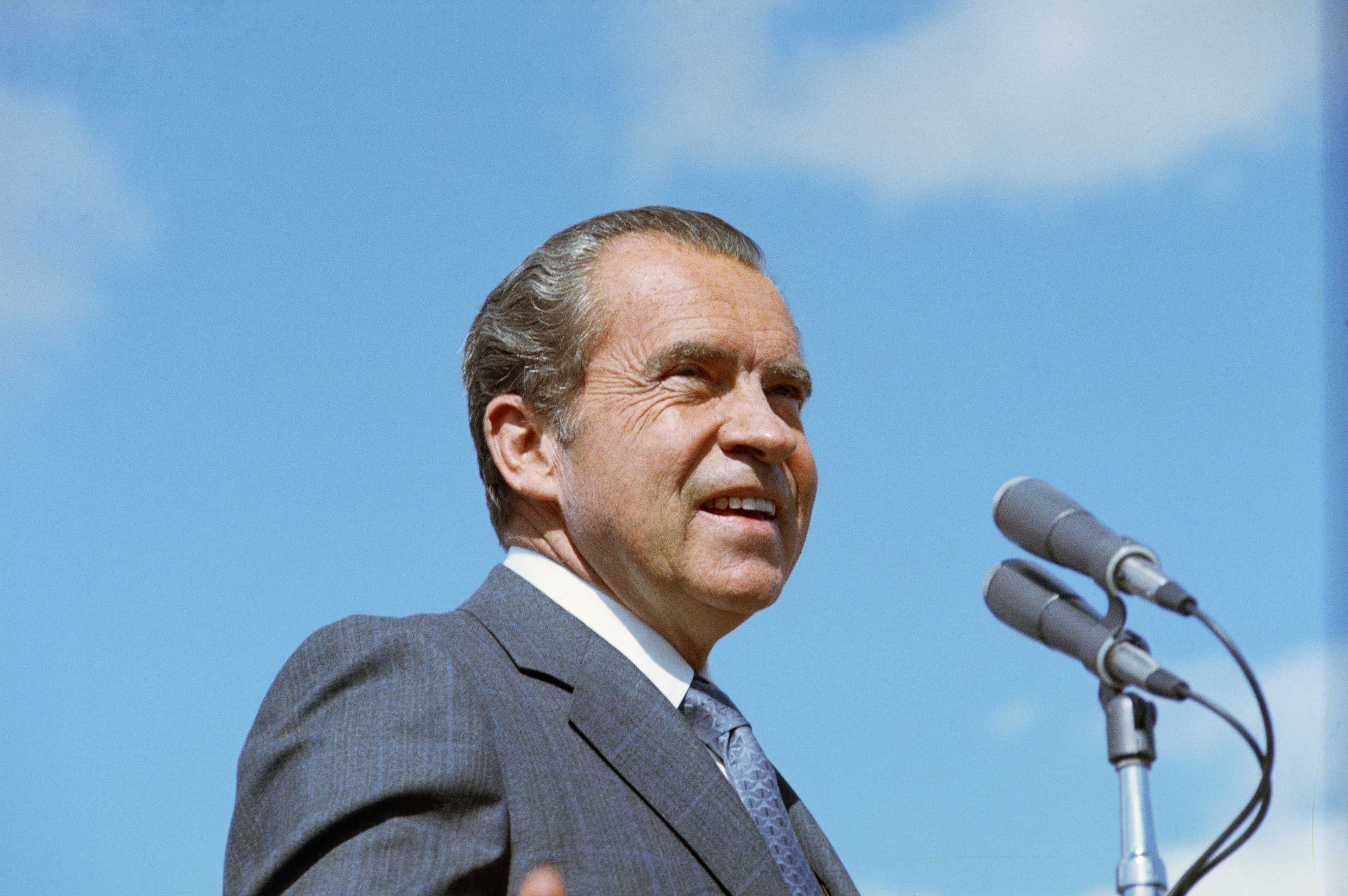
Richard Nixon
It is well to remember that no nation in history has faced so many problems deriving from the motley make-up of its population, and no nation has so determinedly dealt with those problems on the basis of equality for all. Is there still a long way to go? Of course. But we are moving and the direction is right. The quiet revolution continues.
Do you remember what the Pentagon Papers were? They were a study, authorized by the Secretary of Defense, to find out how exactly the United States became embroiled in the war in Southeast Asia. The report was classified Top Secret.Richard Nixon is viewed by many on the left as something of a neo-fascist. His administration has been criticized for its “repressive” tactics, and among the examples given are the government’s halting (temporarily) of the publication of the Pentagon Papers, the spying on private citizens believed to be radicals and the jailing of newspaper reporters who refuse to disclose some of their sources to federal grand juries.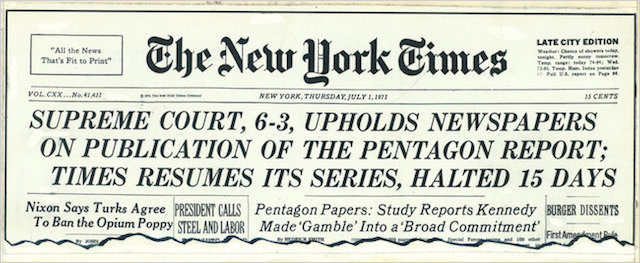
The report necessarily considered military and diplomatic matters that no government would want bandied around the world, especially since the overall problem that spurred the study – the war – was still going on. Whether the security of the United States was compromised by the disclosures is moot.
Some degree of secrecy is essential to the conduct of government, especially in foreign affairs. One need not sanction the often-preposterous system of document classification in Washington to understand the Nixon administration’s objection to the theft and subsequent publication of the Pentagon Papers. Who is to decide what is a vital secret and what is not? Is this a decision that can safely be left in the hands of one emotional private citizen? We must doubt it.
And think of this: In no other country would material such as that contained in the Pentagon Papers be printed in the public press. This is true even of such sterling democracies as Britain and Sweden. Newspapers in those countries would not have touched the documents.
But there is an even more salient point to make here. In no other country would anything like the Pentagon Papers have come into being in the first place. Only in America do we exhume our mistakes and print them up.
If the United States government is repressive, the business of the Pentagon Papers is a weak example.
The spying on private citizens by the Army and others has been excessive, not to say ridiculous, in recent years. And yet it is an entirely understandable aberration. In the last half of the 1960s, the campuses and the streets exploded in rioting, looting and vandalism – all in the name of honest dissent, of course. What governments of men (and no government is simply a government of laws) could be expected to disregard totally the screams for assassination and revolution that shook the welkin in those impassioned days?
What is important about the government’s surveillance policies is that they came quickly to light and were pretty well undercut by the public’s sense of outrage. The Nixon administration hasn’t repressed dissent. Dissent is rampant in all the big and little publications that for years have viewed Nixon as Satan incarnate.
The dissent that is given the hardest time is the dissent from dissent, as manifested by leftists who refuse to let some political leaders exercise their freedom of speech at public rallies.
As for newspapermen who are jailed for withholding information from grand juries, this is a question that is not quite so simple as many journalists see it. A journalist is also a citizen with a citizen’s responsibilities. On the other hand, it is difficult to see how a reporter could function if he could not guarantee anonymity to certain of his sources.
The dual status of the journalist is nothing new. What is needed now is a new recognition by the courts that the institution of the press requires some carefully defined privileges if it is to do its work. I don’t see the matter as one of deliberate government repression. It arises rather from a misunderstanding of how reporters collect news.
Perhaps new legislation is necessary to remove this threat to press freedom. If so, it will come. The sword is no doubt mightier than the pen, but the press is not exactly impotent. If the agents of government fail to protect reporters from arbitrary imprisonments, those agents may have cause to wonder what fell on them.
But this problem, too, can be solved in a reasonable way. And the solution begins with a rereading of the First Amendment. In any event, not every disagreement over some aspect of the Constitution means that the Brown Shirts have taken over Washington.
One area in which there has been important social progress is consumerism. The leftists hate business (they usually state it as “big business” although “big” is a relative word and it is not only the largest corporations that are being brought to heel by legislation and consumer-group action).
But not so much headway has been made in forcing or cajoling manufacturers to stand behind their products that the American consumer is today protected as he never has been before. This doesn’t mean all new automobiles are assembled properly, but it does mean that the automakers and dealers can no longer tell an unhappy customer to get lost. At least not without increased risk.
Can you imagine a dozen years ago an automaker recalling hundreds of thousands of cars because of a common defect? Can you imagine a dozen years ago newspapers that carry a lot of auto advertising printing stories about recalls and customer suits? Can you imagine a dozen years ago a huge impact on the whole consumer economy by one zealous lawyer?
The consumer uprising is one of the most dramatic aspects of the quiet revolution.
The military draft is ended. America’s involvement in the Vietnam War is apparently ended. The United States and China are on speaking terms, and the prospect for closer relations is good. After a generation of Cold War hostility, the United States and Russia are negotiating enormous trade agreements that augur well for world peace.
On the domestic front a new and revolutionary federal welfare program is bound to come, perhaps at last giving all Americans freedom from acute want. There has already been an important change in the way government and the people regard an individual’s right to life. We have come to see that right as embracing the right to eat, to have shelter, to make a fresh start, and to have society’s support when adversity seems to block all chances for improvement.
In recent years Americans have changed their minds – and opened their minds – about a lot of things. Without knowing it, because the changes were mostly gradual and often subtle, Americans have made a new kind of revolution. It is not only their right but their duty to recognize what they have brought about.
The rest of the world is looking this way, and if there is no hope in the United States there is no hope anywhere. What the world has seen, probably better than Americans themselves have seen it, is that this country is not only the strongest and freest of nations. It is also equipped with an amazing gyroscope that keeps the ship remarkably steady no matter how the winds and waves are flailing.
There will always be panicky souls among us who want to give the wheel a full spin or blow a hole in the hull, but their macabre radicalism is important only to themselves. It is not a saleable philosophy in this country because the people know they have a system that offers orderly alternatives.
America has proved that it can change both dramatically and safely when the times require it. As a people, we react well to exigencies.
There are great problems still in our midst and no doubt other problems lie ahead. We can’t afford to close our eyes to all the misery and misbehavior that is so stubbornly stitched into the social fabric. We are not children. We can see things as they are and we can react.
But as we would not be Pollyanna, so it only diminishes us to play Cassandra. Let’s look ahead to the continuation of the quiet revolution, but let’s also look back to the near past and reflect upon the unmanageable problems we have somehow contrived to manage. And then let’s proceed deliberately – and with a good heart.