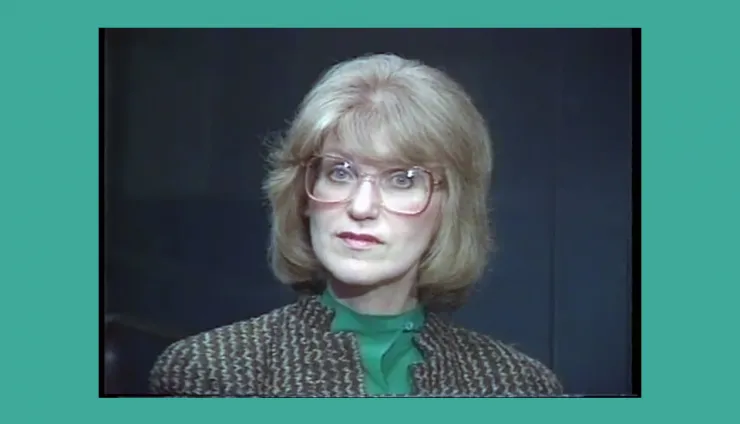
As a reporter, Lois Wille flew with the Blue Angels, played pool with Willie Hoppe and brushed a rhino’s teeth. During a celebrity interview Cary Grant told her he liked fine fabrics so much that he bought and wore women’s underwear. When she made this revelation her lead paragraph, her city editor took it out of the story. The Chicago Daily News was a family newspaper, he said, “and I really don’t think we should be telling our people that Cary Grant wears ladies' panties.”
Odd, then, that when the Daily News won the 1963 Pulitzer Prize for Public Service, it was for a series by Wille on a truly taboo subject: birth control.
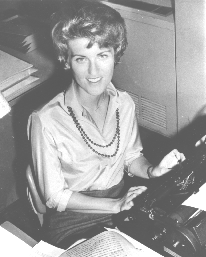
Lois Wille
Wille had grown up in Arlington Heights, a Chicago suburb, and graduated from Northwestern University. She worked for the Daily News for 23 years, until the paper closed in 1978.
In a 1991 interview with Diane Gentry for the oral history archive of the Washington Press Club Foundation, Wille said that when she started, she was one of two women working at the Daily News as a hard-news reporter. She did general assignment work, Helen Fleming covered education. They were not treated as equals, she told Gentry, but neither were they harassed.
“The women were a novelty,” she said. “We were different. It wasn’t an equal. But no hostility and lots of friendliness. Because women did have very limited kinds of things they covered, I also was not a rival. I was not a threat, which may have been significant.”
Wille learned about the birth-control issue while reporting on welfare. Sources told her indigent women “had no access to birth control services as part of their medical care.” Some Cook County Hospital doctors felt they “could not give complete medical care to a woman if they couldn't tell her about contraceptives. . . . If a woman said, ‘Is there any way I can avoid getting pregnant again?’ they had to refuse to answer her.”
The Pill was available but newspapers avoided the subject “because of the dominance of the Roman Catholic Church among Chicago’s political leadership and also because the church was just very powerful in the city itself. . . . It would be offensive to readers if this subject were written about.”
The year before the series, 20,000 babies were born to indigent families at Cook County Hospital.
“I had wanted to write about this problem for a long time, both because it was important to women's health and because it denied an essential part of health care to poor women that more affluent women got as a matter of course,” Wille said.
Her city editor – the same one who had kept Cary Grant’s panty preference out of the paper – was a devout Roman Catholic. When he took leave for surgery, an editor named Bob Rose stood in for him. He became Wille’s ally, pushing the story. With help from Planned Parenthood and the Cook County Hospital staff, she wrote the series.
In addition to the Public Service Pulitzer, which went to the newspaper, Wille won the 1989 prize in Editorial Writing while working for the Chicago Tribune.
“Her super power was the ability to write remarkably tough, righteous coverage of corruption and injustice while conveying extraordinary kindness and decency,” former Tribune editor and fellow Pulitzer winner Ann Marie Lipinski, curator of the Nieman Foundation for Journalism at Harvard University, told the Sun-Times.
Wille's birth-control series ran Sept. 13-18, 1962. Less than three months later, the governing body of the Illinois Public Aid Commission voted 6-4 to pay for birth control for relief recipients.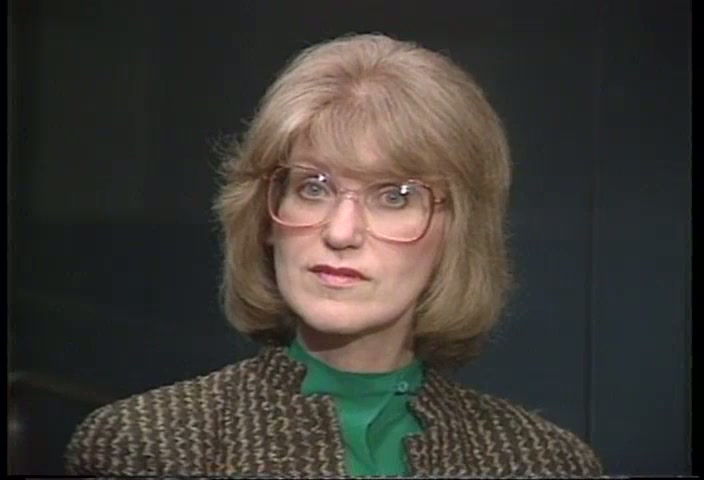
Lois Wille
Here is Wille’s five-part Public Service-winning series, edited slightly for length.
1: The tug of war on birth control
By LOIS J. WILLE
On a hot Saturday morning in August, Mrs. Sandra Allmon, 26, walked into Newberry Settlement House just off Maxwell Street, waited in line with about 100 other women and poured out her story:
“I asked about it at County Hospital when my youngest was born, and everybody shut up like a clam.
“I've got seven now. I told the doctor. And he said, ‘Well, you're healthy enough for seven more.’
“I asked my ADC [Aid to Dependent Children] man, and he just says he didn't know anything about it.
“When I took my baby to the welfare station, I asked them – and when you bring that up, why, they act like they don't know you.
“I heard about you people from a neighbor. It was just like a miracle. I couldn't believe it. You're the only ones who will talk to me about it.”
It was a story that was told in scores of different ways that morning to Mrs. Virginia Hackmer, social worker.
“The faces change,” she said, “but what they tell me is essentially the same – nobody else will help them.”
But last week somebody else said he may take on the problems of the Newberry women – husky Harold (Hap) Swank, new executive secretary of the Illinois Public Aid Commission.
And if he does, a stew that has been simmering for a long time could boil over.
What Mrs. Allmon wanted was this: Information and supplies to prevent her from having more babies.
She got it – as did 5,470 other women in the first 8 months of 1962 – from one of the dozen clinics in churches and settlement houses operated by Planned Parenthood Association.
Of these 5,470 at least 1,370 are supported by the Cook County Public Aid Department.
They pay nothing for the services they receive at the clinic unless they choose a contraceptive pill, which costs them $2.50 a month.
It is these free services for relief recipients that may break open the silent tug-of-war over birth control.
The key issue is: Should Planned Parenthood, a private agency with a $249,000 annual budget, be reimbursed with public funds for its services to welfare patients?
Or, stated another way: Should public funds be used for a purpose considered immoral by at least 40 percent of the population of Cook County? Of these the greatest numbers by far are the members of the Roman Catholic Church, joined in their views by the Greek and Jewish Orthodox churches.
The most vocal proponents of the use of public funds for birth control service are members of the Planned Parenthood board of directors, an array of 48 civic and social leaders, rabbis, Protestant clergymen and physicians.
They are seconded by the Church Federation of Greater Chicago, representing 27 denominations, the Chicago Gynecological Society and the Chicago Institute of Medicine.
“The proper prescription of child-spacing measures is an essential aspect of preventive medicine,” the Gynecological Society said in a resolution 2 years ago.
“It should be available to all who desire it, whether they obtain their medical care through private physicians or tax-supported health services.”
But so far Raymond Hilliard, director of the Cook County Public Aid Department, has not offered to pay the $15,070 Planned Parenthood says he owes them for the first 8 months of 1962.
“The medical advisory committee of the Illinois Public Aid Commission decides what kind of services can be covered,” he said.
“Preventive medicine – including birth control services – is not on that list.”
And there the matter has rested, until the arrival in Chicago of Harold Swank.
Before he was named executive secretary of the IPAC, Swank was never shy about discussing his views on birth control and public funds.
As IPAC assistant executive secretary in charge of Downstate, Swank often told his regional directors that he considered birth control services a legitimate public aid medical expense.
Now, after several weeks in the executive secretary's chair, Swank told the Daily News:
“I want to do some further exploring, to find out what other States offer. Assuming the facts I gather don't alter my position. I will go to the commission and ask them to authorize referrals to Planned Parenthood or any other private facility offering these services.”
And what about reimbursement for the care of welfare recipients?
“I would classify this as an appropriate medical cost,” Swank said.
With these words, Swank has given a giant boost to a persistent band of Chicago area men and women determined to make birth control part of public welfare policy.
The issue first came before the public in 1959, when County Commissioner Charles Chaplin pointed to spiraling costs of the Aid to Dependent Children program and asked:
“Why don't we consider birth control as a means of controlling births?”
Since that speech ADC costs have become more frightening: In July 1960, Cook County ADC recipients got $4,400,000; in January 1962, the sum rose to $7,850,000; and in June 1962, to $9,328,000.
Chaplin’s efforts were supported by State Representative William H. Robinson, Republican, of Chicago, who has protested that great numbers of his fellow Negroes are denied incentive to move upward because of the lack of birth control services to low-income families.
Robinson cited these statistics:
In the decade between 1950 and 1960, the Chicago area white population increased 16 percent. The nonwhite population grew 66 percent.
“The population increase is in the lowest income groups, which represent the greatest consumers of welfare services,” Robinson said.
This denial of birth control services to low-income families has become the battle cry of the newly formed Citizens for the Extension of Birth Control Services.
Says the group's energetic chairman, Dr. Lonny Myers, mother of five:
“No one is proposing that the privilege of having a baby should be denied to low-income families. We are only proposing that they have the same opportunity to space their children and limit family size that those who can afford private medical care now enjoy.”
Mayor Richard J. Daley, after several months’ silence, finally agreed to a request from Dr. Myers to meet with her group.
The Chicago area Council of Jewish Women's Organizations has asked its 315 member groups to approve this resolution: “Family planning should be an integral part of the public health programs and included in the services of all public health institutions in the Chicago area compatible with the ethics of the family involved.”
But behind these developments have been others – more subtle and perhaps more significant.
When Dr. Myers assembled her delegation to call on the mayor, two prominent Chicago businessmen who belong to the Catholic church agreed to join the group.
Another Catholic layman, Cook County Hospital Warden (Superintendent) Fred Hertwig, said: “I feel birth control clinics should be integrated with our public health services. I think they will work, and I think they will do a lot of good.”
These signs of support from some Catholics indicate there will not be a battle with the church, according to Dr. Myers.
“What we are fighting is apathy and ignorance on the part of public officials. We are not fighting the Catholic church – but the fear of the Catholic church.”
2. Planned Parenthood zeroes in on Chicago hospital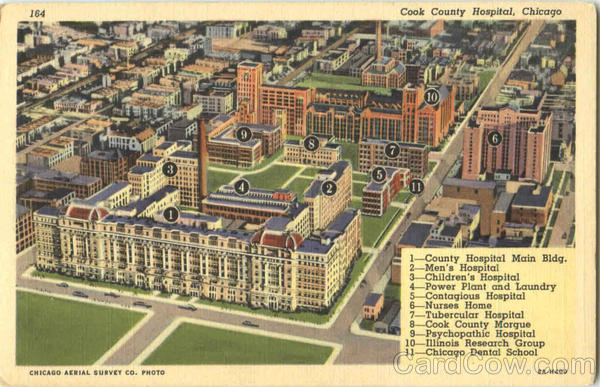
An old postcard of the Cook County Hospital
Within the next 24 hours – if they are average – 56 babies will be born in Cook County Hospital.
No other hospital in the nation can make that claim.
For the most part, the 20,000 babies born at County during 1961 belong to what the hospital calls medically indigent families – ones who must rely on public funds for medical expenses.
At least a third of the 1961 babies born there were illegitimate, and many were placed on Cook County relief rolls the day they entered the world.
For such tiny beings, the County Hospital babies have received an enormous amount of attention in recent months.
They were the subject of an hour-long television documentary on CBS-TV, Birth Control and Public Policy. They were being talked about increasingly at welfare agency luncheons, on radio panel shown, in the press.
All the talk centers around these questions:
Should anything be done to deflate the County Hospital baby boom?
Should the hospital offer birth control information and supplies to new mothers when they make post-delivery visits – a move that the Planned Parenthood Association vows would save the county almost $800,000 a year?
In the last 4 years, hospital officials have said “yes,” and then “no,” and “yes” and “no” to that question. There have been so many flip-flops that even those most vitally interested have lost count.
The most recent answer – as of last week – was a qualified “yes.”
Last Friday the executive secretary of the Planned Parenthood Association, Mrs. Jane C. Browne, received a telephone call from a County Hospital obstetrics staff member with this request:
Would she please send 3,000 copies a month of a Planned Parenthood brochure and another 3,000 copies of the Planned Parenthood clinic directory to County Hospital?
Mrs. Browne promptly forwarded as many pamphlets as we could spare, including some in Spanish, to the director of the hospital’s Fantus Clinic for maternity patients.
In an accompanying letter, she said: “We are very happy to cooperate in this way, but 3,000 pamphlets and 3,000 clinic directories per month will put quite a strain on our budget. I hope that the cost for this literature can be included in the 1963 budget of Cook County Hospital.”
But it isn’t just the cost of the literature that is bothering Mrs. Browne. Thinking of those 3,000 pamphlets and the business they are likely to bring her agency’s overloaded clinics, she said:
“We can’t afford to provide birth control services to all of the medically indigent in Cook County.
“I hope before very long Cook County Hospital will include these services as part of its maternal care.”
If Planned Parenthood literature is about to be distributed inside the hospital, it will mark a major breakthrough in an intensive campaign to secure official sanction of the Planned Parenthood principles of family planning in the giant institution.
In May 1962, Planned Parenthood opened a clinic in a storefront church around the corner from County Hospital. A month ago the building was condemned, and now the agency is seeking permission from a nearby YMCA to use its facilities for a clinic.
But it would rather set up the clinic inside the hospital – for a trial period.
“We can’t afford to run it indefinitely,” said Mrs. Browne. “But we will be glad to show hospital officials how it can operate, and how much money it can save, and then turn it over to them.”
Can such a clinic actually save great sums?
Planned Parenthood has drawn up an elaborate estimate, figured down to the last pill, that concludes the clinic will save $773,930 a year.
But the estimate appears to rest on some nebulous assumptions.
The agency admits it has “arbitrarily postulated” that 60 percent of the 20,000 women who had babies at county in 1961 will choose to use the clinic's services.
Figuring that 25 percent of them will select the Catholic-approved rhythm method and 75 percent will prefer contraceptives. Planned Parenthood draws up these annual costs: Supplies, $144,070; staff salaries, $42,000: total, $186,070.
Its medical advisers estimate that 80 percent of the 12,000 will become pregnant within a year if they make no effort to prevent conception, the agency says.
Because each delivery costs county hospital about $100, the absence of these 9,600 in the maternity wards will save $960,000. Net savings: $773,930.
But the assumptions seem daringly broad.
Would the 12,000 women who use the clinic fail to practice birth control without the help of the hospital?
Is there any evidence to support the claim that 80 percent of them will get pregnant within a year if they do not practice birth control? Apparently this figure is based on an educated guess from physicians, not on hospital records.
Would all of the women who enroll at the clinic follow instructions – and would the instructions prevent conception in every case?
One other question remains unanswered, the reply locked in the minds of county physicians: What, if anything, is done now for women who ask County staff members to give them birth control information?
Social workers at Planned Parenthood settlement house clinics insist they get dozens of patients who asked for such information at County – and were refused. In some cases, another pregnancy would have ruined the woman's health, the Planned Parenthood workers say.
Dr. John P. Harrod, obstetrician and chairman of Planned Parenthood's medical advisers, said he polled a “good share” of attending physicians in the obstetrics and gynecology departments at County, and reported:
"All informed us that they prescribed contraception in private practice, but we could find only one who stated that he had given any contraceptive advice at Cook County Hospital."
3. Note to city hall: population bomb ticks in Chicago
“A population bomb has been planted in city hall.
“It has a mighty short fuse. It is lighted. And when it goes off, many – if not most – of the incumbents of city hall may be casualties.”
Donald J. Bogue, professor of sociology at the University of Chicago, was speaking about all big city halls in the nation when he made that statement. But he feels it is particularly applicable to the one in Chicago.
He doesn't mean to be a doomsday prophet, he says, but he thinks all urban area citizens should know that the population problem is enormous and acute. His analysis:
Central cities of metropolitan areas have ceased to gain population, and a majority of the bigger ones (including Chicago) have begun to lose.
Each of these cities has a high-fertility population that is reproducing at an annual rate almost equal to that of Asia and Africa – 37 per 1,000.
Chiefly, this high-fertility population is made up of Negroes, Puerto Ricans, low-income southern whites, Mexicans and American Indians. He adds:
“Most politicians are reluctant to talk about the problem. These days no one wants to appear antiracial or anti-ethnic.”
But the explosive growth of low-income, undereducated families, coupled with the flow of the privileged to the suburbs, leaves “only one conclusion,” according to Bogue:
“The central cities of our great metropolitan areas are turning into islands of economic backwardness and underdevelopment.”
Construction of “a few high-rise buildings near the river” will not alter this trend, he says, adding:
“Schools are flooded with children, while the quality of public education in our great cities falls rapidly: double shifts, overworked teachers, inadequate control of hordes of children, inadequate funds from a shrinking tax base.
“Neither parents nor the community are able to provide adequate upbringing to this overwhelmingly large new generation. Juvenile crime is rising at rapid rates.
“Within 5 years, the effects of this population growth will be felt on the labor force. It will be marrying and starting families of its own.”
Few knowledgeable persons – particularly if they are in health and welfare work, education or religion – would argue with Bogue's diagnosis of the big city sickness.
But some will disagree violently with his prescription for treatment:
“What evidence we have suggests that these high fertility families are bearing children involuntarily, due to lack of information, motivation, assistance and service.
“Population trends are on the side favoring the eventual adoption of planned parenthood as a part of municipal service.
“Almost certainly, family planning services will be added to welfare programs of public hospitals and welfare agencies.”
Present the professor’s predictions to certain public officials and you are likely to get a stiff “No comment” or an angry outburst, as this one from a board of health employee:
“This birth control thing has gotten completely emotionally out of hand.
“Anybody who wants to know about birth control today, you don't have to set up a booth at State and Madison to tell them. I've talked to some of these people, and I've had the impression they knew since they were 7 years old.”
Or you may get a see-no-evil reply, such as the one from Chicago Health Commissioner Samuel Andelman:
“From a health and welfare standpoint, we do not have a population problem in Chicago.
“We welcome all newcomers to the city. They are being taken care of in accordance with the highest standards of health and welfare.”
Board of health physicians in city clinics currently prescribe birth control only when there is a "medical indication" for the need, Dr. Andelman said, adding:
“Our program is preventive medicine, to prevent disease. And, of course, pregnancy is not considered a disease.”
Others, notably Raymond Hilliard, director of the Cook County Public Aid Department, won't deny we have a problem – but he is convinced the advocates of birth control are putting the cart before the horse.
It is discrimination and lack of education that keep his charges out of the middle class, he says – not lack of birth control.
Hilliard described his visit to one relief recipient, a mother of four – one of them illegitimate – who could not read or write, who sat all day in a scummy room without even a radio to bring her in contact with the world about her.
“I see this woman in a Planned Parenthood clinic,” he said. “She would be docile, she would listen to everything told her – and then she would go home and forget it.
“But after she has had some education, some socialization – perhaps then family planning would be her dish.
“Why, we have trouble getting tubercular patients – whose life may depend on it – to take their pills regularly.”
Some advocates of public-supported birth control clinics who have nothing but praise for every other facet of Hilliard's administration complain that his Catholic religion is behind his views on planned parenthood.
But a number of non-Catholics in welfare work share his opinion.
“Some women with no warmth or affection in their lives – our aid-to-dependent children mothers – want small babies around to fill this void,” said the Protestant director of one private agency.
“When the child reaches 5 or 6 the mother may not know – or care – how to rear him. But when he is an infant she needs and wants him.”
Unfortunately, neither side can prove its point with a wealth of statistics.
Birth control programs among high-fertility, low-income groups are still too new – and too small – to have produced conclusive results.
Concludes the Reverend Edgar W. Ward, pastor of Grace Presbyterian Church, 3600 Vincennes, and founder of a community services board to aid residents of three nearby housing projects:
“I have discovered that a great percentage of people with low incomes don’t want more children, but they honestly don't know about birth control. We definitely have a population problem in Chicago. Birth control clinics are not the only answer, but they are one step toward economic and social uplift.”
4. Birth control clinics full despite official ban
How firm is the much discussed official “ban” on birth control information for low-income Chicago families?
One way to find the answer is to talk to the scores of women who appear daily at birth control clinics operated by Planned Parenthood Assn. at its headquarters at 203 N. Wabash and in settlement houses and churches.
If a wall of official silence does exist, thousands of women must have used extrasensory perception to find their way to these clinics during 1962.
From January 1 to September 1, 5,472 new patients registered at the clinics – almost double the number who registered during the first 8 months of 1961.
The patient load is accelerating so rapidly that new applicants may be turned away this fall. The $122,834 allotted by Planned Parenthood to operate its clinics during 1962 has almost disappeared.
Where are the women coming from?
Most of them hear about Planned Parenthood from neighbors, friends, relatives, ministers, settlement house workers.
But in the last year a significant pattern has emerged: Public agencies – Cook County Hospital, the Chicago Board of Health and Cook County Public Aid Department – are beginning to send women to Planned Parenthood.
Officially, board of health and public aid department policy prohibits these referrals, “but we’re getting them,” said Mrs. Virginia Hackmer, Planned Parenthood social worker.
If Planned Parenthood does close its doors to new patients later this year, most of the indigent women who depend on these three agencies for health and welfare services presumably will have no way of obtaining birth control services.
“A few years ago we had to beg for referrals,” said Mrs. Jane C. Browne, director of Planned Parenthood. “Now they are coming in such numbers that we have to hold up our hands and say ‘stop.’
“It appears that the public agencies realize the need for the services but are passing the buck.”
Of the 5,472 women who enrolled at Planned Parenthood clinics from January through August, 62 percent had family incomes of between $50 and $74 a week. [$20,000 to $30,500/year as adjusted for inflation in 2015.]
Families with incomes of $75 a week or more were asked to obtain the services from physicians in private practice.
Women on public assistance pay nothing for the examination, instruction and supplies they receive, unless they choose the contraceptive pill (as almost half of them do). For this, each woman pays $2.50 a month.
Self-supporting families are charged up to $20 on a sliding scale for Planned Parenthood services.
This includes an examination by one of the gynecologists who work part-time for the agency (one of them is a Roman Catholic) and a cancer smear test.
The physician prescribes after consultation with the patient. A nurse later lectures small groups on the proper use of the method they have selected.
“Most of the women have a great deal of pride,” said Leontine Huff, Planned Parenthood nurse.
“Their prime motivation seems to be the welfare of their children – making a better home for them.”
In their own words, here is how some of the women who registered at the Newberry House clinic one Saturday morning learned about Planned Parenthood:
A mother of eight, including 2-month-old twins: “When I took my babies to the welfare station on Madison this Mrs. ----- said, ‘Do you want another baby right away?’ And she told me I could come here.
“My husband thinks it’s a good idea until the babies are older.”
A young Puerto Rican mother of four: “I heard at the city clinic. A nurse said, ‘You ask your husband first if it’s all right.’ I pay $5 every 2 months for the pills, and they work all right for me. My baby’s almost 2 now. By now I'd have another without the pills.”
Another Puerto Rican women, 35, mother of seven, with a 3-month-old in her arms: “A nice nurse at County Hospital told me. I asked her, and she said she didn't see why she shouldn't let me know.”
Yet, for each woman who said she had been directed to the clinic by a city or county worker, there were several who complained:
“I asked at County Hospital when I went for my checkup, and they said there was no place to go.”
Or, “I asked my ADC worker, and she said I shouldn’t worry about such things.”
From these interviews, it appears that whether or not a woman receives the information from County Hospital, public aid caseworkers or the board of health depends on the philosophy of the individual she asks – and not on official policy.
But, for the record, here are policy statements from the three public agencies:
Said Warden (superintendent) Fred Hertwig of County Hospital: “In our maternity clinic a doctor announces on a loudspeaker that those who want to can be fitted with a contraceptive device.”
But he added that the response “has been small” because “many of the women probably don't know what it (the contraceptive device) is supposed to be for.” There is not enough time for the doctor to give detailed explanations over the loudspeaker, Hertwig said.
The Chicago Board of Health, officially, at least, is firm in its refusal to give out birth control information.
Board of Health physicians are permitted to prescribe birth control only if there is evidence that a woman's health will be ruined by another pregnancy.
And if a woman asks to be referred to a clinic where she can obtain such information?
“We are not disseminators of birth control information; this is not the policy of the Chicago Board of Health,” said Dr. Samuel Andelman, Chicago health commissioner.
Cook County Department of Public Aid is the only one of the three with a written policy on family planning information.
“Staff members may not give information about or make referrals to Planned Parenthood clinics.”
Such referrals “would be in conflict with the department’s neutral position,” the bulletin states.
If a public aid recipient asks her caseworker for information on birth control, the caseworker “may discuss this problem” and refer her to her minister, priest or rabbi, who may then refer her to a physician.
If new Illinois Public Aid Office Executive Secretary Harold Swank follows through with his plan to make birth control information more readily available, the family planning bulletin would be revised to authorize referrals to Planned Parenthood clinics and to reimburse the clinics for their services.
Swank said he views such a program as a “medical service,” adding:
"Both a physician and psychological evaluation would enter into this. If a woman with six children doesn't want any more, you have to consider her frame of mind."
5. Clergy’s views on birth control
Early in June a group of nuns who teach at Holy Family School, 1080 West Roosevelt Road, received identical packets of mail – and identical shocks when they saw the contents.
Inside the envelopes, in the words of their parish priest, the Reverend J. F. Henry, S.J., the sisters found:
“Packets from a birth control agency, with detailed instructions.”
A few days later an outraged Father Henry presented a lengthy statement to the Near West Side Neighborhood Committee.
“Birth prevention is considered seriously immoral by these people,” he said. “Can you blame them for feeling insulted?”
Other recipients of the packet included unmarried young women in his parish whose mothers came to him to “express their indignation,” Father Henry told the committee.
He also reminded them that U.S. postal laws on obscenity provide that anyone who mails information on “how or by what means conception may be prevented” is subject to a fine of up to $5,000 or a prison term of up to 5 years.
How did such material find its way to the sisters of the Holy Family?
It was “an unfortunate error,” explained Mrs. Jane C. Browne, executive director of Planned Parenthood Association.
The agency is cooperating with the Community and Family Study Center of the University of Chicago on a research project to determine if a massive “educational” campaign can cut the birth rate in an underprivileged “high fertility” neighborhood.
Father Henry's church lies in the heart of the area chosen for one phase of the project.
Using lists of registered voters, students from the University of Chicago typed the envelopes that carried the pamphlets to Holy Family parishioners.
“The nuns had registered under their original names. They didn't use ‘sister,’ ” said Donald J. Bogue, professor of sociology at the university and director of the Family Study Center.
Both Bogue and Mrs. Browne wrote long letters of apology to Father Henry, pleading with him to extend their “sincere regrets” to the sisters.
For the past several months, Planned Parenthood and Family Study Center workers have been holding their breaths.
Would this incident trigger a religious war over birth control – something that so far has been avoided in Chicago?
Apparently it will not.
Planned Parenthood attorneys are conferring with postal authorities to determine what they can and cannot mail, and Bogue promises:
“We will do our very best to minimize the number of persons who receive this material but do not welcome it.”
Father Henry sent his protest statement to a number of city and county officials, and still the calm prevails.
Yet there is a deep chasm separating their viewpoints.
The Catholic Church holds that the natural purpose of marriage is procreation of children. Any interference with the sexual act to prevent conception is a sin against nature.
The only morally acceptable method of family planning is abstinence during a woman's fertile period, the church says.
Protestant and reform Jewish denominations, in general, believe that love between man and wife is equal in importance to its procreative function. The deliberate control of procreation is permissible, even desirable, when utilized by conscientious and responsible marital partners, they say.
These conflicting views were taken into consideration in a resolution approved 2 years ago by the Chicago Board of Rabbis:
“The Chicago Board of Rabbis is unanimous in its view that decisions concerning contraception must be made by individuals concerned in the light of their own religious insights and convictions. No one rule can govern the practice of all since what is deemed reprehensible by one may be considered the highest morality by another.”
The Right Reverend Gerald Francis Burrill, head of the Episcopal Diocese of Chicago, wrote in the diocesan magazine Advance:
“The begetting of children should be intelligently planned so that the health and well-being of both parents and children are respected. To breed like animals is to deny our God-given freedom, intelligence, and responsibility.”
But he added: “To deny children their birth through the use of contraceptives in order that we may avoid responsibilities or enjoy unrestricted luxury is basically wrong.”
Protestant denominations did not always endorse contraceptives for family planning. In fact, it was the Puritan leaders in New England who were responsible for this country's most stringent anti-contraceptive laws – not Roman Catholics.
The Reverend Walter Imbiorski, executive director of the Chicago area Cana Conference, the Roman Catholic organization dedicated to promoting Christian marriage, refers to this change in Protestant views in his statement on proposals to use public funds for birth control:
“The Catholic moral position on artificial birth control, which is in fact identical with the position held by the vast majority of Christians until the 1930s, is quite well known.
“But the present situation involves more than a moral question which all men must face. It concerns the right of a religious minority to promote its views in the democratic process, and it involves a complex problem of what truly constitutes good public welfare policy – not policy made under the pressure of a ‘crisis situation’ but policy that involves justice and dignity and the long-term well-being of Chicago's newest citizens.”
Father Imbiorski summed up the Catholic moral position on birth control in these words:
“The progesterone steroids (birth control pills) may never be taken for the purpose of preventing conception.
“However, if there is a physiological malfunction or a pathological condition which they can remedy, they may be taken on sound medical advice, and the second effect, temporary sterility, may be tolerated.
“Rhythm, abstinence during a woman's fertile period, is permissible if both husband and wife agree to its use, if no moral dangers are created by its use, and if there be good and sufficient reason for its use.
“Artificial contraceptives – either chemical or mechanical – are never permitted because they destroy the nature of the act of marital love.”
Proponents of the use of public funds for birth control services are hopeful that an angry exchange between religious groups can be avoided by safeguarding each family’s right to select the method it prefers – or reject the program entirely.
Said the Reverend Edgar Chandler, executive vice president of the Church Federation of Greater Chicago:
“We want to make it quite clear that we are looking for what is accepted to be complete medical coverage for persons who want this coverage and are not refrained by any moral or religious scruples from accepting it.”
Harold Swank, new executive secretary of the Illinois Public Aid Commission, who is contemplating reimbursing private agencies for birth control services to public aid recipients, said he hopes to avoid arguments over moral and economic factors.
He does not view birth control as a solution to welfare problems, he said – but as a “medical service” that should be offered to low-income families.
"I assume they will settle moral questions in their own consciences before requesting the service," he said.
“Within this framework. I am sure we can keep the peace.”