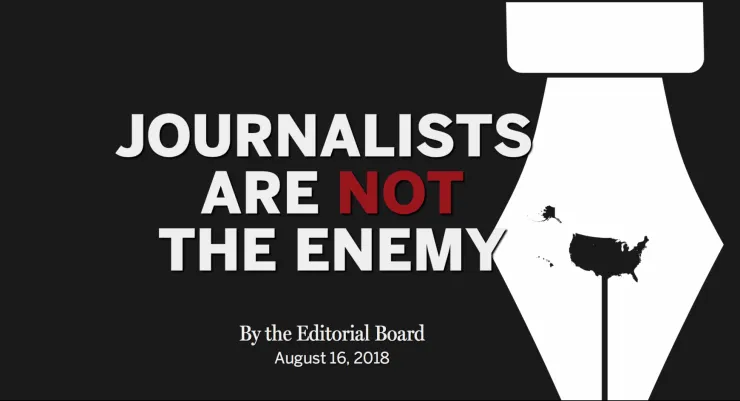
In a series of coordinated newspaper editorials, hundreds of publications today condemned President Trump’s attacks on the media. This effort was led by The Boston Globe, and its editorial today, "Journalists Are Not the Enemy," read: "To label the press ‘the enemy of the people’ is an un-American as it is dangerous to the civic compact we have shared for more than two centuries."
In conversation with Marjorie Pritchard, Deputy Managing Editor, Editorial Page, The Boston Globe.
What was the idea behind the idea, and why now?
MARJORIE PRITCHARD: President Trump has stepped up his attacks on the media calling us "fake news," but more recently labelling us "the enemy of the people." It feels like that could have some dangerous consequences, so we decided to ask editorial boards around the country to weigh in on it.
Is there a particular significance of the timing?
MP: Well, no. His attacks of calling us "the enemy of the people" are quite alarming to us. We decided to respond as a newspaper, and then contacted other outlets too.
How many newspapers took part in this? How did you spread the word?
MP: As of yesterday, it was over 350 newspapers, but many more have signed on and are responding.
We sent out some emails asking if editorial boards would be interested in writing their own editorials about the importance of a free press. We contacted the American Society of News Editors which sent out an email to its members, and then various press associations in each of the states in turn sent emails to their members. It started to come in, slowly at first, and then in a big way. We had 70, then 100, and 200...
What did you hope to achieve?
MP: The process, as far as editorial boards of publications are concerned, they are writing about the importance of a free press. They are writing in their own words because the role of the press is different in Boston than it is in Bismarck. It is different in big cities versus rural areas. It's a collective statement in support of the First Amendment.
Your editorial today has polls and statistics of people's trust in the media. How would you measure the impact/success of this collective effort?
MP: We are going to try figure out how we are going to measure the impact of this. Right now, we have a lot of comments, plenty of interviews, but yes, we have to figure out what kind of impact this has.
Before this, do you think the media has been united in dealing with the attacks and accusations? How has the media dealt with this in the past?
MP: Publications have dealt with it individually. News organizations that the President has criticized and called out have responded differently than someone who has never been called out. Collectively, I think we are all alarmed. We are not the enemy. We are actually fellow countrymen.
Is this a one-off effort, or are there going to be similar collective efforts in the future?
MP: Right now, this is what we are focused on. I think it's certainly going to get a conversation going of what it means to be a free and independent press under the Trump administration.
How does this effort address press credibility?
MP: I can't imagine that this would erode our credibility. Freedom of the press is enshrined in the Constitution. I can't imagine that this would be a controversial thing to defend free press.
How would you respond to someone like James Freeman of The Wall Street Journal, who writes: "This invitation may pose for some editorial page editors even if — like most people in their line of work — they loathe Mr. Trump. That’s because most editorial boards emphasize their independence from the newsrooms at their respective papers."?
MP: Editorial boards are speaking for themselves. Goals of the press are different here than it is in different parts of the country. So, they would have their own views, but even though it might be different, they have the same sentiment that a free and independent press is very important and we want to keep it that way.