This year, the Pulitzer Board recognized Jericho Brown in Poetry for his “loving evocation of bodies vulnerable to hostility and violence.” "The Tradition," published by Copper Canyon Press, is Brown’s third book. In it, Brown introduces a new poetic form — the duplex, combining elements of the sonnet, ghazal, and blues. Learn more about the technique behind these verses, the encompassing identity they ennoble, and the personal significance of "The Tradition."
PULITZER PRIZES: You mentioned in an interview with the Library Journal that you consider "The Tradition" a story and that readers of poetry need only to follow along and hear the story. What do you hope that readers take away from this story?
JERICHO BROWN: I don’t know that I really have a bullet-pointed list of things I’d like for people to take away. I do hope that when people read "The Tradition," they become much more aware of how to hold one’s, we call these things issues in the world these days, one’s issues in your head at once. And that we’re walking around in that way, as people, as human beings. We’re not one joy, one celebration, one problem, one trauma. That each of us individually is balancing a lot that come together to make a more whole identity. I think that’s part of what "The Tradition" is about. It’s about the fact that I’m Black, and I’m 100% Black, and I’m Black whole. It’s about the fact that I am Southern, and I’m 100% Southern, and I’m Southern whole. And that I’m not dividing these things up among myself. I really would like for people to become more aware of that within themselves and to become more aware of that when they see one another. So really, that’s what the book is about.
It’s about the natural world and how our natural world, how our environment is suffering, and how we have a responsibility to it. And at the same time, it’s about race. And it’s about Blackness, and it’s probably the first book I’ve ever written that has a section about whiteness.
I’m thinking about it all. I’m thinking about police brutality. I’m thinking about all of these things. I’m thinking about sexual violence, rape, sexual assault, sexual coercion, a word I am thankful for and afraid I’m thankful for. I’m thinking about microaggressions, a word that I didn’t have when I was growing up that I’m thankful for. And what I mean to do in the work is to take that and put it all together. And how do I take all of these things that are in my life? Because this is one life and I’m one person. The challenge of the book is to make that work. Because our minds like to think, “Oh, this is about blank,” and what I actually want "The Tradition" to be about is all of these things. It’s also a book about the sonnet, the history of the sonnet. So it’s hard to nail it down in that way, in terms of “about,” and that’s exactly what I want.
PP: Along that line of taking all of these things and putting them together, in your interview with Atlanta Magazine, you described the three sections of the work: nature and race (as reflected through Greek mythology), labor and race, and violence/love and race. How did you develop this three-part format?
JB: When you’re putting a book together, you notice that some poems are speaking to other poems and some poems are singing to other poems. And what you want to do is find ways to put something together thematically, but you also put some things together because they remind of one another. Part of the way that I’ve put the book together is I realized, well, here are a bunch of poems with titles that are about literal objects: “The Shovel,” “The Rabbits,” “The Waterlilies.” I have a lot of poems in the book that are titled in that way. And at first, I thought, “oh I’ll put these together!” And then I realized in terms of what they’re about, they have nothing — they only have titles in common. They don’t have things in common in terms of what the poems are about. Then I thought, “Oh, I’ll just put all the sonnets together,” and then I thought, “Oh, that doesn’t work either.”
So I looked at the poems individually and logistically. What’s in this poem in terms of an image? What’s in this poem in terms of a theme? And can I put these together? And that’s how I ended up with a three-part structure. The book is also interested in religion and in faith, and there’s a way that a three-part structure can remind a reader of the trinity and of the trinity archetypally. I’m sort of just playing around with structures of the mind that we already know exist and how to make them more evident in the book all over again.
PP: In addition to the three-part structure, you feature a new poetic form: the duplex — the sonnet, ghazal and blues element. When beginning the creation of this work, did you intend to develop this new form, or did it emerge as your writing process unfolded?
JB: I had the idea in my head. I guess I went in trying to create the form because I had the idea in my head for a long time. Maybe 10-15 years before I ever wrote a duplex, I had been thinking about refrain and repetition and what kind of work it does, and juxtaposition and what kind of work it does. How do you take things that have nothing to do with each other, and what kind of emotional reaction do you get when you put them side-by-side? Pound’s “In a Station of the Metro” is one example of this. “The apparition of these faces in a crowd: / Petals on a wet, black bough.” Looking at those two lines and seeing how they do something to us emotionally. The fact that they have nothing to do with each other, and yet, when you put them together, they have everything to do with each other.
I was thinking about that a lot, and I was thinking about how I once heard Nikky Finney say, and I think she got this from A.J. Verdelle, that repetition is holy. Why is it that when we sing, or why is it that when I read a pantoum or villanelle, or why is it that when two lines in a blues poem come right behind each other, I have such a strong feeling? I wanted to make that strong feeling happen in this form that I was creating. So I was kind of dealing with the form in my head without any lines, and that’s why the original duplexes, all of the ones that are in the book anyway, were made from lines that already existed. I had the frame of the form in my head, and I used lines that I already had to see if I could really make the form work. So that’s how they were made.
PP: It's so interesting to hear you mention this process. As I was reading, I was definitely curious about the form’s origin story.
JB: With all my poems, and with the duplexes especially, but with all my poems, I really just try to use everything I have. I really want to imagine a world in which we have everything we need. And if I can imagine that world in my poems, I hope I can make that world come true in real life. People talk about what they do in their writing day or what they do with their writing time. One of the things that I’m doing is I’m really excavating lines that go back. There are lines in "The Tradition" that go as far back as 1999, and I’m going back and looking at all of those lines and trying to put them together, trying to use what I couldn’t use before because I should know now. I should be a better poet now than I was then, and yet, even then I was a poet and therefore, I had lines that worked. I just didn’t know how to make them work in a poem.
So that’s how the duplexes were made. I quite literally took every line that I had ever written in a poem that didn’t work, or every line that wasn’t yet in a poem that was 9-11 syllables long, and I put them all in a file. I printed them out. I cut them up. And I started working with them as little slips of paper.
PP: Going back to your comment about using poems to create an imagined world where we have everything we need and making that world come true — one thing you mentioned in an interview with Them was that while poems are not themselves solutions in a policy sense, they can be very impactful and lead to solutions. How have people engaged with "The Tradition," especially amid the widespread protests against systemic racism and police brutality?
JB: This is the thing about poems, it’s hard to tell. This is really why I think all artists are living such difficult lives. We have this understanding that we’re doing something people need, but we don’t necessarily always get the evidence of that need. And yet, we know — everyone knows — that we would live in a different world if the world did not have poems, dances, songs, novels, plays, movies. We actually need these things to survive. And not just for escape, not just for relaxation, not just for entertainment. They do something else for us. They influence us in ways that we will never be able to name or nail down, and that’s why artists have to build communities among themselves because we are always reminding each other, “what you do matters and what you do has meaning to me.”
So I think, yeah, over the years, I’ve gotten a lot of emails about poems, about books, and obviously about "The Tradition," I’ve gotten more email than before. Partly thanks to the Pulitzer Prize, obviously. [Laughs.] And those emails come from people that I admire a great deal, including Alfre Woodard who recites a new poem that I’ve written. George Wolfe, one of my favorite people on Earth, saying he had been really moved by the poems. Those kinds of things make me feel like it’s working.
And then there are people who are doing real-life organizing in this moment, who are reading, among the poems that are part of this moment, reading my poems as poems, reading "The Tradition" in particular as a book that is a syllabus of the moment. And that means the world to me! I mean, I’m ecstatic and grateful about that. I can’t plan for that, though, and I can’t bank on it. And I love it, and yet I don’t depend on it because there’ll be a day I write another book, and that book will come out of a different kind of moment. It’s a weird balancing act because it’s everything and also can’t be what drives it.
I’m a poet by identity. It’s what I do, and if it’s what I do, I’m going to do it no matter what. What happens on the outside isn’t my business. My business is “can I get better about writing poems?” My business is not getting my poems to Joe Biden and changing his mind about X. I can’t manage that.
PP: How did you find out you won the Pulitzer Prize, and what does this mean to you?
JB: I don’t know what it means to me just yet. I’m a baby Pulitzer winner. I’m much more busy than I’ve ever been before. There’s more people calling me to do more things, including writing assignments. I have more emails than I’ve ever had before, but I know better than to complain about too much of that. It’s opened up another genre for me. I wrote an op-ed for The Guardian after the murder of George Floyd and a story for The New York Times about Pride, how we’re celebrating Pride differently this year since we’re all indoors with the pandemic. Doing that kind of work and looking more seriously at essays I’ve written in the past. That’s got a lot to do with the Pulitzer. It’s changed the platforms from which I can speak, and often those platforms have more people. It’s also probably changed the amount of money that I can charge people when I give readings.
For me, it’s been affirming, but also vindicating. I was telling you about doing this work, about being an artist and doing this work in the dark. It’s like the decision to shelter in place and social distance. It’s work you do because you’re certain it’s going to help, although there will never be proof of it helping. The proof we have of it working is that less people are dead. I’ll never know who I saved by not leaving the house. But there are people going out, not social distancing, who don’t know that they’re safer because of me staying indoors.
I was just coming to this moment in my life where I was really beginning to feel what I hope every artist gets to feel, and that is vindicated. The sense that in spite of the fact of having been mistreated by the world for being who you are, mistreated for being an artist, mistreated for being a wacky poet, mistreated by your parents for not wanting to do whatever it was they wanted you to do when you went to college — in spite of that there’s some little thing you feel that you were right. That you did the right thing. I started feeling like that after I finished my second book. The Pulitzer was the evidence of that feeling. The Pulitzer manifested this feeling that I had in the world, that it was okay, that it had worth and value. Because somehow or another, when you’re not a poet and people find out you have a Pulitzer, they assume you’re doing it right — but they’re the same poems as before.
Winning the Pulitzer makes me a bit of an ambassador for poets and for poetry, this marker of having done it “right.” And I can turn to my sisters and brothers because they’ve been doing it right, too, because they’ve been doing it exactly like I have! I come to you with the Pulitzer Prize because I’m the one they let in the room, but we’re all struggling to make beauty happen. I think there’s that that I get from the Prize and that I’m grateful for.
I don’t know how to talk about this. I do feel that winning the Pulitzer puts me in a lineage. There have been seven other Black people to win the Pulitzer Prize in Poetry: Gwendolyn Brooks, Rita Dove, Yusef Komunyakaa, Natasha Trethewey, Tracy K. Smith, Gregory Pardlo, Tyehimba Jess. I’m the eighth. I’m the baby Pulitzer. These are poets I’ve loved and admired. In particular — I get emotional thinking about this — when I was a very young poet, one of the biggest inspirations was Yusef Komunyakaa. He’s Black, I’m Black. He’s from Louisiana, I’m from Louisiana. So he has the accent that I grew up hearing, that I used to have before I started traveling around the world. His work always harked back to that childhood in Louisiana. I felt it was speaking to me. I’d be in class listening to what people said and think “No, he really means this because in Louisiana, things that might feel surreal aren’t surreal back home.” Something about that work reached out to me. When I won the Prize, I finally felt like I had met it.
I’m really happy to be to be bringing it back to the South. Natasha Trethewey, another poet from the South. Always happy for a chance to remind people that folks from down here can read and write. Always happy to remind that Black people can read and write, that people below the Mason-Dixon line can read and write. I love Yusef so much. I’m just so glad. I don’t even know if he knows. I don’t know how to call him. I am proof in this world that his work did all the work it could possibly do through me — because here I am. It makes me very happy.
When I found out I won, I thought, “You mean I have a Prize like Yusef?” I was sitting on my bed watching Dana Canedy make the announcement, that’s how I found out. I lost it. I was watching because I’m a poet and had a book out, and it did well. Thought maybe I’d be a finalist. She said my name, and I started screaming. What dimension did I just walk into? What decision did I make this morning that made this my day?
Jericho Brown received the 2020 Prize in Poetry for 'The Tradition,' a collection that 'combines delicacy with historic urgency.' Read on to discover his creation process and what it felt like to win a Pulitzer from his bedroom.
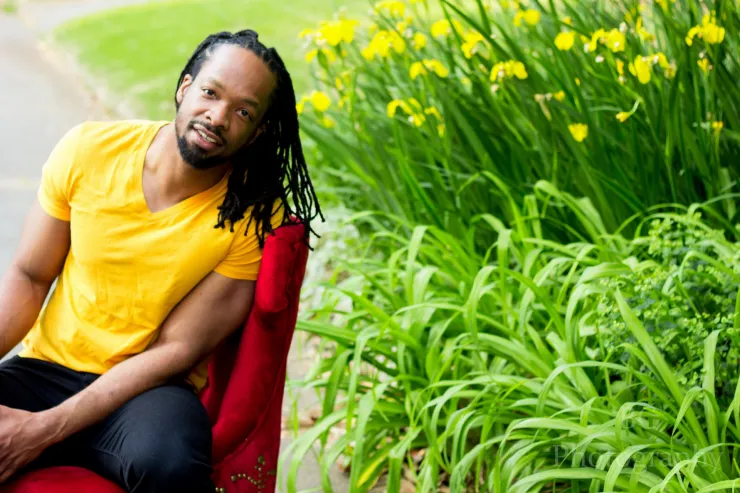
2020 Pulitzer Prize winner in Poetry, Jericho Brown.