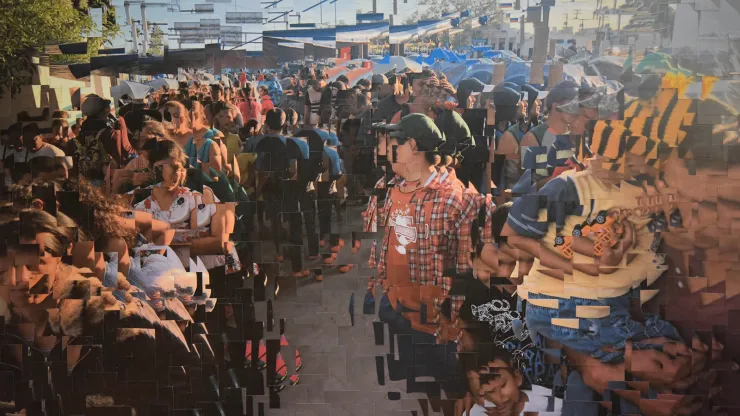
Nadia Reiman followed coverage of Trump’s “Remain in Mexico” policy since it was first rolled out. After bringing the topic to This American Life and incorporating Emily Green and Molly O’Toole’s reporting on the issue, the culminating episode ‘The Out Crowd’ was recognized by the Pulitzer Board with the Prize’s inaugural Audio Reporting award.
Listen to the winning episode here, and read on to learn how this podcast came together, why audio was the perfect fit, and what winning the Pulitzer for this story means to Reiman.
PULITZER PRIZES: You mentioned in an interview with The New York Times that this podcast was inspired by your research into Trump’s “Remain in Mexico” immigration policy. How did you decide to bring this story to This American Life?
NADIA REIMAN: I had been following the coverage of this policy since it was first rolled out. It seemed so unusual on its face — to return asylum seekers to another country while they waited. But it wasn’t until one of my sources told me that they thought this was going to be bigger than family separation that I brought it up with the team.
The thing about immigration reporting, especially under this administration, is that the changes have been so vast and so all over the place that I’m often just observing and documenting before even entertaining the idea of a story. I spend hours with sources just on background, just trying to make sense of what is happening. And then, because we’re such a narrative-forward show, not everything that happens works for a story for us. So the next step after understanding what these immigration changes practically meant was seeing if there was a natural narrative arc we could follow, or something that we’d be able to document in a particularly nuanced way.
After talking to people and observing how MPP was rolling out, I noticed that although there was so much excellent coverage about it, the vastness of the policy wasn’t really hitting people. I don’t think that people understood how fundamentally our nation would change as a result of it. Also, the MPP story, as far as a story goes, is a very dramatic one. A lot of high stakes. A lot of people in impossible situations with no easy answers. That type of story is like candy to me. I love it. The more complicated the better.
Plus I thought we could do a particularly good job bridging that knowledge gap and really taking people into a world, helping them see and feel the intensity of what this policy was doing. Audio is especially powerful. It’s really intimate. And it’s good at taking you into places and making you feel — it engages your brain in a different way. So this just seemed like a situation that was both our journalistic duty to document and understand, and also, just a really powerful story to tell in audio.
PP: How did the team that reported it come together? Were Molly and Emily involved from the start, or were they brought on as the idea progressed?
NR: They were brought in when we had hammered out the basic concept. From the moment that I pitched the show, I knew I really wanted to hear from asylum officers. My colleague Miki Meek and I had been talking about the amazing reporting that both Dara Lind from Vox and Molly had done about asylum officers, and that had scratched an itch that both Miki and I kept talking about. It got to what it was like for the people who had to carry out these policies, who had to sit there and hear migrants tell them all of these hard, terrible things and then decide whether or not to send them back. We couldn’t imagine what that job was like. So we knew we wanted that perspective somehow.
Molly’s reporting had captured so many different feelings and complications, from so many different officers. It seemed like a natural fit. It also sort of read in a way where we could hear it, so it made sense to us to reach out to her.
So our first step was talking to the L.A. Times and to Molly to see if she wanted to report out her asylum officer story a little more with us. Once she said yes, we got to work building out the rest of the show. Back then I had been talking to a lot of my sources about the massive numbers of kidnappings that were happening. One person told me that kidnappers waited outside the ports of entry in Mexico as migrants were returned, ready to kidnap them like catching fish in a stream. That really stuck with me — especially because so many of the people returning to Mexico were children. So I really wanted another part of the show to be about a kidnapping. And I really wanted it to show what most kidnappings were like — meaning, many of them involve kidnapping families with kids. Emily happened to pitch to us independently her story, like without knowing we were looking for just that. She said, “I have tape of the kidnappers” and we were floored. We knew it would be special and that we’d be able to hear something not many people get to hear. That was very serendipitous.
The beginning of the show was the last thing to technically come together. But again, we knew we wanted to report something about the tent camps that were growing along the border. Ira has such a gift for being able to find the moments of joy that exist even in the harshest situations — and being in the camp, being able to see it through him and Aviva and then hear from a kid like Darwin helped bring the lightness and fun that people still create for themselves even in the dark. And at the same time, it painted a picture of a massively faulty situation that we made ourselves. Our policies and our decisions created this environment, so it seemed like the right way to frame the whole show.
PP: What’s something you want listeners to know about the behind-the-scenes technical and reporting work that goes into producing a podcast like this?
NR: I think people that make audio know this, but often people that don’t make it do not: there is a lot of thought, work, and careful consideration that goes into even the spontaneous moments you hear in a show like this. There’s no part of this work that happened fully by chance — even the moments that are those bits of luck and magic that you capture when you’re reporting — even those are deployed very purposefully.
Another thing that I want people to understand: We used voice actors for the asylum officers to protect their identity, but there is very little “acting” per se that they actually did. We had them recreate the emotion, tone and pace of the original recordings almost obsessively. It was very important to us that accuracy was paramount, so we spent a long time making them listen to the original tape, having them recreate it, and doing it again and again until it sounded the same.
It’s a special challenge for an audio reporter to be told “I’ll talk to you but you have to keep me anonymous” — because we need their voice or there’s no story! We didn’t want to pitch shift or do anything that would make the story sound phony or that would make it relatively easy for someone to undo and therefore identify the officers. So we opted for actors, and I’m really happy with how it turned out. Our sources were protected and the audience heard something very real. Both of the officers called me after hearing the story to say how strange it was to have someone who was NOT them sound so much like them.
PP: You mentioned in an interview with Kenyon College Magazine that you first learned you could “do something substantial with radio” while working with Costa Rican Radio U. How do you feel audio reporting adds “something substantial” to the way stories are able to be told?
NR: I think it’s the intimacy. I think the way audio engages your brain is so unique. If it’s done well it’s like a blueprint for your imagination — and that has a lot of power and also a lot of responsibility. It’s a sharp tool, having something that wields this much emotion. There’s something so bone-deep about hearing a story — it’s the first way we as humans even understood them. They were told to us; we heard them before we could even read or fully comprehend. I think audio reporting has the power to connect stories on a deeply, deeply human level. And I think the best audio reporting already does that.
PP: How did you find out you won the first Pulitzer Prize in Audio Reporting, and what does this mean to you?
NR: I found out with the rest of the world via that livestream! It’s the greatest honor. I would have never thought that the 22-year-old awkward, overenthusiastic Latina girl that accidentally deleted her first big political interview get on her minidisc would be sitting here with this award. It’s crazy in a great way. It’s extremely overwhelming. And also, to have the stories of these officers and these migrants recognized as important means so much. It’s an honor to be trusted with them. I’ve said this before, but the way that we as a country treat those that are not citizens, those that we don’t consider to have any political power, says a lot about who we are. If this episode helped people understand something that seemed far away and wonky and connected them to it, I feel happy.