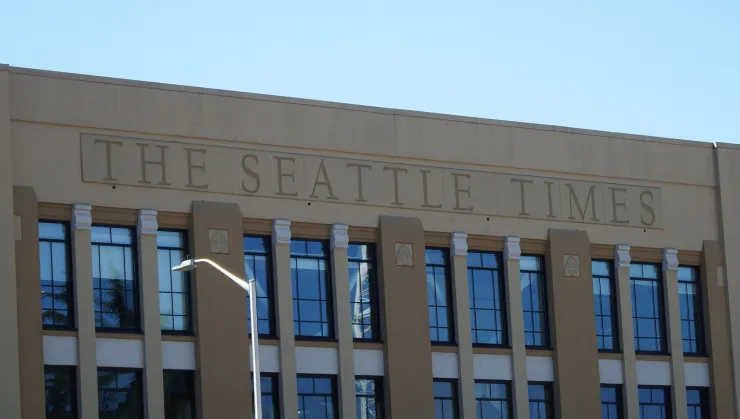
Dominic Gates, Steve Miletich, Mike Baker and Lewis Kamb won the 2020 Prize in National Reporting for their "groundbreaking" stories on factors contributing to the two deadly Boeing 737 MAX crashes.
Read on to learn how this reporting came together and which elements most surprised the Seattle Times team, in this interview with Gates.
PULITZER PRIZES: After the first crash of the 737 MAX, how did you begin to report on what had caused the tragedy?
DOMINIC GATES: Just a week after the first accident in late 2018, Boeing actually revealed in a “service bulletin” message to airlines operating the MAX and to pilots flying it that a new flight control system on the airplane seemed to have gone wrong and advised pilots on a procedure to counter it.
This was an immediate shock to the entire aviation press. After passenger plane crashes, investigations often take a very long time to figure out what happened and many times a report comes out a year later blaming a combination of pilot error, an old, poorly maintained plane and bad weather. This time, a brand new Lion Air 737 MAX had crashed catastrophically in fine weather and Boeing had essentially admitted within days that something was wrong with the plane.
All the major aviation trade and national news organizations now focused as I did on finding out what that was. News emerged from official sources in trickles as Boeing offered a few details, including giving us the name of the faulty system (MCAS) and some of its technical parameters.
We got more details from the preliminary investigation report that came out a month after the crash and from leaks from a pilot union when a top Boeing executive met with American Airlines pilots in Fort Worth to brief them about what had happened. That meeting went badly for Boeing, as the pilots were disturbed not to have been told about MCAS before the crash. The audio was leaked to several media outlets, including to us.
As it became clear MCAS was a flawed design, I began talking with longtime sources within the FAA and Boeing, engineers who work on safety certification in Seattle, to find out what had gone wrong with the certification process.
PP: How would you describe the investigative process to discover many of the technical details?
DG: My initial discussions with my internal FAA sources revealed only indirect information and concerns, not direct knowledge. The first important thing I learned was that many of the FAA technical staff and their managers who had worked on certifying the MAX had never heard of MCAS until the crash. Most of the work of certification had been delegated to Boeing itself. MCAS had received little FAA scrutiny.
The editors assembled a team of top reporters to join me and help nail the story. Though only one of them had experience with aviation work, they quickly added new and valuable sources, finding people using LinkedIn, social media and through cold-call conversations with anyone who had a connection.
In my own discussions with FAA sources, one detail jumped out at me.
An engineer told me that a formal System Safety Analysis provided to the FAA by Boeing as part of the certification process included technical parameters different from those Boeing released after the crash. He told me this certification document cited MCAS with a stated authority to move the jet’s tail and push the nose down that was a quarter of what Boeing had stated as its authority in that Service Bulletin after the crash. This seemed hugely important. Had the plane been certified using incorrect technical information?
I needed proof. I couldn’t write this without seeing the document and confirming it. It took several months of digging, but eventually a source met me at a clandestine location and showed me the relevant excerpt from the System Safety Assessment. This document Boeing delivered to the FAA stated that MCAS could move the tail 0.6 units while the jet manufacturer had told the world after the crash it could move the tail 2.4 units. That’s halfway to full nose-down. I learned that MCAS had been changed late in the jet’s development to make it move the tail more, but that the System Safety Analysis had not been updated and most people in the FAA certification office were unaware of the change.
I prepared a story outlining this and detailing the major flaws built into the MCAS design, which Boeing by then had already said it was going to fix, without admitting that they were flaws. We knew this would be a bombshell. I sent all the details of my story to Boeing for comment on March 6, 2019, just over four months after the Lion Air crash. I told Boeing we intended to publish on Sunday A1 on March 17, giving them more than a week to come up with their responses. On March 10, the second MAX crashed in Ethiopia.
PP: What was the public’s reaction to your initial reporting, and how did this evolve throughout 2019?
DG: The Seattle Times MAX team met in the newsroom on March 11 and I argued in that meeting that maybe we shouldn’t now run the story the following Sunday, because we didn’t know anything yet about the second crash and it might have some entirely different cause.
We agreed to intensely focus on the Ethiopian crash and find out what we could. It took only days before it was clear that the flight pattern was so similar to that of the Lion Air flight that a similar cause seemed likely.
On the Thursday, I spoke with an aviation expert who revealed a detail discovered in the wreckage: The tail was in the full nose-down position on impact. That sealed it. We wrote that story about the detail from the wreckage pointing to MCAS again on Thursday and we set up the Sunday A1 story to go ahead on March 17.
We told readers in the story that we’d sent the details to Boeing before the second crash. That had a huge impact. I was inundated with mail and with requests from all over the world to give interviews. Many of our readers are former Boeing people. They were universally angry at what we had uncovered. Many other readers not part of the industry were shocked to learn of the extent to which FAA oversight has been delegated to Boeing itself.
Boeing did not question any of our published detail.
That story was the beginning of a series of investigative features. Each revealed more about the pressures within Boeing and within the FAA that had led to MCAS being certified without sufficient oversight.
PP: Your stories highlighted a culture of cost-cutting and design shortcuts that led to the crashes of the 737 MAX. Do you feel that the company’s culture is shifting after the news coverage?
DG: Boeing’s leadership has announced its intention to shift the corporate culture back toward its historic legacy of engineering prowess and safety. Only time will tell if this is mere words or truly a change in approach.
PP: Your work revealed, among other things, the exception granted by the FAA for Boeing’s non-compliance with crew-alerting regulations. What has been the reaction to lifting the veil on these industry procedures?
DG: After multiple investigations criticized parts of the certification process, the FAA has announced various measures to strengthen oversight.
It will address the issue of “undue pressure” being put on safety engineers by managers, both within Boeing and within the FAA.
It will in future pay more attention to how flight crew alerts are handled by less experienced pilots.
One story we wrote highlighted how changes in the system whereby the FAA delegates certification work to the manufacturers had weakened oversight. So far, although certainly the FAA is now paying more attention, that system remains essentially unchanged. Some members of Congress are pressing for legislation that would reverse the changes we highlighted.
In the FAA plan to return the jet to service, the MAX still gets a pass on the latest crew-alerting regulations.
PP: What’s something you’d like readers to know about how this story evolved behind-the-scenes? Was there any piece of your reporting that particularly surprised you or that you continue to think back on?
DG: There were many memorable journalistic moments, including the meeting when I was shown the System Safety Assessment. And another secret interaction I had with a new source identified by one of my colleagues was a “deep throat” coup that the reporters on the team vividly remember as a highlight. I cannot reveal details.
I was surprised at how much our reporting was fully embraced and praised by the industry. And even though Boeing leaders still hesitate to outright admit flaws in the MAX design, company officials accept and respect what we wrote.
PP: With so much else going on in 2020, the Boeing MAX story has faded somewhat into the background and it seems the jet will return to service by year end. Is the story over? How do you anticipate your coverage continuing?
DG: The story isn’t over. It will return to prominence for the public when the jet returns to service. We don’t yet know the final outcome of all the investigations, including a grand jury criminal investigation.
Boeing now faces a devastating, pandemic-driven aviation downturn. If it is to recover, the MAX must return and be accepted as safe by passengers. There is still much to be written about that and about responsibility for the tragedies.
PP: What impact do you hope this reporting will have on the future of the airline industry?
DG: We hope for an increased focus on safety at Boeing and for a legislative shift to make the FAA oversight process more thorough and independent.
PP: How did you find out you won the Pulitzer, and what does this mean to you?
DG: Having won two major national awards before the Pulitzer, we knew there was hope. So the top editors arranged a Zoom call for the entire staff and we all watched the announcement live.
That meant I received the news live with my wife (also a Seattle Times journalist) and daughters around me, while all my colleagues in their own homes celebrated on the computer screen. It was wonderful.
In the months since we won, the COVID pandemic restrictions mean the Seattle Times team has still not been able to gather to celebrate. We will one day.
For me personally, this is an amazing validation of my work and of the choice I made to come to the U.S. 28 years ago. Then, I had a career as a mathematics teacher behind me and no credentials as a journalist. What a great country. What a wonderful job.