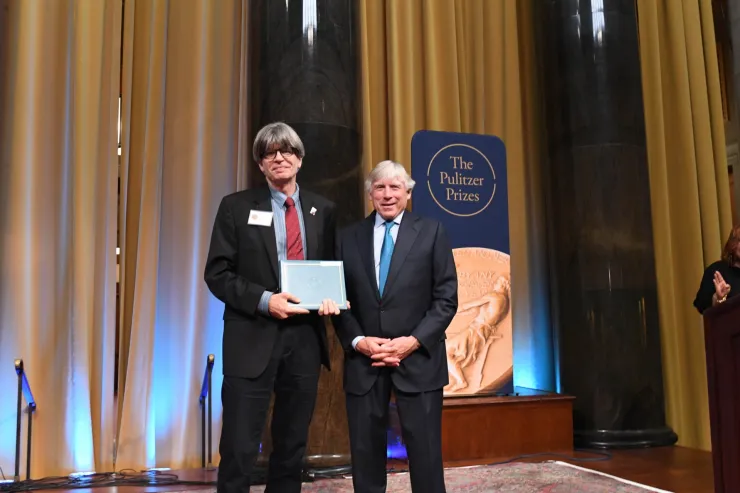
Richard Powers won the 2019 Pulitzer Prize in Fiction for "The Overstory," which the Pulitzer Board described as "an ingeniously structured narrative that branches and canopies like the trees at the core of the story whose wonder and connectivity echo those of the humans living amongst them."
As part of an ongoing series of interviews with and reflections from this year's prize winners, Powers spoke to the Pulitzers about his story, its characters and, naturally, trees.
"The Overstory" is Powers' 12th book. He was a Pulitzer finalist in 2007 for "The Echo Maker."
PULITZER PRIZES: Given the recognition "The Overstory" has received, it's bound to become a favorite of book clubs. What question would you hope a group of people reading the novel would address?
RICHARD POWERS: I would hope that readers might ask some of the same things that the characters in "The Overstory" are forced to ask themselves. What chance does activism have against the relentless appetite of capitalism? Can violence be excused in the defense of the last few patches of land that haven’t yet been lost to the violence of “development?” What difference do individual actions make? What is the best thing we can do for the world of the future? Is meaning really a private, synthetic, and subjective thing, or might it be found out there, in living processes that predate human beings by billions of years? What does it mean, to learn that trees turn out to be social beings, networked together underground, cooperating and coordinating their behaviors with one another? How would it feel to think like a mountain or like a forest? Can we free ourselves from the grip of groupthink, the parochial narrowness of human time, and the colonizing consensus of “the real world?” Why are there so few non-humans in our literary stories? What is it in us human beings that has led us to believe that we are separate from and sovereign over all the rest of creation? How can we become indigenous again? What would it take, to get us to come back home?
PP: One of your characters claims the only way to change people's minds is with a good story. Have you seen this story change people's minds?
RP: I suppose what a novelist really wants to change is not merely a reader’s beliefs about things — that job is the specialty of informative non-fiction — but the way that a reader feels and sees and attends to the processes all around her. Story tries to do exactly that; by setting plausible characters with defensible values into collision with themselves, with each other, and with the world, a good plot makes readers ask themselves what they want to happen and who they would have to be in order to root for any given outcome.
The single most gratifying thing about writing this book has been hearing from so many readers who want to tell me stories of their own. They tell me about trees from their childhood that they haven’t thought about in decades. They describe trips they are planning, to see the places and species mentioned in the novel. The say how, for a while after reading, trees seem to them weirdly intentional and social. They mention a new appreciation for duration and long time.
A good story is the wellspring of attention. My absolute favorite letters are like the one I received from a man in a Midwestern city who wrote, “I’ve been living on this street for 23 years, and I never bothered to look at who I was sharing it with.” That, more than anything, is what I’d like to bring to a reader: the feeling that we are not here alone, that it’s worth meeting the neighbors.
PP: Another of your characters, Neelay Mehta, grows up with the gaming industry as it evolves into a space where programmers can really create their own worlds. Could you share any thoughts on the storytelling potential of video games, and are there any that you find particularly interesting?
RP: Narrative has been an integral part of computer recreation since the beginning of the digital revolution. Many novelists of my generation cut our teeth on text adventures like “Colossal Cave,” “Planetfall,” and “A Mind Forever Voyaging,” and it has been something to watch an entire new branch in the millennia-long saga of human story-telling come into being and start to mature. Actually, I should say many new branches, since interactive fiction has ramified in many directions, through early, high literary offerings like Michael Joyce’s “afternoon,” Shelley Jackson’s “Patchwork Girl,” and Caitlin Fisher’s “These Waves of Girls,” to more recent cinematic, broad-market point-and-click landmarks like “Gone Home,” “The Stanley Parable,” “The Vanishing of Ethan Carter,” and “Life Is Strange.”
Even more than graphic novels, interactive computer fiction brings whole new elements and possibilities to the art of story. The earliest story-tellers, sitting around the night fire, knew how to milk that tension between interactive improvisation and the fixed legacies of plot. Now we have platforms and tools for realizing far more than that: living story-spaces that knit themselves anew in satisfying and unpredictable ways, each time they are experienced. The catch is that the medium, in its technical challenges and much larger, non-linear, multivariate space, is far more difficult and demanding than writing a novel (which, I can testify, is not itself a trivial undertaking) or even making a linear film. My feeling is that these genres are still in their infancy. Lucky artists and audiences of the future! We haven’t seen anything yet.
PP: How did you learn you had won a Pulitzer? What did it mean to you?
RP: I had no idea when the Pulitzers were being announced, who the judges were, or what books were under consideration. I didn’t even know if my publishers had put my novel up for the prize. I had been writing all morning and into the afternoon, in my house in the woods, right on the border of Great Smoky Mountains National Park, and I was just getting ready for my favorite afternoon break: a hike in the woods and a swim in one of the incredible rivers down at the bottom of my mountain.
Just as I was about to head out, I got a call from my agent. She said, “Rick, did you just win the Pulitzer Prize?” I laughed, thinking it was some kind of set-up for a joke, but she assured me that congratulations were pouring in. Before I could quite wrap my head around the fact, my editor called, confirming the news. We cheered and marveled together, and I told him that I was going to celebrate by heading down into the forest. He begged me to stay put. “A few journalists are going to want to talk to you.”
I never did get down into the park that day. Even now, a couple of months later, I have considerably less time for hiking and swimming than I had before the prize. But the Pulitzer does mean that my forest story is spreading in ways it never would have, without the recognition. That’s something I’m deeply grateful for. The woods are out walking, even when I can’t get to my walk in the woods.
PP: If you were to read a book under a tree in the American West and Pacific Northwest where much of your book is set, what species would it be?
RP: Such a sadistic question! I can only choose one, out of all that incredibly diverse and magnificent cast of possible companions? What time of year are we talking about? What time of day? What elevation? — Cedars, pines, spruces, firs, ashes, alders, birches, cottonwoods, dozens of different kinds of oaks, scores of hawthorns … How about the sequoia, several times larger than the blue whale? How about a bristlecone pine, one that’s a thousand years older than the invention of writing? I could pick a paloverde for the look of its twisted green, or a big yellow willow for the incredible way the light filters through it. California laurel or a juniper, for the scent, or an Arizona walnut for the taste.
But let me chose sound while I read, and go with an aspen. There is so much to love about that tree. I’ve sat under them in the northern Rockies, colonies of slender, chalky-green trunks among carpets of blue flowers. The noise those heart-shaped leaves make when the wind blows sounds like the ground under your feet is shuddering. Each trunk in a stand of aspen is a clone of every other, but every short-lived tree is joined underground into a single root mass that can be older than Homo sapiens. Discrete aspen organisms — open and sunny groves, acres across — have wandered for countless miles over the mountains, advancing and receding with the changing climate. Now, as the climate starts to change faster than they can escape through migrating, America’s most widely distributed tree is starting to die back.
For a little while, though, we still have them. As Donald Culross Peattie puts it, “Where the deer bound, where the trout rise, where your horse stops to slather a drink from icy water while the sun is warm on the back of your neck, where every breath you draw is exhilaration — that is where the Aspens grow.”