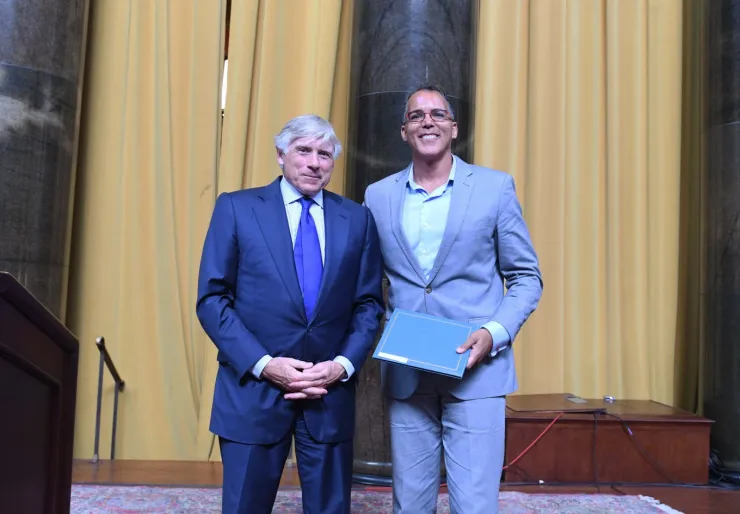
If there was a tipping point in black public officials’ efforts to protect law-abiding blacks from blacks who broke the law, when was it? What fueled it?
It was not a tipping point; it’s the opposite of that. It was a steady, gradual, cumulative process, over decades. It was a series of small decisions, often under the radar, by local officials. It involved police, prosecutors, legislators, parole officers, probation officers … who, over a 50-year period, made the criminal justice system tougher, harsher, more punitive.
Is that trend reversible?
Definitely. We’re seeing it. Our juvenile incarceration rate is half what it was 10 years ago. Last year there were 35 death sentences imposed. In 1990, there were 350. That’s extraordinary. Several states have cut their prison populations by more than 20 percent in the last decade. It’s important to acknowledge the role that activists have played in moving those numbers.
How pivotal is current, bi-partisan talk and movement on criminal justice reform?
There is a lot of attention on the national government — on Trump now and Obama when he was president — that doesn’t reflect the national government’s lack of power to change things. Eighty-eight percent of all incarcerated people are in state, county, local prisons and jails, not federal facilities. So, this is mostly a state and local problem.
Prosecutors are the most powerful people in the justice system. Over the last two and half years, around the country there have been prosecutors elected in campaigns against predecessors who sometimes were locking up innocent people. Those newly elected prosecutors campaigned against mass incarceration, calling it a moral failing. And I’m not just talking about people running those kinds of campaigns in deep blue states but people running and getting elected on those campaigns in Georgia, Alabama, Texas, Florida.
What comes to mind when you hear the term “mass incarceration?”
A couple things. One, even though the United States has roughly 5 percent of world’s population, it accounts for more than 20 percent of the world’s prisoners. The other thing is that the term captures some of the racial disparity. One in three African Americans is under some form of criminal justice supervision.
For the broad public, including black people, how much meaning does the term “mass incarceration” hold beyond, perhaps, being a sound bite, a slogan?
That is a hard, important question. There, you get to some of the tensions I try to write about in the book. African Americans are very disturbed, in general, by the fact that we have this enormous prison population, racial disparities, police shootings of innocent black civilians, stop-and-frisk … They are disturbed that a law-abiding, educated black man who’s looking for a job is less likely to receive a call back than a white man with a criminal conviction. They’re disturbed that education programs have been ripped out of our prisons during the last 20 years.
At the same time, people are scared and want to be safe. That tension … is part of what makes this issue so hard in the black community. When crimes goes up, as it did in Baltimore recently, a number of black legislators contemplated tougher law — even legislators who’d recently said tougher laws don’t work. But when crime is rising and the elected representatives don’t have access to alternatives, money for job programs and drug-treatment programs and violence prevention, they do seem to have money for law enforcement, which is the easy reach.
Are there locales where, across the board, everybody is digging in against the criminal justice ills you cite?
These social movements will always involve small numbers of people. We have this myth of the civil rights movement, where everybody was marching and everybody was protesting. My dad said he and others in the SNCC [Student Non-violent Coordinating Committee] were not popular and were few in number. There were 250,000 people at the March on Washington, but, decades later, 10 million people said they were there.
Everybody working for social justice? That’s never going to happen. Having said that, there are restorative justice programs such as Common Justice in Brooklyn, N.Y. where people in the community address crime, crime victims and victimizers. A lot of victims just want a sincere, authentic apology from the victimizer. They want to talk about how their life was changed by this incident, this robbery, this whatever. Under the right circumstances, they are open to listening to person who harmed, and to understanding if addiction or mental illness or other factors brought them to that point.
How did your view of the criminal justice system change from the start of your career as a public defender to the end of that part of your professional life?
It deepened. One concrete thing about me that changed is that I learned what power public defenders can have when we do our job well. Even if I lost a case, my job was to make sure that my clients’ story was told, that they were heard, that their humanity and dignity was acknowledged. It was an honor for me to stand with people who had come from the worst housing, neighborhoods, schools and say, “In this process, you are going to get the best.”
How did you decide on the language and tone of “Locking Up Our Own?”
I had to write in a way that would be broadly appealing. I intentionally stayed away from academic framings that can load down a book and make it inaccessible to people who are not academic. I also was conscious of the length. I wanted people to not just buy, not just look but read the book. I knew it would be 225 pages at most, which meant I cut out a lot of material. But I am glad I did. It’s the reason we are having this conversation.
Winning a Pulitzer, what about that?
I had no idea I’d even been nominated. I found out with the rest of the world that I’d won.
When my editor called — he emails and calls only if it’s an emergency — I briefly let him interrupt a conference call I was conducting about the 20th anniversary of the Maya Angelou Public Charter School in D.C., where I am a founder. I thought my editor was confused when he said, “They announced the winners … ” I went back to my conference call. When I finished the call, I saw that a hundred new emails had come in, congratulating me. Sometimes I still can’t believe it.