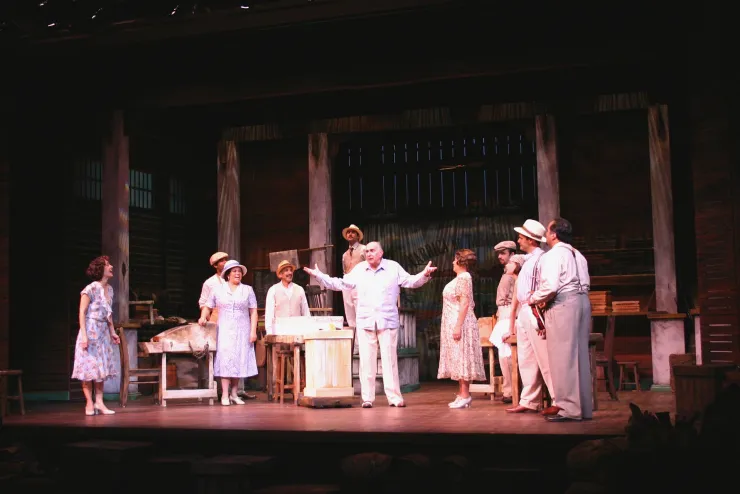
Soon, jurors and the Pulitzer board will begin to determine who will win the 2020 Prize for Drama. Historically, winners have seen their works performed in a wide array of interpretations. Writers’ degree of comfort with that range varies widely: Read some of their thoughts on various productions, and the importance and impact of collaboration.
A Living, Breathing Art Form
In an interview with Backstage, 2012 Drama winner Quiara Alegría Hudes advised aspiring dramatists to “find your fellow travelers — the people of your age and experience who you will learn and grow with so that you can make the work together.”
Among Hudes’ fellow travelers? “How I Learned to Drive” playwright and 1998 winner Paula Vogel, one her teachers at Brown University. Of Vogel, Hudes said: “She’s still playing make-believe. And that energy is infectious."
Vogel also is a proponent of deep collaboration with performers, directors and all those who contribute to a play coming alive. “This may sound controversial,” she told The New York Times, “but I can’t possibly know everything about my play or how to stage every scene. Don’t let that keep you from writing that play or that scene, because directors and actors will help you. Why are we in theater if we’re not forming something collaboratively?”
“We’re told to fix our scripts to make them producible, to make them more affordable to put on, yet it is the plays that are the most challenging to stage that are chosen because of those very impossibilities,” Vogel said, referring to Tony Kushner’s 1993 prize winner “Angels in America.”
In a Pulitzer.org interview, 2004 winner Doug Wright expressed a similar sentiment:
First and foremost, [scripts] are blueprints for ephemeral events. A director, a team of designers and a cast of actors gather to realize them in three dimensions, for a finite period, to a living, breathing audience (except, of course, for those somnambulant Sunday matinees).
No Kissing, No Crying
But some writers aim to maintain tighter control once a script has left their hands, including three-time winner Edward Albee, who said: “Be as explicit with instructions for delivering lines as possible.”
With a nod to Albee, another two-time winner — Lynn Nottage — said that she has become stricter with instructions over the course of her career. She told The New York Times that even when she thought she had “laid out enough clues,” her vision is not always fully realized. For example, in her 2003 play “Intimate Apparel,” the two main characters' relationship is meant to remain unconsummated — but Nottage has had to add further directives to ensure it ended on that note.
In the same Times piece, 2007 winner David Lindsay-Abaire he added notes to ensure the characters in his prize-winning family drama “Rabbit Hole” kept their emotions close to the vest: “I put a note in the published version saying this is not a play where people emote, they don’t cry,” he said.
When the Lights Go Down
Arguably, playwright’s ultimate collaboration is with their audience.
Martyna Majok told Pulitzer.org shortly after her 2018 Prize win that she strives to straddle the divide between audience members with background in the subject matter and those who come to a show with less specific knowledge:
That balance of [playwriter] shorthand and having to educate an audience is something I must always think about. I want to make people who’ve had those experiences say, "Yes!" But I also don’t want to exclude an audience that doesn’t have those same experiences. And most people in theater audiences, with so much disposal income, do not. But we all understand betrayal and loss and yearning and grief.
Jackie Sibblies Drury's 2019 winning play "Fairview" further develops the relationship between the work and the audience by actively prompting reactions from those in the theatre.
Drury, whose work addresses race on many levels and ultimately breaks the fourth wall, told The Undefeated:
I feel like watching white audiences watch the work of people that I respect and admire who are people of color, and seeing how the audience changes the work, I feel is a big part. Just acknowledging the inherent power dynamic in that and how that feels connected to power dynamics in society.
Suzan-Lori Parks flipped the script in an interview with the Interval, suggesting that the audience partly reveals to her as a writer the true message of a play.
"I guess I like the message to be a mystery from the writer. The message and the meaning and the issues are very apparent to the audience and very apparent, upon examination and work, to the director and the actors, but the writer does not have to know the meaning or the message," the 2002 prize winner said.
"Disgraced" writer and 2013 winner Ayad Aktar stresses an intimacy of another nature with theatre goers. In an interview with the Melbourne Theatre Company, he explained: "When an audience begins to sense that they are being told a story there is a kind of waking up that happens, a very simple kind of 'Oh, what’s going to happen next?' feeling … So there is a sacred trust built on a narrative bond between the audience and the writer and the artist."
‘Take Flight!’
In a piece in Broadway World, 2003 winner Nilo Cruz expressed admiration for many of his fellow Pulitzer winners, including Suzan-Lori Parks, Paula Vogel and Tony Kushner. He honed in on just what makes writing for the stage different from other types of literature.
“I think that a work for the stage needs to be more theatrical, and I think playwrights should be expanding the notion of realism on stage. I think that language needs to be expanded. I think language needs to fly off the page, and take flight!”