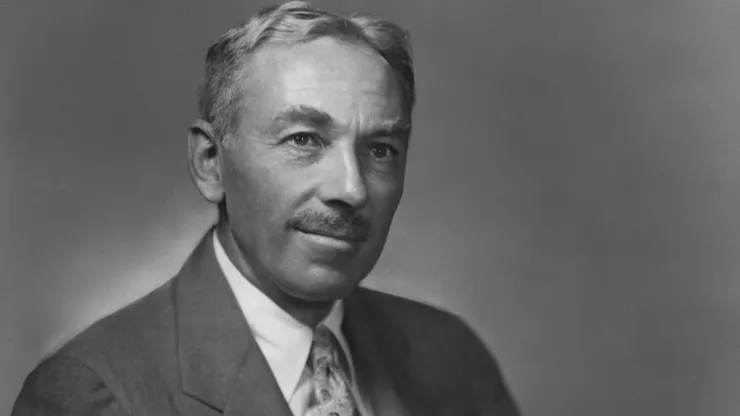
In 1978, the Pulitzer Prize Board awarded E.B. White a special Pulitzer for “his letters, essays and the full body of his work.” White was 78 years old at the time and his body of work was indeed full.
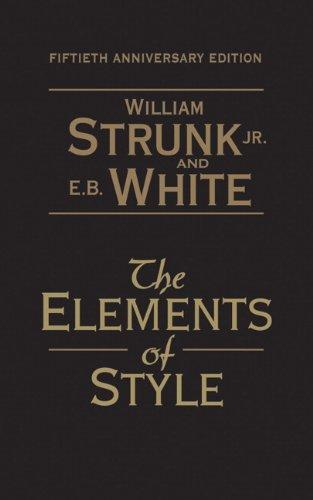
The 50th anniversary edition of The Elements of Style.
His writing manual, The Elements of Style, was a thin book known in hundreds of classrooms and newsrooms as Strunk and White. It was first composed by William Strunk Jr. of Cornell University in 1918 and then expanded by White before its republication in 1959. Countless reporters drummed one of its chief commandments into their brains: Omit needless words.
But White was also a prolific essayist for The New Yorker from 1925 on. He wrote the classic children’s books Stuart Little and Charlotte’s Web. And, as his Pulitzer citation suggested, he wrote a lot of letters.
The year before his Pulitzer Prize, Harper and Row published a 686-page selection of those letters. William McPherson, first editor of The Washington Post’s “Book World,” reviewed Letters of E.B. White on Nov. 21, 1976.
McPherson himself later became an acclaimed novelist, writing Testing the Current and To the Sargasso Sea. His review of White’s book was part of a portfolio that won him the 1977 Pulitzer Prize in Criticism for his contributions to “Book World,” The Washington Post’s weekly literary magazine.
The White Papers: first class mail
By WILLIAM McPHERSON
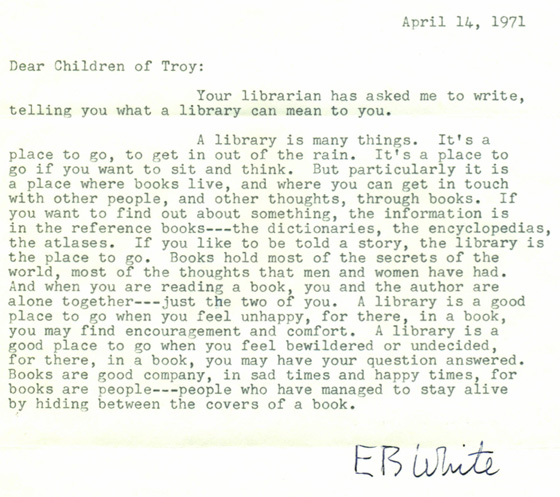
A letter sent by White to the children of Troy, Michigan, on the opening of the city's first permanent, public library building in 1971. In conjunction with the opening, Children's Librarian Margarite Hart solicited letters from scores of prominent figures, including then-New York Governor Nelson Rockefeller, Apollo 11 Commander Neil Armstrong and 1991 Drama winner Neil Simon.
As anyone knows who’s recently read a note from his central databank, the letter as it used to be committed is all but dead. The writer has been supplanted by a computer operating under an assumed name in Hackensack, New Jersey, programmed to insert a personal reference — your name, perhaps — in the first and third paragraphs of every printout. Such a scrap of paper corresponds to the art of the letter as the voice of the telephone weather report does to conversation.
And yet every now and then a live one flutters into the mailbox without having passed through Hackensack or even the Dictaphone; sometimes it has smudges on it. Several hundred of them arrived the other day, the collected Letters of E.B. White, printed, bound and jacketed in a single handsome volume. With careful rationing, they might last the winter. They prove once again that reading someone else’s mail can be a lot more fun than reading one’s own. (In this case, one needn’t feel guilty about it either.)
E.B. White writes terrific letters, among other things, to all sorts and conditions of men. Collected and edited by his goddaughter, Dorothy Lobrano Guth, in what clearly seems a labor of love, they form what is probably as close to an autobiography as we'll ever get.
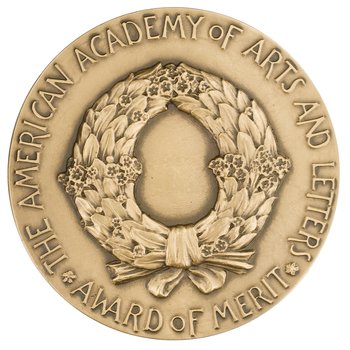
The medal of the American Academy of Arts and Letters.
At 77, White is of an age where honors are hung upon him like ornaments on a Christmas tree, accepted with resignation and a kind of skeptical humor. In 1960 he was awarded the Gold Medal for Essays and Criticism of the distinguished American Academy of Arts and Letters. (“Essayists are thankful for small favors,” he wrote later. The medal itself he described as “too big to wear and too small to roll like a hoop.” Where does a man keep it, he asked. “I tried it in a bottom drawer and it seemed needlessly obscure. I tried it on the table in the hall and it seemed ostentatious. ... I see no solution to medals and don't really enjoy them. Medals should be edible, so you could get it over with and have a moment of enjoyment.”)
White accepted membership in the Academy in 1973, having declined an invitation to join its filial body, the National Institute of Arts and Letters, in 1946. “The Institute and the Academy, whatever else they are, are busy, busy, busy,” he wrote. “Someone is always getting tapped, someone is always receiving an Award, votes are always being taken, and poets are always dying and being memorialized. Drinks are served, prizes are won, money is distributed” — all without the presence of White, who has never been seen in the vicinity of 633 West 155th Street, where the Academy and Institute are housed. “It’s just an address to me,” he wrote" — one that turns up in the mail almost every day on one pretext or another.” In addition to the Academy's gold medal, President Kennedy gave him the Presidential Medal of Freedom and he was awarded the National Medal for Literature in 1971. All in all, a spiffy collection of ornaments.
And a distinguished collection of books. There have been 18 of them, beginning in 1929 with a collection of poems, The Lady Is Cold and the spoof with James Thurber, Is Sex Necessary? They include One Man’s Meat (1944), The Second Tree From the Corner (1954), and The Points of My Compass (1962) — all collections of essays — and the famous books for children, Stuart Little (1945), Charlotte’s Web (1952) and The Trumpet of the Swan (1970). He and his wife Katharine have been associated with The New Yorker for years, he as a writer and she as an editor; together they collaborated on the anthology A Subtreasury of American Humor (1941). For four and a half years, beginning in 1938, White wrote a column for Harper’s magazine.
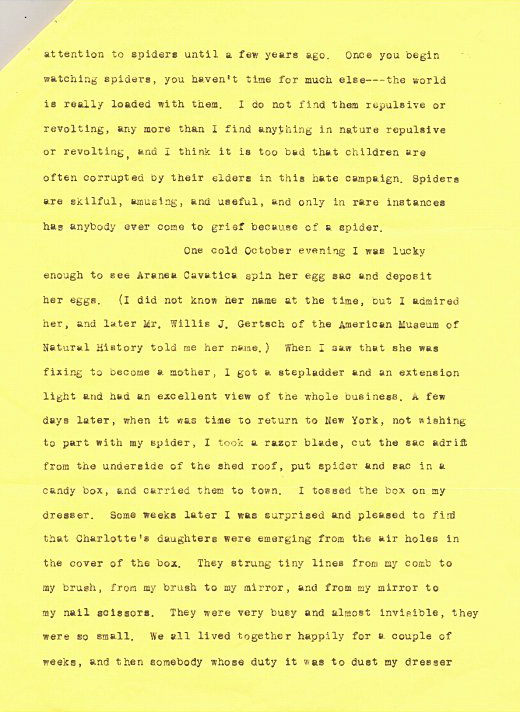
Notes from E.B. White on the inspiration for Charlotte's Web.
A lot of work, a lot of words, and a great and continuing respect for both. “That is no way to approach a manuscript,” he wrote, criticizing the Reader’s Digest. “(The way to approach a manuscript is on all fours, in utter amazement.)”
One might similarly approach these letters, written with such clarity and grace and humor over a span of 68 years, beginning in 1908. “This book is about a man’s life and his times,” writes its editor, “the development of an individual and his country from the years of the Model-T Ford to the Bicentennial.”
White was born in Mount Vernon, N.Y. The initials stand for Elwyn Brooks; he acquired the name Andy at Cornell. “My numbers were lucky ones,” he writes, looking back on his childhood. “July is the seventh month, and I appeared on the eleventh day. Seven, eleven. I’ve been lucky ever since and have always counted heavily on luck.” Hard work didn’t hurt, either.
The going was often tough. “I, too, know that the individual plight is the thing,” he wrote James Thurber in 1937. “I knew it when I stayed with my mother while she died in a hospital in Georgetown. I knew it day before yesterday when (my son) Joe (looking suspiciously like me) stood up in meeting house and recited the 117th psalm before the elementary school. You beget a son when your mind is not on that at all, and seven years later he is there in a clean white shirt, praising the Lord. You spend your days chuckling at the obstinacies of French waiters and Italian cooks, but always knowing that much of life is insupportable and that no individual play can have a happy ending.
“If you have the poetic temperament you go on groping toward something which will express all of this in a burst of choir music, and your own inarticulateness only hastens the final heart attack. Even when an artist has the ability and strength to assemble something of the beauty and the consternation which he feels, he is usually so jealous of other artists that he has no time for pure expression. Today with the radio yammering at you and the movies turning all human emotion into cup custard, the going is tough. Or I find it tough.”
But not always, of course. Of Charlotte’s Web, he wrote, “It is a straight report from the brain cellar, which I dearly love, having spent so many hours there, winter and summer, spring and fall, good times and bad times, with the garrulous geese, the passage of swallows, the nearness of rats, and the sameness of sheep.”
Straight reporting is what E.B. White is all about. To paraphrase the end of Charlotte, he is in a class all by himself. “It is not often that someone comes along who is a true friend and a good writer.” Judging by these letters, he is a true friend; like Charlotte, he is a good writer.