When “half the Bowie Police Department” descended upon Pulitzer Prize-winning columnist Leonard Pitts’ Maryland home shortly after 4:30 in the morning on Sunday, June 30, he was “awakened out of a pretty nice sleep” — only to be met at the door by armed officers who thought he might be killing his wife.
Someone, somewhere, had placed a false 911 call claiming that Pitts was murdering his wife and would shoot any police officers who arrived at the scene. Meanwhile, he and his wife were sound asleep, as were their daughter, her wife and their 3-year-old daughter.
In an interview with the Pulitzer Prizes, Pitts, whose widely syndicated Miami Herald column is known for provocative takes on sensitive topics such as politics, religion and race, said he was convinced the attack was based on his journalistic work. Pitts, who is African-American, said he would not be surprised if the attack also was racially motivated, though he could not be sure.
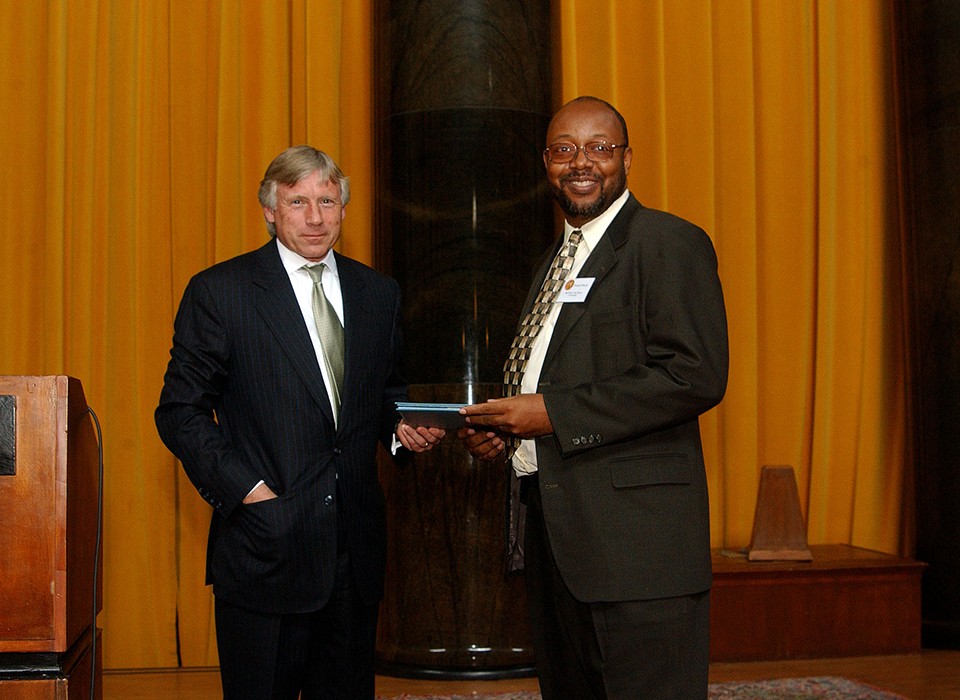
Leonard Pitts accepts the 2004 Pulitzer Prize in Commentary from Columbia University President Lee C. Bollinger.
The scam known as “swatting” — placing a false phone call, often from hundreds or thousands of miles away on a blocked phone, to prompt a SWAT response from police — has been perpetrated since the early 2000s, mostly targeting entertainment world celebrities, including Kim Kardashian, Ashton Kutcher, Russell Brand, Rihanna, Miley Cyrus and Tom Cruise.
Consequences are potentially devastating. Pitts told the Pulitzers that had he known the hoax caller had told police he would attack officers, in addition to claiming he was in the process of murder, he would have been much more anxious about walking out and having a measured conversation with the police. Pitts lightly said he looked less like a threat when he emerged wearing Captain Marvel pajamas (he wrote about imagining himself as a boy superhero coming to the aid of others in this Pulitzer Centennial essay), with his clearly living wife nearby, but the officers still handcuffed him. They were sensitive when he said his wife’s knees and hips were not up to rough treatment, and apologized afterward, but they proceeded to search the house.
“I don’t know if there’s anything they can do,” Pitts said. He said some readers and friends have suggested that police should take extra steps before responding to a 911 call from a blocked number — but Pitts countered that if a real crime were taking place, he would want an emergency response as fast as possible. Police are investigating who placed the call and where from, but have yet to name a suspect. The only one guilty of wrongdoing, Pitts said, was the anonymous caller.
Pitts said the incident was reflective of the current political moment and divisiveness in the country. “Forces of intolerance feel themselves freshly liberated to say and do things they never would have done before,” he said.
He noted the power of technology to connect people, but said it also can bring out the worst in human nature. He recalled a conversation with a scholar at the Smithsonian who told him that some questioned how there could have been a Civil War, when the telegraph had been invented and “we can talk to each other.”
“Technology may change, but people do not,” Pitts said. “Each level of new communications technology” allows people to “Facetime grandma” or connect with “loved ones serving overseas.” The downside, he said, was that it also enables “more ways to distribute our nastiness.”
“All who write opinion get nasty stuff,” Pitts, who also has been subject to death threats though has never faced anything like this specifically before, added.
In his July 2 column he wrote of the threats so many African Americans face, noting that he was relatively lucky that the responding police officers who arrived at his home were “calm and respectful.”
Pitts wrote:
[Once I understood what was going on, I felt reasonably confident everything would be fine if I remained calm and allowed police to figure things out. It helped me, I think, that they themselves were calm. Nobody yelled or cursed at me. I wasn’t manhandled, and when it was over, I received an apology.
Compare that to Cleveland, where 12-year-old Tamir Rice was killed playing with a toy gun in an open carry state, within two seconds of police arriving. Compare it to Columbia, South Carolina and to suburban St. Paul, where Levar Jones and Philando Castile were shot — Castile died — while complying with police who had asked for their driver’s licenses. And by all means, compare it to Phoenix where officers with guns drawn cursed and threatened a black woman and her children last month over an alleged shoplifting incident.
I wasn’t treated like that, and I was supposedly a wife killer.
I don’t know if the police in Bowie are better trained or if I just got lucky. I do know that too many unarmed black people are wounded and killed by frightened and adrenalized cops. And that I could have become one of them and didn’t.