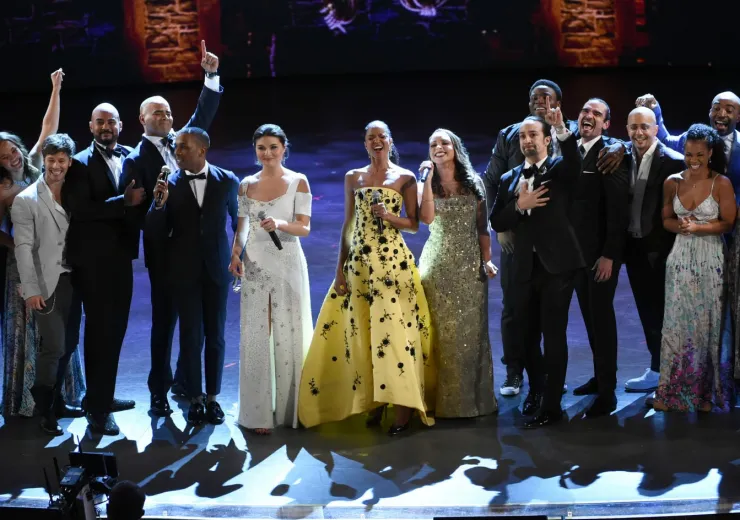
On Sunday night, Hamilton became the 24th Pulitzer Drama winner to subsequently take home the Tony for Best Play or Best Musical. The last production to win a Pulitzer and the Tony for Best Musical was Jonathan Larson's Rent in 1996.
Hamilton took home 10 other Tonys.
During his acceptance speech for Best Score, Miranda acknowledged the shooting at Pulse nightclub in Orlando, Fla. Sunday night's broadcast was dedicated to the victims and their families.
Miranda recited a sonnet penned for the occasion:
My wife's the reason anything gets done
She nudges me towards promise by degrees
She is a perfect symphony of one
Our son is her most beautiful reprise.
We chase the melodies that seem to find us
Until they're finished songs and start to play,
When senseless acts of tragedy remind us
That nothing here is promised, not one day.
The show is proof that history remembers
We live through times when hate and fear seemed stronger;
We rise and fall and light from dying embers
Rememberances that hope and love last longer.
And love, is love, is love, is love, is love, is love, is love, is love, cannot be killed or swept aside.
I sing Vanessa's symphony, Eliza tells her story; now fill the with music, love and pride.
Miranda joins the likes of Arthur Miller, August Wilson, Wendy Wasserstein, Neil Simon, Tony Kushner, Oscar Hammerstein and Richard Rogers in collecting the double honor.
We've gathered video highlights from those six musicals and 18 plays, and the writers behind them.
John Patrick, who in 1954 won the Pulitzer and Tony for The Teahouse of the August Moon, met Tony herself — Antoinette Perry, for whom the awards are named — at age 19. He talks about going to the theater and lunch at Sardi's with her.
The annual Tony broadcast brings larger-than-life performers to the small screen. In 2011, a 50th anniversary revival of Frank Loesser and Abe Burrows' 1962 Pulitzer winner How to Succeed in Business Without Really Trying saw Daniel Radcliffe stepping out in Rob Ashford-choreographed numbers.
Of the original production, Pulitzer-winning critic Walter Kerr wrote, "Not a sincere line is spoken in the new Abe Burrows-Frank Loesser musical, and what a relief that is ... How to Succeed is crafty, conniving, sneaky, cynical, irreverent, impertinent, sly, malicious, and lovely, just lovely.
During the 1969 broadcast, James Earl Jones reprised his powerful role as Jack Jefferson in Howard Sackler's 1969 Pulitzer-winning play, The Great White Hope. Jones starred in the film adaptation the following year.
After winning a Pulitzer in 1976, the original cast of A Chorus Line also took to the Tony stage.
While A Chorus Line brought the rehearsal room to centerstage, the creative process more often happens beyond the audience's reach.
Arthur Miller said of Death of a Salesman, which won the Drama Pulitzer in 1949:
"Death of a Salesman is written with the idea of a man having a train of experiences internally and externally at the same time.
"And without stopping to have monologues, we should be aware of both the inside of his head and the outside. And that is the mechanism of that play, which, quite frankly I don't think has ever been reproduced again. Either by me or anybody else.
"But it took a long time to arrive at that."
As the Pulitzers celebrate their centennial, hear what Doubt playwright John Patrick Shanley thinks about the difference between stage productions now versus several decades ago.
"The economics of theater have changed, and back then you wrote a play like Inherit the Wind or [Tennessee Williams' 1948 Pulitzer winner] Streetcar Named Desire or Of Mice and Men and when the time came to turn them into a film, you had this host of characters to work with and multiple locales.
"And what's happened since is that Doubt is down to four characters and a few locales."
Back to last night's star. While two shows could hardly be more different than Doubt and Hamilton, the latter does demonstrate the kind of economy Shanley describes as a quintessential aspect of modern-day theater. The Tonys recognized Thomas Kail for Best Direction of a Musical, Howell Binkley for Best Lighting Design of a Musical, Paul Tazewell for Best Costume Design of a Musical, and Andy Blankenbuehler for Best Choreography.
Congratulations to Miranda, the cast and crew.