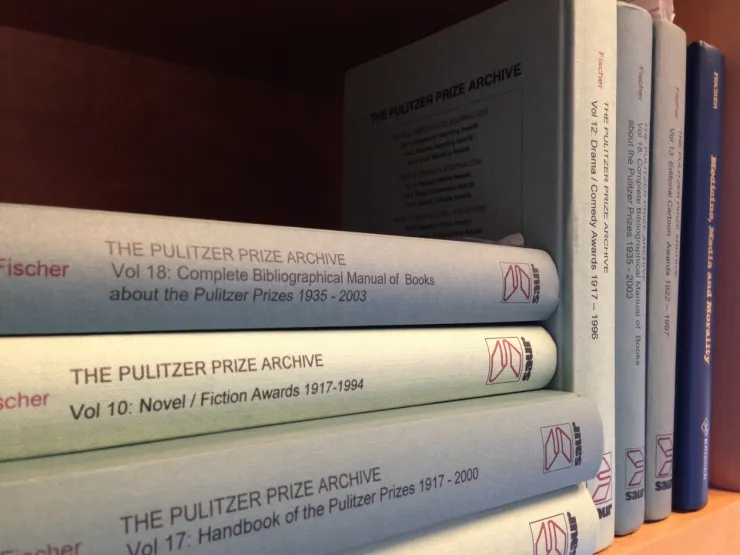
As you can imagine, the books come and go with the years at the small Pulitzer Prize office at Columbia University, but one set of volumes, some green, some white, is ever-expanding. These are the books on the history of the prizes edited by the German scholar Heinz-Dietrich Fischer. There are 50 now, double-shelved in their corner.
The books have been invaluable in helping to create this content stream for the centennial of the Pulitzer Prizes. We have files and files of jury reports and prize-winning material, but much of this archive is far more accessible in Dr. Fischer’s lifework.
For example, two entries in Dr. Fischer’s The Pulitzer Prize Archive are subtitled Volume 2: National Reporting 1941-1986 and Volume 20: Chronicle of the Pulitzer Prize for Biography. The first contains choice news stories from the winning entries, the second facsimiles of the Biography jury reports from 1917 through 2003. We’ve used these extensively to choose some of the work celebrated here.
Dr. Fischer, who is nearing 80, is professor emeritus in international communication from Ruhr University in Bochum. How did he come to his work on the Pulitzer Prizes? Why has he stuck with it for 40 years?
For the answers, we went to the source. Here is Dr. Fischer’s response.
I saw a gap in Pulitzer Prize history, and 40 years later I’m still filling it
“Are you crazy?” one of my friends asked in the mid-1970s when I told him of my intention to write books about the history of the Pulitzer Prizes. He feared that from my university across the Atlantic, far removed from needed sources, it would be impossible to realize the project I had in mind.
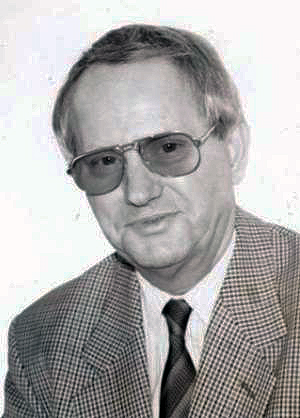
Dr. Fischer
Today, after four decades and 50 Pulitzer Prize-related volumes, 47 in English and three in German, my friend encourages me to continue this fascinating undertaking.
How did I come to this time-consuming research and writing?
I was familiar with the life and works of Joseph Pulitzer from my years as a student at the Free University of Berlin. The university was in the American sector of the city during the 1960s. While working as a visiting professor at the School of Journalism at the University of Missouri during the academic year 1968-69, I learned more about the Hungarian-born Pulitzer, who had begun his American career in nearby St. Louis.
Back in Germany, I became associated with the John J. McCloy journalism fellowships of the American Council on Germany. McCloy was high commissioner for Germany after World War II, and his goal was to transform Germany “from an occupied enemy into a trusted and reliable partner.” The fellowships were part of that effort.
Through this connection, I came into contact with the Pulitzer Prize office at Columbia University. After long discussion, the administration and the board of the prizes granted me unlimited access to the Pulitzer Prize collection and jury reports for research purposes.
Erika, my wife, had written a book about the Academy Awards. She joined me as co-author of the Pulitzer project. We began in 1975, just as Professor John Hohenberg departed as administrator of the awards. He had done the job for 22 years and written several books about the Pulitzer Prizes.
From his new position at the University of Tennessee, Professor Hohenberg gave us useful hints and encouraged us to fill a gap in prize history. Heartened by his good wishes, we set out to develop an overview of available documentation of the prizes in both journalism and letters.
It took us a couple of years to assume the risk of preparing the first volume. As foreigners, we were uncertain about how the people who helped us at Columbia would judge our work. Their reaction was positive, and we decided to continue
Each April, we traveled to New York to gather material for the next volume. We chose that time in part because it allowed us to attend the annual Pulitzer Prize announcements in the World Room at the Journalism Building. The ceremony always impressed both of us.
We also attended several May award luncheons. One was quite remarkable. In 1998 a special posthumous Pulitzer Prize was awarded to George Gershwin on the occasion of the 100th anniversary of his birth. We had the pleasure of meeting his sister, Frances Gershwin Godowsky, who received the prize certificate.
In 1989, we were working on volume four of our International Reporting series. Just as we were reading Bill Keller’s Pulitzer Prize-winning articles on the Soviet Perestroika policy, Hungary, Joseph Pulitzer’s native country, made world history. It suddenly opened its border with Austria, breaching the Iron Curtain and allowing East German citizens to flee to the West.This so pleased our West German federal government that we probably doubled or tripled our imports of Hungarian wine, salami and other goods. But some larger gesture to express our national gratitude seemed appropriate, and Erika and I came up with an idea.
We wrote to the head of our West German Foreign Office, Hans-Dietrich Genscher, sharing details about Joseph Pulitzer’s Hungarian birth and his bequeath to Columbia University. We proposed that the German government sponsor an institute or school of journalism at Budapest University on the condition that it be named for Pulitzer. Early in the 20th century his will had endowed both the Graduate School of Journalism and the Pulitzer Prizes at Columbia.
To our surprise and delight, our government welcomed the idea and sent Germany’s Hungarian ambassador to Budapest University to offer one million marks toward the establishment of a journalism school.
Unfortunately, the old Communist cadres who still dominated university policy declined the offer. They probably feared that such a school could educate a new generation of journalists who would disclose details of their totalitarian pasts.
The Pulitzer Prizes celebrated their 75th anniversary in 1991. Erika and I were proud to be invited to the festivities at the Columbia campus. Already our books had elicited praise. Joseph Pulitzer Jr., a newspaper publisher and longtime chair of the Pulitzer Prize Board, called them “most interesting.” Tom Goldstein, dean of the journalism school, said we had produced “an invaluable work of history and journalism,” and George Rupp, the Columbia president, found the series “an impressive collection.”
Good words also came from Pulitzer Prize administrators. A note from Seymour Topping bade us “congratulations on yet another fine piece of work.” Sig Gissler “deeply appreciated” our “devotion to the Pulitzer Prizes” and said our books would “be of enduring value to the Board, to our office and to all those who come after us.”
In Europe, where the Pulitzer Prizes were relatively unknown, our books helped to make them popular. The media of many countries began to report on prize winners and their works each year. Journalism awards in several European countries follow Pulitzer principles. For example, the German Theodor Wolff Preis has a system similar to that of the Pulitzers.
While working on a book project in the German language, our two-author team came to a sudden end in mid-2007 when Erika died. It was her sincere wish that I continue the Pulitzer book project. I hesitated for a time but decided to honor her wishes. I intend to bring out further volumes as long as my age and health permit — and as long as the cooperative people in the Pulitzer office, especially Edward M. Kliment, deputy administrator, continue to answer my many requests for research material.
Now, as the great American institution of the Pulitzer Prizes celebrates its 100th birthday, only one thing makes me nervous: the political situation in Joseph Pulitzer’s native country. Hungary, now a part of the European Union, has by far the most restrictive press laws of all member states.
Joseph Pulitzer, lifelong advocate of a free press, would not be happy about that.