The most famous winner is the one that makes Americans swell with pride. The one so perfect it looks staged.
Or maybe it’s the one in which an assassin shoots another assassin. The moment that helped drive decades of conspiracy theories.
Or it’s the naked Vietnamese girl screaming after a napalm attack. The one that still weighs on our consciousness.
These are all Pulitzer Prize-winning photos, capturing moments of history that often made their way from newspapers to schoolbooks to posters and even T-shirts. Some helped change laws — or even win, or end, wars.
“Each photo is basically a portal to the past,” says Jody Sowell, director of exhibitions and research at the Missouri History Museum. “For us today, having them blown up helps us see details and the power of the still image.”
Pulitzer-winning photos from every year since 1942, when the medium was first recognized by the prizes, will be on display at the museum from Saturday through Jan. 20. They are part of “Pulitzer Prize Photographs,” a traveling exhibition from the Newseum in Washington, which also has a permanent display of every Pulitzer photo, from the World War II flag-raising at Iwo Jima to last fall’s caravan of migrants from Central America.
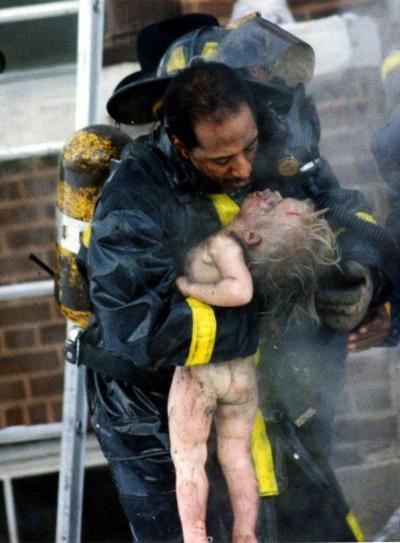
St. Louis firefighter Adam Long attempts to resuscitate 2-year-old Patricia Pettus after rescuing her from a burning apartment Dec. 30, 1988. The girl later died at St. Louis Children's Hospital. The photo, published in the Post-Dispatch the day after the fire, won the Pulitzer Prize for spot news photography in 1989. Photo: Ron Olshwanger
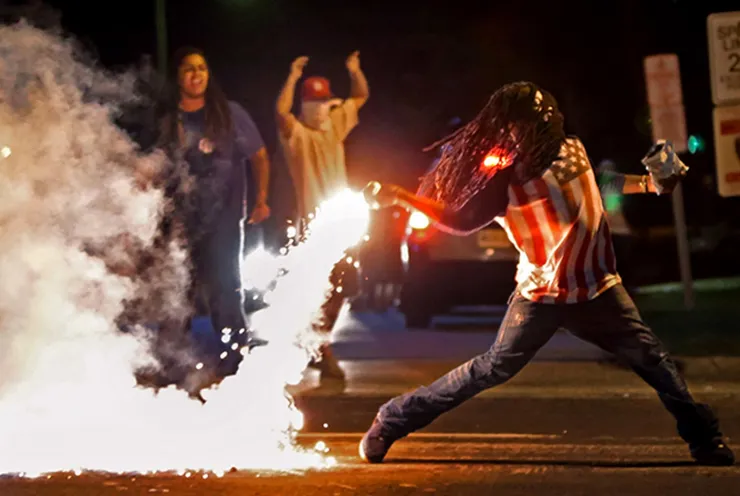
Among the photos in the main exhibit are two from the Post-Dispatch. One is a 1988 image of a firefighter trying to resuscitate a naked, sooty child. The other, from 2014, is of a Ferguson protester wearing an American flag T-shirt as he throws back a tear gas canister chucked by police.
The latter was part of a portfolio of Ferguson photos that won the Pulitzer Prize in 2015. The rest of the images are in a wider display of historic Post-Dispatch photos taken of everything from sports figures, such as boxer Leon Spinks swinging at Muhammed Ali in 1978, to lifestyle moments, such as lines of black cars parading through Forest Park on Easter 1924.
“You get an amazing glimpse of history — local, national and international,” Sowell says.
The prize-winning pictures evoke almost every emotion imaginable, from the pride and poignancy associated with the Iwo Jima Marines to the pain of the crying South Vietnamese children running from napalm in 1972.
Among the most charming is from 1958, when a police officer leans over to talk to a child who has almost stepped into the path of firecrackers and a Chinatown parade.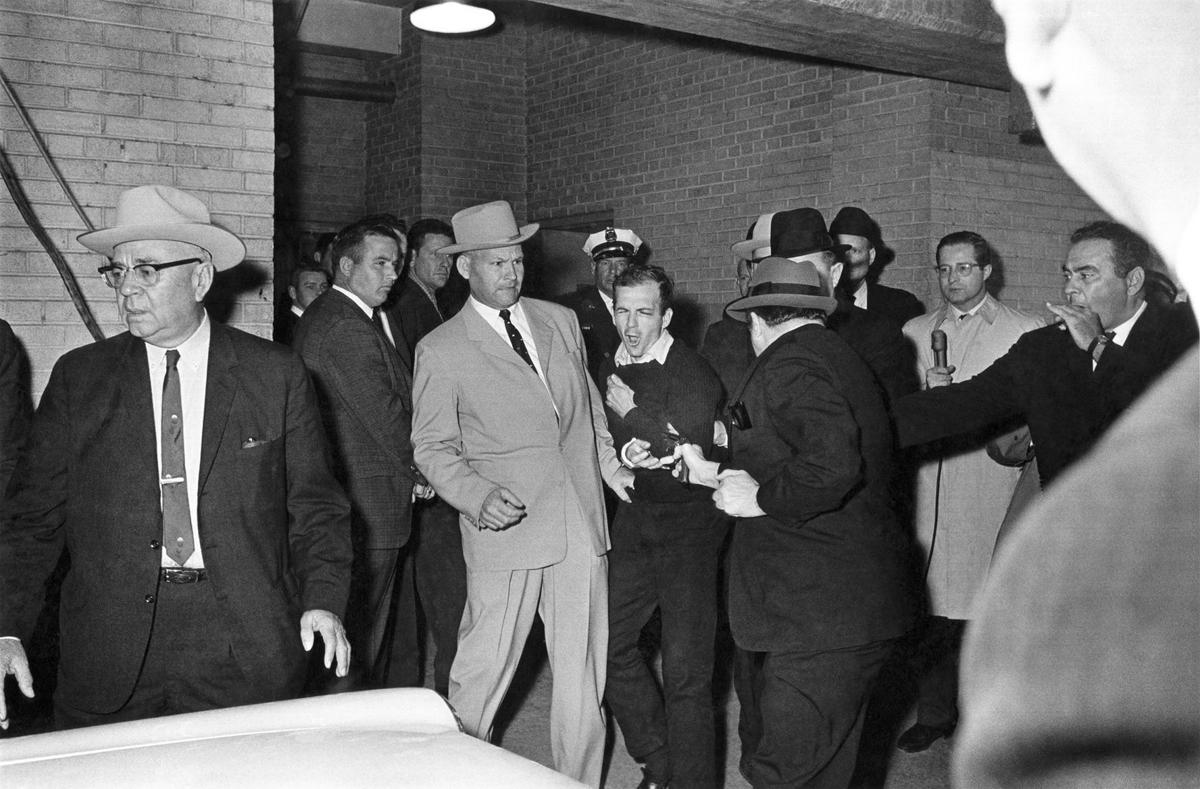
Lee Harvey Oswald, accused assassin of President John F. Kennedy, reacts as Dallas nightclub owner Jack Ruby shoots at him from point-blank range in a corridor of Dallas police headquarters Nov. 24, 1963. Photo: Bob Jackson/Dallas Times-Herald
But what does one feel when looking at the famous photo of Jack Ruby shooting Lee Harvey Oswald in 1963? Shock, like viewers who saw the shooting on TV. Anger that Oswald would never be questioned in court, taking some of his secrets to his grave and leaving conspiracy theories to fill in gaps. Or maybe even disdain, a sense that the man who killed President John F. Kennedy got what he deserved.
“A photo is an emotional link to your brain and to your heart,” Indira Williams Babic says.
Babic is director of photography and visual resources at the Newseum. Although she casually alludes to the cliche about a photo being worth 1,000 words, she says she does believe that old saying. “A photo stays with you forever,” she says. "You don’t need to be able to read to understand it."
The first winner was of violence at a labor union strike in Detroit. The photographer, Milton Brooks, happens to have been born in St. Louis.
The older photos are all in black and white. That may be lucky; so many of them show scenes of war, executions and even lifeless bodies.
One of the most unsettling (and perhaps less frequently published) shows the body of a Bangkok student hanging from a tree surrounded by onlookers and a man hitting the body with a chair. There is context, though, for this 1976 photo by Neal Ulevich of the Associated Press: Thai students of right- and left-wing factions had fought as the country’s third government in three years was about to collapse.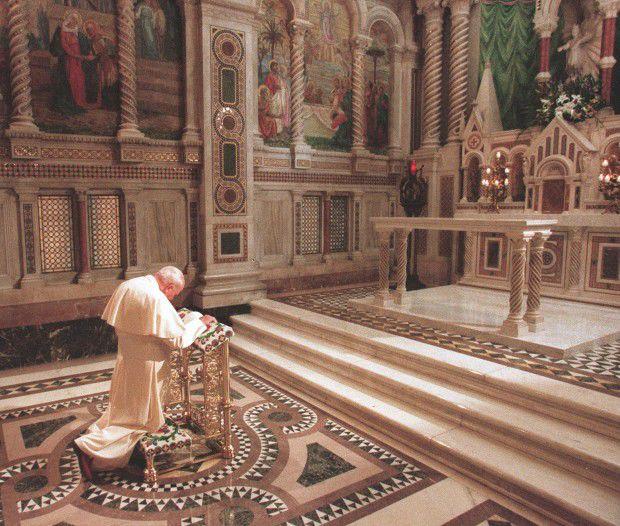
Pope John Paul II prays in the Blessed Sacrament Chapel at the St. Louis Cathedral before the evening prayer service on Jan. 27, 1999. Photo by Odell Mitchell Jr. of the Post-Dispatch
The stories behind many of the photos are fascinating. Robert H. Jackson of the Dallas Times-Herald once described in a book how he waited with other photographers to see Oswald being transferred from one lock-up to a supposedly safer jail:
“I was leaning against the fender of a police car. As I looked through the camera, Oswald took eight or ten steps, and I saw a body moving into my line of sight. I leaned over the car to the left. Ruby moved three quick steps and bang. When he shot, I shot.”
Andrew Lopez has explained how he photographed a Cuban priest giving last rites to a condemned corporal, whose army and leader, dictator Fulgencio Batista, had been defeated by Fidel Castro in 1959. A military commander demanded the photographer’s film. Lopez reached into his pocket and gave him a roll (just not the one with the future prize winner).
Kiosks and video in the exhibit show even more photos (the ones that were part of portfolios) and give more information directly from photographers.
“There are lots of tough images,” Sowell says. But there are also photos that celebrate life: a series documenting natural childbirth; more than one dramatic rescue; a family welcoming home a soldier.
The first color photo to win the award was in a 1975 portfolio. After that, even though the photos still are often of serious events such as famine, they seem to veer away, somewhat, from so many assassinations.
Babic and Sowell point to how many of the photographs have made a difference. After the Iwo Jima photo, purchase of war bonds grew. Photos of Vietnam reduced U.S. residents’ support for the war. Boston and other cities passed laws on fire escapes after photos of a deadly collapse.
Years after the 1988 Post-Dispatch photo won the prize, the photographer, freelancer Ron Olshwanger, said a New York architect told him he’d resisted putting ugly fire detectors in his new house. His wife used Olshwanger’s photo to persuade her husband, who credited the photo and detectors with saving his family months later when a fire broke out.
Babic says news photographers’ goals are to “tell people stories and effect change.”
They consider light, composition and keeping safe, she says, but they also hope to “do something good.”
Sowell says this free exhibit of Pulitzer Prize photos will lead to discussions among viewers who remember where they were or what they felt during the historic times the pictures were taken. Parents may offer explanations to children. Although grade school students may not get much out of the photos, kids in middle school and above will find a lot to take in, Babic says. There is a warning that images may not be appropriate for young children.
“This is about breaking news and feature photography, and, unfortunately it’s about what is happening in the world,” Babic says. The biggest news and what people often want to know about are often about tragedy, war, disasters.
As always with photos, some people will second-guess whether the images were too disturbing to be published. Or ask how a photographer could document a tragedy rather than intervene.
Sowell loves that the show will prompt conversations. He also says that because the museum’s other exhibits usually zero in on a fairly narrow topic, the photos show an unusually wide range.
“We’ve probably never had so much history in one gallery.”
What “Pulitzer Prize Photographs” and “In Focus: St. Louis Post-Dispatch Photographs” • When Saturday through Jan. 20; hours are 10 a.m.-5 p.m. Wednesday-Monday, 10 a.m.-8 p.m. Tuesday • Where Missouri History Museum, 5700 Lindell Boulevard, Forest Park • How much Free • More info mohistory.org.
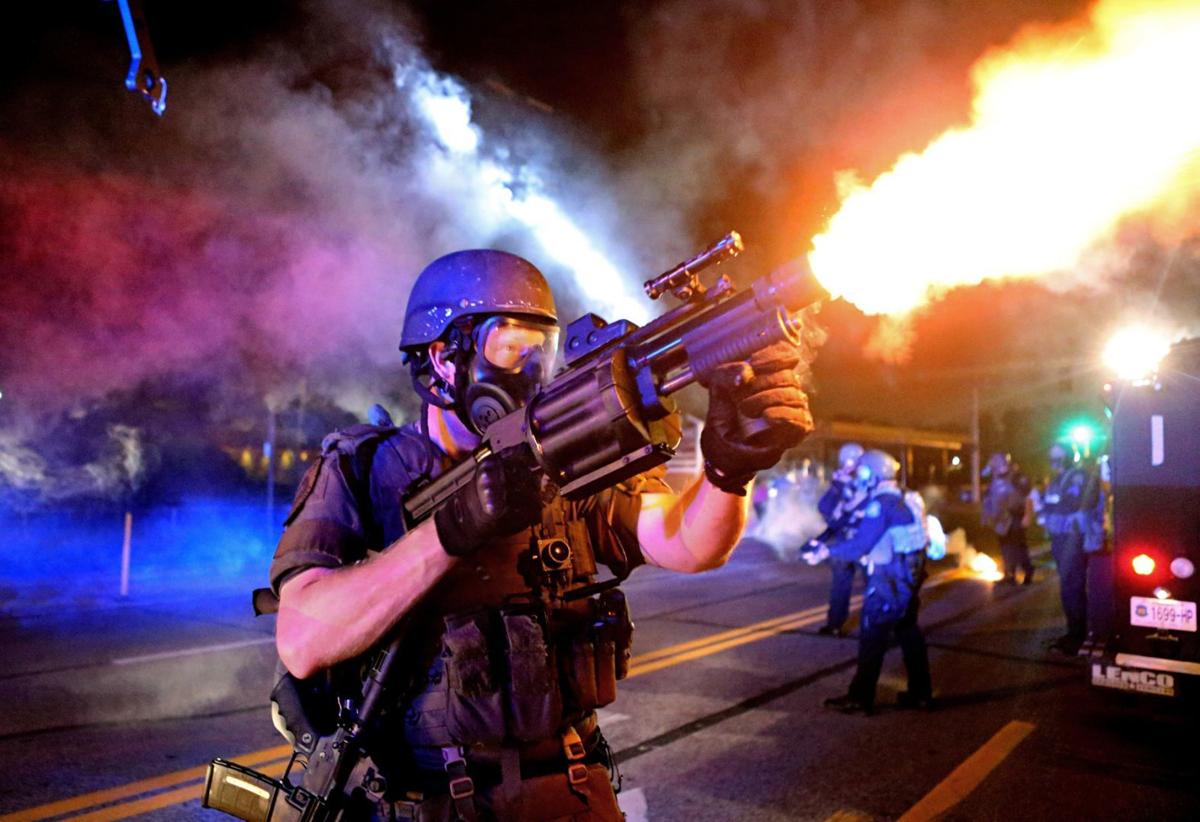
A member of the St. Louis County Police tactical team fires tear gas into a crowd of people in response to a series of gunshots fired at police during demonstrations in Ferguson. For more than two weeks, police and protesters clashed nightly. Photo: David Carson, St. Louis Post-Dispatch - August 18, 2014