Sometimes the Pulitzer Prize jury reports in the letters categories are as interesting for what the jurors rejected as for what they liked. That was certainly true of the 1960s.
Did age matter? Why did one juror turn down a book by Langston Hughes? What was “Light Verse” and could Phillis McGinley actually win the prize for it? How about the Beats? Anne Sexton and other “confessional” poets?
The ’60s gained a reputation for cultural and political upheaval, but the demographics of the Pulitzer Prize-winning poets stuck to the norm. The age of the youngest three averaged 37, the oldest three 67. All were white. Eight were men.
In this sample from the jury files you’ll find the names of many emerging poets as well as interesting comments on why some won and others lost.
1960: Heart’s Needle, W.D. Snodgrass
A small miracle of anguish and tenderness
From juror Louis Untermeyer:
James Merrill, who has been lauded by some of the younger poets, is unquestionably accomplished – he is, in fact a little too accomplished. He has great technical skill, but he is not quite able to conceal it. If he does not rely on his virtuosity, he somehow calls attention to it. There are fine things in his little book [The Country of a Thousand Years of Peace]: “The Octopus,” “Thistledown,” “Hotel de I’ Univers et Portugal,” “Mirror,” “Laboratory Poem,” and “Walking All Night” are not only graphic but intensely thoughtful. They are frankly impressionistic, but the impression lasts longer after the poem is over.
I wish I could nominate Selected Poems by Langston Hughes (Knopf) for the prize. I like what Hughes says and the way he says it. I wish more of his book attained the stature of poetry, but his rhythms – the blues, the jazz, and the “beat” – are the rhythms of good popular verse even though the intention is that of a true poet. . .
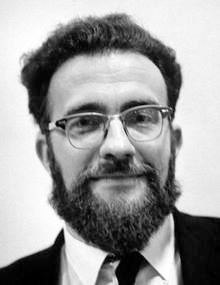
W.D. Snodgrass
And now to my candidate for the first prize: Heart’s Needle by W.D. Snodgrass. I think there is no doubt that Snodgrass is a truly distinguished new poet. With his first volume he establishes himself as one who, experimenting with new subject matter, does not scorn tradition. On the contrary, he puts new vigor into traditional matter. Instead of abjuring the now unfashionable devices (well-turned rhymes, rhythmical regularity, and orthodox syntax), he uses them with full appreciation of their potentialities. . . .
The title poem – or sequence of poems – is Snodgrass’ finest single achievement. The unusual subject – a divorced father making and losing contact with his young daughter – is treated so delicately (and so lyrically) that it is a small miracle of anguish and self-directed anger, of pitifulness (but not self-pity) and deeply affecting tenderness. I can’t think of a new poet in the last decade who has said so many things so well, so simply and yet so startlingly.
1961: Times Three: Selected Verse From Three Decades, Phyllis McGinley
‘The perfect word in the perfect place’
From juror Alfred Kreymborg:
With Eyes at the Back of Our Heads by Denise Levertov (New Directions). A competent poet in the modern vein which relies on the prose statement of experience. There is honesty of purpose in her work and genuine poetic perception.
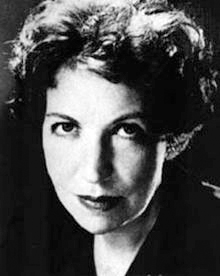
Phyllis McGinley
What a Kingdom It Was by Galway Kinnell (Houghton Mifflin). This is Galway Kinnell’s first book, and though I dislike the phrase, he is a man well worth watching. An excellent technician and fairly original in style, he has the rare quality of combining warmth of feeling with technical virtuosity.
Because It Is by Kenneth Patchen (New Directions). I find the drawings more amusing than the poems. Though the poems are, for the most part, intelligible, which is usually not the case with other practitioners of his school, they seem to me to be stream-of-consciousness outpourings that are never refined or perfected. . . . I feel sympathetic toward Patchen because of his tragic health problems, but I really do not feel that his poems add any lustre to the world. [Patchen had suffered a serious spinal injury in 1937 and lived most of his life in intense pain.]
The Happy Birthday of Death by Gregory Corso (New Directions). What I said about Kenneth Patchen’s poetry goes for Gregory Corso. He is one of a school evidently much admired by New Directions. I get nothing from it.
Poems by Allen Tate (Scribner’s). A very serious poet with a heavy hand. I wish more of his poems touched the heart instead of the head. Despite his high standing in the poetic field, I find him a difficult poet to read and enjoy.
The Woman at the Washington Zoo by Randall Jarrell (Athenaeum). Here is a delightful book. Randall Jarrell, the gifted Southerner, is unquestionably one of the most original artists in the field of American poetry today. This, his first book in five years, but his seventh volume of poetry, contains some enchanting poems, conceived and stated with the dexterity of a true artist.
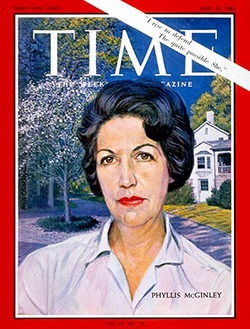
McGinley Time magazine cover
To Bedlam and Part Way Back by Anne Sexton (Houghton Mifflin). The dramatic impact of this book is terrific. Once having opened it, it is impossible to lay it down. There is originality in her writing and lyrical dexterity. A combination of the romantic and the realist, her lines seem effortless in their fluidity. Her autobiographical poems are heartbreaking and unforgettable. A very fine poet who would have been my first choice were it not for the fact that I have become hesitant about voting for a poet’s first book. This may not be fair, but I find it disconcerting when a poet one was enthusiastic about ten years ago has done nothing of any distinction since.
Occasionally, her perfect metrical forms grow a little tedious and occasionally one is irked by her unholy lack of sentiment toward things that one happens to be sentimental about, such as the English Cathedrals, which she dismisses with memories of “tough scones,” and “a Lowesoft platter.” . . .
Times Three by Phyllis McGinley (The Viking Press). This omnibus volume contains seventy new poems plus a selection from three decades of published work is almost an unalloyed treat. Phyllis McGinley is equally admired and loved by scholars, intellectuals, and most of all, the people. Keenly intelligent, an expert craftsman, the perfect word in the perfect place, delightfully easy to read and read aloud. I find her a tremendous relief after a long siege with the cerebral poets who require glossaries and such. Being an incurable optimist myself, I find her acceptance of the trifling and some of the larger annoyances of life healthy and refreshing.
When she wants to, Phyllis McGinley can be as compassionate, sensitive, and moving as anyone writing today.
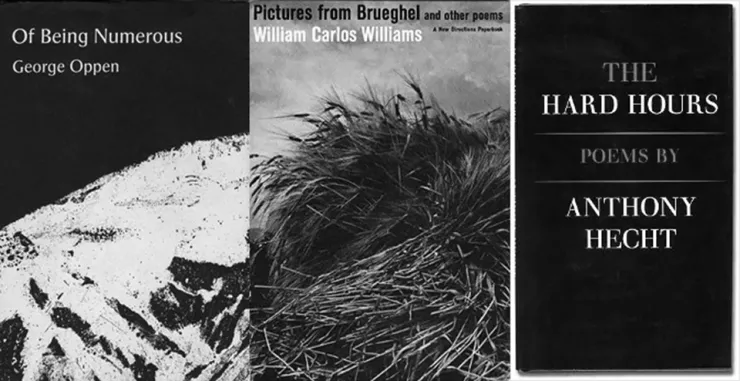
1963: Pictures from Breughel, William Carlos Williams
It’s high time this poet won the Pulitzer Prize
From juror Louis Untermeyer:
Denise Levertov. The Jacob’s Ladder (New Directions). There is a graphic power here as well as an overburdening nostalgia. There is, moreover, an unforced intensity, a tight sort of grace, and a fragility that is both fine-spun and firm. If the poetry indicated some sort of growth instead of a series of static episodes or poetic statements, it would be more moving, for the best of these pages show power, a power which frees the lines from their own sometimes oppressive imagery.
Sylvia Plath. The Colossus (Knopf). Young though she is – just thirty – Sylvia Plath is, if not an established poet, an already mature one. Her images are both precise and allusive; her mind is keen ands yet playful; her subjects are not confined to the “woman’s point of view,” and, though she is winning in her natural femininity, she never trades upon being feminine. She disdains cuteness in phrase and feeling; on the contrary, she cuts to the essence of her thought.
Anne Sexton. All My Pretty Ones (Houghton Mifflin). There is little for me to add to the enthusiasm I have already expressed for Anne Sexton’s previous volume and the praise printed on the jacket of this one. Dudley Fitts, Robert Lowell and many others recognize and respond to her deep but controlled emotional crises and the force of her intensities. Her work, poignant and important, is like that of no other writer in America today. She would be a top contender in any contest in any country.
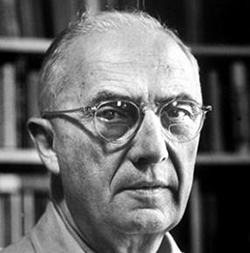
William Carlos Williams
William Carlos Williams. Pictures from Breughel (New Directions). The only questionable thing about Williams as a poet is his theory about “measure” and the “variable foot,” which he thinks he has discovered. Therefore the reader should skip the last two pages by an admirer entitled “Ten Years of a New Rhythm.”
Otherwise, this book is packed with beauty, an original kind of beauty. At first glance some of the poems seem as merely colloquial as flat prose but another glance will reveal their intrinsic, ineffable poetry. The least important looking pages are arresting, eloquent and convincing. Such a poem as the three-part “Asphodel, that Greeny Flower” is one of the loveliest – and maturest – love poems of our day, memorable and lasting. . . .
(Williams) has never received a Pulitzer Prize. It is high time that the committee recognize him, as have practically all the poets in the U.S.A., many of whom have been influenced by his integrity, his strength of utterance, and his dedication to the essential poetry of things instead of the usual abstractions.
1964: At the End of the Open Road, Louis Simpson
A poet seeking a grand style but unafraid of simplicities
From juror Stanley Kunitz:
At the End of the Open Road is Simpson’s fourth collection of poems and it unmistakably demonstrates the sureness of his development and the growing confidence and force of his voice. His aspiration to be an “American” poet in the grand style sometimes leads him astray into post-Whitman pastures of rhetoric. The longest poem in the book, “The Marriage of Pocahontas,” does not succeed in digesting its documents. . . .
The book as a whole has a certain magnitude; the pressures building behind it were not invented for the occasion – they come with a history; the mind of the poet has strength and clarity; he moves freely within the self-determined disciplines; and he is unafraid of simplicities. Even though the margin of superiority is not great, it is still verifiable enough, after some weeks of deliberation, to justify the selection of Simpson’s book.
1965: 77 Dream Songs, John Berryman
‘A fierce and idiosyncratic imagination’
From juror Stanley Kunitz:
Our sole hesitation in this choice derives from its posthumous aspect –[Theodore] Roethke died in 1963 – and from the fact that this poet has already been awarded a Pulitzer Prize in 1953. . . . As a general rule, prizes ought to be for the living. Not knowing how to resolve this argument ourselves, we are happy to pass it on to the Board for their considered judgment.
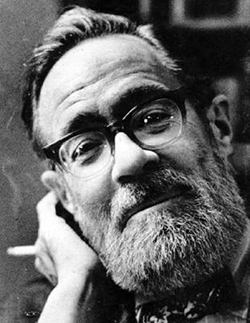
John Berryman
If the decision is to honor a living poet, we have one of almost equivalent merit to propose, viz., John Berryman, for his 77 Dream Songs. Ever since the publication of Homage to Mistress Bradstreet in 1956, Berryman’s peers among the poets have almost unanimously acclaimed his brilliance. His new book gives fresh evidence of a fierce and idiosyncratic imagination.
It is something of a shock to come upon this poet for the first time, since few of us are prepared to hear his convulsive rhythms, or to tolerate his breakdown of syntax and persona, of the type associated with psychic breakdown. Sometimes his compulsive voices get out of control and break into hysteria, bathos, or self-pity, but at his best . . . he is a true original, now frightening, now wildly funny. This book, we are reasonably confident, belongs to the history of American poetry.
1968: The Hard Hours, Anthony Hecht
In honoring this poet, ‘we are honoring poetry itself”
From juror Louis Simpson:
Anthony Hecht has always had an exquisite sense of diction and his poetry is a pleasure to read for the control of meter and sound. In recent years, however, a great deal more has been added, particularly the strength of feeling and sympathy that strikes the reader in poems such as “Rites and Ceremonies.”
Hecht is not a polemicist, nor does he have an aesthetic axe to grind. He is simply a poet who depends on the perfection and strength of the original poem. He has never been awarded a major prize. In honoring Hecht I think we are honoring poetry itself, apart from considerations of dogma or literary politics.
1969: Of Being Numerous, George Oppen
The most beautiful thing in the world? Clarity, clarity, clarity
Two jurors speak:
From Howard Nemerov: I favor – enthusiastically – our unanimous recommendation of George Oppen for the Pulitzer Prize. I have recently re-read all three of his books of the last decade – never saw the one published during the thirties – and I think the one on which we are basing our judgment clearly superior to the earlier ones, and very beautiful considered in itself.
From Louis Simpson: There are some startling things in it; it’s true, and intelligent, and experimental. . . . To describe Oppen’s work I do not think I can do better than quote his own lines:
Clarity, clarity, surely clarity is the most beautiful
thing in the world,
A limited, limiting clarity
I have not and never did have any motive of poetry
But to achieve clarity.