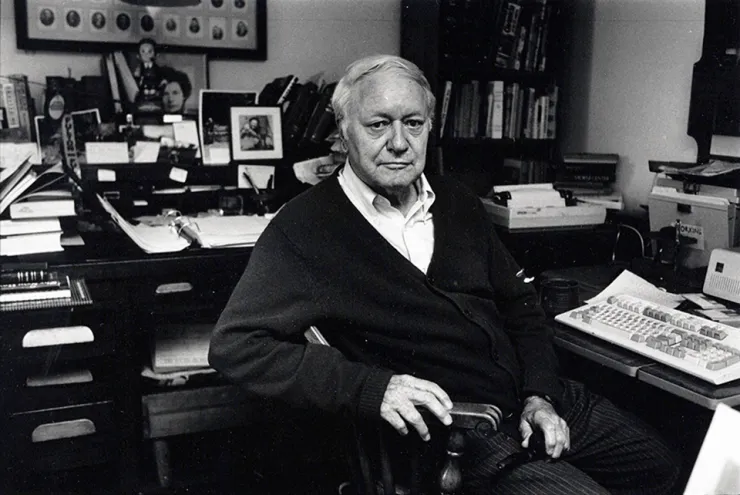
By the time the 50-year anniversary arrived in 1966, James Reston of The New York Times was among the best-known reporters in the country. He had won two Pulitzer Prizes, one in 1945 and a second in 1957.
Of all the prize-winning journalists invited to the Prizes’ semicentennial banquet in New York on May 10, 1966, it was Reston who was asked to speak for five minutes about rends in journalism.
Here is what he said.
Reporters now eat in restaurants with tablecloths
I suppose I am here because it is the reporter’s business, from time to time, to muscle into places where he is not supposed to be. But this is a wonderful occasion, and very journalistic. For here again are the newspapermen, who cannot agree on any professional standards for themselves, celebrating their presumption to set standards for 50 years for everybody else. I didn’t know Mr. Joseph Pulitzer, but I assume he had a sense of humor.
He must also have had a sense of human pity. For he established in this institution, not only an award for our occasional achievements, but what is probably more important to us, an alibi for our shortcomings. And he succeeded so well, with the faithful help of this great university, that even when we loiter and fail, people say, well, anyway, Old So and So wasn’t that bad: he once won the Pulitzer Prize.
My assignment is to sit down in 4½ minutes and meanwhile to recite on some of the trends in my craft. It is not easy. Things are getting a little mixed up in the writing business. The journalists have been winning Pulitzer Prizes for history, and the historians have been winning prizes for journalism, and it has even been suggested occasionally that we have been winning prizes for what is really fiction.
Nevertheless, I suppose we can spot some trends in modern journalism. We are gradually learning that we are no longer the first couriers of the news. We cannot get there as fast as the radio or describe the tears on Jackie Kennedy’s cheek as well as the television.
We resent this and we stick in our furrow like the obsolete mule, but the new age is good for us. It is forcing us to use our minds as well as our legs. It is making us think about the causes of violence, rebellion and war rather than merely reporting the struggle in the streets. And this, in turn, is giving us the opportunity to attract – though I’m sure we’re taking advantage of it – a much more intelligent, sensitive company of reporters than we have ever had before.
This new generation of reporters is quite different from the old combative types, many of whom won Pulitzer Prizes for some thumping disclosure. They are specialists. They do not have to stay with one newspaper or another. The Government and the Foundation and the big American corporation, now engaged all over the world, and the university, are interested in specialists who know something about relations with the public. The best of them can be ambassadors, or vice presidents of Ford, or assistant secretaries of state, or instant professors at more money than they can normally make in the newspaper business. It is a new generation and a new problem.
Reporters now eat in restaurants with tablecloths, and since the Kennedy Administration – an administration of intellectual tightwads – the reporter is expected to pick up the tab for what used to be his free lunch.
They are better educated in this generation, of course, and the advantages of this are obvious, but while they are brainier they are not more muscular. They know what to say now after they get through the door, but I have a feeling that they don’t knock down as many doors. I am not sure that this is progress.
The balance of political power in America is not running with the press or the Congress but with the president. He now has more power to make war, to tolerate or create the conditions that lead to war than ever before. The point could be proved if we had time. But in any event, we are going to have to use blunt instruments and have some tough characters around, and sometimes I wonder about this, especially when I listen to news conferences at the State Department.
The language of the present generation of reporters is informed and even elegant. They no longer ask secretaries of state flat out how we got into this mess in Vietnam. They say: Mr. Secretary, keeping in mind Article ___ of the South East Asia Treaty, and the dubious constitutional position of the present South Vietnamese government, could you indicate how you feel about the legal justification for our present military involvement in Saigon? You could imagine how much news you will get out of that.
Some of the old newspaper traditions, of course, we maintain. Our self-righteousness, I can assure you, is undiminished. Our capacity to criticize everybody and our imperviousness to criticism ourselves, are still, I believe, unmatched by novelists, poets or anybody else. The biggest story of the last 50 years has been revolutionary change, which we have urged everybody to embrace, but we have changed less than any other business in America, done less research and development than any other industry and established a system of labor relations that makes Jimmy Hoffa look like a statesman.
I trust you will not misunderstand. I believe in my profession. For all its troubles it never had a better chance for public service or a greater opportunity for creative minds than it does today. I am impressed by poets, novelists, historians and musicians, not because I think they are so wonderful, but because they can concentrate on the yearnings of the human spirit, and on truth rather than news, which is not the same thing as truth. I am impressed with them also because I don’t see how they get their inner torments down on paper without the tyranny of a daily newspaper deadline.
But just as the 19th Century was the century of the novelist, so this postwar phase of the 20th Century may be the era of the journalist. It may very well be that America needs a Whitman who can articulate the tradition of the past and the mission of the future.
Have the elder race faltered?
Do they droop and end their lesson, wearied over
there beyond the seas?
We take up the task eternal, and the burden and the lesson.
Pioneers! O pioneers!
Whitman put it all in this couplet, and we wait for another to strike the true note, combine the old symbols with the new realities and influence the spirit of the coming age, but pending the arrival of this popular philosopher poet, the rest of us have to do the best we can, and the reporter, I believe, has an important part to play.
In some ways his opportunity is greater or anyway, easier, than the poet’s or the novelist’s, because he does not have to create his audience. He writes when the people are paying attention. The violent convulsions of the time concentrate the public mind, startle the people out of their normal preoccupations with family and work, and then for a brief time – but only a brief time – the reporter is an educator, and the press and television have more effect on public attitudes and assumptions in this nation than all the schools, universities, and books in the land.
Somewhere there is a line where the old skeptical, combative, publish and be damned tradition of the past in our papers may converge with the new intelligence and the new duties and responsibilities of this rising and restless generation. I wish I knew how to find it, for it could help both the newspapers and the nation in their present plight, and it could help us believe again, which in this age of tricks and techniques, may be our greatest need.
At the moment we are left in Washington and in our newspapers with pragmatism, which is a useful tool but a poor guide, and reliable guides are hard to come by. My wife gave me one many years ago from Robert Burns. He said:
Whatever mitigates the woes, or increases the happiness
of others:
This is my criterion of Goodness.
And whatever injures Society at large,
Or any individual in it:
This is my measure of Iniquity.
This is a noble but difficult philosophy to follow at a time when power and even principle are dominated by individual personality, but we are not left without some guidelines. The best one I know of for the present time came from the opening statement of principles of the Spectator in London at the beginning of the 18th century.
Then it was said that the purpose of the paper, after reporting the news, was “to correct the vices, ridicule the follies, and dissipate the ignorance which too generally prevail at the commencement of the 18th Century.” And to do so by enlivening morality with wit, and tempering wit with morality. These, they said, were “the great and noble objects the Spectator ever holds in view.” And unless some prize winner in this room can do better, I think it is a pretty good object for all of us to hold in view.