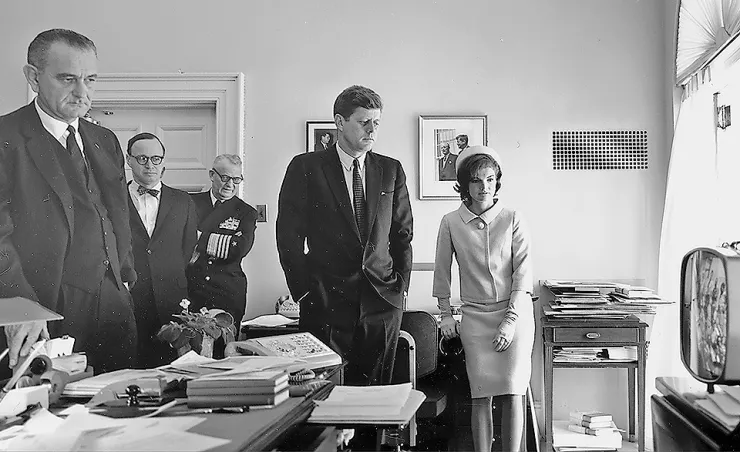
The year Arthur M. Schlesinger Jr. won his second Pulitzer Prize happened to be 1966. He was tapped to give one of five short speeches at the banquet to celebrate the 50th anniversary of the prizes. He had been born the same year the first Pulitzer Prizes were awarded.
The son of an American historian at Harvard University, Schlesinger had won the History prize in 1946 for The Age of Jackson. Twenty years later, the subject of his Biography prize winner was recent and close to home. He won for A Thousand Days: John F. Kennedy in the White House.
There was, in fact, a bit of autobiography as well as biography in the book. Schlesinger had been a special assistant in the Kennedy White House. The historian Barbara Tuchman, a juror that year, complained that A Thousand Days would have been a better book had Schlesinger stuck to reporting and research and left out big judgments that could be made only with proper distance and reflection. As a historian, she wrote, he “well knows the distorting effect of the close view and of personal involvement.”
Nevertheless, Tuchman called A Thousand Days “a masterful performance in narrative.”
Like the other speakers at the banquet on May 10, 1966, Schlesinger was asked to share his thoughts about trends in his discipline. He had good news for his listeners: American history was enjoying a renaissance.
New generation ready to reclaim high ground for history
By ARTHUR M. SCHLESINGER Jr.
The first half century of Pulitzer Prizes has seen in the field of history something of a revolution both in the kind of history written in the United States and in the place of history in the balance of the American mind.
When these Prizes began fifty years ago, the historical enterprise in America had withdrawn somewhat from the great national audience. This was a relatively new development. Through most of the 19th century history had been a dominant literary form in the United States, speaking powerfully to the central concerns of the nation. Bancroft, Parkman, Prescott, Motley, Sparks, Irving were in every serious private library. Historians were notable figures. Then, toward the end of the century, history began to lose the reading public. Thus Henry Adams’s History of the United States During the Administrations of Jefferson and Madison, coming out in 1889-91 and a classic from its first appearance, sold a mere 3,000 sets in its first decade after publication.
The decline of popular interest in history was due partly to the changes in national taste. A country in the tumult of growth, rapidly turning into an industrial society and a world power, was caught up by the excitements of the present; it had little time for elegant excursions into the past. And it was also due to changes within the historical guild itself.
The typical historian was no longer, as he had been in the 19th century, the gentleman scholar; he was now the college teacher; and only a few – as in our day, Samuel Eliot Morrison – have had the happy faculty of combining the humane cultivation of the one and the technical proficiency of the other. The professionalization of scholarship, with the establishment of graduate training and the enthronement of the PhD, brought with it a new narrowing emphasis on minute inquiry and monographic publication.
The result was that, where the classical historians of the 19th century had written for statesmen and editors, jurists and divines, for the serious public in general, the professional historians of the early 20th century – with a few distinguished exceptions, like Frederick Jackson Turner – wrote primarily for their colleagues and students.
Moreover, many seemed to regard this with entire satisfaction as their best and final audience. Theodore Roosevelt, a surviving historian of the old school, complained bitterly about these “conscientious, industrious, painstaking little pedants, who would have been useful in a rather small way if they had understood their own limitations, (but) had become because of their conceit distinctly noxious. They solemnly believed that if there were only enough of them, and that if they only collected enough facts of all kinds and sorts, there would cease to be any need hereafter for great writers, great thinkers.”
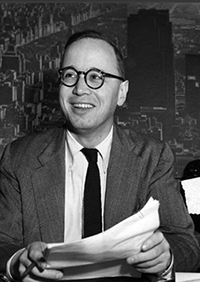
Click here for Schlesinger radio interview
Roosevelt’s outburst did inadequate justice to the absolute importance of the establishment of high professional standards. The meticulous recovery of documents and verification of facts carried forward in these years laid the indispensable foundation for bolder flights in the future. Yet Roosevelt did justly call attention to an incipient complacency and parochialism within the historical guild – a willingness to settle for a narrow corner of the nation’s intellectual life and a renunciation of larger vision and influence.
The aftermath of the First World War, however, brought with it a resurgence of popular interest in history. The phenomenal success of Wells’s Outline of History – one and a half million copies sold in the United States in a dozen years – showed that historians had a great potential public, even if members of the American Historical Association were not inclined to satisfy it. Perhaps history was too important to be left to the historians.
In any case, a group of gifted outsiders turned to history in the twenties and thirties and began to restore the relationship to the nation which the professionals had permitted to lapse – men and women like Allan Nevins, Carl Sandburg, Bernard De Voto, Douglas Southall Freeman, Henry Pringle, Van Wyck Brooks, Marquis James, Margaret Leech and so many others. At the same time, Charles A. Beard, having left academic life and become in a sense an outsider himself, and V.L. Parrington, a professor but of English, showed the power – if in terms later generations found somewhat naïve and mechanical – of sweeping ideological interpretations of the nation’s past.
The onset of the Second World War accelerated the revival of the historical consciousness. “In terms of change and danger,” as John Dos Passos, another outsider, wrote in the forward to a book significantly entitled The Ground We Stand On, “when there is a quicksand of fear under men’s reasoning, a sense of continuity with generations gone can stretch like a lifeline across the scary present.”
The profession regarded these developments with mixed emotions. Not all historians, it should be said, had accepted the narrowing of the historical mission. In 1912 James Harvey Robinson had challenged the guild with his spirited manifesto The New History; and in subsequent years a number of historians –Beard, Carl Becker, my father, among them – had sought to revitalize the writing of history by enlarging its scope, diversifying its method and increasingly its relevance.
This had led between the wars to not unuseful but rather artificial controversy within the profession about the nature of history – was it science or art? – and about the limits of historical knowledge – objectivity vs. relativism. By the forties it had become evident that such questions did not permit clear-cut answers: that objectivity was an unattainable ideal but an essential discipline, and that history had elements of both art and science. Liberated from these debates, a new generation of historians, many of whom had been thrust for a season by the Second World War into the world of action and passion, brought, I think, a new energy to the study of the American past.
The new energy was informed by a more sophisticated conception of the historical enterprise. Nothing, I believe, has counted more in this connection than the rise of intellectual history – and I commend the Pulitzer committee for recognizing this by awarding the History prize this year to the most distinguished of our intellectual historians, the late Perry Miller. The rise of intellectual history has been important not only in pursuing its own purposes – the origin and impact of ideas – but in restoring fertility to apparently exhausted fields of conventional history. Seen through the perspective of ideas, political, economic, diplomatic and institutional history acquired new force and vitality. Intellectual history has broadened the framework of interpretation, facilitating the application of insights from economics, psychology, anthropology and sociology as well as encouraging comparative study of developments in other continents and other epochs.
The result has been a notable revival in historical studies. I must confess myself impressed, not to say intimidated, by the quality of work turned out today by our younger scholars – its liveliness, imagination, range, technical skill and literary grace. I believe that the next generation of historians may well reclaim for history the central place it occupied in the American mind in the days of Bancroft and Putnam.
This revolution has also affected the contiguous area of biography and autobiography, though the changes here have been less dramatic and linear; for biography, a more personal and idiosyncratic art, has to a considerable degree escaped the corporate professionalism which has so often inhibited the writing of history. Thus half a century ago biography had not fallen into the juiceless state which characterized too much of technical history when the Pulitzer Prizes were founded. In the years since, it has at its best surmounted the various temptations of hagiography, public relations, debunking, too facile Freudianism and so on to carry forward a solid tradition in American letters.
The contemporary revival of history is, I believe, for other reasons than simply the vanity of historians. For history should be much more than simply a technical exercise or a literary flourish. I do not mean to suggest that history offers sure answers to conundrums of public policy or infallible insights into the future. But I do believe that history is a moral necessity in a society marked by power. It is man’s best antidote to his illusions of omnipotence and omniscience. It should forever remind us of the limitations of our passing perspective; it should strengthen us to resist the pressure to convert monetary interests into moral absolutes; it should lead us to a profound and humbling sense of our frailty as human beings – to a recognition of the fact, so often and so sadly demonstrated, that the future will outwit all our certitudes and that the possibilities of history are far richer and more various than the human intellect is likely to conceive.
A nation informed by a vivid understanding of the ironies of history is, I believe, best equipped to live with the temptations and tragedy of power; and, since we are condemned as a nation to the role of power, let a growing sense of history temper and civilize its use.