Lauren K. Soth knew whereof he spoke. He was the editorial page editor of the Des Moines Register, but he was also an agricultural economist.
Although Soth had a degree in journalism and an interest in newspapering, he spent the 1930s teaching college and advising the federal government on farm economy. He served in the Army during World War II.
Soth joined the Des Moines Register in 1947 and was appointed editorial page editor in 1954. The following year he wrote an editorial that changed his life, affected U.S.-Soviet relations and won him the 1956 Pulitzer Prize in Editorial Writing.
Soth’s editorial responded to a Jan. 25, 1955, speech in which Nikita Khrushchev, the Soviet premier, suggested that his country could improve its economy by following U.S. agricultural practices. In a “sportive mood,” as he later characterized it, Soth offered Iowa’s help. To his surprise, the editorial reached Khrushchev, who took him up on the offer.
President Dwight D. Eisenhower expressed support for the idea, and despite State Department reservations, a Soviet delegation was soon on its way to Iowa. Soth was among five Iowans who completed the exchange with a trip to the Soviet Union.
Here is the editorial that started it all.
If the Russians want more meat ...
By LAUREN K. SOTH
Nikita Khrushchev, who seems to be the real boss of the Soviet Union now, signaled his emergence to power by a well-publicized speech before the central committee last month lambasting the performance of the Soviet economic managers. In this speech, Khrushchev especially attacked the management of agriculture. And in doing so, he took the rare line of praising the United States.
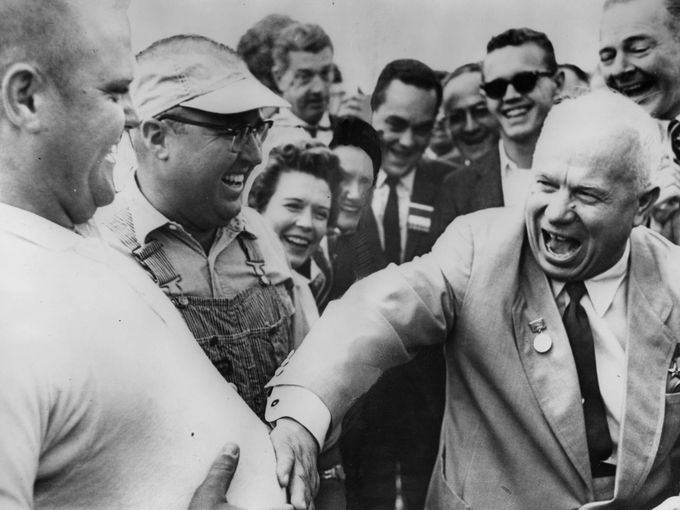
Nikita Khrushchev in Iowa in 1959.
Khrushchev advocated the development of feed-livestock agriculture as in the United States. “Americans have succeeded in achieving a high level of animal husbandry,” he said. He urged Soviet collective and state farms to plant hybrid corn to provide more feed for livestock. And he demanded an eightfold increase in corn production by 1960.
Speaking as an Iowan, living in the heart of the greatest feed-livestock area of the world, we wish to say that, for once, the Soviet leadership is talking sense. That’s just what the Russian economy needs — more and better livestock so the Russian people can eat better.We have no diplomatic authority of any kind, but we hereby extend an invitation to any delegation Khrushchev wants to select to come to Iowa to get the lowdown on raising high quality cattle, hogs, sheep and chickens. We promise to hide none of our “secrets.” We will take the visiting delegation to Iowa’s great agricultural experiment station at Ames, to some of the leading farmers of Iowa, to our livestock breeder, soil conservation experts and seed companies. Let the Russians see how we do it.
Furthermore, we should be glad to go to Russia with a delegation of Iowa farmers, agronomists, livestock specialists and other technical authorities. Everything we Iowans know about corn, other feed grains, forage crops, meat animals and the dairy and poultry industries will be available to the Russians for the asking.
We ask nothing in return. We figure that more knowledge about the means to a good life in Russia can only benefit the world and us. It might even shake the Soviet leaders in their conviction that the United States wants war; it might even persuade them that there is a happier future in developing a high level of living than in this paralyzing race for more and more armaments.
Of course the Russians wouldn’t do it. And we doubt that even our own government would dare to permit an adventure in human understanding of this sort. But it would make sense.
Sources: Pulitzer Prize Editorials: America’s Best Writing, 1917-2003 (Third Edition), William David Sloan, Laird B. Anderson (eds.), Iowa State Press, 2003, pp. 136-37; Complete Biographical Encyclopedia of Pulitzer Prize Winners 1917-2000, by Heinz-Dietrich Fischer and Erika Fischer, K.G. Saur, Munich, 2002, p. 229. An excellent account of the exchange visits is “Diplomatic Farmers: Iowans and the 1955 Agricultural Delegation to the Soviet Union,” by Peggy Ann Brown, pp. 31-62, Volume 72, No. 1 (Winter 2013), Annals of Iowa. LINK: http://ir.uiowa.edu/cgi/viewcontent.cgi?article=1672&context=annals-of-iowa