Martyna Majok
Why are stage plays your preferred form of storytelling?
MARTYNA MAJOK: My mom is an immigrant who worked in a factory and cleaned houses. New York was close by where we lived in New Jersey, but the theater world seemed so distant because of how expensive it is.
I first saw theater on a whim when I was 17 or 18. What I Ioved most was that the characters seemed like a family. Maybe that has to do with being an immigrant myself, and meeting strangers who become your chosen family. I grew up with TV and film and books because they were accessible. I’ve never been moved in the same way that I am when I see thrilling theater.
What was that first performance?
MM: “Cabaret.” At the time, I was hustling at a pool hall in Belleville, New Jersey. One day, I won $45, the most I’d ever won. That was the day my mom brought home — from a house she cleaned — some magazines and pamphlets that were our free reading. One of them had John Stamos in it. My mom was, like, “Uncle Jesse eis in New York.”
Aside from being an amazing production, starring John Stamos, “Cabaret” was a story set in dark times. It was funny and sexy and inviting, and didn’t compromise on any of that. That informs how I approach writing. People hear the description of my plays and say, “Oh, that sounds sad.” And I swear to them that, actually, it’s funny. My friend calls them hear-me-out plays.
You were born and spent your early years in Poland, not far from the Chernobyl Nuclear Power Plant, which had that huge fire and radiation leak. How does that and other aspects of your life inform your writing?
MM: I just went to get my annual thyroid ultrasound, my annual check for cancer. Brushes with mortality make you hyperaware of timelines. Regarding Chernobyl, I don’t know if my medical conditions are specifically related to that; there are not many people doing studies about that. But that, and growing up low-income and being far away from extended family and being aware of my mortality … maybe just makes the stakes higher. It puts a fire under you.
How do you make what’s important and sometimes profoundly personal for you meaningful to a broad and, perhaps, generic audience?
MM: That balance of [playwriter] shorthand and having to educate an audience is something I must always think about. I want to make people who’ve had those experiences say, “Yes!” But I also don’t want to exclude an audience that doesn’t have those same experiences. And most people in theater audiences, with so much disposal income, do not. But we all understand betrayal and loss and yearning and grief.
So, you don’t assume that audiences will automatically accept what you’re offering.
MM: I will continue to write what I’ve experienced and seen. I will meet things on my own terms … And I hope people in the audience will try to meet me there.
What are you working on right now?
MM: Two musicals. One is an adaptation. One, which I’ve been working on for the past eight years, is about Chernobyl. I didn’t have any part of that event relayed to me until I was 20 years old. I became obsessed with stories from the area, and with people who are returning there to live after they were forcefully evacuated. They were, like, “F--- this. My home is here.” The area is still pretty radioactive. The musical will be focused on that and issues of home and how our loved ones may be living their lives in ways we don’t agree with … Also, in May, my play, “Sanctuary City,” about [Deferred Action for Childhood Arrivals] about immigrant Dreamers opens.
I’ve taken a lot of work, including for TV, which I’m not sure I can talk about publicly just yet … My main question when it comes to work is, like, “Are you gonna pay me?”
You live a lush life these days?
MM: I can pay my rent, and I’m really happy about that. That’s kind of the major bar. I have a cat, and that’s a big luxury. I do still rent an apartment. But, compared to five years ago, I’m doing OK.
Does the relatively high cost of tickets for major plays bother you?
MM: Yes. It’s weird to be writing about experiences when the people having them are not represented in your audience … There’s a playwright I know who’d asked audience members who’d just seen the show, which had a largely black cast, to give so other people can see the show … Mixed Blood Theatre in Minneapolis started a program called “Radical Hospitality” [that gives low-income theater-goers unsold tickets]. At the end of the first year of that program, they found out they’d made the same amount of money. Plus, in the end, their house was fuller than it would have been.
If, among your own plays, you have a favorite or favorites, what are they?
MM: It might be “Ironbound,” which is my mother’s story. I had tried to write it three times. The first one was awful. She saw it and didn’t talk to me for a year. I don’t blame her.
It wasn’t just that the play was not good; it was that she’d lived a life where silence was security. We grew up with domestic violence and immigration. She had tried hard not to let people know. She was afraid we [kids] would be separated from her. For me, I needed to say these things that were part of my narrative, too.
When I got to [Yale School of Drama for] grad school — this place I could go to only because my study was funded — I asked myself if I gave up [playwrighting] right now what would be the one thing I would regret not saying. It was that play … At the premier in D.C., my mom was my date. There were 300 people in the audience who stood up to applaud at the end of the show. Here was my mom next to me, with her invisibility as a factor in her survival, getting a standing ovation. That was the happiest moment of my career. The Pulitzer is the second happiest.
How did your mom receive that standing ovation?
MM: She is a quiet, cagey lady. I don’t know exactly what she got from it. But I felt she understood that my play was a love letter. Now, [at “Ironbound”] premieres she goes up to strangers and says, “That was me.”
Have your Polish relatives seen your work?
MM: For a while they were, like, “What do you do? Do you write movies?”
I was, like, “Yeah. Kind of.”
Similar to us, they understand stamps of approval from institutions. When I got into Yale School of Drama, they were, like, “Yes!”
The day they announced the Pulitzers … my mom was in Poland. I said, “Let me call my mom. Let us go drinking into the night.” I couldn’t reach her for two hours: Poland had erupted. She had family coming over screaming about my Pulitzer. She kept getting these notifications over Facebook. All the Polish paparazzi were coming to the house and asking all these questions.
What does your Pulitzer mean for you?
MM: I’ve sort of dreamed of this ever since I knew it was a possibility. But winning it was a complete shock … There are doors I’ve been pushing on for years that are slightly more ajar now. Now, it seems like I’m open to more possibility in a higher tier. We’ll see.
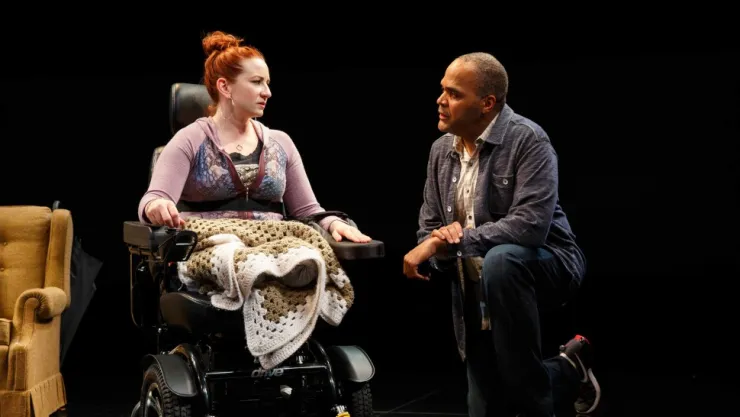
After those first two productions of “Cost of Living,” nobody was doing this play. I’ve been told by certain theaters that they find it difficult to cast, that they can’t find disabled actors. Hopefully that won’t be as much of an issue because of the award. Hopefully, more disabled actors will get work. Being associated with the award, I hope, validates the importance of working class and immigrant stories and the stories of all the people represented in the play.