
Released to a muted reception by Cape and Smith in 1929, "The Sound and the Fury," marked a pivotal turning point in the life of two-time Fiction winner William Faulkner. 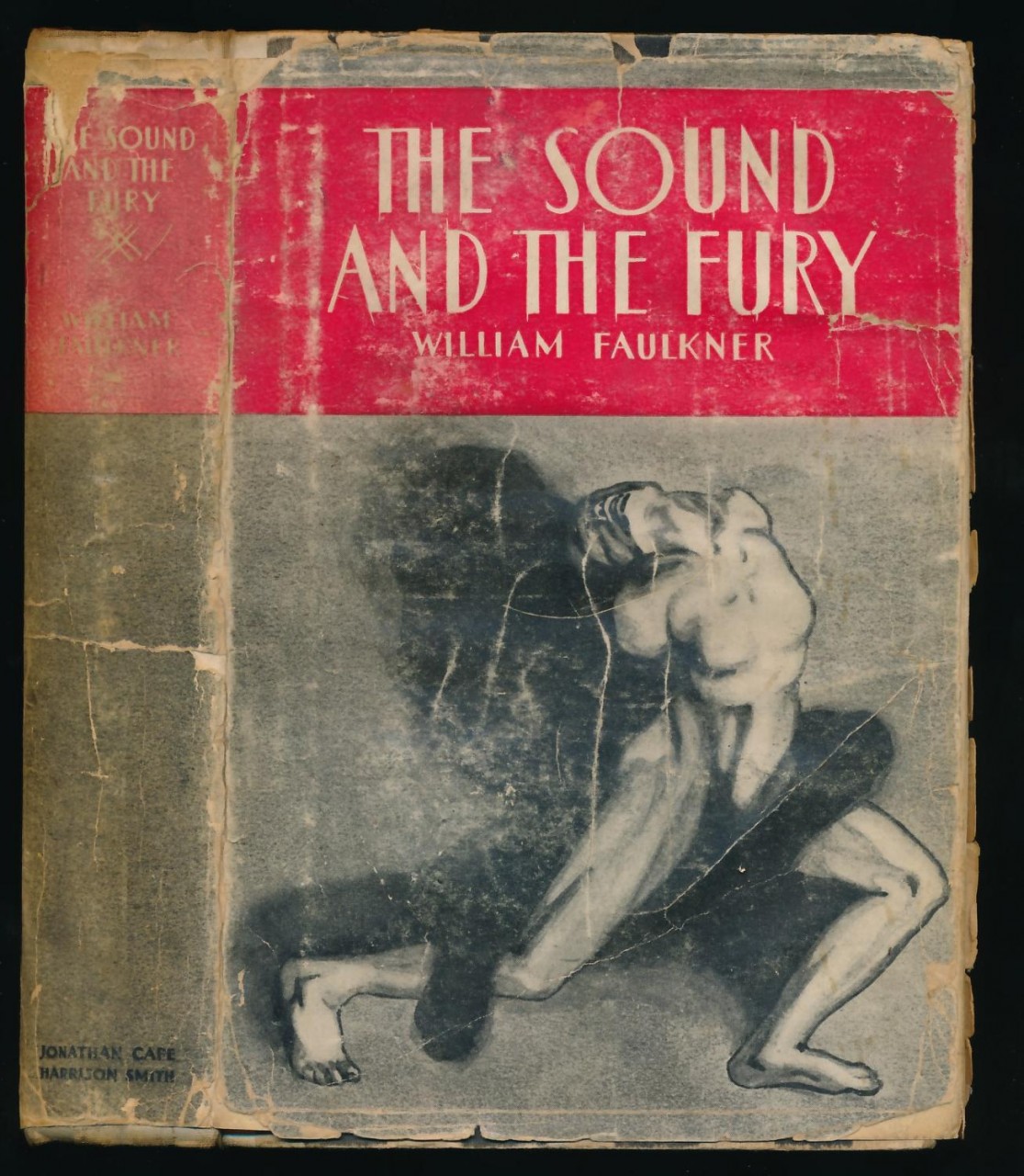
A first edition of "The Sound and the Fury." (File)
In 1929 when the book was published, Faulkner was still two decades away from receiving the Nobel Prize in Literature in 1949, and his susequent Pulitzers in 1955 and 1962. He had spent most of the 1920s in the process of reinvention.
A dandyish presence throughout his youth in Oxford, Miss., who enlisted in a Canadian reserve unit of the British Army during World War I, he largely was indifferent to his formal studies, missing an opportunity to complete a degree at the University of Mississippi by neglecting his classes in favor of a burgeoning interest in poetry. Informal tutorials with Phil Stone (a Yale-educated Oxford attorney who Faulkner briefly followed to New Haven) and Sherwood Anderson largely compensated for educational deficits while facilitating his introduction to literary modernism, notably the work of T. S. Eliot and James Joyce. Anderson also played an integral role in facilitating the publication of his first two novels.
While Faulkner and the "Winesburg, Ohio" author lost touch following their intense mentorship, it was Anderson who spurred the younger writer to hone in on his native city and the surrounding Lafayette County countryside in an era defined by the attacks on Jim Crow and the problematic rise of Lost Cause historiography.
Arguably diminished by a focus on New Critical literary theory and a diffuse narrative centered around the psychological trauma of the Great War, the resulting "Flags in the Dust" was rejected by 10 publishers before being issued by Harcourt, Brace & Company as "Sartoris." Although it failed to resonate with critics and audiences, prompting Viking to reissue the full manuscript under its original title in 1973, Faulkner succeeded in crafting the initial landscape of Yoknapatawpha County, his "apocryphal" rendering of his native environs.
In writing "The Sound and the Fury" and its sequel, the contemporaneously drafted, Yoknapatawpha-set "As I Lay Dying" (1930), Faulkner was driven by opposing influences. While his multi-decade courtship of fellow Oxfordian Estelle Oldham led to a marriage in 1929, the stepchildren brought to the relationship from her previous union to extraterritorial jurist Cornell Franklin necessitated an income — initially furnished by a series of magazine short story sales.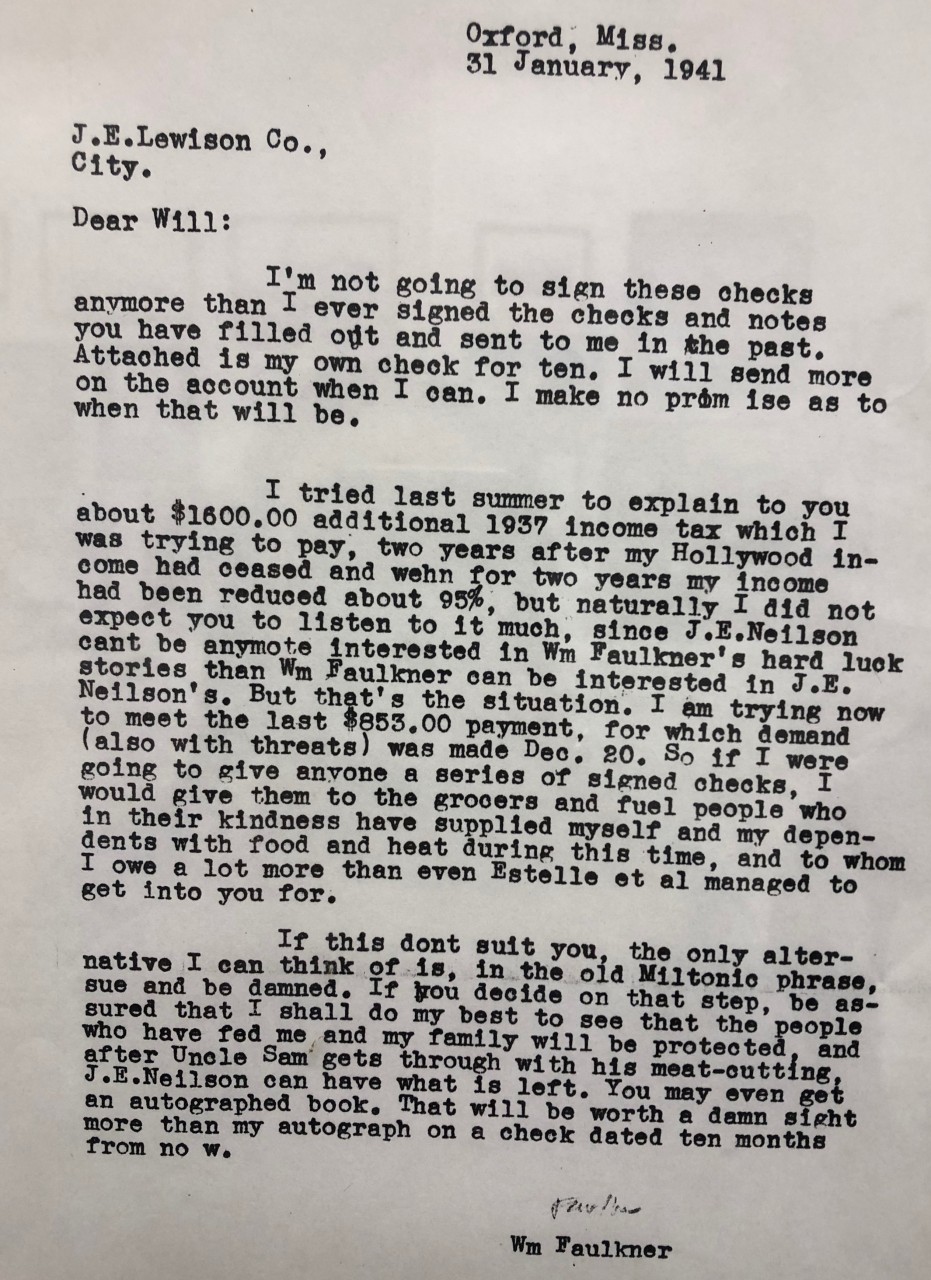
Faulkner's marriage to Estelle was often troubled by mutual alcohol abuse, his extramarital affairs and her shopping sprees, as this 1941 letter to Neilson’s Department Store attests. (The Neilson's Project)
Yet the failure of his first three novels had spurred stylistic exuberance, evidenced by his stream-of-consciousness rendering of Quentin Compson's breakdown at Harvard University in "The Sound and the Fury." It would inform "As I Lay Dying"'s panoply of narrators and reach its apogee in the nonlinearity (ending as the Quentin sequence commences) of "Absalom, Absalom!" (1936), the frontispiece of the Yoknapatawpha saga.
Quickly written and positioned for commercial success, "Sanctuary" (1931) burnished Faulkner's credentials in the popular consciousness, with strong reviews and sales. Yet a consistent income remained elusive, necessitating what may be viewed with the benefit of hindsight as a teleological turn to a different kind of mythopoeic artistry: Hollywood screenwriting.
"Millions are to be grabbed out here and your only competition is idiots," Columbia College graduate and erstwhile journalist Herman J. Mankiewicz telegraphed to once and future colleague Ben Hecht in 1926. "Don't let this get around." By the early 1930s, it was old news, with even the redoubtable likes of F. Scott Fitzgerald and Dorothy Parker seduced to varying extents by the financial imperatives of the moving image.
Though Faulkner seldom traversed the heights of Hecht or Frances Marion in his part-time screenwriting career (undergirded by sci-fi pulp maestro Leigh Brackett and Academy Award-nominated dialogue specialist Jules Furthman, "The Big Sleep" (1946) comes closest to echoing the circuitous structures of his fiction while remaining an egalitarian collaboration), the sheer incongruity of this sideline would play a key role in defining his public persona.
Indeed, the trope of a dejected, philandering Faulkner in Hollywood — shirtless, typing on pool furniture in sunglasses while nursing a hangover in the canyons — has endured long after his death, inspiring a 1976 memoir from longtime mistress Meta Wilde and John Mahoney's memorable turn as the dipsomaniacal W. P. Mayhew in the Coen Brothers' "Barton Fink" (1991).
(It should be noted that Faulkner's collaboration with "Big Sleep" director Howard Hawks evolved into a close friendship that endured into his rediscovery. Some of their other projects included the aborted Henry Fonda-Ronald Reagan vehicle "Battle Cry" and "Land of the Pharaohs," an unjustly maligned 1955 sword-and-sandal epic prominently defended by Martin Scorsese.)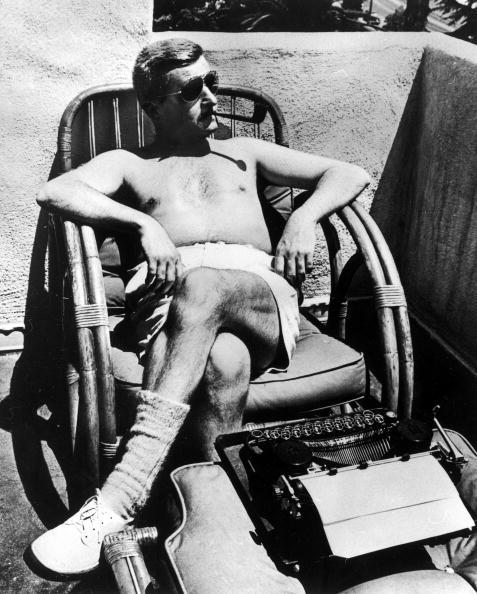
The canonical depiction of Faulkner in Hollywood, as shot for Life magazine in the early 1940s. (Alfred Eriss/Pix Inc./Time Life Pictures/Getty Images)
Hollywood and film noir eventually would play an indirect role in presaging Faulkner's unlikely ascendance. Like fellow modernist John Dos Passos, he was early to grasp the possibilities of mixed media and nonlinear narrative; originally published as "The Wild Palms" (1939), "If I Forget Thee, Jerusalem" was referenced by Jean-Luc Godard in "Breathless" (1960) and anticipated the parallel yet interrelated narratives of such films as Robert Altman's "Nashville" (1975).
However, it was the bestselling "Intruder in the Dust" (1948) — a mystery of sorts in which a heterogeneous group of Yoknapatawpha residents succeed in exonerating Lucas Beauchamp, an African-American farmer falsely accused of murder — that crystallized Faulkner's reputation, exemplified by Clarence Brown's critically successful 1949 film adaptation.
That same year, according to Faulkner biographer Joseph Blotner, Swedish Academy President Gustaf Hellström likened the writer to Selma Lagerlöf and Hjalmar Bergman, who "each in his own way had also transformed their rural family setting into a vast universal theatre lighted by magic and offering the spectacle of a humanity teeming with larger than life characters." After the Nobel committee elected not to award the Literature Prize in 1949, Faulkner received the award retroactively "for his powerful and independent artistic contribution in America's new literature of the novel" on November 10, 1950.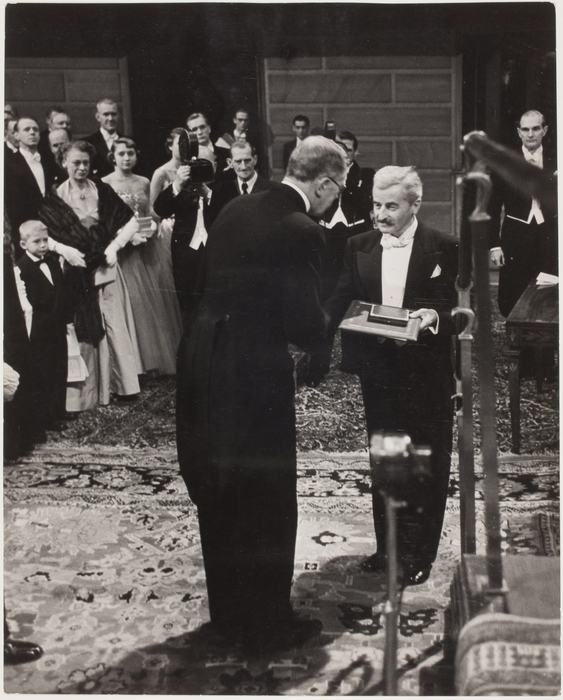
Faulkner accepts the Nobel Prize from King Gustaf VI Adolf on December 10, 1950. (International Center for Photography)
The initial exhilaration of receiving the Nobel was followed by a familiar cycle of despondency, including the alcoholism-related hospitalization of Estelle and his own admission to a Bronx sanitarium for electroconvulsive therapy after a particularly dire binge in late 1952. What would have been insurmountable for others was now de rigeur in Faulkner's inchoate personal life, and he managed to publish the long-simmering "A Fable" in the summer of 1954. 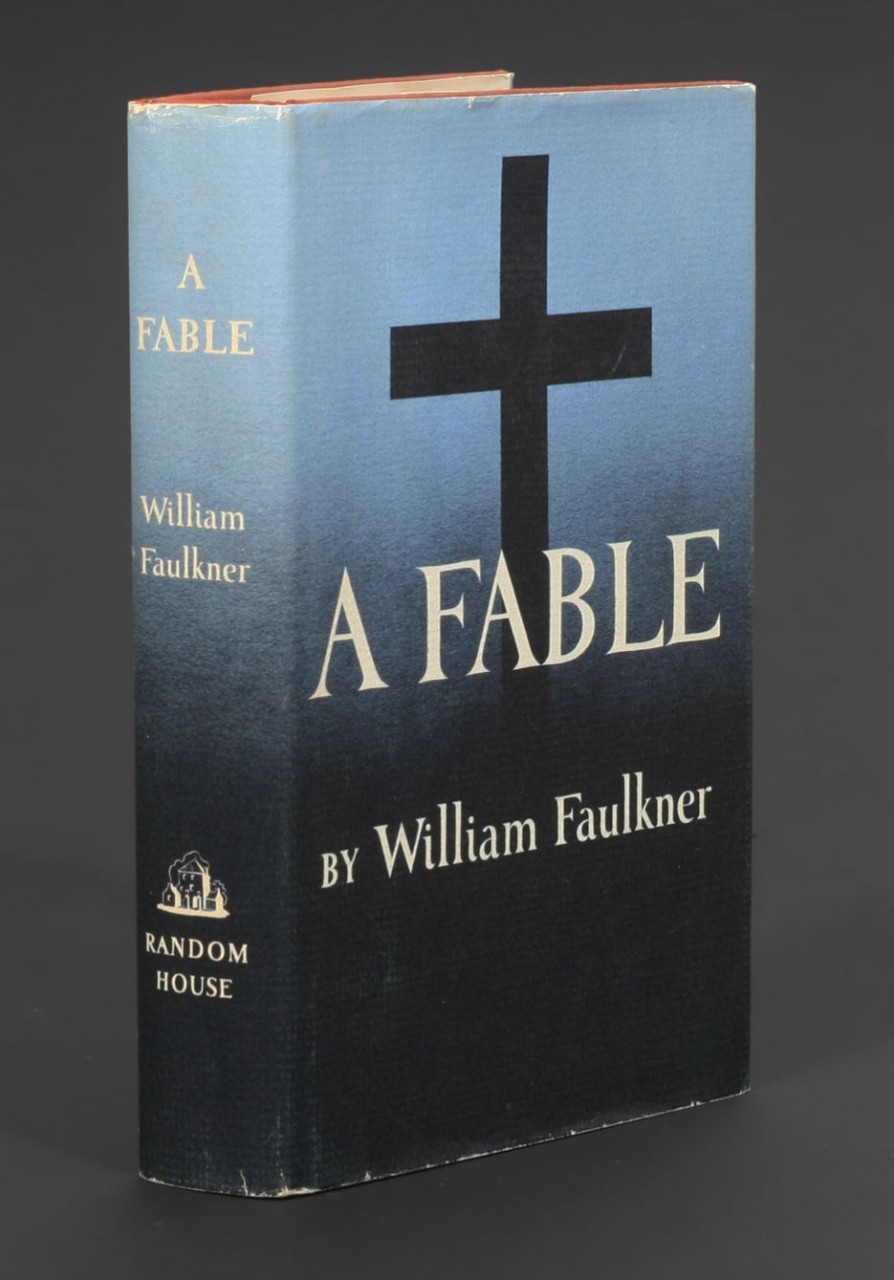
First edition of "A Fable." (Manhattan Rare Book Company)
A Christian allegory set in the trenches of World War I, the Dostoyevsky-influenced novel elicited some of the most divisive reviews of Faulkner's career, with Philip Blair Rice (writing for the Kenyon Review, a bastion of New Criticism and perhaps the most influential literary journal of the era) condemning it as "eccentric" and "artistically unachieved" even as Swiss critic Henrich Straumann likened the book to "Moby-Dick" and "War and Peace."
Shortly after its release, "A Fable" was entered into the 1955 Pulitzer Prize cycle, the first competition entirely overseen by Administrator John Hohenberg, who served concurrently as a professor of journalism at Columbia University. Although Faulkner was neglected by previous juries, the book was ranked second by a committee comprised of seminal Hemingway scholar Carlos Baker, chair Francis Brown and Irwin Edman.
Favoring Milton Lott's debut Western, "The Last Hunt," the group ranked "A Fable" second with a key caveat delineated by Brown: "There are portions of this novel which seemed to be as close to greatness but I think we are agreed that it fails ultimately because of its inability to communicate with the reader. We also have a feeling that Faulkner has done better in the past and that it would be a mistake to give him something less than a Pulitzer award for something less than he has done before."
As he was wont to do, Hohenberg commented on the jury's ranking in a diary that served as the basis for a book published by Syracuse University Press in 1996. "I think they are out of their minds but I must send their report to the Pulitzer Board as drafted whether it makes sense or not," he wrote. "There's so little nowadays that makes sense in any case."
Ultimately, the jury failed to persuade the Advisory Board at their April 1955 meeting. "In a brief but eloquent speech, Hodding Carter nominated his fellow Mississippian," he recalled. "I needed only a glance around the table to determine that Faulkner, after being neglected for his greatest works, finally would be given a Pulitzer Prize as our greatest living novelist. And so it turned out, by a unanimous vote."
Although the announcement was delayed by more than an hour as a quorum of the University Trustees was mustered to ratify the Board's choices (as stipulated until 1975), Faulkner received the 1955 Fiction Prize — prompting inevitable written complaints from Brown and Baker to Hohenberg — on May 2.
With no ceremony to prepare for in an era when Pulitzers were awarded by mail, Faulkner threw himself headfirst into work on "Land of the Pharaohs," his final Hollywood opus, before settling into the final act of his career: a comparatively relaxed, family-oriented schedule of public appearances (including a belated return to academia as a distinguished writer-in-residence at the University of Virginia) and writing, often for long stretches at New York's hallowed Algonquin Hotel.
His final novel, "The Reivers," was published about a month before his death on July 6, 1962. "If some saw in 'this autumnal story' a retreat into anecdotal escapism," said Blottner, invoking Time magazine's review of the book, "it was still a 'work of love.'" As with much of his late oeuvre, there were divergent outlying opinions, including V. S. Pritchett's appraisal of the picaresque Yoknapatawpha comedy as an achievement worthy of Mark Twain.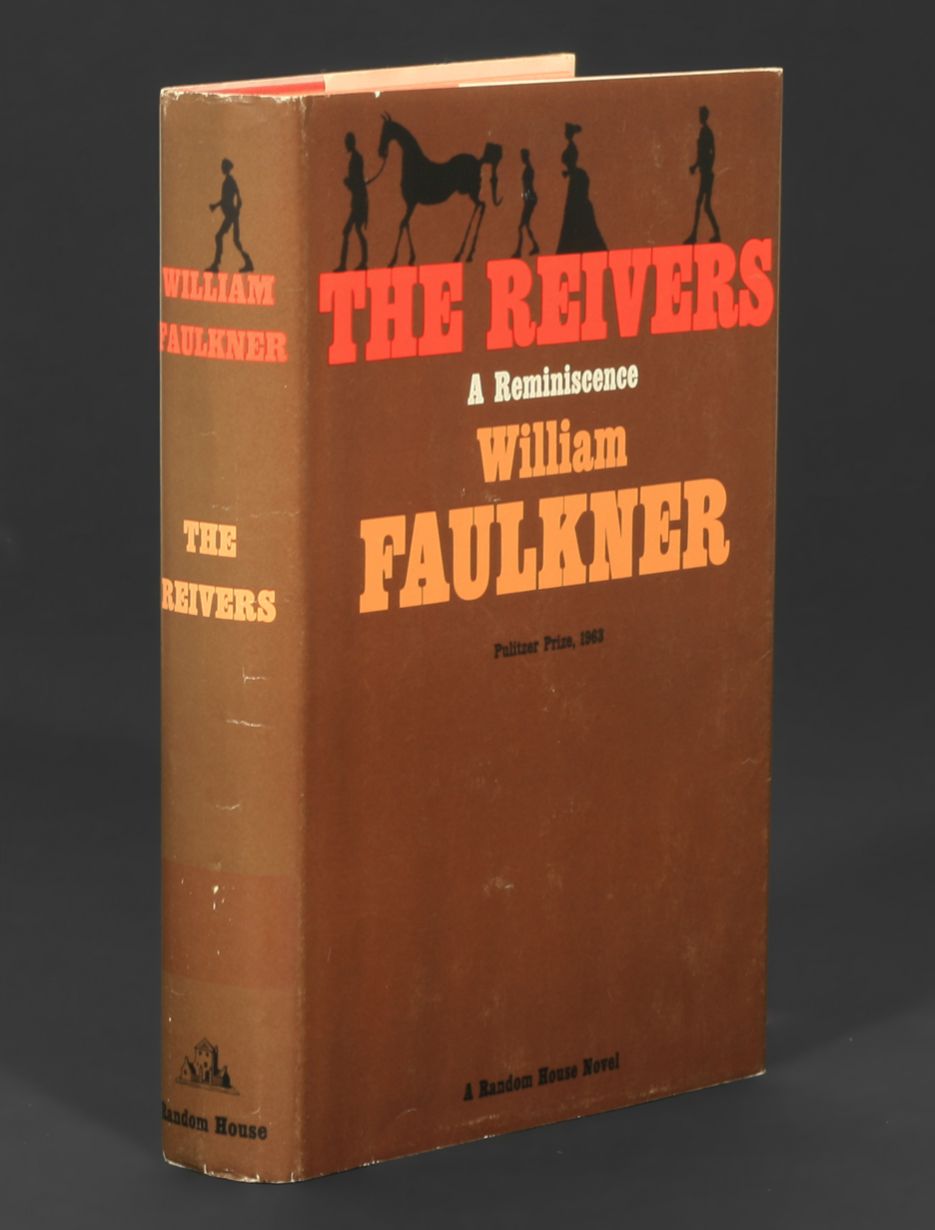
A later edition of "The Reivers" with its Pulitzer singled out. (Manhattan Rare Book Company)
Following the obscurantist tinge of "A Fable" and the muted reception accorded to the concluding two volumes of the Snopes family trilogy, "The Reivers" emerged as an accessible and mammoth success in the weeks following Faulkner's death, eventually inspiring a 1969 film adaptation starring Steve McQueen and Burgess Meredith. Even more surprisingly, it was the second choice in the 1963 Pulitzer Fiction jury report, with John Barkham and Irita Van Doren lauding the book as a "genial comedy" that "contains a minimum of the rhetoric and moralizing which characterized Faulkner's later writing." 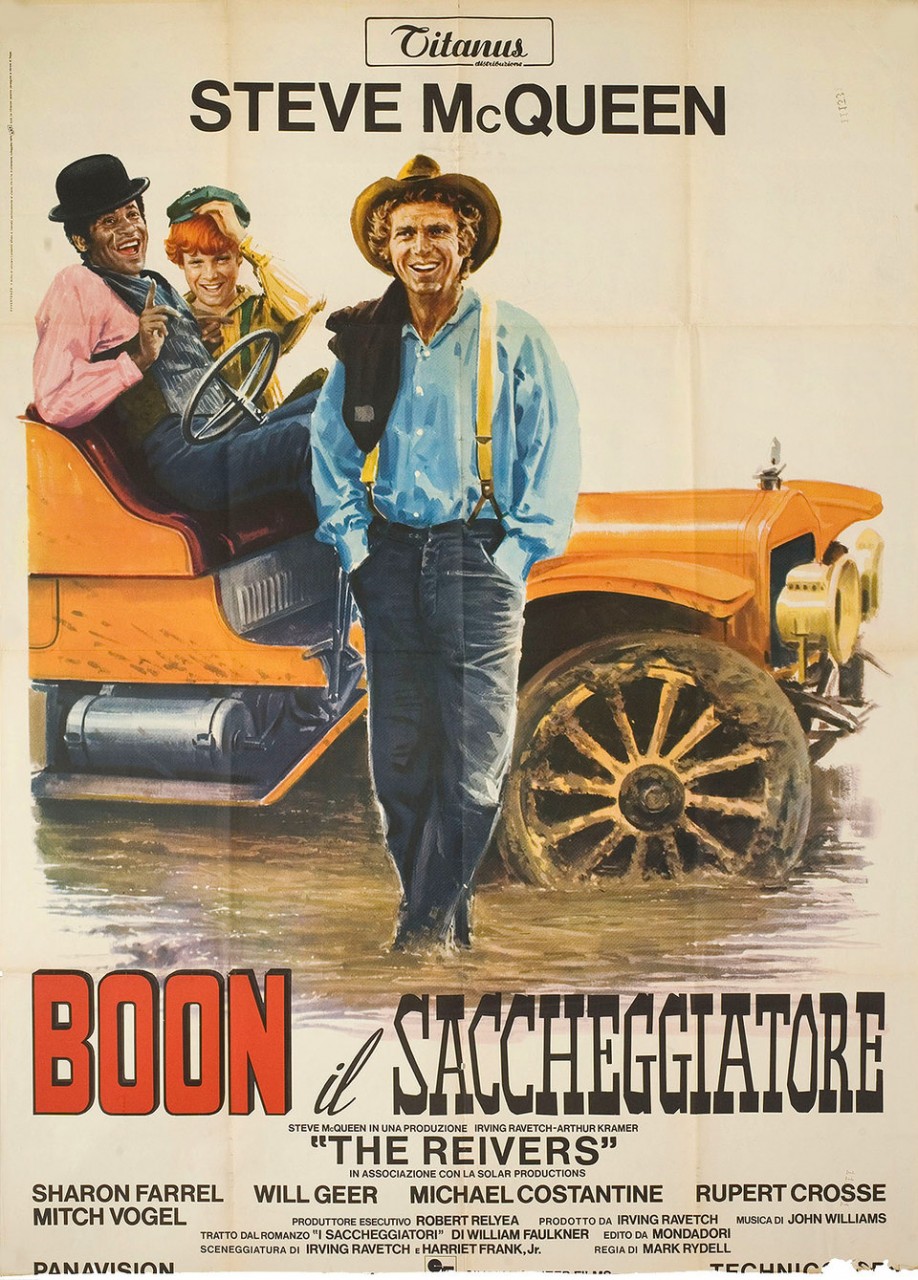
Italian poster for "The Reivers." (File)
While the jury expressed a preference for Katherine Anne Porter's "Ship of Fools" (a long-germinating Nazi allegory that the author herself characterized as "unwieldy," echoing critical pronouncements from Elizabeth Hardwick and Stanley Kauffmann), the Advisory Board once again overruled the nominating committee, selecting Faulkner as the second posthumous recipient of the Fiction Prize.
In contrast to the minor imbroglio that surrounded the selection of "A Fable," the decision elicited little in the way of public commentary and was soon overshadowed by the controversy surrounding the Advisory Board's decision not to recommend Edward Albee's "Who's Afraid of Virginia Woolf?" for the Drama Prize. (Albee would later receive the 1967, 1975 and 1994 Drama Prizes, while Porter would receive the Fiction Prize for her collected stories in 1966.)
Scholars of American literature and general readers alike generally contend that neither "A Fable" nor "The Reivers" are on par with the halcyon era that commenced with "The Sound and the Fury" and endured through the 1940s. Nevertheless, the fact that these works still resonated strongly with the era's leading critics — and ultimately merited Advisory Board intervention — attest to Faulkner's unique persistence of vision. "The aim of every artist is to arrest motion, which is life, by artificial means and hold it fixed so that a hundred years later, when a stranger looks at it, it moves again since it is life," he reflected to the Paris Review in 1956. In sinuous fictions, concise vignettes and cinematic masterpieces, Faulkner met the aims of his pronouncement.