As an adolescent, I stared, fascinated, at the piece of parchment, about half the size of a sheet of typing paper, hanging in my grandfather’s study. My grandfather was MacKinlay Kantor, author of the Civil War novel Andersonville, about the notorious Confederate prison camp in Georgia. On the seventh day of May, 1956, according to that small certificate in its gold frame, the trustees of Columbia University greeted all persons and made it known that MacKinlay Kantor had been awarded the Pulitzer Prize for Letters — Fiction.
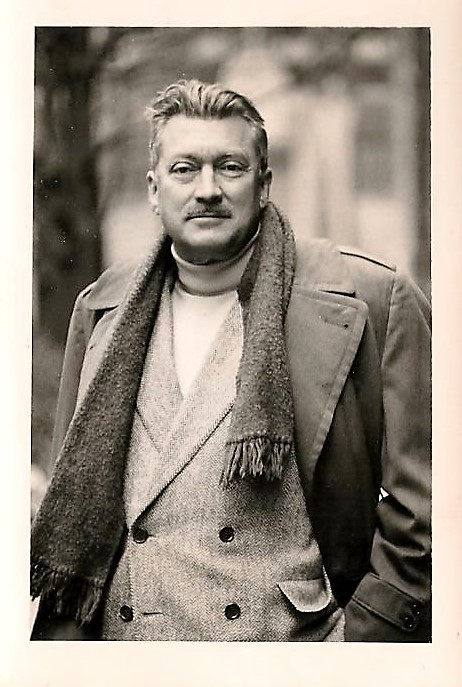
'Mack' Kantor
I knew my grandfather well. In 1968 when “Mack” was 64 and I was 14, my mother (his daughter), my father, my brother, my sister and I moved to Siesta Key, Fla., less than a mile from the cedar, slate and coquina-rock beach house owned by Mack and my grandmother, Irene. They had built it in 1936, then expanded it 20 years later with the money from Andersonville’s huge success.
I was a snotty adolescent, predisposed to think skeptically of members of all previous generations, especially those who happened to be in my family. By 1968 my grandfather’s literary reputation was beginning to decline, and his politics were becoming ever more conservative and hawkish just as I was forming opinions in the opposite direction. That, plus my grandfather’s sometimes overbearing personality and high opinion of himself, nudged me into a pattern of discounting his importance as a writer.
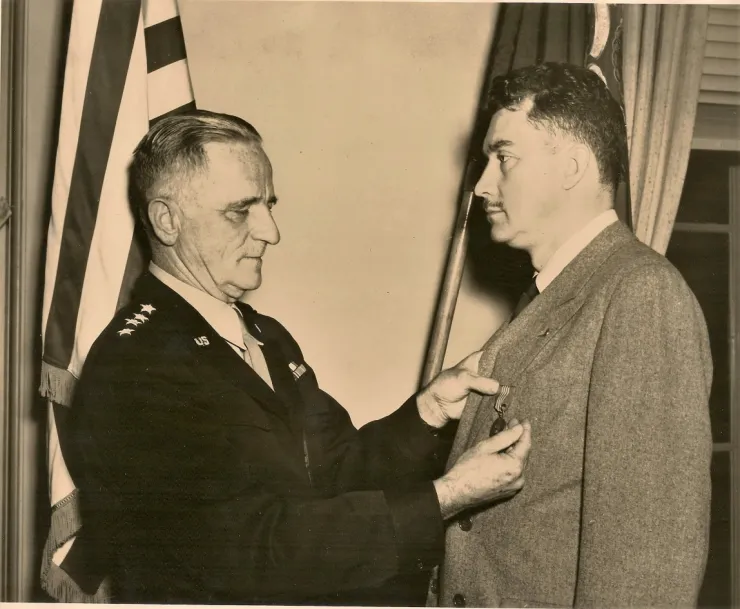
He had written more than forty books, created the story that underlay the Oscar-winning movie The Best Years of Our Lives and been awarded the Medal of Freedom for his work as a correspondent in World War II. But all of that was ancient history to me, barely visible through the fog of the past. I never even knew about the Medal of Freedom, the highest award the government can bestow on a civilian, until I began to research my grandfather’s life two years ago.
The one thing that had always impressed me, and impressed anyone who heard of it even after his name and the names of his books had been mostly forgotten, was there, inside that frame — a document appearing to be nothing more than a bit of bureaucratic inconsequence, a preprinted form with spaces for a name and a title, which were typed in as if an afterthought.
As someone who aspired to be a writer — a desire I had always attributed to a seventh-grade poetry assignment or a charismatic college professor — I had often considered what it would be like to win recognition on such a grand scale. I could imagine the almost drug-like rush upon hearing the news; the ratification for all the world to see that your best efforts were, in fact, good enough.
I didn’t have to imagine, though. When I set out at age 60 to discover the truth about my grandfather’s life and his influence on my own, among the 50,000 items kept in 148 boxes comprising the MacKinlay Kantor collection at the Library of Congress, I discovered a large cache of letters describing his experience writing Andersonville and winning the prize.
In fact, the very first document I saw — sitting atop the first file in the first box I opened — turned out to be the germ from which Andersonville had sprung. It was a letter Mack had written to my grandmother, Irene Layne, on April 24, 1945, from a German town just five miles outside the just-liberated Buchenwald concentration camp. In it he bitterly recounted encountering “the sour-sweetish odor of rotten bodies, of pallid dead skin, of burnt bones and flesh – the perfume of burning, typhus-ridden rags and shoes, the latrines oozing with their rich concentrated filth, the old and new pools of vomit covering the ground.”
In a later interview I found, he said that in Buchenwald he had been shocked by the horror of what men were capable of doing to other men in the name of war, and the recognition that the insanity was not restricted to Nazis in Germany. “There were two smells,” he said, “pine smoke and vomit, with a little bit from the dead bodies mixed in. . . . So I thought, for all intents and purposes, I’m standing in Andersonville right now. Then I knew I was going to write it.”
It took him a decade of further research — including eating moldy biscuits infested with maggots like those served to Andersonville prisoners — before he was ready to write the book. He then spent 18 months completing it — a massive novel of more than 300,000 words.
As he neared the end of his labor, he wrote: “I thought I had known exhaustion and depletion before, and here, at the age of fifty-one, I find myself struggling with a burden I couldn’t have attempted to shoulder when [in my twenties]. I suppose old men shouldn’t get ambitious. And sometimes, wracked and sleepless at night, I wish to hell that I hadn’t. Of course the book is so good that frankly it seems to me that I must not have written it. It somehow captivates everyone who reads it. . . . There hasn’t been anything remotely resembling it in the annals of American historical fiction. Everyone has to go back to War and Peace for comparison.”
Almost miraculously, his absurd level of self-belief turned out to be not simply his own opinion but also the literary world’s. As I waded through the voluminous correspondence concerning Andersonville from Mack’s editor, publisher and publicists at World Publishing, I came across an astonishing letter from the top man, Bill Targ. On May 25, 1955, when he received the final pages of the novel, Targ wrote: “I feel something historical about this day. . . . No matter what happens, you’ve written the biggest, the most moving novel I’ve read by any American (excepting perhaps Moby Dick).”
Again, the hyperbole seemed not entirely unjustified.
In September, after Mack had labored through the galleys, all 768 pages of them, he and Irene went off to Europe to recover. By midmonth, finally on the mend, he was cheered by this note from his agent Donald Friede: “There now begins a feeling of mounting excitement and anticipation. It’s a wonderful feeling, and it cannot be counterfeited. . . . How we both live for things like this — and how rarely they happen. . . . We have the rare knack of enjoying and milking every last drop of excitement.”
Friede wrote again just before the holidays: “And a Merry Christmas to you — oh best-selling author in the United States of America! For that is what you are today.”
The accolades poured in with the money. The superlative printed on the front of the New York Times Book Review – “the greatest of our Civil War novels” — was echoed around the country.
By the spring of 1956, Mack and Irene had arrived in Paris, at the elegant Prince de Galles Hotel across the Seine from the Eiffel Tower. One of his few disappointments of those months was that Andersonville lost the National Book Award to Ten North Frederick by John O’Hara. I found a revealing note on this subject from Targ to Carlos Baker, a renowned literary critic and Princeton professor who later wrote the best-known biography of Ernest Hemingway. Targ recalled a “private conversation” the two men had on the night Andersonville was passed over for the award in which they vehemently agreed that a far less deserving book had won. They concluded that justice would prevail “in the long run.”
Indeed it would. A letter my grandfather wrote on May 4, 1956, took me along for the ride. He described a chance encounter with an old friend. Mike Cowles had hired Mack as a columnist at the Des Moines Register a quarter century earlier, and had since gone on to found Look magazine. Now, by coincidence, they were staying at the same hotel. “We met at the bar for drinks, Irene arriving a bit late. Mike had said, I suppose you’ve already been given the inside dope about your getting the Pulitzer Prize.” Mack’s heart flipped somersaults in his chest. He had no such dope, and with great effort refrained from leaping for joy. “I said without batting an eyebrow: . . . I never count on anything until official announcement is made. . . . And Mike smiled and said, Well, I guess I ought to know – I’m on the jury – and may I add that it was unanimous.”
Actually Mack’s memory of the conversation must have been a little off. Cowles was on the Pulitzer board, which ratified the jury’s recommendation. The jury consisted of Francis Brown, the editor of the New York Times Book Review, and none other than Baker, who had already made his feelings about Andersonville known to Targ. The two men articulated those feelings in their report to the Pulitzer Board: “Andersonville, a historical novel in the grand manner, recaptures the tragedy and drama not only of the prison stockade from which it takes its name, but of the Civil War itself.”
As Mack and Irene and Cowles and his wife sat together in the bar, Cowles must have sketched out the jury report while my grandfather floated along on a high unrelated to the top-shelf whiskey in their glasses.
“We had our drinks,” my grandfather wrote, “then Irene and I wandered out to a cab, rode clear down to St. Germain Blvd. at the Odeon, sat, had coffee, walked, had wine, walked slowly, ate mild dinner in a small cheap café but GOOD, walked all the way up to the Seine under stars on the first warm night of the year in Paris, walked through the Tuilleries gardens, walked home, sat in a bar, I had TWO yellow Chartreuses, Irene had TWO tomato juices, came up to bed, read magazines idly, went to sleep before one a.m. . . . Is that a way to celebrate a unanimous Pulitzer Prize?”
It sounded good to me.
Andersonville turned out to be not just the peak of my grandfather’s career but also the beginning of the end of it. He spent years writing another massive historical novel, Spirit Lake, attempting to do for the Indian Wars what Andersonville had done for the Civil War. Objectively it might have been Andersonville’s equal, but the reading public’s tastes were changing. The patience for thousand-page books written in florid language with archaic dialect had all but expired. Spirit Lake met with mixed reviews and disappointing sales. Mack kept writing as he had always done, but his health and spirit never recovered and the work of his final years only diminished his fading reputation.
He died in 1977. The millions he’d earned from Andersonville and his Hollywood scriptwriting had vanished, his home was mortgaged, a New York Times obituary marked his passing dismissively. My grandmother moved to modest quarters and lived five more years, leaving little for their children to inherit but a handful of paintings, a huge cache of books and that framed declaration of literary success.
Just looking at it now, I recall the comforting musk of mildew and moldering books and cedar that had always surrounded it in the eternal twilight of my grandfather’s study. And I can look at it anytime I want. When my mom died in 2009, the Pulitzer certificate came to me, as I was the writer in the family. I hung it on a wall in my house but have only truly come to appreciate it after these many months of steeping myself in his life.
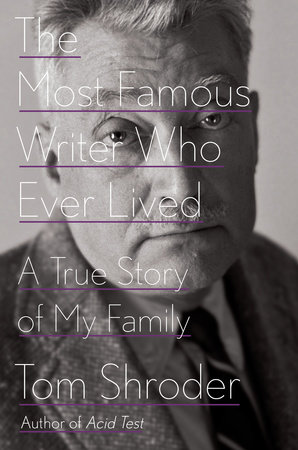
Shroder's new book about his grandfather.
I discovered my grandfather was flawed in ways I had never suspected, yet far more admirable than I could have imagined. Born into poverty with an emotionally abusive father, his elemental drive and love of words had propelled him, at least briefly, to one of the highest pinnacles a writing man could attain. Though I will never match those accomplishments, at least I now know that I have become a writer not because of some poem I wrote in seventh grade or an inspirational lecture delivered in a college classroom, but because I have my grandfather’s blood in my veins and his memory in my heart.